

Would you trust your doctor if they didn’t take notes on your condition?
No doubt, there have likely been many changes since you last visited your physician. One of the biggest transitions is the shift from manual writing to the use of ambient scribes.
Ambient scribes are quiet, nearly invisible technology that listens to a patient’s concerns, records the consultation, and generates a polished clinical note.
This technology is highly effective for physicians’ workflows, which is why the Department of Veterans Affairs began expanding the use of ambient AI scribes across medical centers nationwide in 2026. In another example, the Cleveland Clinic reported that more than 4,000 of its 6,000 medical practitioners also actively used the technology.
Much like medical transcription services, which help healthcare providers create accurate and accessible records, ambient documentation tools can support better care and potentially help save lives.
But, as ambient scribes expand in hospitals, the question remains: how reliable can they be?
Why Doctors Love Them
In the medical field, there’s a term called “pajama time,” which refers to the hours spent finishing charts after all patients have left. With the help of ambient scribes, that very term could mean real rest instead of catching up on medical records.
Beyond comfort, there’s also a measurable benefit. A JAMA Network Open study found that reported burnout fell from 51.9% to 38.8% after 30 days of ambient-scribe use. Participants also reported improved, undivided attention to patients.
Another study in Singapore found that ambient-scribe use reduced documentation time by 15% and increased the proportion of eye contact by 10.6%, without much effect on consultation length.
These examples show the tech is making a positive impact in the medical field. However, that’s no reason to let your guard down, because clinicians cannot treat its draft as a reliable final record.
Transcribing Is Not the Same as Getting It Right
A transcript attempts to preserve what people said. An ambient scribe does something more ambitious – deciding what is relevant, removing what it deems unnecessary, and restructuring the information according to its discretion.
Put simply, it creates an interpretation based on its understanding.
While it simplifies the note, it could also have overgeneralized the case, altering the intended meaning. A verbatim transcription, on the other hand, preserves the conversation word-for-word, preserving the accuracy of the whole record.
An example could be:
Doctor: How have you been feeling since your last visit?
Patient: Mostly better. The chest pain is gone, but I still get short of breath when I climb two flights of stairs. It doesn’t happen when I’m just walking around. I’ve also been forgetting to take my evening medication once or twice a week.
Here, the verbatim transcription is exactly as spoken. An ambient scribe, however, may condense it to:
Subjective: Patient reports overall improvement. Chest pain has resolved. Mild exertional shortness of breath persists. Medication adherence is inconsistent.
The ambient scribe omits important context, such as whether the shortness of breath occurs only after climbing two flights of stairs, or whether the missed medication was only once or twice a week. Both details could carry different clinical implications. If it can drop context like this in a mild case, imagine how much worse it could get in a severe one.
The Examination That Never Happened
The problem with ambient notes is that they look perfect. Because the output is polished, errors are typically harder to detect.
A 2025 evaluation comparing ambient-generated notes with physician-authored notes found that the former were more thorough and better organized. However, they were also more prone to hallucination: 31% of ambient notes, to be exact, compared with 20% of physician-authored notes. That 11-point difference may seem small, yet it’s real lives at stake.
Another study involving 7,545 generated notes found that omissions were the most common error, followed by hallucinations and accidental inclusions. As you’ve probably guessed, that’s a matter of life and death.
If you’re the patient, the last thing you want is a misdiagnosis. That could mean the wrong treatment or medication, which could worsen the disease and, ultimately, cost a life.
Why “61.92% Accurate” Does Not Mean What You Think
“Mostly accurate” is never enough. If a single comma can change a sentence’s meaning, imagine getting the detail only about 60% right? The problem could worsen because AI errors extend far beyond punctuation. The system could misrecord numbers, add information that no one said, or omit the patient’s main concern.
In general, ambient scribes fail in four ways:
| Failure | What it can do |
| Misrecognition | Changes a detail such as medication, symptoms, or even the speakers (who said what) |
| Omission | Leaves out crucial detail |
| Hallucination | Adds information that was never part of the conversation |
| Field contamination | Moves an error into structured EHR and other medical records |
The last one worsens the error. Once someone enters the error into the system, the database records an inaccurate version of your condition, which can affect how other physicians treat you. The worst part is that they will never know that the record was inaccurate because these medical workers were not present at your consultation.
The Vendor Will Not Sign the Note. The Doctor Will.
So it’s better not to use ambient scribes, right? Not automatically.
Bear with us. AI can make an error, but that doesn’t mean physicians won’t. An overworked or fatigued medical worker can make the same kind of mistake.
The solution is appropriate integration of AI and human judgment. The ambient workflow relies on one critical safety control: a clinician must review the generated note before finalizing it. This is exactly what Cleveland Clinic practices, requiring its physicians to review and approve AI-generated drafts before they become part of the EHR.
That way, it saves time and preserves accuracy, since the physician reviews and corrects a draft rather than writing the note from scratch.
Probably the most important detail here is accountability. AI is not accountable for an error. Only a licensed, authorized clinician can explain where a detail went wrong, which is why every record still needs a clinician’s careful review.
AI can prepare the draft. It cannot own the record.
Where the Machine Struggles Most
Clinicians might get a clean recording in a controlled environment: a soundproof room, a properly positioned microphone, a clear conversation without strong accents or interruptions. Sounds impossible, right?
Clinics are busy. There can be a lot of people talking in the background, and patients themselves may be in pain, out of breath, or otherwise struggling to speak clearly. These factors may seem like an ordinary day at the office, but they can still impair the accuracy of the AI draft.
Many physicians report limited trust in ambient-generated notes, particularly for physical examinations and medical decision-making, and that’s a good sign. Ambient scribes, and even the strongest speech-recognition systems, can misinterpret medication names, anatomical terms, and region-specific medical jargon.
It also highlights why experienced medicolegal transcription services are crucial – because only a trained human can effectively and accurately transcribe what is being said in a medical setting.
Who Is Listening, and Where Does the Audio Go?
Aside from accuracy, a bigger concern that many might have missed is access.
When a system records a consultation, it must store the audio somewhere. Patients’ medical information should never be compromised. That’s why patients should be informed whenever the tool is active and have the right to decline. For example, the Cleveland Clinic requires verbal consent, and VA facilities allow veterans to opt out without affecting the documentation.
For healthcare providers and systems, they must be able to answer the following:
- Who has access to the audio, and how long is it preserved
- Is patient information used to train models?
- Can the organization audit how a note was produced?
Government transcription services follow the same standards, enforcing strict privacy and accountability requirements.
“HIPAA-compliant” should begin the conversation, not end it.
Why Health Systems Choose Ditto for Accountable Medical Transcription
At Ditto Transcripts, clinical audio is treated as sensitive source material that requires professional review, not as a finished medical record merely because software converted it into polished text.
Here is what Ditto offers:
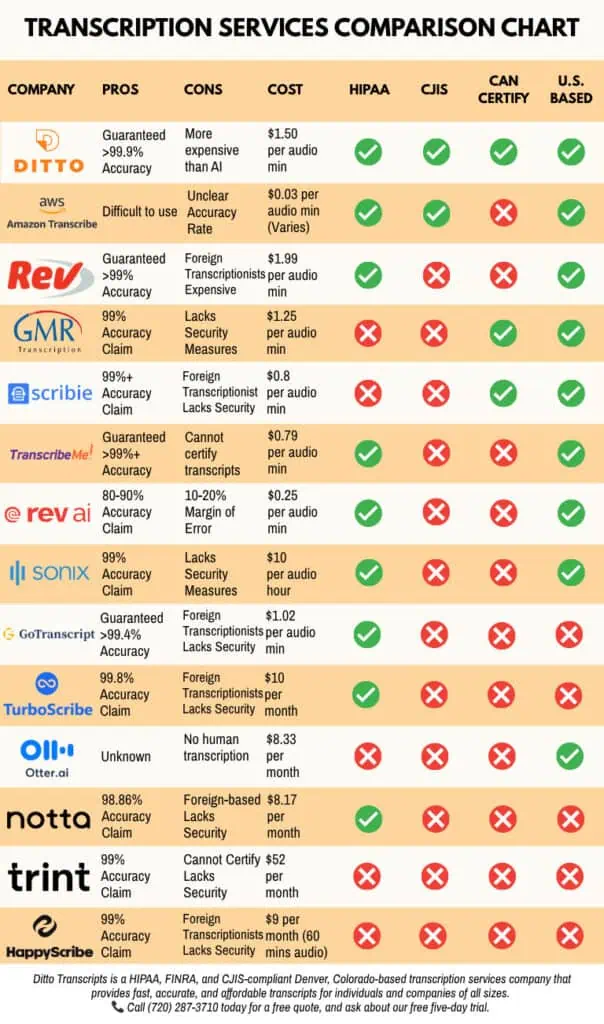
- Human-reviewed work: Trained human transcriptionists do and review the transcripts before they are returned to the client.
- U.S.-based transcriptionists: Transcribers are experienced with American medical language and documentation requirements.
- Secure handling: Ditto is HIPAA-certified, ensuring security for health information
- Clear accountability: Ditto answers clients’ concerns even after the output is rendered, addressing questions or corrections made during the transcription process – no bot involved.
- Transparent costs: Our medical transcription prices let you calculate and identify your transcription needs to reduce costs. You can also share your transcription requirements so we can discuss the price further.
- Verified client experiences: Ditto’s testimonials tell you everything you should know about our service.
The Record Is Permanent
Ambient scribes can give clinicians something valuable: more attention for the person sitting across from them.
That benefit deserves recognition. So does the risk.
A clinical note follows the patient. It guides future physicians, supports prescriptions, affects coding, documents consent, and may later become evidence in a dispute. A missing detail can be overlooked in care. An invented detail can become medical history.
The standard can’t be that the note sounded right when someone skimmed it.
AI can listen. AI can organize. AI can draft.
A qualified human must still decide whether the record is true, and be prepared to stand behind every word.
Ditto Transcripts is a Denver, Colorado-based transcription company providing fast, accurate, and affordable transcripts for individuals and organizations of all sizes. Ditto is FINRA-, HIPAA-, and CJIS-compliant. Call (720) 287-3710 today for a free quote.