


Court proceedings contain testimony, arguments, rulings, objections, and other statements that may matter long after a hearing ends. Accuracy is therefore more important than choosing the lowest rate.
When an attorney, court, agency, or authorized party already has a lawful recording, professional legal transcription services can convert it into a searchable document. However, a privately prepared transcript is not automatically the official court record. Court rules determine who may prepare, certify, file, and use an official transcript.
This guide covers typical court transcription costs, pricing factors, the difference between private and official transcripts, and what to review before choosing a provider.
In this article, you’ll learn:
- How much court transcription costs
- What factors affect transcription pricing
- The difference between private and official transcripts
- What to look for in a transcription provider
- How court transcripts support legal review and preparation
How Much Does Court Transcription Cost?
At Ditto, our legal transcription prices range from $1.50 to $5.00 per audio minute. The final rate depends on the number of speakers, audio quality, turnaround time, and requested formatting. Ditto also lists a $100 project minimum.
A 60-minute single-speaker recording with extended delivery would total $90 before the minimum is applied. A complex 60-minute hearing with several speakers and rush delivery could cost $300 before optional charges.
These rates apply to private transcription from an existing recording. Official federal court transcripts use approved per-page rates and must be ordered according to the procedures of the court where the proceeding occurred.
|
|
Rush Price |
Standard Pricing |
Extended Pricing |
|
Category A |
$2.25 / audio minute |
$1.75 / audio minute |
$1.50 / audio minute |
|
Category B |
$5.00 / audio minute |
$3.00 / audio minute |
$2.50 / audio minute |
Category A covers digitally recorded single-person narratives and standard one-on-one interviews, such as post-hearing dictation, case notes, client interviews, or deposition-preparation meetings.
Category B covers recordings with three or more speakers, significant background noise, quiet voices, poor recording quality, difficult accents, or complex terminology. Most recorded hearings fall into this category because they involve several participants and less controlled audio.
Add-ons include $0.25 per audio minute for verbatim formatting. Timestamps cost $0.25 per audio minute when placed every minute or less often, and $0.50 per audio minute when added more frequently. Same-day work requires a customized quote.
What Affects Court Transcription Pricing?
Number of Speakers and Audio Quality
A one-person dictation is easier to transcribe than a hearing involving a judge, attorneys, witnesses, clerks, and interpreters. More speakers require additional identification, labeling, and review.
Rates may also increase when the recording contains overlapping speech, echo, distant speakers, background conversations, poor microphone placement, or distorted audio. A transcriptionist may need to replay difficult sections repeatedly, and some words may remain inaudible when the source recording is unclear.
Turnaround Time
Faster delivery usually costs more because the provider must prioritize the project or divide a long recording among several qualified transcriptionists. Standard or extended delivery is more economical when the transcript is not urgent.
Formatting and Complexity
Page layout, line numbering, timestamps, speaker labels, exhibit references, and certification language can affect the quote. Provide the required template before transcription begins.
Verbatim transcription may cost more because they preserve false starts, repetitions, filler words, and other spoken details that a clean-read transcript omits.
Court recordings may also contain case citations, medical terminology, financial language, or expert testimony. Pleadings, witness lists, exhibit indexes, and preferred spellings can help improve consistency.
Official Court Transcripts and Private Transcripts Are Different
Under 28 U.S.C. § 753, covered federal proceedings are recorded verbatim using an approved method. The designated reporter or transcriber prepares and certifies requested portions of the official record. The statute states that a court transcript is not official unless it is made from the certified record by the reporter or another designated person.
The federal court system also states that transcripts of electronic court recordings are produced by private transcription services designated by the court. A transcript created from a personal copy of a recording may be useful for internal review. However, it may not replace the official transcript required for an appeal, filing, or court order.
Before ordering court transcription services, confirm:
- Whether the court permits the recording to be released
- Whether the transcript must be ordered through the court
- Whether the court must approve the provider
- Which certification and format are required
- Whether redaction or filing deadlines apply
Requirements vary by jurisdiction and proceeding.
Advantages of Court Transcription
Locate Relevant Information Quickly
A searchable transcript lets attorneys and authorized reviewers find a witness name, exhibit, objection, date, or legal term without having to listen to the entire recording. This can make case review and motion preparation more efficient.
Review Testimony in Context
Written text helps legal teams compare questions, answers, rulings, and objections in sequence. It can also support citation checking and preparation for later proceedings.
Prepare for Depositions and Trial
Prior testimony may help attorneys identify inconsistencies, unresolved issues, and topics requiring further examination. Separate deposition transcription services may be needed when sworn testimony is taken outside the courtroom.
During a trial, trial transcription services can support daily review, motion practice, and appellate preparation when permitted by the court.
Share With Authorized Participants
A transcript may help attorneys, clients, experts, insurers, or other authorized participants review proceedings they were unable to attend. Distribution must still comply with sealing orders, privacy requirements, protective orders, and court rules.
A transcript is not automatically proof of every disputed fact. Its legal effect depends on whether it is official, complete, authenticated, admissible, and used in accordance with the applicable rules.
Court Reporters Versus Legal Transcriptionists
Court reporters and legal transcriptionists both create written records, though their roles differ.
| Court reporter or court-designated recorder | Legal transcriptionist |
| Captures or safeguards the official record during a proceeding | Works from an existing audio or video file |
| May use stenotype, voice writing, or approved electronic recording | Replays the recording and types the spoken content |
| May provide real-time text when qualified and requested | Usually delivers the transcript after recording is complete |
| Follows court rules for official transcripts | Follows the client’s format unless court designation applies |
| May certify and file the official transcript | Certification alone does not make a transcript official |
Federal law permits several approved recording methods, and federal court reporters may provide written transcripts upon request. Real-time reporting is also a recognized specialty, so court reporters do not always wait until after a proceeding to produce text.
Certification and licensing requirements vary by state and court. The National Court Reporters Association, or NCRA, is a professional organization that provides certifications for court reporters and related professionals. However, NCRA certification is not a single nationwide license that authorizes every reporter to work in every jurisdiction.
How to Choose a Court Transcription Provider
Check Accuracy and Court Acceptance
Ask how the provider reviews transcripts, handles inaudible sections, and processes corrections. Also confirm with the clerk, attorney, or court office whether the provider, certification, format, and source recording will be accepted.
Review Security
Court recordings may contain personal identifiers, medical details, financial information, sealed material, or law-enforcement information. Ask how files are transferred, stored, accessed, and deleted and whether subcontractors are involved.
Compare the Full Quote
The lowest rate may not include verbatim text, timestamps, difficult audio, rush delivery, or court formatting. Request a written quote covering the scope, delivery date, add-ons, revision process, and project minimum.
Assess Experience and Support
A provider should be able to discuss legal terminology, speaker identification, formatting, deadlines, and secure delivery. Ditto’s testimonials describe clients’ experiences with accuracy, responsiveness, turnaround time, formatting, and pricing.
Why Choose Ditto for Court Transcription?
Court recordings require accuracy, confidentiality, predictable delivery, and suitable formatting. Clients choose Ditto for:
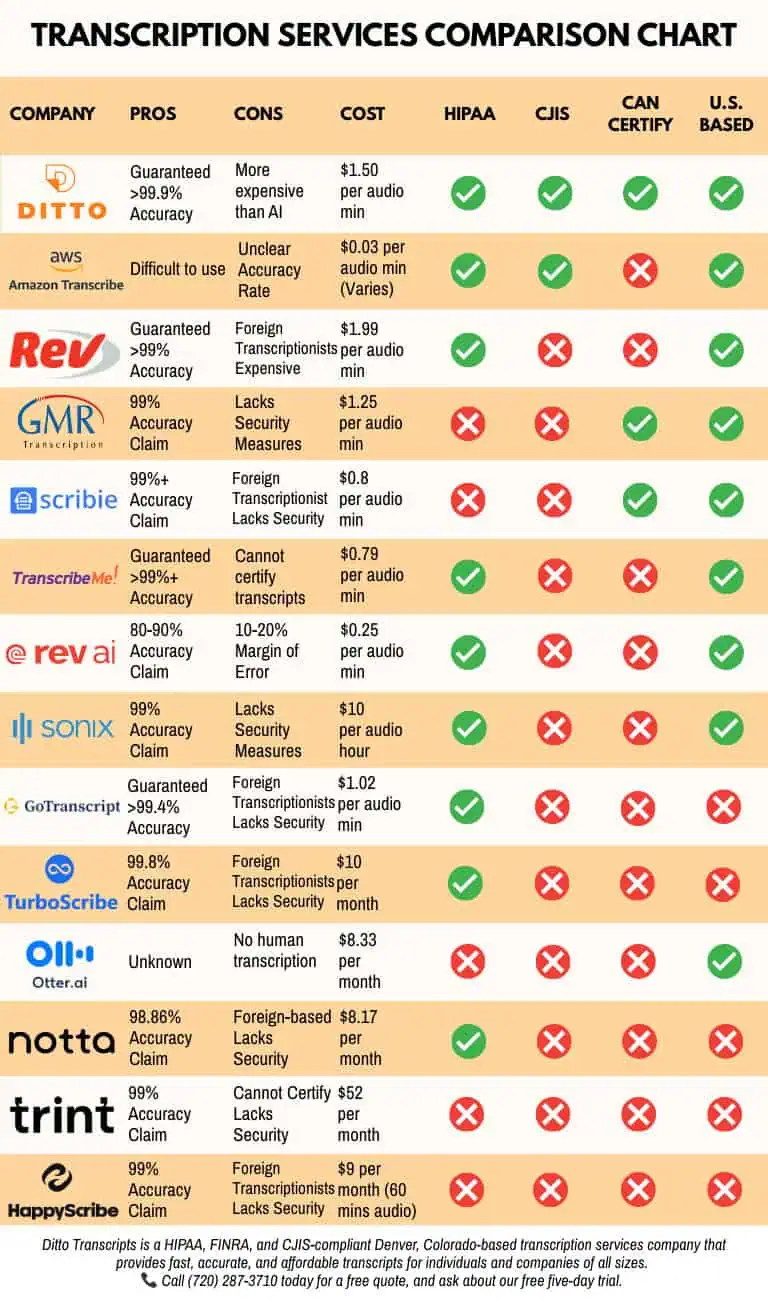
- Human-reviewed accuracy: Ditto offers a 99% accuracy guarantee for completed transcription projects.
- U.S.-based transcriptionists: Ditto’s legal transcriptionists are based here in the United States and have undergone background checks.
- Legal experience: We transcribe recorded hearings, jury trials, arraignments, bail hearings, sentencing hearings, depositions, and other legal matters.
- Flexible turnaround: Published options include rush, standard, and extended delivery, with customized pricing for same-day work.
- Clear pricing: Category A and Category B rates indicate how speaker count, audio quality, and urgency affect the quote.
- Custom formatting: Clients may request timestamps, speaker labels, verbatim text, and court-specific templates.
- Security-focused handling: Ditto is CJIS- and HIPAA-compliant and our workflows include secure file transfer.
- No long-term contract: Clients may submit individual projects without an annual agreement.
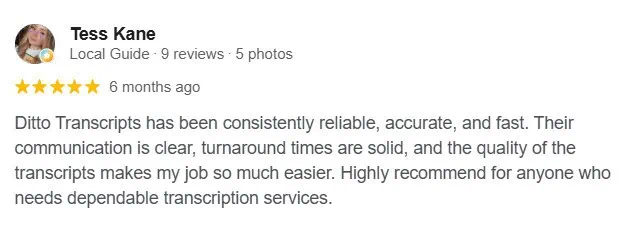
- Client feedback: Need more evidence? Ditto’s testimonials highlight real client experiences involving accuracy, turnaround time, formatting, responsiveness, and project pricing.
These services and claims appear on Ditto’s legal and court transcription pages. Clients should confirm the qualifications, certification, and court approval required for their project.
Get an Accurate Quote Before Transcription Begins
Court transcription costs depend on the recording and its intended use. A clear single-speaker file may fall near the lower end of the published range, while a multi-speaker hearing with difficult audio and a rush deadline may reach the higher end.
First, determine whether you need a private working transcript or an official court transcript. Then provide the recording, deadline, speaker information, required format, and jurisdictional requirements for an accurate quote.
Ditto Transcripts is a Denver, Colorado-based, HIPAA-compliant transcription company providing fast, accurate, and affordable medical transcription services. Call (720) 287-3710 for a free quote.