


You are not feeling well and visit a clinic to obtain a medical certificate. The medical examiner concludes that you are “not ready for full duty,” yet the word “not” is missing from the transcript of the recorded assessment. A single error changes everything.
Hospitals and clinics have used ambient AI scribes for years. While it saves a medical worker from drowning in charting, failing to verify this information can have dire consequences.
Workers often use medical findings to process compensation claims, yet they may not be able to if the medical record never shows a diagnosis. That is why records must never be treated as routine paperwork; rather, they should be treated as documents that reflect what was said. In these cases, professionals rely on medicolegal transcription services to help ensure accurate records and prevent future problems.
In this article, you’ll learn:
- Why transcription accuracy matters in workers’ compensation claims.
- How IMEs, recorded statements, and depositions affect claims.
- Where AI transcription struggles with medical and legal audio.
- Why compliance, confidentiality, and chain of custody matter.
- How human transcription helps preserve reliable records.
Why Workers’ Compensation Depends on the Record
Injuries are one of the most common reasons for workers’ compensation claims. The process involves physician evaluations, statements, and legal professionals assessing the severity of the situation. All these factors directly impact the claim, for better or worse.
Here are some of the usual records obtained:
| Record | What it captures | Why accuracy matters |
| IME dictation or recorded assessment | Medical observations and professional opinions | It sets the boundaries, findings, and even causation. |
| Recorded statement | It could be your or another worker’s/witness’ account | These reports become part of the documents that could be relevant deeper in the case |
| Deposition or hearing transcript | Testimony in a formal proceeding | It supports questions, challenges, and findings |
In documentation like this, one error can make it impossible to tell which account is accurate. Ultimately, it changes how the big picture is understood, and suddenly, transcription quality becomes critical.
The IME Transcript: Medical Details That Cannot Be Guessed
An independent medical examination (IME) provides an evaluation by an examiner who is not acting as the worker’s treating clinician. It may address causation, physical restrictions, recovery, or return-to-work capacity.
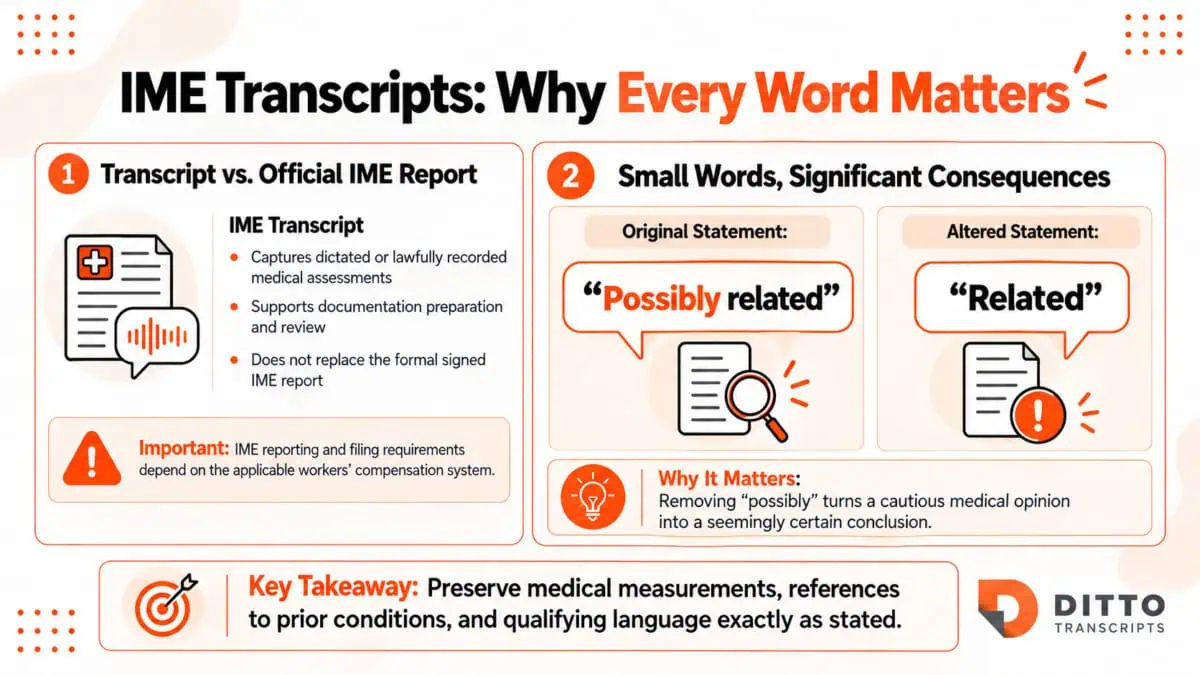
This is where medicolegal transcription services become useful. The goal is to preserve an expert’s opinion accurately so the right people can evaluate it, not simplify it.
Recorded Statements: Every Qualification Counts
Recorded statements often capture details that medical reports cannot:
- What happened in the accident?
- What did the witness notice after the event?
- What did the colleague do?
- Uncertainty in the account, such as “I think it was around noon,” is not “It happened at noon.”
Part of the investigation process is comparing statements with existing reports and records. Here, a transcript is extremely useful because it saves time and reduces the need to constantly replay an audio file to figure out who said what.
Although conflicting accounts or questions worth investigating matter, an inconsistency alone is not proof of fraud.
Verbatim transcripts support this investigation because they accurately preserve what was said, who said it, and complete timestamps. That way, verifying information from an audio recording becomes easier and more guided.
Speaker labels, requested timestamps, and claims-system formatting make transcripts easier to review. For interviews where exact wording matters, verbatim transcription services preserve the speaker’s language rather than polishing away meaningful details.
Before recording a statement, teams must check the applicable consent rules. These rules vary; for example, California law generally requires consent from every party to record a confidential communication, while New York law uses a different consent framework. Failure to recognize these rules may result in an inadmissible document.
Depositions and Hearings: Accuracy Must Withstand Scrutiny
Ever wondered why depositions and hearings happen before the statements? Because the transcripts from these initial proceedings can help identify inaccuracies and contradictions.
Depending on the forum, the rules may require the following:
- Speaker identification
- Page and line numbering
- Exhibits
- Corrections made
- In many cases, certification.
A closer example can be found under Federal Rule of Civil Procedure 30, where the officer must certify that the deposition accurately records the testimony.
State workers’ compensation proceedings have their own rules, and it is best to inquire and research rather than assume that a universal rule applies. For documentation needs, professional deposition transcription services could be the difference between getting that workers’ compensation or not.
Why AI Transcription Struggles With Comp Audio
We don’t have a bad blood with AI. In fact, at Ditto, we believe it is changing how people perceive and create transcripts.
AI has unmatched speed and undeniably lower prices. However, neither equates to accuracy. When it comes down to it, would you choose an AI solution with 61.92% accuracy, or a professional who guarantees 99+% accuracy?
AI could excel if the environment is perfect:
- Recordings occur free from noise
- Professional setup including microphones and other audio-recording devices
- No overlapping of voices
- Limited resource person
- All words are explained, with no jargon.
However, that is rarely the case. In fact, it’s quite the opposite. In a real recording, technical difficulties, heated exchanges, inaudible words, and unwanted noises are usually captured. Professionals have to work with it, and that is exactly where AI struggles.
If only used for a first draft, AI saves plenty of time, even for professionals.
However, that first pass isn’t the same as a verified record, especially when medical opinions or sworn testimony are involved. A human professional still finalizes and certifies the document.
Compliance and Chain of Custody Are Part of Accuracy
When documentation is requested, both the finalized document and the process that produced it may be required.
That includes:
- Which audio was transcribed
- Who has access
- What prompts were used, if it was AI-assisted
- Which version is submitted
Professional workflows are to preserve the original recording and document its movement through intake, transcription, review, and delivery. This is part of the process because it may later be relevant to the legal event, especially when the document’s credibility is questioned.
Here’s what many don’t know. Health information adds another layer in these matters. The U.S. Department of Health and Human Services explains that HIPAA permits certain disclosures for workers’ compensation purposes, subject to the applicable law and limits. Not every claims participant is covered by HIPAA, and disclosures are not unrestricted.
A chain of custody cannot fix inaccurate words, although it can help establish that the record being evaluated is the record that was actually produced.
Why Choose Ditto Transcripts for Workers’ Compensation?
Workers’ comp combines medical, insurance, and legal terminology. Transcribers must understand it without assuming what speakers intended.
At Ditto Transcripts, we prioritize human transcription for sensitive records that need careful handling. Our workers’ compensation work includes IME dictation, medical summaries, and deposition-related materials.
For claims teams evaluating transcription support, Ditto offers practical advantages:
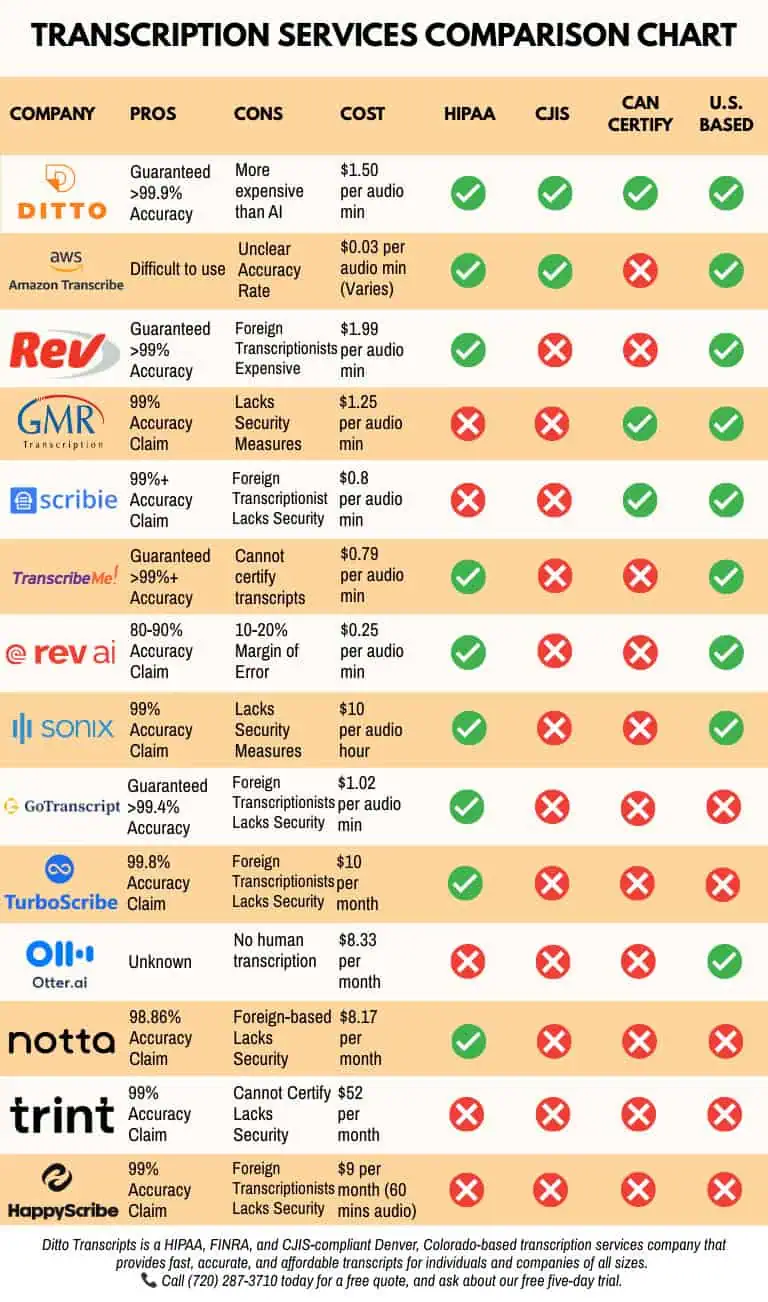
- Human accuracy: Ditto and our U.S.-based transcriptionists guarantee >99% accuracy in our outputs, ensuring you get your money’s worth.
- Security: We understand and value safety. We are HIPAA-, FINRA-, and CJIS-compliant, reflecting our commitment to security.
- Professional documentation: We specialize in a wide range of transcription fields, including legal, academic, government, and medical-related documents, professionally formatted to fit your needs.
- Flexible pricing: Our easy-to-use calculator lets you compute and adjust legal transcription prices, or you can call us to discuss further.
- Client experience: Still not convinced? These testimonials could change your mind.
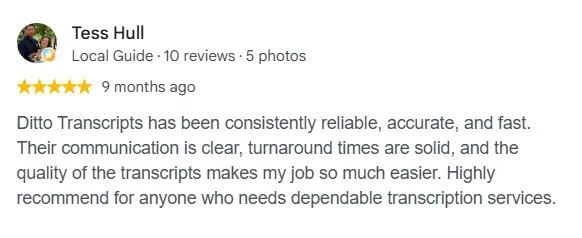
The value is a record professionals can review confidently, while legal compliance and claim decisions remain their responsibility.
The Record Should Support the Decision
Transcription must be done very carefully. A claim of accuracy is not enough – it must be guaranteed and certified.
People deserve the real account, not a version of what someone thought they heard or a machine output that doesn’t fully understand the situation. Treat these records to the highest standards because, in a legal proceeding, they could make or break a case.
In workers’ comp, the transcript is evidence. Treat it that way, and the people evaluating the claim have a stronger basis for reaching a defensible decision.
Ditto Transcripts is a Denver, Colorado-based transcription services company that is FINRA-, HIPAA-, and CJIS-compliant and provides fast, accurate, affordable transcripts for individuals and companies of all sizes. Call (720) 287-3710 today for a free quote.