


Academic research often involves hours of interviews, focus groups, lectures, and recorded observations. Turning these recordings into written documents can take considerable time, especially when researchers need to examine every response carefully.
Professional academic transcription services help researchers convert recorded material into accurate written records that can be reviewed, quoted, and verified. These services support academic research by preserving participants’ words and providing reliable documentation for evidence-based findings.
Academic transcription makes recorded information easier to analyze, reference, and incorporate into scholarly writing. Rather than repeatedly listening to recordings, researchers can work directly with searchable text.
In this article, you’ll learn:
- How transcription supports academic writing and qualitative research.
- Which transcription formats suit different research projects.
- How transcripts help with interviews, field notes, archival materials, and lectures.
- When human transcription is preferable to automated transcription.
What Is Academic Writing?
Academic writing is a formal way to communicate research findings, theories, and evidence. It is commonly used in journal articles, dissertations, theses, research papers, and scholarly reports.
Unlike informal writing, academic writing emphasizes verifiable evidence, precise terminology, and clearly attributed sources.
Researchers frequently use specialized language, such as “epigenetics” in biology or “cultural hegemony” in sociology, to explain complex ideas. They also follow citation standards, including APA, MLA, or Chicago style, depending on their discipline.
When research includes interviews, discussions, or recorded observations, transcription helps transform spoken information into material that can be examined and cited accurately.
Why Is Transcription Important in Academic Writing?
Qualitative research often depends on understanding how participants express their experiences, opinions, and perspectives. Recordings preserve the original conversation, while written transcripts make the information easier to organize and analyze.
Professional qualitative research transcription services help researchers convert recorded interviews, focus groups, and discussions into accurate written records. Accurate transcription helps researchers identify recurring themes, examine language patterns, and support findings with direct quotations.
Transcripts also let researchers revisit specific statements without repeatedly searching through audio recordings.
For projects involving exact wording, verbatim transcription can preserve fillers, repetitions, false starts, and other speech details relevant to the analysis.
However, researchers should remember that transcripts do not automatically capture every aspect of communication. Tone, gestures, facial expressions, and other nonverbal cues may require separate annotations or reference to the original recording.
Types of Transcription Used in Academic Research
The appropriate transcription format depends on the research question and the required level of detail.
| Transcription Format | Description | Best Use |
| Verbatim | Preserves spoken words, repetitions, fillers, and relevant speech patterns. | Discourse analysis and detailed qualitative interviews |
| Clean verbatim | Removes unnecessary fillers and false starts while preserving the speaker’s meaning. | General research interviews and readable records |
| Edited transcription | Improves readability through limited grammatical or structural adjustments. | Published interviews and educational materials |
Speaker identification and timestamps can also be added to these formats. They are features, not separate transcription types.
Researchers should choose a transcript format before beginning analysis because removing speech details may affect how responses are interpreted.
How Transcription Supports Different Types of Academic Research
Transcription serves different purposes depending on the type of academic research involved. Whether researchers study interviews, document field observations, examine historical records, or review lectures, accurate transcripts make information easier to access and analyze.
Here are four common ways transcription supports academic research.
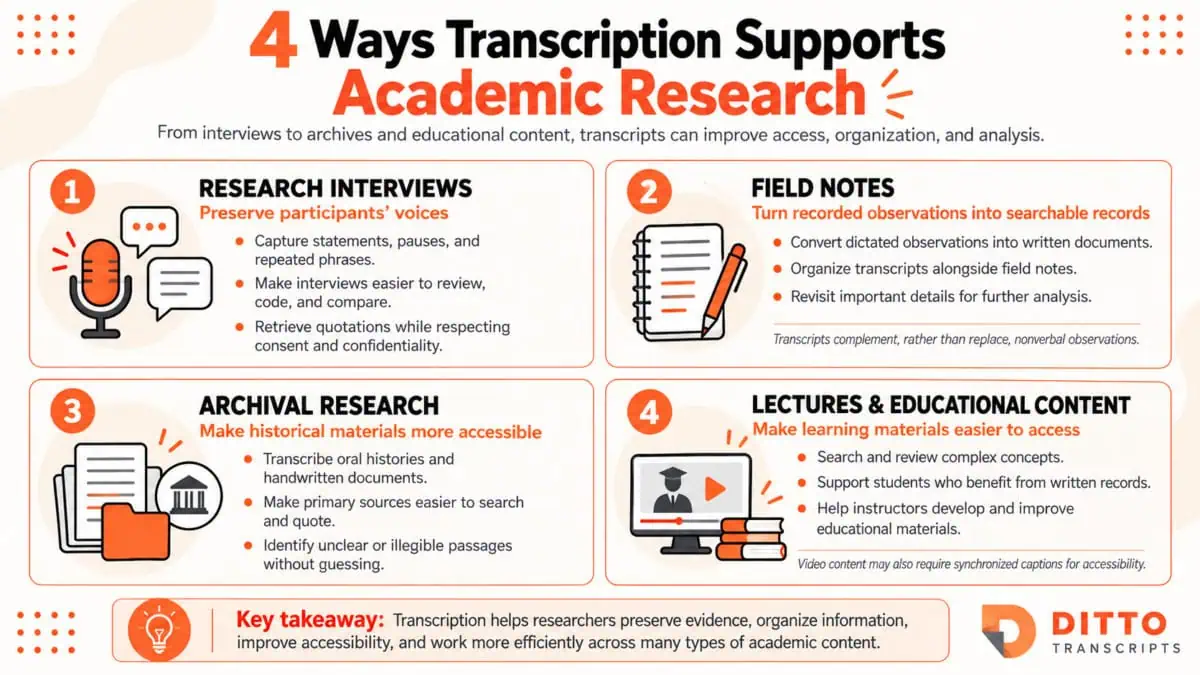
Each research activity has different transcription requirements. Interviews may require detailed records of speech patterns, while field observations and archival materials may need additional context or annotations. Educational transcripts can also improve accessibility, although video content may require synchronized captions and other accommodations.
Choosing the right transcription approach helps researchers preserve essential details, maintain source integrity, and produce more reliable academic work.
Should Researchers Use AI or Human Transcription?
Automated transcription has become increasingly accessible, allowing researchers to generate preliminary transcripts within minutes.
However, speed does not guarantee accuracy.
An AI transcription accuracy figure of 61.92% suggests that automated text may need extensive review before it can be used in academic research. Actual performance varies by system, language, recording conditions, and evaluation method.
Technical terminology, overlapping speakers, background noise, and unfamiliar accents can introduce errors that affect how researchers interpret participants’ statements.
Human transcriptionists can use context, research specialized terminology, and flag uncertain sections rather than guessing at unclear words.
AI-generated transcripts may still be useful as preliminary drafts, particularly for clear recordings and low-risk tasks. For research where wording and meaning are central to the findings, careful human review remains important.
The same concerns apply to sensitive recordings handled through deposition transcription services, where incorrect wording or speaker attribution may affect how testimony is understood.
Why Clients Choose Ditto for Academic Transcription
Academic transcription is more than converting recorded speech into text. Researchers need documents that preserve participants’ statements, support careful analysis, and remain useful throughout their projects.
At Ditto Transcripts, we provide researchers, students, and educational institutions with dependable transcripts that reduce administrative work and make recorded information easier to study.
Clients choose Ditto because we offer:
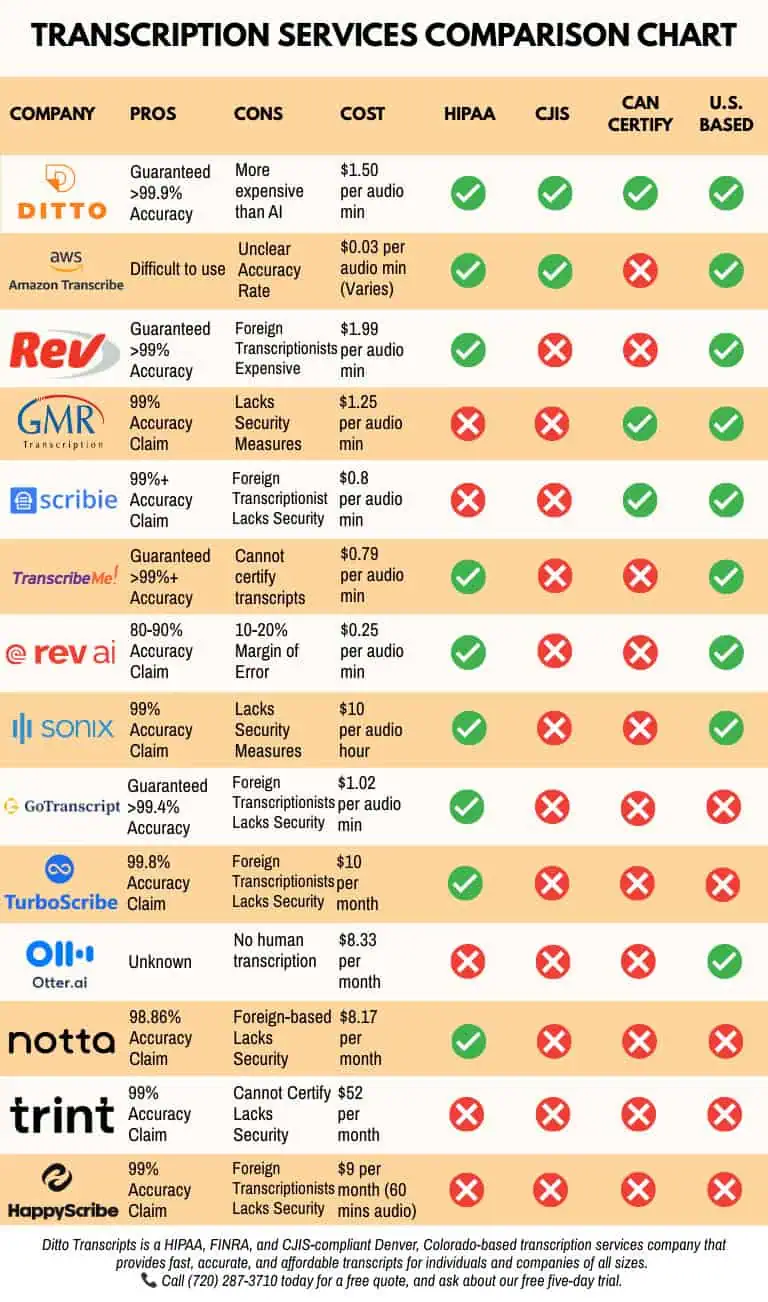
- Human transcriptionists: Trained professionals listen carefully, research unfamiliar terminology, and review recordings rather than relying on automated transcription.
- Academic transcription experience: Our team works with interviews, focus groups, lectures, dissertations, research discussions, and other academic recordings.
- High accuracy standards: Ditto provides a 99% accuracy guarantee, helping researchers obtain dependable written records.
- Flexible transcript formats: Clients can request verbatim or cleaned-up transcripts, speaker identification, timestamps, and project-specific formatting.
- Support for challenging audio: We give multiple speakers, accents, background noise, and specialized terminology careful human attention.
- Secure file handling: Confidential recordings and sensitive research materials are processed through security-conscious workflows.
- Flexible legal transcription prices and turnaround options: Pricing and delivery schedules vary by recording length, audio quality, urgency, formatting, and project requirements.
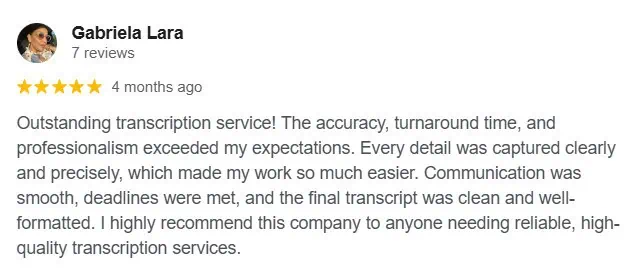
- Client testimonials: Here’s what our previous customers say about their experience.
Accurate Transcription Supports Better Academic Writing
Transcription helps researchers turn recorded information into material they can search, examine, and reference throughout the writing process.
From qualitative interviews and field observations to archival materials and lectures, accurate transcripts make it easier to preserve important details and support conclusions with evidence.
The most useful transcript accurately reflects the original recording while meeting the research project’s specific needs.
By choosing the right transcription method and carefully reviewing the final records, researchers can spend less time managing recordings and more time analyzing their findings.
Ditto Transcripts is a Denver, Colorado-based transcription services company that is FINRA-, HIPAA-, and CJIS-compliant and provides fast, accurate, and affordable transcripts for individuals and companies of all sizes. Call (720) 287-3710 today for a free quote.