
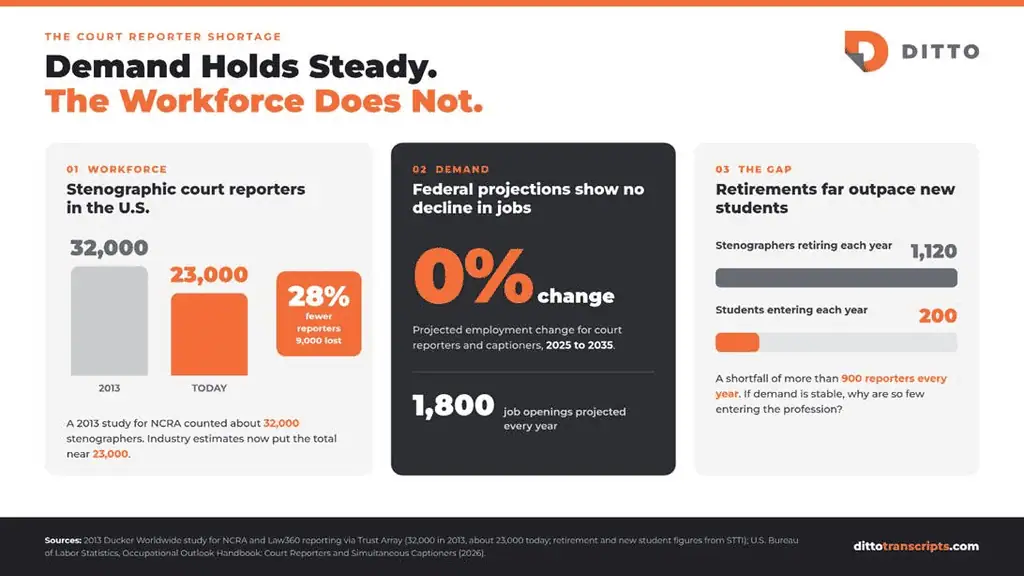
Court reporters play a vital role in the legal system. Although demand for their services remains steady, their numbers have declined by 28% over the past decade, from 32,000 to 23,000. This raises a few important questions: if demand is stable, why are fewer individuals entering the profession, and how are we going to replace court reporters?
You see court reporters in practically every legal TV show or movie where the brilliant lawyer gets the hostile witness to break down and confess to the crime. Court reporters, also known as stenographers, usually sit near the witness box. They are often frantically typing on a small machine recording every word and sound. Like most jobs, advancements in technology have improved the speed and accuracy of recording legal proceedings.
Many assume that Artificial Intelligence (AI) would replace most court reporters, but this transition has not occurred. And there is a simple reason.
Current AI technology cannot match the accuracy of human transcriptionists, particularly for verbatim transcription involving multiple speakers, background noise, cross talk, and challenging accents.
Most legal proceedings, both inside and outside traditional courtrooms, require accurate recording and transcription. Judges, attorneys, defendants, and others rely on these transcripts to review testimony. Even a single error can potentially overturn a ruling.
Reasons Why Court Reporters Are Decreasing
There are multiple reasons why court reporters are a dying breed. First, the shortage isn’t a sudden revelation and has been years in the making. The average age of a professional court reporter, also referred to as a certified stenographer, is 56 years of age. Even more problematic is that 60% of court reporters are 55 or older.
Another key issue is supply: fewer young people are entering the profession, and the number of in person educational programs has declined dramatically all over the US.
It appears that many young people do not view court reporting as an attractive career, possibly due to concerns about AI replacing human transcriptionists. However, based on my experience after 16 years of offering legal transcription[BW1] I believe human court reporters or qualified transcriptionists, will remain essential for decades.
Why? Because complex legal proceedings with multiple speakers and accents can be challenging to transcribe. Humans, with the necessary skills and experience can overcome these challenges. AI cannot. Not yet, anyway.
However, it is necessary to view the situation with a pragmatic approach. With fewer people interested in the profession, another obstacle exists. There are fewer schools that teach the skill, which means the educational pipeline is narrowing quickly. Enrollment in stenography programs have decreased 74%, with almost half of in person programs having disappeared altogether.
Currently, there are 18 National Court Reporter Association (NCRA) approved programs and about 53 total in the U.S. Program completion typically takes 2 to 3 years, or 24 months for an associate’s degree. However, the dropout rate is nearly 85.6%.
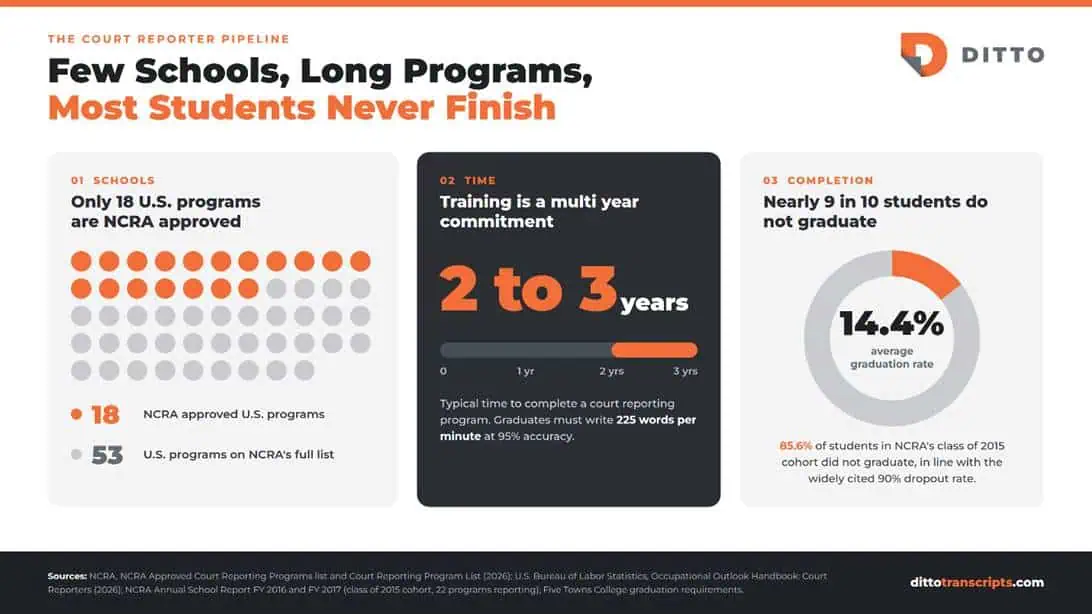
Even if an individual desires a court reporting career, a few obstacles exist. In addition to acquiring the necessary knowledge, students must also develop physical skills. Certified stenographers are expected to record around 225 words per minute, with a 95-97% accuracy rate.
The court reporting profession has continually adapted to change. From quill pens in the 19th century to typewriters and stenography machines in the 1940s, technology has improved speed and accuracy. Despite modern software, the declining number of qualified court reporters remains a significant challenge.
Average Court Reporter Salaries
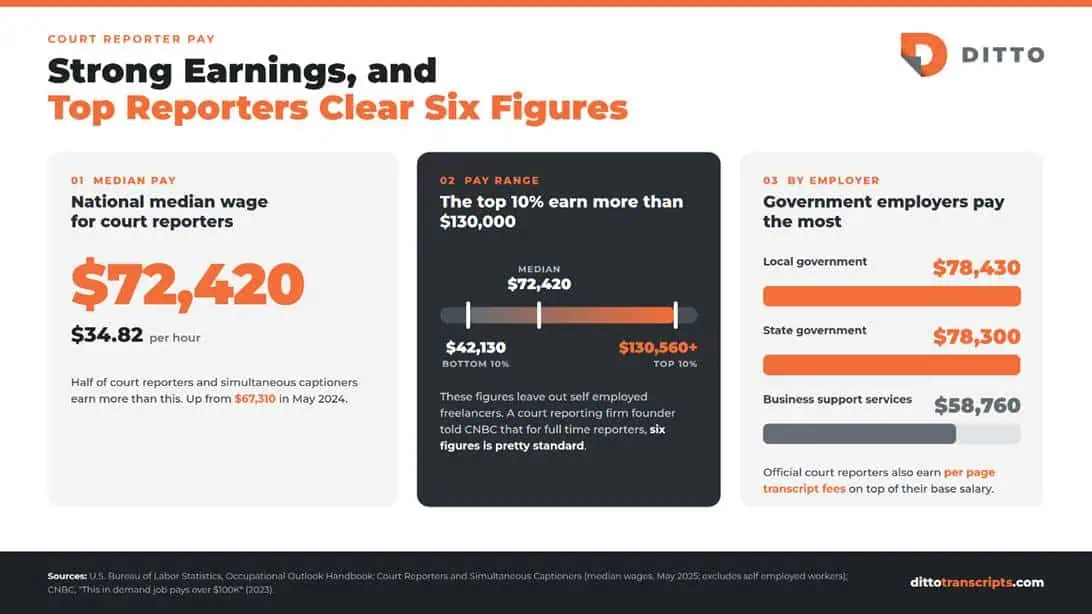
According to recent data, the national median salary for court reporters is approximately $72,420, or $34.82 per hour. Many experienced court reporters, particularly freelancers, earn over $100,000 annually.
Another article for a leading online job board listed the pros and cons of court reporting.
Some pros include:
- Good salaries
- Positive Job Outlook
- Minimal academic requirements
- Freelance opportunities
The cons include:
- Sedentary work environment
- Stress
- Long work hours
- High accuracy expectations
It is notable that most of the cons listed above are common to many professional occupations. High accuracy is expected in most roles. Additionally, the potential impact of AI on court reporting is often overlooked.
Busted or Broken: The Future of Court Reporting
An aging workforce, limited training programs, and declining career interest are clear warning signs for the court reporting industry. Some argue that the lack of entry-level positions is a major contributing factor. Which makes me wonder, if the demand is there, why are entry-level positions declining?
Consider how surgeons are trained in the medical profession.
Young physicians acquire their surgical skills starting in a three- to four-year residency program and usually followed by a one-to two-year fellowship. Alongside skilled surgeons, apprentice surgeons don’t immediately tackle organ transplants. They begin with simple procedures, paying particular attention to opening and closing the incision. Attention to detail, along with steady hands and tremendous mental acuity, are some hallmarks of a successful surgeon.
Industry insiders, including experienced court reporters, note that the disappearance of entry-level positions may pose some challenges in the coming years.[BW2] [PS3]
For example, a newly certified court reporter doesn’t immediately work on a high-profile murder trial. They often begin with simple depositions, with few speakers and low-level subject matters. Such assignments allow new stenographers to build the skills and confidence needed to tackle more complex cases and trials.
Without enough qualified court reporters available, attorneys and court systems have allowed inexperienced individuals to digitally record trials, hearings, and depositions. These records must eventually be transcribed, and as we referenced earlier, current AI programs cannot produce an acceptable accuracy rate. Therein lies the problem. Who can accurately transcribe these digital files and at what cost?
The Future of Court Reporting
Will the legal system continue to see declining numbers of certified court reporters? All signs indicate the answer is yes.
Despite steady demand for qualified court reporters, training options have decreased. It appears the industry has not kept pace with change, as court systems increasingly rely on inadequate AI solutions rather than investing in recruiting and training new stenographers.
In other words, it seems that the industry is betting, or hoping, that AI technology will perfect multi-speaker, verbatim transcription in the near future, thus reducing the expense of hiring a human transcriptionist.
Although informal sources such as Reddit are not definitive, many experienced court reporters say that their skills are no longer valued by judges, attorneys, and other stakeholders.
Unless AI transcription accuracy improves significantly, transcription companies will need to fill the gap. It remains to be seen whether legal professionals are willing to pay a premium for high-quality, accurate transcripts or accept 60% accurate AI transcripts.
The jury is still out on this issue. However, I predict an uptick in legal work for the transcription industry, especially those companies that are CJIS (Criminal Justice Information Systems) compliant.
Conclusion
The outlook for court reporting is challenging. With fewer training programs and declining interest in the profession, the number of active court reporters will likely continue to decrease over the next decade.
Potential earnings for the court reporting profession should entice more applicants. However, developing the necessary skill set to succeed as a court reporter appears to be a significant deterrent for young job seekers.
Transcription companies equipped to address this shortage stand to benefit, provided the legal profession maintains its accuracy standards.