
61.92% and 99% may seem close enough. However, the difference could mean the difference between freedom and imprisonment – or even life and death.
A transcript that’s almost 40% inaccurate is practically useless. It’s unacceptable in courts. And in most cases, you can’t trust it for personal use, simply because you don’t know what information is and isn’t actually correct.
In a recent study, Ditto Transcripts found that AI transcription is only 61.92% accurate, far below our own guarantee. That is one major reason why legal firms, healthcare teams, and many professionals use our legal transcription services.
We don’t blame you for wanting to use AI transcription. We very much understand how tempting it is to use their services. Who wouldn’t want cheap, quick, and convenient transcripts? All of that sounds very nice until errors occur.
That is why accuracy must be measured by what the transcript preserves, not by how convincing it looks.
What 61.92% Accuracy Looks Like in Real Life
Here’s a sample scenario. Suppose a witness says:
“I arrived at 8:15, saw Mr. Carson leave through the east door, and called my supervisor at 8:22.”
Sounds straightforward, right? If it is recorded in a clean audio room with microphones and equipment that can capture the audio without noise or disruptions, it could be transcribed pretty accurately. However, that’s not the case.
Courtroom or off-the-record conversations generally have messy audio. AI transcripts could mistake “8:15” for “8:50,” while “east door” could become “each door.” In addition, the surname could be attributed to the wrong person.
Case in point: Many errors can happen when you trust AI transcription services that are only 61.92% accurate. If that many errors can occur in a simple sentence, imagine how much worse it would look in depositions or medical recordings that could last hours.
Researchers consider these mistakes using a metric called word error rate, or WER. It counts substitutions, deletions, and insertions relative to a reference transcript. A Stanford-led study tested major speech recognition systems and revealed average WERs between 19% and 35%.
While AI transcription has come a long way and is already deeply integrated into many systems and applications, it is still far from delivering a highly accurate transcript.
The Audio Gets Harder Before the Stakes Get Lower
As mentioned earlier, real-life audio is never perfect.
Thick accents and jargon are only half of the story behind why AI transcription accuracy dips. The other lies in problems such as overlapping speakers, invasive background noise, and other challenges the source speaker experiences.
AI output may be acceptable for some meetings, but it may not suit other industries.
For legal teams, court transcription services exist precisely because the difficult parts cannot simply be guessed. Court documents are thoroughly reviewed and challenged. A single mistake could entirely change the outcome’s trajectory.
So, does that make AI transcriptions automatically bad? No. As the number of court reporters shrinks and the number of cases piles up, it is understandable that any assistance with the workflow would be accepted, especially if it is quick and high-yield. However, that should never lower the standard for setting an accurate record.
A Wrong Word Is Bad. An Invented One Is Worse.
When you think you already know the mistakes AI transcriptions can make, the problem goes even deeper.
An inaccuracy can be easy to spot and correct because it is often a sound-alike or a missing word. However, the situation worsens when there are hallucinations, which have been observed in modern speech-to-text systems.
Hallucinations are the addition of words in transcripts that never really existed. They “fill” gaps the system recognizes, making it difficult to identify what was actually said. A study by OpenAI’s Whisper revealed that roughly 1% of audio transcriptions contain hallucinated phrases or sentences, which can completely change the meaning of the output.
Note: The hallucination rates reported by OpenAI aren’t universal, as other researchers use different methods. This means the general extent isn’t identifiable yet, although the problem clearly exists.
Applying that to perspective: in medicine, that difference can mean an invented symptom or instruction. In insurance, it can alter a recorded statement. In litigation, it can place words in a witness’s mouth.
Remember that we said AI transcriptions are not automatically bad? We stand by it. In fact, our recent article covering ambient AI medical scribes notes that AI transcriptions could be very helpful when combined with human review.
Basically, AI creates the first draft, and a human expert approves the final transcript.
Convenience is real. So is the review requirement.
High-Stakes Transcription Can’t Settle For “Close Enough”
When businesses, life, or whatever case it is, is at stake, having a transcript that is “almost” and “close” is not enough.
That is why experienced medicolegal transcription services rely on people who understand medical terminology and hospital contexts to meet their documentation needs.
Here’s what professionals offer that automated output cannot reliably promise:
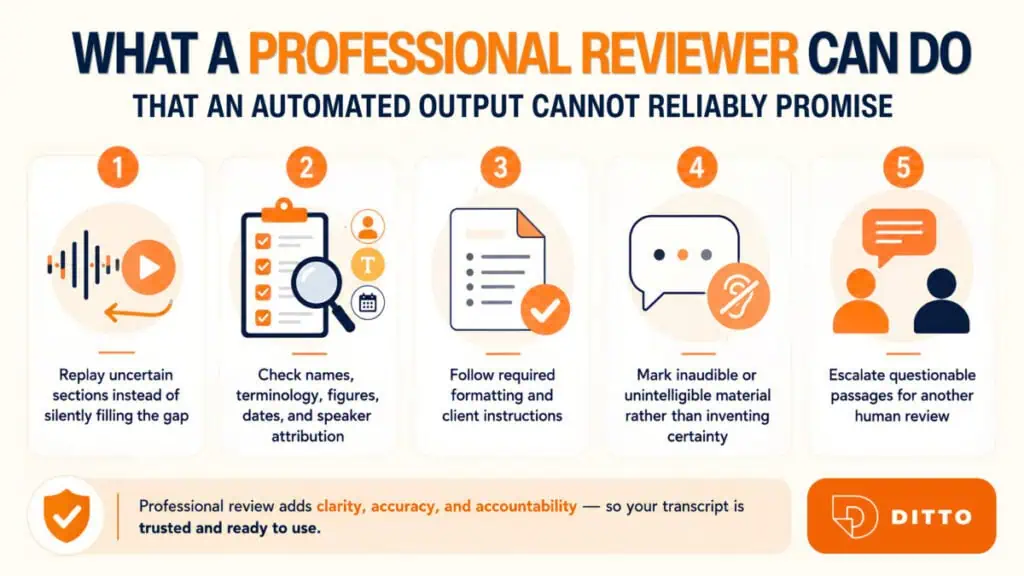
For records that require a word-for-word account, verbatim transcription preserves the actual speech rather than simplifying it or removing important context.
Why 99% Is a Process, Not a Superpower
Ditto’s 99% accuracy guarantee does not mean we never make mistakes.
That is not how quality works.
Instead, what we can guarantee is a genuine human production and review process. Once you work with us for your transcription needs, you get a professional. The transcript comes with a traceable workflow and an output that is accurate, properly formatted, and tailored to your needs.
This is the real difference between automation and professional transcription: accountability is built into the workflow.
We don’t simply provide a transcript to finish a project. Instead, we cover all your transcription needs, from discussing prices to after-service support once the project is turned over.
Why Professionals Choose Ditto When Accuracy Has to Hold Up
At Ditto Transcripts, audio is not treated as raw material for the fastest possible text. We treat it as source evidence that deserves careful handling.
Here is what clients can expect:
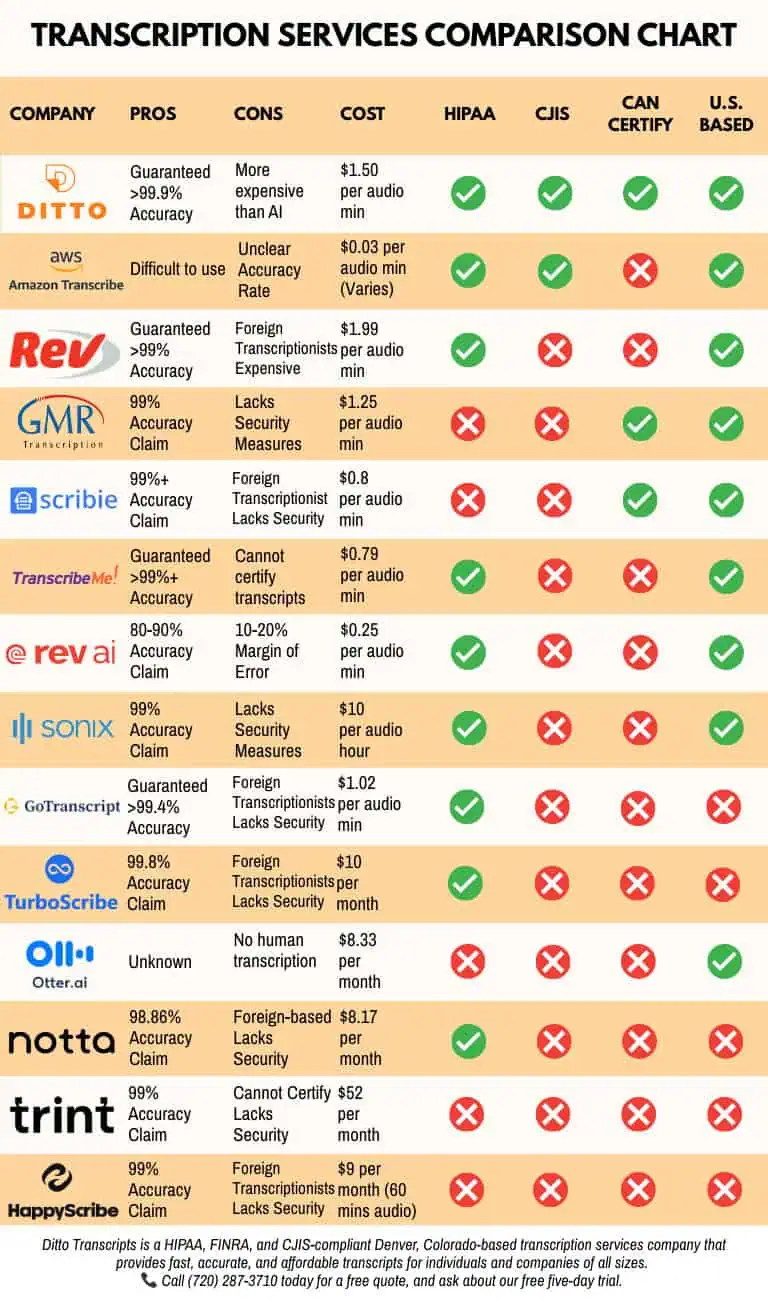
- Guaranteed accuracy: Ditto Transcripts doesn’t simply claim 99% accuracy; we guarantee it.
- 100% U.S.-based human transcriptionists: Real human, trained professionals transcribe your output, not an automated speech assistant.
- Secure handling: Ditto protects sensitive information through our HIPAA- and CJIS-compliant workflows.
- Human accountability: Our service does not stop once the project is rendered. We will attend to your questions if there are concerns about the project – no annoying bot in between.
- Transparent legal transcription prices: Published rates explain how turnaround time and recording complexity affect cost.
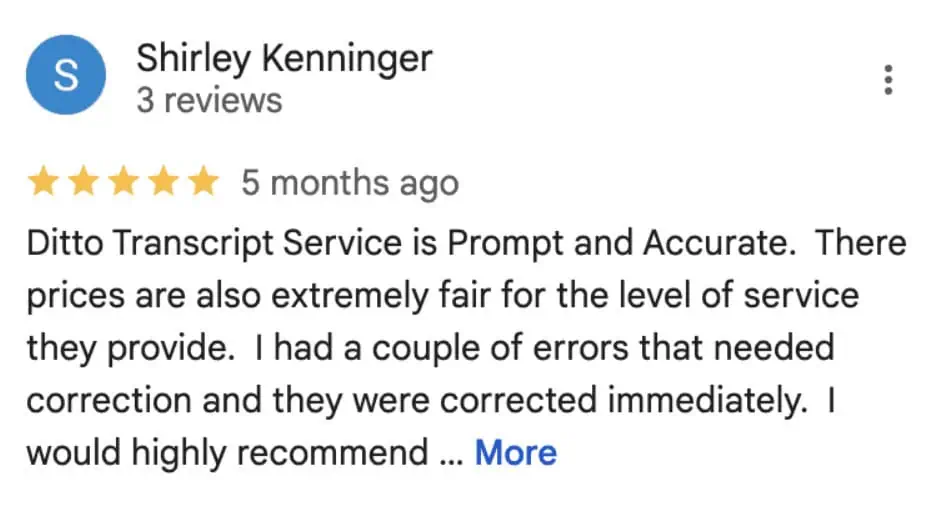
- Verified client experiences: Ditto’s testimonials basically tell you everything you should know.
The 38-Point Gap Is Really a Trust Gap
If there is one thing where AI beats humans, it is speed.
Sure, it can make transcriptions that allow searchable keywords and unmatched rendering of drafts. However, that speed does not translate to reliability.
When a transcript is only 62% correct, it can lead to serious consequences when left unchecked. That kind of transcript is as good as useless and will only create more complications.
61.92% tells us what happened in Ditto’s AI testing. 99% is the standard Ditto guarantees.
Ditto Transcripts is a Denver, Colorado-based transcription company providing fast, accurate, and affordable transcripts for individuals and organizations of all sizes. Ditto is FINRA-, HIPAA-, and CJIS-compliant. Call (720) 287-3710 today for a free quote.