
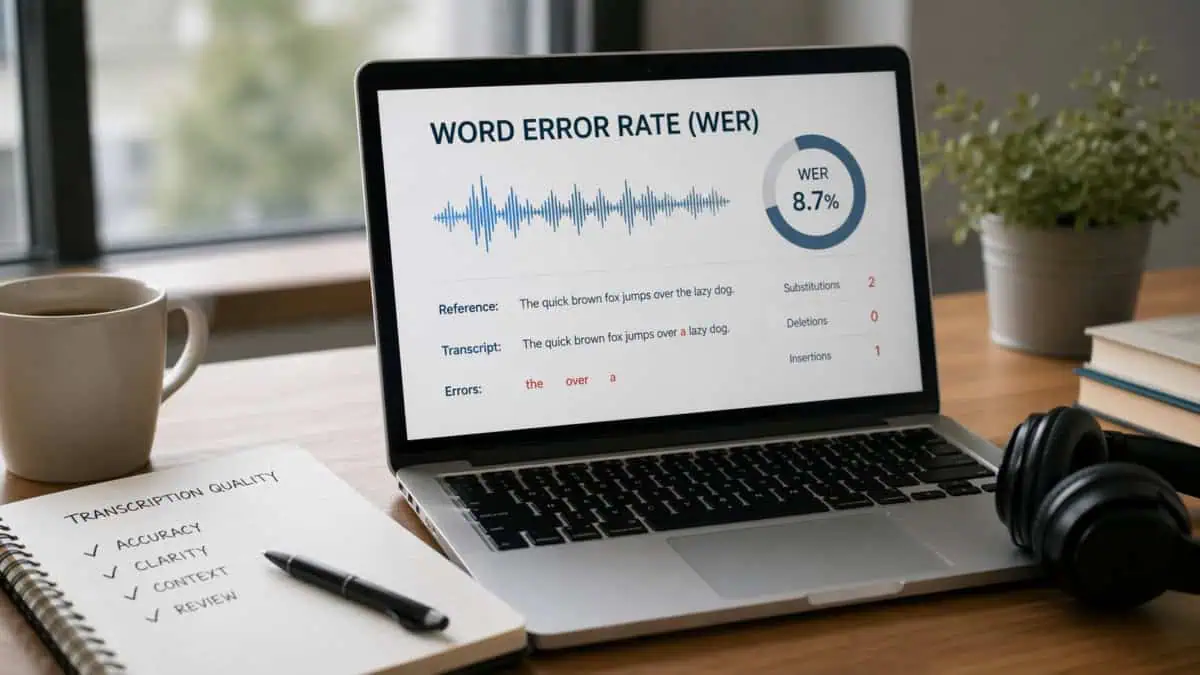
When people look for the “best” transcription services, they often encounter the same promises: fast turnaround, high accuracy, and affordable pricing. However, most of these companies claim high accuracy and yet offer little guarantee of it. And more often than not, it leaves out the part that actually matters: how accuracy is measured and what word error rate means when the transcript is used by real people.
Transcripts have a significant real-world use case. For example, legal transcription services are sought to aid legal professionals in case preparation and proceedings – and inaccurate transcripts beat that purpose. That’s why word error rates are important. So, you might be asking now, is there a “standard” error rate? And how is it actually calculated?
In this article, you’ll learn how:
- A “99% accurate” claim means little without context about the audio, testing method, and review process.
- There is no universal acceptable error rate, as different use cases require different levels of precision.
- AI can speed up transcription. Yet, they are not appropriate for sensitive or high-stakes content, which still needs human quality control.
What Is A Transcription Word Error Rate?
A transcript does not automatically become reliable just because a provider says it is 99% accurate.
In reality, accuracy claims need context. And that depends on the following:
- How the transcript was evaluated
- What kind of audio was involved
- Does the file have multiple speakers
- Did a human review the finished output before it was delivered?
That is where word error rate, or WER, become relevant. WER measures how many words in a transcript were wrong, missing, or added compared with a correct reference transcript. Even major platforms such as Google Cloud and Microsoft strongly recommend testing with representative audio and human-labeled ground truth rather than relying on generic claims.
That sounds simple enough. However, the number alone can be misleading.
A transcript can have a relatively low error rate and still cause problems. For example, a wrong medication name, a misheard legal phrase, an incorrect number, or a missing “not” can change the meaning of an entire sentence.
So while WER is useful, it is not the same as trustworthiness. Instead, it is only one part of the whole. Google and Microsoft both said that evaluation should be closely tied to the actual use case and the quality of the reference data.
Why Is There No Single “Acceptable” Word Error Rate?
This is probably the most important point in the whole discussion.
There is no universal error rate that works for every transcript.
Modern solutions, such as Microsoft’s guidance on speech model evaluation, state that acceptable WER depends on the application, content, and audio conditions. Meanwhile, Google stated that accuracy should be measured against audio that is representative of the real production environment.
In other words, the right standard changes depending on what the transcript is for.
Here is the practical version of that idea:
| Use case | Error tolerance | Why it matters |
| Internal brainstorming call | Moderate | The transcript mainly helps with recall and search |
| Podcast or marketing interview | Lower | The text may be published, quoted, or repurposed |
| Board meeting or compliance discussion | Low | Small wording mistakes can affect records and accountability |
| Legal, medical, or investigative audio | Very low | Errors can affect decisions, liability, and the integrity of the record |
That is why businesses should be careful with blanket claims. A machine transcript that is “good enough” for note-taking might be nowhere near good enough for court reporting, insurance statements, medical documentation, research interviews, or public-facing records. However, transcripts are most useful when they serve a real purpose, such as when legal professionals seek court transcription services to create legally admissible transcripts.
What Usually Causes Transcription Accuracy To Drop
Most transcription errors can be traced to a handful of reasons. Here they are:
Poor Audio Quality
If the recording is noisy, distant, muffled, clipped, or echoey, the transcript will suffer. Google specifically recommends evaluating accuracy using acoustically representative audio because real-world conditions strongly affect results. That applies whether the system is AI-based, human-assisted, or both.
Specialized Language
Industry terms, internal acronyms, product names, legal phrasing, and uncommon proper nouns make transcription harder. These are ever-present in specialized projects, like the ones that we cover with our government transcription services. AWS and Microsoft both provide custom vocabulary or custom speech tools specifically to improve performance on domain-specific language, which tells you a lot by itself: general models often struggle when the content gets technical.
Multiple Speakers
Meetings, interviews, hearings, and panel discussions are harder than single-speaker dictation. Amazon Transcribe offers speaker diarization to separate speakers in the output, and its documentation notes support for identifying distinct speakers in the transcript. The fact that diarization is its own feature is a reminder that transcription is not just about hearing words. It is also about assigning those words to the right person.
Accent And Speaking Style Variation
Fast speech, overlapping speech, heavy accents, low volume, interruptions, and inconsistent pronunciation all add friction. Microsoft’s evaluation guidance highlights that names, jargon, and task type can meaningfully affect WER, especially when the audio is not clean or standardized.
Why “99% Accurate” Is Not The End Of The Conversation
A lot of buyers hear 99% and stop thinking. That is a mistake.
First, a percentage means very little unless you know how it was measured. Was it measured on clean studio audio or on real customer files? Was there one speaker or five? Did the provider compare the transcript against a human-verified reference? Was the result machine-only or human-reviewed?
Second, even a small percentage of mistakes can add up over a long recording. In a lengthy interview, hearing, deposition, or executive meeting, a small error rate can still leave a meaningful number of mistakes to fix. The more important the audio is, the less acceptable it becomes.
This is one reason Google and Microsoft both recommend evaluation against representative audio and ground truth rather than broad marketing claims. The right question is not “What number did the provider advertise?” The right question is “Can this transcript be trusted for what we need it to do?”
AI Transcription Is A Quality Control Nightmare
There is no point pretending AI transcription is useless. It is not. It is fast, scalable, and often very useful for first drafts, internal search, content indexing, and rapid turnaround workflows.
However, speed is nothing without accuracy.
That is exactly why the biggest speech-to-text platforms keep emphasizing testing, custom vocabularies, representative audio, and model tuning. If AI were sufficient on its own in every environment, those features would matter far less. They matter because transcription performance changes with context, and raw output still needs verification in higher-stakes work.
For businesses, the safer way to think about AI is this: it can accelerate the workflow; it should not be confused with final review. If the transcript is going to be published, submitted, quoted, archived, relied on in a dispute, or used in any regulated or sensitive setting, somebody still needs to make sure the text is actually right.
What Organizations Should Ask Before Choosing A Transcription Provider
If your organization is evaluating transcription services, the best questions are often the most practical ones.
- Ask how accuracy is measured.
- Ask whether the provider evaluates results against real customer-style audio or only ideal conditions.
- Ask how they handle technical terminology, speaker changes, and poor recordings.
- Ask whether a human checks the final transcript before it reaches the client. And ask whether they routinely work with the types of files your organization actually produces.
A provider that truly understands transcription accuracy should be able to answer those questions directly, without hiding behind vague percentages.
Why Organizations Choose Ditto for High-Accuracy Transcription
If your organization needs transcripts that can actually be trusted, Ditto Transcripts helps close the gap between raw output and dependable final text.
Accuracy in transcription is not just about getting most of the words right. It is about ensuring the final transcript is readable, properly reviewed, and reliable for its intended use. That becomes especially important when the content involves legal matters, business decisions, research, medical documentation, interviews, or any recording where small mistakes can turn into larger problems later.
Ditto’s transcription services are built for clients who need more than a rough draft. We offer specialized verbatim transcription services for all industries. And for all of them, we deliver transcripts that are carefully reviewed, context-aware, and ready for practical use, not just generated quickly and left unchecked.
Here at Ditto, we offer:

- High accuracy: We provide transcription services with a 99% accuracy guarantee across a wide range of industries and use cases.
- Human-reviewed transcripts: AI can speed up the process; however, speed alone does not make a transcript dependable. Every transcript is reviewed for quality before delivery.
- Support for complex content: From legal proceedings and interviews to medical files and business recordings, we work with content where terminology, speaker clarity, and context matter.
- Flexible turnaround and pricing: Different projects call for different timelines and budgets. Our service options and transcription rates are built to stay practical without cutting corners on quality.
- Readable, usable formatting: A transcript should not just be accurate. It should also be clean, organized, and easy to work with once it reaches the client.
- Responsive service: When clients have questions or concerns, they need real communication, not a vague automated reply. We take that seriously.
For organizations comparing transcription providers, that difference matters. A fast transcript is an easy promise. A transcript that holds up when accuracy really counts is a different standard altogether.
And that is exactly where Ditto stands apart.
Accuracy Standards Matter More Than Marketing Claims
Transcription error rates can be useful if they are understood in context. A percentage on its own does not tell you how the transcript was measured, what kind of audio it came from, or whether the final text is actually ready to use.
That is why organizations should look beyond surface-level claims and pay closer attention to how transcription quality is achieved. The real standard is not whether a provider promises a strong number. It is whether the transcript can be trusted once the recording is important enough to rely on.
For routine internal use, a rough automated transcript may be enough. For records, documentation, accessibility, legal matters, medical content, research, or business-critical communication, though, accuracy has to mean more than convenience. It has to mean review, clarity, and confidence in the final output.
The organizations that understand that difference are usually the ones that choose better transcription partners from the start. Ditto understands that completely – that’s what makes us the best.
Still not convinced? Maybe one of our client testimonials will help you decide.

Ditto Transcripts is a Denver, Colorado-based FINRA, HIPAA, and CJIS-compliant transcription services company that provides fast, accurate, and affordable transcripts for individuals and companies of all sizes. Call (720) 287-3710 today for a free quote.