
Have you ever heard Siri, Apple’s in-app assistant, speak? It was originally voiced by Susan Bennett, whose recordings were processed using speech-synthesis tech. Now, what you hear in Siri isn’t exactly Susan speaking. It’s a voice created through synthetic speech, an imitation built from recordings of a real person. While it’s fine to ask Siri about today’s temperature, others use similar technologies for more nefarious purposes.
Recorded statements used to be a way to prove a person actually said what they did. But more and more, this isn’t actually the case, especially with the rise of insurance fraud. This means legal transcription services are now held to a higher standard. Transcription companies no longer “just” convert audio to text. They also create documents that could become part of the evidence trail and must preserve how they handle the data so those records can withstand scrutiny.
In this article, you’ll learn:
- How synthetic voices enable insurance fraud
- Why transcripts matter as evidence
- The importance of chain of custody
- Where human review protects accuracy
- How transcription strengthens claim documentation
Insurance Fraud Costs $308.6 Billion a Year
The Coalition Against Insurance Fraud reported that insurance fraud costs on average $308.6 billion a year, or roughly 10% of property and casualty losses. But the fraud only needs to be believable on first impression, and everything else follows. As long as the fake voice doesn’t raise suspicion, the system may treat it as legitimate and fail to trigger additional verification measures.
Fraudsters can use a synthetic voice to pass an identity check, then change claim information or submit false evidence to make the claim appear legitimate.
The worst part? These synthetic or AI-generated voices need not imitate a specific person. There is plenty of available information (real or fake) that the system combines, looking legitimate even in databases – without any real person that fully matches it.
There are a lot of loopholes, we know. And that’s why transcripts should never be treated as another check on a list.
Your Transcript Is Evidence, Not Paperwork
Even though a decision on a claim has been made, it does not automatically mean that it’s free from future re-examination. And that’s where the problem comes up.
Audio recordings alone are bulky. Imagine having to go through a 2-hour audio file only to find one or two key statements? It takes a lot of effort, focus, and accuracy to repeatedly comb the audio, take notes, and manually search for any errors – all of which are solved by transcripts.
A carefully prepared transcript changes how convenient access to information can be.
It allows an adjuster or investigator to:
- Quickly scan and skim across statements
- Compare accounts
- Identify changes in dates, locations, and participants
- Make quotations
- Share information and direct counsel to specific portions of the record
- Identify speaker labels and uncertain or inaudible sections
Verbatim transcription, for example, is commonly used in contested claims. It captures exactly and completely what has been said, painting an accurate picture of the event.
Don’t get us wrong. Transcripts alone don’t establish voice authenticity. Instead, they create an organized record that investigators can use and analyze alongside other evidence to identify what is real and what is not.
When the Interviewer Is Also a Machine
Almost everything today has at least some influence from AI. Fraudsters aren’t the only ones using technology. Insurers are also using it to handle and process claims and conversations.
Conversational AI, for example, asks claimants questions, creates transcripts, and flags suspicious cases to a Special Investigation Unit (SIU), thereby streamlining the process and making it more convenient.
However, AI-generated outputs should be taken with a grain of salt, as they are not inherently reliable. As basic as it may seem, AI drafts are prone to errors such as confusing speakers or mishearing or misrecording information.
Here’s where it could get worse: AI could transcribe a recording that uses a synthetic voice into a clean, professional-looking document without recognizing that the source was fabricated.
Does that make AI interviewers useless? Definitely not. It could actually help improve workflows, as it can be effective for triage. For transcripts, however, it must be approved and reviewed by a human professional.
Where Accuracy Actually Bites
Insurance recordings have their own respective purpose and uses:
Recorded statements
These require exact documentation of what has been said. That includes accurate numbers, dates, and even amounts down to the last decimal. Their final format is according to carrier systems and review workflows.
Examinations Under Oath
These usually require page-and-line formatting, according to the jurisdiction. Most importantly, it usually requires certification, ensuring that the record is legally admissible.
Medical and Independent Medical Examination Recordings
These include medical jargon, such as conditions and medications, as well as other health information. It is usually done by experienced medicolegal transcription services that are experts in handling this type of recording.
SIU Interviews
Special Investigation Unit (SIU) interviews commonly support regulatory referrals, civil litigation, or criminal investigations. The challenge with SIU interviews is accurately preserving the recording rather than interpreting, improving, or summarizing the speaker’s language.
Consent Is Not the Same in Every State
Not all states have the same consent rules.
Some states allow one participant to consent to a recording, while others require consent from all parties. The same goes for insurance rules, which can vary depending on the company handling them.
Even with consent, insurers should have legal counsel establish procedures for handling and maintaining records.
Case in point: poor documentation leads nowhere. It only creates legal and regulatory problems, which insurers can avoid by following the right process from the start. They must handle records in accordance with the laws of the jurisdiction and maintain complete, accurate claim records.
The Human in the Loop Is the Defense Mechanism
AI can be used to commit fraud just as easily as it can be used to create a draft. However, to what extent are those drafts usable?
This is where professional and experienced transcriptionists prove their value. Human transcriptionists, like those at Ditto, ensure accuracy and create an accountable record of what’s said in the audio, something automated systems often struggle to do.
Put simply, AI provides a quick answer, while a human expert fully documents that the answer is unclear.
Why Insurance Teams Choose Ditto for Defensible Documentation
At Ditto Transcripts, we treat insurance recordings as sensitive sources of evidence, not simply as audio to convert into text.
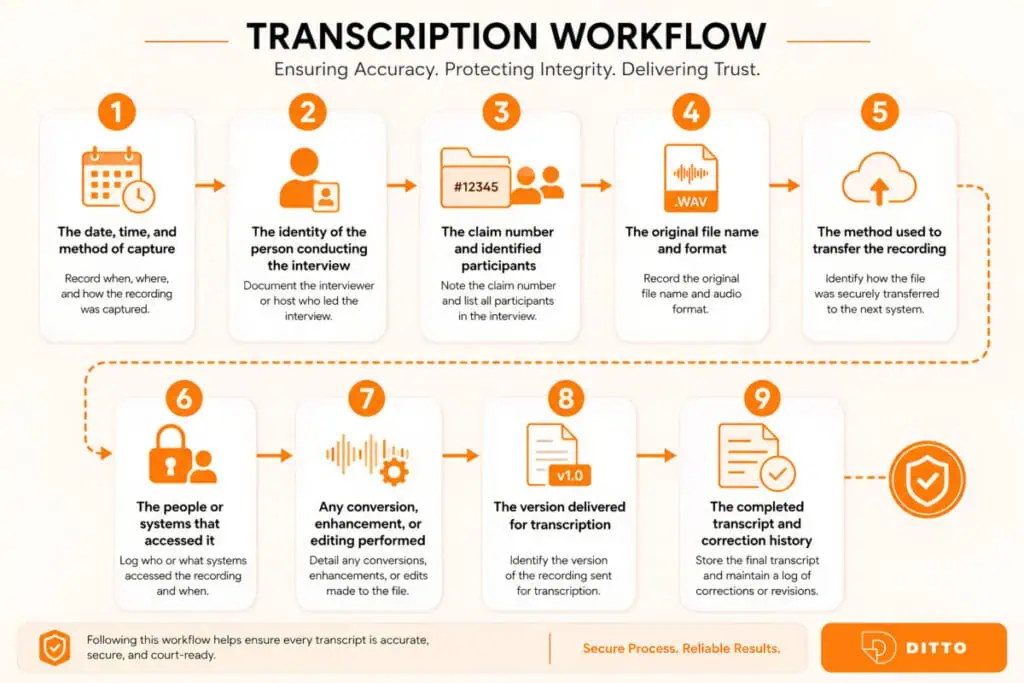
Here is what carriers, adjusters, and SIU teams can expect when working with us:
- Human-reviewed accuracy: We guarantee (not claim) 99+% accuracy on all of our transcripts.
- U.S.-based transcriptionists: Our professionally trained professionals are familiar with American legal, medical, and other industry-specific jargon.
- Secure handling: Ditto upholds the highest standards of compliance with HIPAA, CJIS, and FINRA, ensuring the secure handling of sensitive information.
- Clear accountability: Questions and corrections can be traced to a human-supported production.
- Transparent insurance transcription pricing: We don’t beat around the bush. Our costs are upfront – and you can contact us to discuss your transcription needs – no bot involved.
- Verified experiences: Ditto’s testimonials practically tell you everything you should know.
The File Always Has to Survive the Challenge
Today, voice recordings are simply not enough. Aside from synthetic voice attacks, even legitimate audio could be tedious to work with, especially if it takes hours to find what you’re looking for.
Insurers must rigorously investigate inconsistencies, and this can only be done efficiently with a transcript from a reliable provider.
In the era of deepfakes, transcription is not the cleanup step after the interview. It’s the first line of defense against fraud.
Ditto Transcripts is a Denver, Colorado-based transcription company providing fast, accurate, and affordable transcripts for individuals and organizations of all sizes. Ditto is FINRA-, HIPAA-, and CJIS-compliant. Call (720) 287-3710 today for a free quote.