
A few years ago, a quick search meant opening Yahoo, Google, or Bing and typing your question. It provided leads on your question, though you still had to find and verify the answer. Today, all you have to do is open the search engine, give the prompt, and voila, you have a quick summarized answer.
That very method is widely applied in many industries, except in the legal field. One major risk is data exposure, as interaction with AI may not stay between the user and the machine. Legal firms must consider carefully whether they use an AI assistant or legal transcription services, where sensitive information is shared.
What feels like a private shortcut today could become something opposing counsel asks about tomorrow.
The Prompt Is the New Smoking Gun
3M’s legal team hired an expert to assess the company’s potential role in the explosion and to prepare an expert report for the case. While working on it, the expert used ChatGPT.
Everything seemed normal until discovery, when plaintiffs’ counsel noticed something strange, referring to a document that appeared to be AI-generated, and asked to see the prompts behind it. That caused nearly a three-hour pause in the deposition and revealed that about 350 pages of the expert’s ChatGPT conversations were produced.
The biggest red flag? A prompt asking ChatGPT to help “show how 3M is 0% at fault”
This only means that the finished report is not the only thing opposing counsel could examine; how it was prepared, particularly if AI is involved, is as relevant as the final output.
Discovery Doesn’t Stop at the Finished Document
Experienced legal teams know that emails, messages, recordings, and nearly all electronically stored information can become part of discovery. However, what they may not have initially realized is that it also covers AI – all the prompts, uploads, and outputs that contributed to the final work.
The prompt is like a blueprint, showing all information relevant to drafting the document. It reveals what questions were asked, what assumptions were made, and even how an answer was obtained. The 3M case shows why that trail can matter when opposing counsel wants to understand how an expert concluded.
Still, that does not mean every AI prompt is automatically discoverable.
Under Rule 26, opposing counsel may seek relevant, nonprivileged information, including material an expert considered when forming an opinion. Draft expert reports and many private communications between attorneys and experts still receive legal protection.
Rule 45 can also be used to request electronic records from third parties. Still, production is not automatic; privilege, work-product protection, burden, and other legal limits may still apply.
The same thinking applies to decisions involving deposition transcription services, particularly when recordings contain sensitive testimony or case strategy.
Using AI Does Not Create a Privilege Shield
There is another important distinction. Typing something into an AI platform does not, by itself, create attorney-client privilege or work-product protection.
Even so, saying that AI prompts can never be protected would also be wrong.
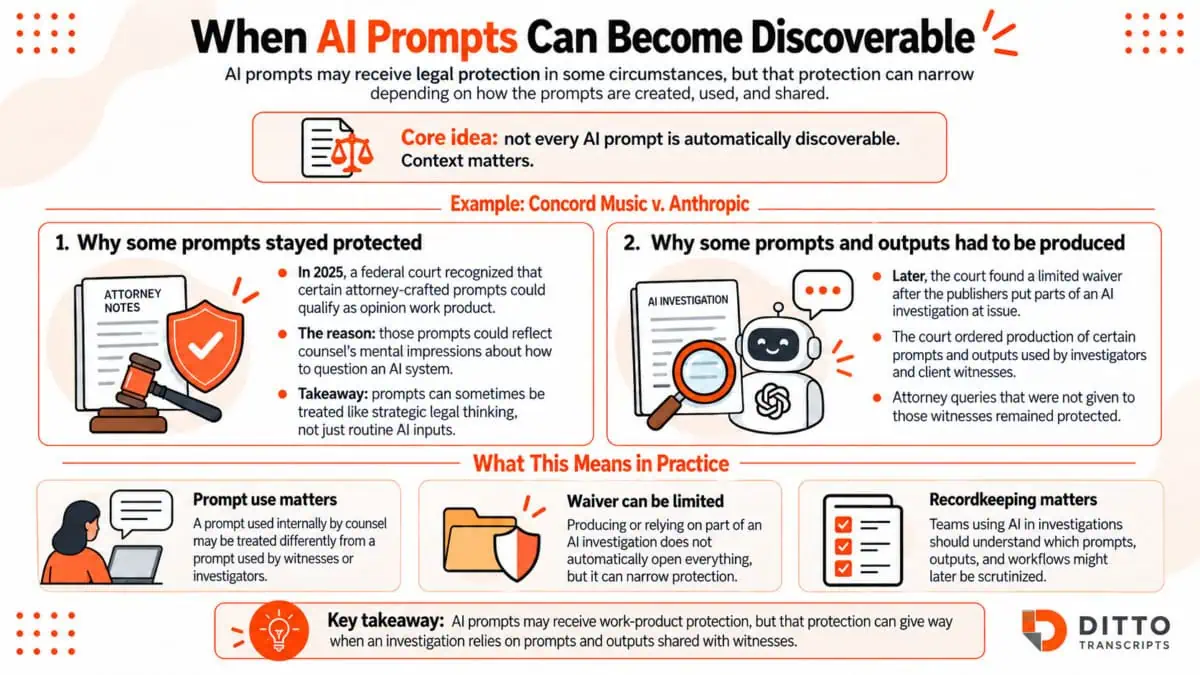
Protection depends on the circumstances, particularly who created the material, why it was created, how it was used, whether confidentiality was maintained, and whether protection was later waived.
The American Bar Association (ABA) has also warned lawyers to use generative AI carefully. Its Formal Opinion 512 says attorneys should consider whether client information could be accessed or disclosed outside the firm before entering it into an AI tool.
Every Tool Touching Case Material Creates Another Data Surface
Legal teams may use AI to transcribe testimony, summarize depositions, or organize case material. Depending on the platform, it can create more than simply a final document. The system may also retain the uploaded audio or files, the prompts used to process them, generated responses, and account activity tied to the work.
As convenient as that may be, its output is no longer about accuracy alone; it is also about which information the workflow created or retained.
That matters when choosing court transcription services that handle evidence or sensitive details that could directly affect litigation.
So, before you choose any of these vendors, the answers to these questions must be identified:
- Where is the information stored, and for how long?
- Does the vendor use customer content to train models?
- Who can access the material?
- Can files and associated records be deleted?
- What information remains after the engagement ends?
- What records would exist if discovery or a preservation obligation later arose?
What a Defensible Workflow Looks Like
“Be careful with AI” is easy advice to give and difficult to implement.
A defensible workflow makes data handling deliberate before sensitive material leaves the firm.
| Stage | Practical safeguard |
| Intake | Identify privileged, confidential, personal, or evidentiary material. |
| Vendor review | Ask how a vendor handles data and what previous customers say. |
| Processing | Communicate and share information only through secure channels. |
| Review | Double-check the output and identify who handles the source material.Verify the finished work and document who handled the source material. |
| Preservation | Identify the workflow created and what was retained |
If you need a word-for-word capture, verbatim transcription can most effectively preserve what was actually said without requiring an AI system.
Why Legal Teams Choose Ditto When the Record Has to Hold Up
At Ditto Transcripts, we don’t route sensitive case audio through generative AI for speed.
Here is what legal teams can expect:
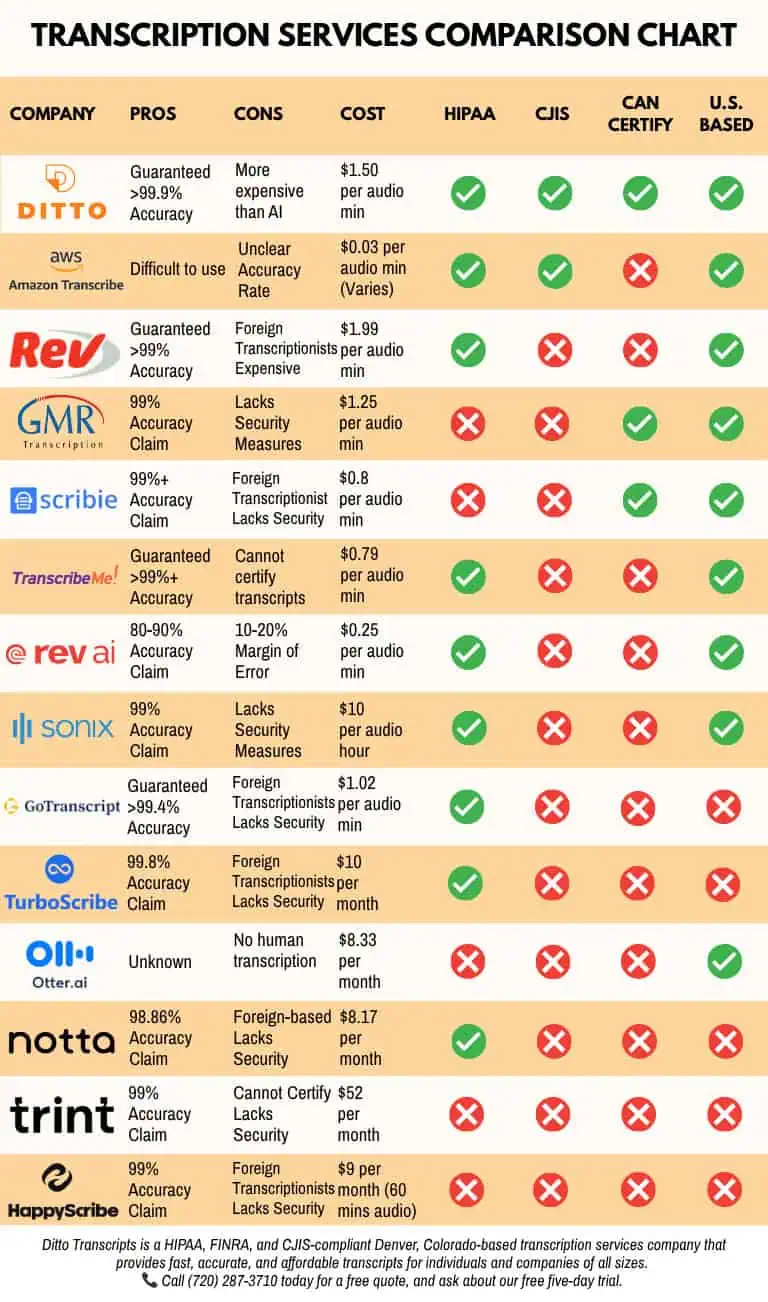
- 100% U.S.-based human transcriptionists: Our trained human transcriptionists can provide the transcript and testify when needed.
- Secure handling: We uphold the highest security standards, backed by FINRA, HIPAA, and CJIS compliance.
- No generative-AI prompt trail: At Ditto Transcripts, rest assured that AI-related matters are not your problem.
- Human accountability: Our service extends beyond the project turnover. Have a question or need editing? We are more than happy to help- no bots in between.
- Transparent legal transcription prices: Turnaround options and pricing are published upfront so firms can choose based on the case’s needs.
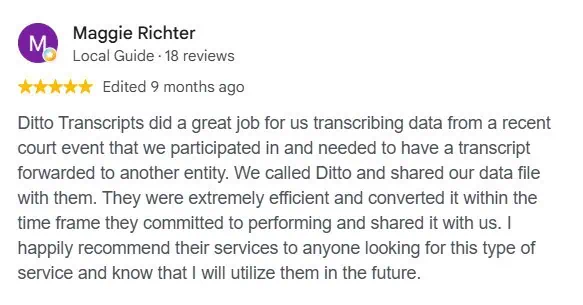
- Verified client experiences: If you’re still not convinced, our testimonials will tell you everything you need to know.
The point is not to make technology disappear from legal work. Rather, it is to prevent an AI trail that could impair a case’s deliberation.
The Bottom Line
The 3M expert story reminds us that preparing a legal document matters as much as the final output.
That does not mean every AI prompt will automatically be handed over in discovery. Some may still be protected by privilege or work-product rules, depending on how they were created and used.
The bigger point is simpler: once AI becomes part of the work, its prompts and outputs can become part of the legal conversation, too.
For legal teams, the safest operational assumption is simpler: Before feeding sensitive case material into an AI system, consider whether you would be comfortable explaining that interaction in discovery. Because in 2026, the prompt may not stay behind the screen. It may become part of the record.
Ditto Transcripts is a Denver, Colorado-based transcription company providing fast, accurate, and affordable transcripts for individuals and organizations of all sizes. Ditto is FINRA-, HIPAA-, and CJIS-compliant. Call (720) 287-3710 today for a free quote.