


Important decisions can disappear surprisingly quickly after a meeting ends. One person remembers one version of what was agreed to, another remembers something slightly different, and everyone starts searching through emails, messages, and recordings for the answer.
Transcribing Webex meetings gives teams a searchable written record they can return to instead of relying on memory. Webex includes built-in transcription features, while professional business meeting transcription services offer another option when accuracy matters more, audio is difficult, specialized terminology is involved, or human review is needed.
When those meetings involve litigation, investigations, attorneys, or other formal legal matters, professional legal transcription services can provide the additional accuracy, formatting, and attention to detail those recordings may require.
In this article, you’ll learn:
- What Webex meeting transcription is and how it works
- The benefits and limitations of automated Webex transcription
- When professional human transcription may be the better option
What Is Webex Meeting Transcription?
Webex meeting transcription converts spoken conversations from a meeting or webinar into searchable written text.
For recorded meetings, Webex can automatically generate transcripts from MP4 recordings when the feature is enabled. Cisco says the transcript appears alongside the recording, where users can search for particular words or phrases. Hosts can also edit transcript text to correct inaccuracies or punctuation.
On the Webex Suite meeting platform, organizations can also allow participants to save an in-meeting transcript without recording the meeting. The feature depends on the settings an administrator has enabled.
A transcript can be useful for identifying:
- Decisions
- Action items
- Project deadlines
- Questions and answers
- Names and technical terms
- Follow-up responsibilities
It also makes it easier to revisit a specific portion of a long meeting without replaying the entire recording.
Benefits of Transcribing Webex Meetings
The main advantage of transcription is accessibility. Spoken information becomes searchable, reviewable, and easier to share with authorized team members.
| Benefit | How a Transcript Helps |
| Searchable records | Find specific terms, names, or decisions without replaying the meeting |
| Better collaboration | Give absent or remote team members a written record to review |
| Accountability | Revisit what was assigned, discussed, or agreed upon |
| Documentation | Preserve important conversations alongside other project records |
| Knowledge retention | Keep useful information available after employees or teams change |
| Accessibility | Give people another way to consume meeting content besides audio or video |
| Faster review | Read relevant sections instead of watching an entire recording |
A transcript should not automatically be treated as an official or legally controlling record. Its role depends on how the organization uses it and whether it has verified its accuracy.
How to Enable Webex Recording Transcripts
Cisco has changed its Webex administration interfaces over time, so older instructions may no longer match what administrators see today.
For most organizations, administrators now manage transcription settings through Control Hub or User Hub.
Enable Recording Transcripts for a Webex Site
Administrators using Control Hub can:
- Sign in to Control Hub.
- Go to Services > Meeting > Sites.
- Select the appropriate Webex site.
- Open Settings.
- Under Common Settings, select Site Options.
- Locate the video and recording settings.
- Turn on Create recording transcripts for all hosts’ MP4 recordings.
Administrators can also allow hosts to decide whether transcripts should be created for their recordings.
Enable Transcripts for an Individual User
Administrators can enable transcription for specific people rather than an entire organization.
In Control Hub, select the user, open the Meetings settings, choose the applicable Webex site, and go to the user’s advanced settings. You can then enable the option to create recording transcripts for that user’s MP4 recordings.
Enable Your Own Recording Transcripts
Where administrators permit it, individual hosts can enable transcripts through User Hub.
Go to:
Settings > Recording > Create recording transcripts for your MP4 recordings
Cisco notes that the option may not appear if the site administrator has already configured transcription for everyone or has prevented individual users from changing the setting.
What Happens After a Webex Meeting?
Once a supported recording is processed, its transcript appears beside the recording and can be searched during playback.
Cisco says recording transcripts generally take up to about twice the meeting duration to generate. A one-hour meeting, for example, may take roughly two hours for its transcript to appear.
The host can then review the transcript and edit inaccurate words or punctuation.
Cisco currently states that its recording-transcript feature supports English audio. Organizations relying on multilingual transcription should therefore verify what their particular Webex configuration and licenses support before depending on the automatic transcript.
Remember Consent and Privacy
Meeting transcription is not purely a technical issue.
Organizations should consider consent, privacy, confidentiality, data retention, and access before recording or transcribing conversations.
Cisco states that participants must provide consent before a Webex meeting can be recorded, summarized, or transcribed.
That matters especially when meetings contain:
- Customer information
- Employee information
- Financial data
- Medical information
- Trade secrets
- Legal discussions
- Government information
Organizations should follow their own legal, regulatory, contractual, and internal requirements when deciding what to record, how long to retain it, and who may access the resulting transcript.
For public-sector organizations dealing with hearings, regulatory discussions, interviews, or other official recordings, government transcription services may be useful when human transcription and more structured documentation are required.
Where Automated Webex Transcription Can Struggle
Webex’s automatic transcription is convenient. However, convenience and accuracy are not the same thing.
Real meetings include many conditions that make speech recognition difficult: multiple speakers, interruptions, accents, poor microphones, specialized vocabulary, and people talking over one another.
Cisco notes that its AI-generated meeting summaries and transcripts may struggle to identify multiple people speaking in one room accurately and may not correctly understand company-specific or domain-specific vocabulary.
Overlapping Speakers
People rarely take perfectly organized turns in a real meeting.
Someone interrupts. Two people respond at once. Another participant starts speaking before the first person finishes.
Automatic speech recognition can struggle to separate those voices, especially when participants have similar speech patterns or microphone quality varies.
If you’ll rely on the transcript later, overlapping sections deserve additional review rather than automatic acceptance.
Technical Terms and Proper Names
Industry meetings often contain language an automated system has little context for.
A financial meeting might include EBITDA, company tickers, internal project names, acronyms, or unusual surnames. A healthcare meeting may contain drug names and clinical terminology. An engineering meeting may contain specialized product numbers and technical abbreviations.
An automated system can produce a sentence that looks grammatically plausible while substituting the wrong term.
Speaker Identification
Speaker labels can also create problems.
A transcript becomes much less useful when it assigns a critical statement to the wrong participant. That matters when teams are using the transcript to establish who agreed to complete a task or who made a particular recommendation.
For important meetings, check speaker attribution against the recording.
How Accurate Is AI Transcription?
Automated transcription technology continues to improve, and it can be useful when speed matters more than producing a final verified transcript.
However, Ditto’s own testing found a mean AI transcription accuracy rate of 61.92% across the systems evaluated. That number reflects Ditto’s testing and should not be interpreted as the accuracy rate of every AI transcription platform or every Webex recording.
The practical question is whether you need a quick working draft or a transcript you intend to rely on.
For casual internal notes, an automatic transcript may be sufficient after a quick review.
For client meetings, executive discussions, financial records, legal matters, government recordings, or other high-stakes material, errors can have much more serious consequences.
How to Improve Your Webex Transcript
Even with automated transcription, good recording practices can improve the source audio.
Keep microphones close enough to capture clear speech, reduce unnecessary background noise, and encourage participants to avoid talking over one another when possible.
It also helps to spell unusual names, acronyms, or proprietary terminology aloud when you first introduce them.
Better audio gives both automated systems and human transcriptionists better material to work with.
When exact wording matters, a verbatim transcription can also preserve fillers, repetitions, interruptions, false starts, and other speech characteristics rather than cleaning them from the final document.
When Should You Use Professional Webex Transcription?
Webex’s built-in feature makes sense when you need a convenient transcript for routine meeting review.
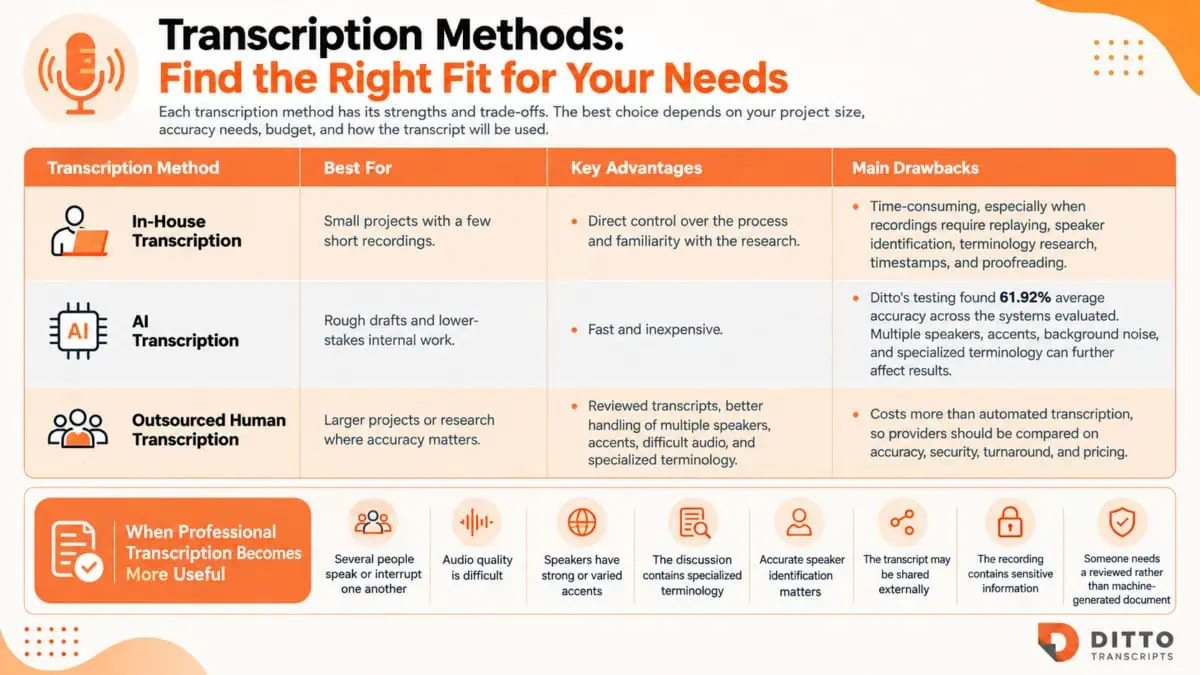
The more important the transcript becomes to a business, legal, or documentation workflow, the more valuable human review becomes.
Why Choose Ditto for Webex Meeting Transcription?
Webex transcription is not simply about getting words onto a screen. A useful meeting transcript should accurately preserve who said what, handle specialized terminology, remain readable, and give teams a document they can confidently return to later.
At Ditto Transcripts, trained human transcriptionists handle recordings instead of delivering unchecked automated transcripts.
Clients can expect:
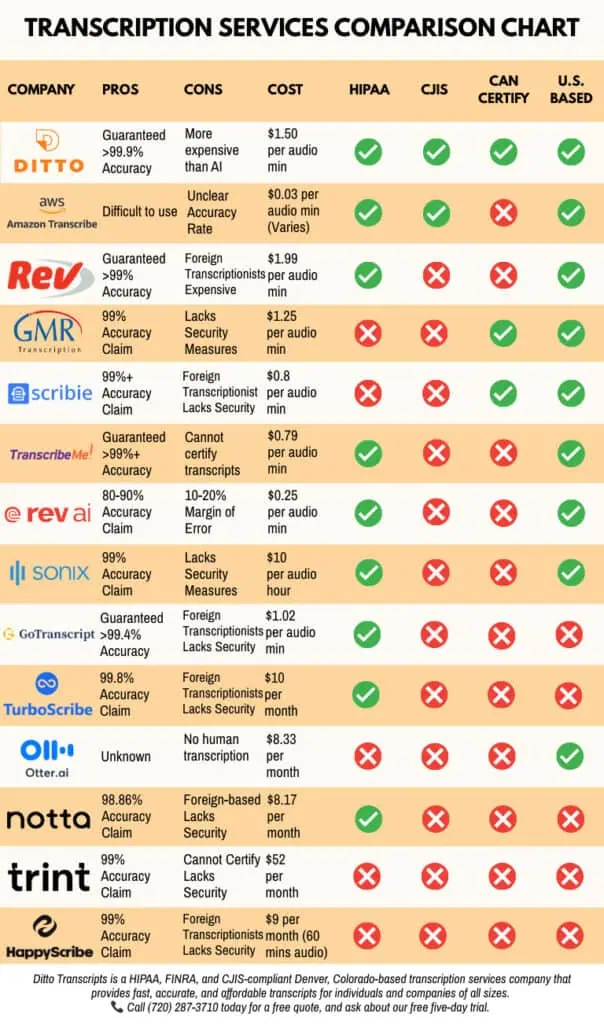
- 100% human transcription: Professional transcriptionists work on the recording rather than relying on AI as the finished product.
- 99% accuracy guarantee: Ditto guarantees 99% transcription accuracy.
- U.S.-based transcriptionists: Ditto’s transcriptionists handle accents, multiple speakers, technical vocabulary, and complex recordings.
- Support for difficult audio: Human judgment helps when recordings include interruptions, background noise, low-volume speakers, or overlapping conversations.
- Flexible turnaround: Clients can choose different turnaround options depending on urgency and budget.
- Secure workflows: Ditto supports CJIS- and HIPAA-compliant transcription workflows and is SOC 2 Type II- and FINRA-compliant.
- Transparent pricing: Ditto’s legal transcription prices currently range from $1.50 to $5.00 per audio minute, depending on turnaround time and recording complexity. Standard Category A pricing is $1.75 per audio minute, while qualifying extended-turnaround files begin at $1.50 per audio minute.
- No unnecessary long-term contract: Organizations can send individual files or recurring projects based on their workload.
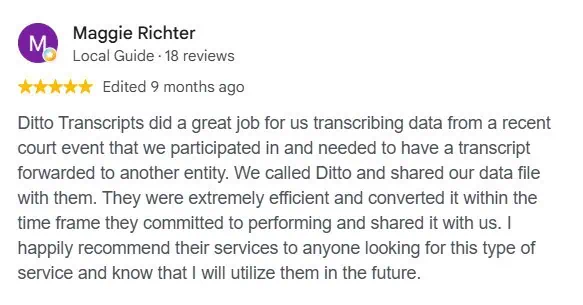
- Verified customer feedback: Ditto’s testimonials include feedback from clients describing their experiences with accuracy, turnaround, pricing, and service.
The goal isn’t just to produce another document. The goal is to give your team a transcript that stays useful after the meeting ends.
Make Your Webex Meetings Easier to Revisit
Meetings contain decisions, explanations, questions, commitments, and institutional knowledge that can become difficult to recover once the call ends.
A searchable transcript turns that temporary conversation into information your team can revisit without replaying an entire recording.
Webex’s built-in transcription can be an efficient option for routine meetings, especially when the recording is clear and the transcript will be reviewed before anyone relies on it.
When the recording is difficult or accuracy, confidentiality, terminology, and speaker attribution matter more, professional human transcription provides another option.
Ditto Transcripts is a Denver, Colorado-based transcription services company providing human transcription for legal professionals, law enforcement agencies, government organizations, and other clients—call (720) 287-3710 for a free quote.