


Market research produces an enormous amount of information, much of it from interviews, focus groups, meetings, and other recorded conversations. According to ESOMAR figures cited by Ipsos, the broader global insights industry generated about $153 billion in 2024, including $56.1 billion from the core market-research segment.
The challenge is not collecting more information. It is making recorded information easy to search, analyze, compare, and share. For meetings, presentations, and other professional recordings, business transcription services can help turn spoken material into accurate written records.
For research teams, market research transcription services provide another practical option. Instead of repeatedly replaying interviews or focus groups, researchers can work from searchable transcripts that preserve participants’ responses in written form.
What Is Market Research Transcription?
Market research transcription converts recorded interviews, focus groups, meetings, presentations, and other research conversations into written documents.
Unlike a short set of notes or an executive summary, a transcript preserves substantially more of what participants actually said. Researchers can then search responses, compare interviews, identify recurring themes, pull quotations, and return to the original discussion when questions arise later.
Common source material includes:
- One-on-one customer interviews
- Focus groups
- Product-testing sessions
- User-experience interviews
- Expert interviews
- Research presentations
- Customer-feedback sessions
The level of detail can also vary. Some projects need clean, readable transcripts, while qualitative research may require retaining every filler word, interruption, repetition, and false start. In those situations, verbatim transcription can preserve speech patterns that editing might otherwise lose.
Where Is Transcription Used in Market Research?
A transcript is most useful when researchers need to return to a conversation, compare it with other responses, or analyze exactly how something was said.
| Application | How Transcription Helps |
| Customer interviews | Makes individual responses searchable and easier to compare |
| Focus groups | Preserves discussions involving several participants |
| Product development | Documents reactions to features, problems, and proposed improvements |
| Ad testing | Records participants’ responses to messages, creative concepts, and campaigns |
| Competitive research | Helps researchers compare comments about competing brands or products |
| Qualitative analysis | Creates text that can be coded, categorized, and reviewed for recurring themes |
| Reporting | Makes relevant comments and quotations easier to locate |
Research transcripts can also support universities, graduate researchers, and other scholarly projects. For studies involving recorded interviews or focus groups, academic transcription services can provide written transcripts for qualitative analysis, saving researchers from spending hours producing them themselves.
Benefits of Transcription in Market Research
Preserve What Participants Actually Said
Small differences in wording can change the meaning of a research response.
There is a meaningful difference between a participant saying, “I might buy this” and “I would buy this.” Relying exclusively on memory or handwritten notes can cause those distinctions to disappear.
A transcript allows everyone analyzing the research to return to the same record rather than relying on separate recollections of the interview.
This does not eliminate interpretation or researcher bias, although it gives analysts a more complete source document against which interpretations can be checked.
Make Research Easier to Search and Analyze
Listening to the same recording repeatedly is an inefficient way to locate one important comment. A searchable transcript can turn hours of recorded material into text that researchers can navigate much faster.
Researchers can search for:
- Product names
- Competitors
- Features
- Complaints
- Pricing concerns
- Repeated phrases
- Customer preferences
Depending on the research methodology, transcripts can also be imported into qualitative analysis and text analysis tools.
That does not mean automated sentiment analysis should replace human interpretation. Context, sarcasm, ambiguity, and individual research objectives can all affect what a statement means. The transcript simply gives researchers structured text to work with.
Improve Collaboration
Market research projects often involve people from product development, marketing, customer experience, analytics, strategy, and senior management.
A shared transcript gives those teams a common source document instead of forcing each person to interpret the recording independently.
Researchers can annotate the same interviews, share excerpts, compare participant responses, and trace conclusions back to the original conversation.
Transcription can be particularly useful when teams operate across time zones or when someone reviewing the research was not present during the original session.
Preserve Research Context
A questionnaire may tell you which answer someone selected. A transcript can preserve the explanation surrounding that answer.
That context can be particularly valuable in qualitative research, where the reasoning behind a response may matter almost as much as the response itself.
Depending on the requested transcription style, a transcript may also document pauses, interruptions, laughter, overlapping speech, or other relevant verbal cues.
Those details should not automatically be interpreted as evidence of a participant’s feelings, intentions, or honesty. Researchers still need to analyze them within the broader context of the study.
Support Documentation and Recordkeeping
Some market-research projects involve regulated industries, public agencies, legal matters, or other environments with specific documentation requirements.
A transcript can provide an additional searchable record of a recorded discussion. However, it does not replace records that an organization is legally or regulatorily required to maintain.
Organizations should determine their own retention, privacy, consent, and documentation requirements based on the research being conducted.
Public-sector organizations with recorded hearings, interviews, meetings, or research projects may also use specialized government transcription services when they need accurate written records.
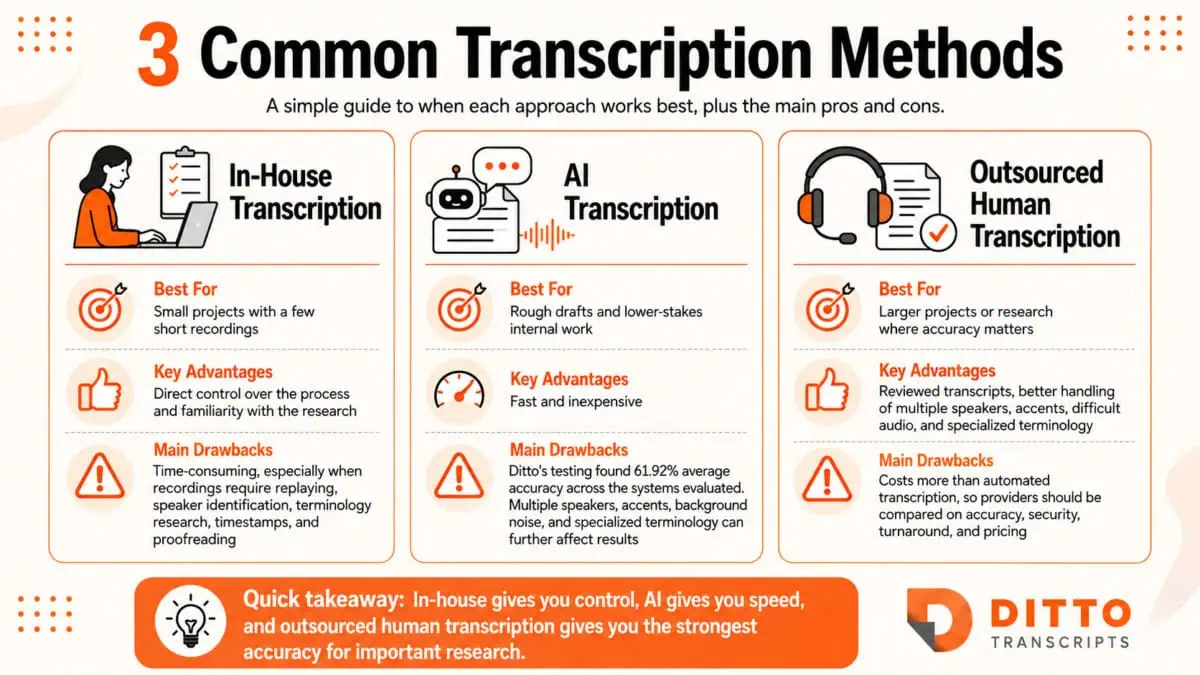
Three Ways to Transcribe Market Research
Research organizations generally have three options: transcribe recordings internally, use automated transcription, or outsource the work to professional human transcriptionists.
Why Choose Ditto for Market Research Transcription?
Market-research transcription is not simply about converting audio into words. The finished transcript needs to preserve participants’ responses accurately enough that researchers can return to the document and use it confidently during analysis.
At Ditto Transcripts, trained human transcriptionists handle recordings rather than delivering unchecked automated transcripts.
Clients can expect:
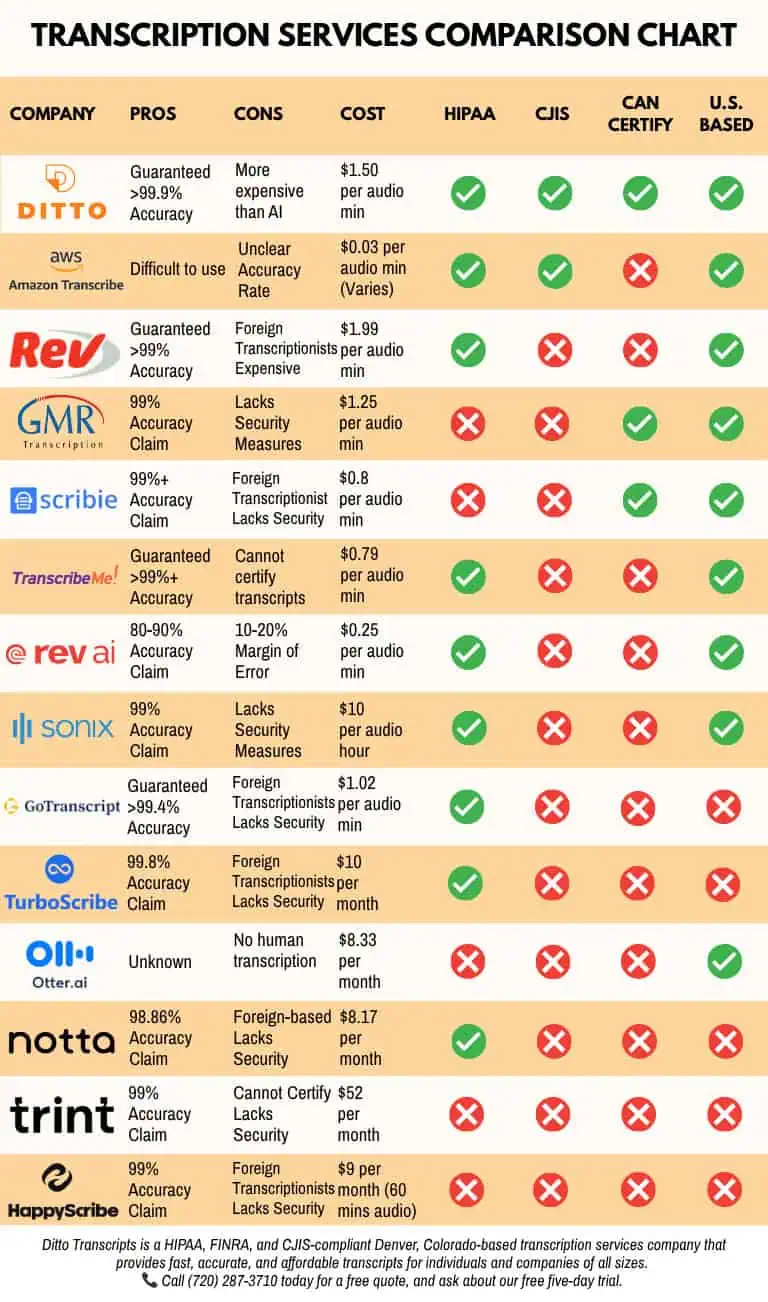
- 100% human transcription: Trained transcriptionists work on the files rather than relying on an automated transcript as the final product.
- 99% accuracy guarantee: Ditto guarantees 99% transcription accuracy and uses human review as part of its process.
- U.S.-based transcriptionists: Ditto’s transcriptionists are based in the United States and can work with specialized terminology, accents, speaker changes, and complicated recordings.
- Support for difficult audio: Human judgment helps with overlapping speakers, quiet voices, background noise, and terminology that automated systems may misinterpret.
- Flexible turnaround: Researchers can select faster delivery for urgent projects or longer turnaround options when budget is more important.
- Secure handling: Ditto supports HIPAA- and CJIS-compliant workflows for projects involving sensitive information.
- Transparent pricing: Ditto publishes its transcription prices so clients can see how turnaround time and recording complexity affect rates. Current rates range from $1.50 per audio minute for qualifying Category A extended-turnaround files to $5.00 per audio minute for Category B rush files.
- No unnecessary long-term contract: Companies can submit individual research projects or recurring work based on their needs.
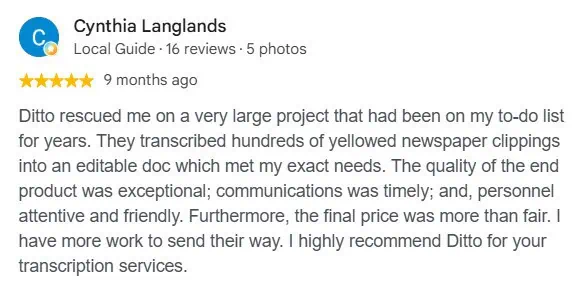
- Verified customer feedback: Researchers can also review Ditto’s testimonials, including feedback from academic researchers and clients who have used the company for interview transcription and other projects.
The objective is not simply to produce more text. It is to give researchers a transcript they can actually search, analyze, quote, and use.
Turn Recorded Research Into Searchable Data
Market research increasingly combines surveys, analytics, behavioral data, interviews, focus groups, and other sources of information.
Recorded conversations remain especially valuable because they preserve something structured datasets often cannot: the participant’s own words.
Transcription turns those recordings into searchable research material without requiring teams to replay hours of audio every time they need a detail.
AI can provide quick drafts, and internal transcription may work for smaller projects. When recording volumes increase or accuracy becomes more important, professional human transcription gives organizations another way to convert interviews and discussions into useful written records.
Ditto Transcripts is a Denver, Colorado-based transcription company providing human transcription services for organizations and individuals. Ditto is HIPAA- and CJIS-compliant and offers market research, academic, business, legal, and other specialized transcription services. Call (720) 287-3710 for a free quote.