


Speech recognition can help law enforcement agencies work faster in certain situations, especially when officers need quick access to commands, translations, or call information. However, speech recognition is not the same as professional transcription, and that distinction matters.
Law enforcement recordings often include poor audio, overlapping speakers, stress, background noise, sensitive evidence, and the needs of legal transcription services. Speech recognition can support some workflows, although official records, case files, court preparation, and investigative materials still require accuracy, context, and human judgment.
What Is Speech Recognition?
Speech recognition is a technology that converts spoken language into commands, text, or machine-readable input. It is used in virtual assistants, phone systems, dictation software, automated captions, translation tools, and speech-to-text platforms.
At a basic level, speech recognition systems capture audio through a microphone, convert sound waves into digital data, analyze speech patterns, and match those patterns to likely words or commands.
That last part is important. Speech recognition systems often choose the most probable word sequence based on training data, context clues, and language models. That can work well for simple commands like “call dispatch” or “set a timer.” However, it becomes more difficult when the audio involves multiple speakers, stress, slang, overlapping speech, accents, background noise, or law enforcement terminology.
Common Types of Speech Recognition
Different speech recognition systems are built for different purposes. Some are designed to recognize one speaker. Others are built for commands, phone menus, translation, or speech-to-text output.
| Type | Common Use |
| Speaker-dependent recognition | Trained to recognize one specific user’s voice |
| Speaker-independent recognition | Designed for multiple users without individual training |
| Continuous speech recognition | Processes natural speech without long pauses |
| Discrete speech recognition | Works best when users pause between words |
| Natural language processing | Helps systems interpret context and intent |
| Command and control | Responds to specific voice commands |
| Interactive voice response | Powers automated phone menus and routing |
| Speech-to-text | Converts spoken words into written text |
These tools can be useful, although they are not equally reliable for every law enforcement task. A system that can understand a command in a patrol vehicle may not be reliable enough to create an official transcript of a suspect interview.
How Speech Recognition Can Help Law Enforcement
Speech recognition is not useless for law enforcement. In the right context, it can improve speed, access, and officer efficiency.
Real-Time Language Translation
Speech recognition tools can facilitate quick communication when officers and civilians do not share a common language. Mobile translation apps may help officers ask basic questions, understand immediate needs, or communicate during the first moments of a field interaction.
This can be useful until a qualified human interpreter is available.
However, automated translation should be treated carefully. Tone, idioms, slang, cultural context, and legal nuance can be missed. For sensitive interviews, witness statements, Miranda-related communication, or official documentation, agencies should not rely only on automated translation.
Voice-Activated Controls in Patrol Vehicles
Voice commands can help officers control certain vehicle or device functions without taking their hands off the wheel or eyes off the scene.
For example, an officer may be able to use voice commands to activate lights, communicate with dispatch, start a report, log an event, or control in-car systems.
This kind of speech recognition works best when commands are limited and predictable. It does not require the same level of interpretation as a full interview transcript.
Voice Recognition for Identification
Voice recognition is related to speech recognition, though not the same thing. Speech recognition focuses on understanding words. Voice recognition focuses on identifying or verifying a speaker based on vocal characteristics.
In some investigations, voice analysis may help compare speech patterns, accents, cadence, or other vocal features. This may be useful in matters involving threatening calls, scams, ransom demands, or repeated phone-based offenses.
Even then, voice recognition should be handled carefully and reviewed in accordance with proper investigative and evidentiary standards.
Automated Dispatcher Assistance
Some dispatch systems use speech technology to help flag urgent phrases, possible locations, emotional escalation, or background sounds during emergency calls.
This can support dispatchers by highlighting details that might be missed during a stressful call. For example, a system may highlight repeated references to locations, sounds of distress, breaking glass, vehicle noise, or other possible emergency indicators.
These tools can be helpful, although they are not perfect. Dispatchers still need training, judgment, and human awareness to evaluate what is happening in real time.
Can Speech Recognition Handle Law Enforcement Transcription?
Speech recognition can create fast text output; however, speed is not the same as reliability.
Law enforcement transcription often involves body camera footage, dash camera audio, 911 calls, suspect interviews, witness statements, jail calls, dispatch audio, internal affairs recordings, and other sensitive files. These recordings are often difficult even for trained human transcriptionists.
Automated tools struggle with:
- Background noise
- Multiple speakers
- Overlapping speech
- Sirens, traffic, wind, or radio static
- Emotionally or distressed speakers
- Accents and dialects
- Slang or coded language
- Legal and police terminology
- Unclear names, dates, addresses, and case numbers
- Speaker identification
For court transcription services, investigative review, public records requests, case preparation, or official documentation, those weaknesses can create serious problems.
Why Speech Recognition Accuracy Falls Short
Speech recognition technology has improved, although it still does not match professional human transcription for difficult law enforcement recordings.
Recent accuracy testing shows that AI transcription can achieve only about 61.92% accuracy under certain conditions. For casual notes, that may be acceptable. For law enforcement records, it is not enough.
A 61.92% accurate transcript still leaves too much room for errors, missing words, wrong speaker labels, incorrect names, and misunderstood context. Someone must still review, correct, and format the transcript before it can be trusted.
That review process may take so long that the agency loses the speed advantage automation promised in the first place.
Why Human Judgment Still Matters
Human speech is complicated. People interrupt each other, trail off, change tone, use slang, speak emotionally, mumble, pause, correct themselves, or imply meaning without saying everything directly.
Human transcriptionists can use context to make better decisions. They can replay difficult sections, research terms, identify likely speaker changes, flag inaudible words, and avoid guessing when something is unclear.
That judgment is especially important for deposition transcription services, trial transcription services, law enforcement recordings, and other transcripts connected to legal review.
AI can generate a draft. A trained human transcriptionist can create a transcript that is more accurate, readable, and useful.
When Speech Recognition Makes Sense
Speech recognition can still be valuable for law enforcement when it is used for the right purpose.
| Use Case | Speech Recognition Fit | Why |
| Basic voice commands | Strong fit | Commands are usually limited and predictable |
| Quick translation support | Helpful yet limited | Useful for basic communication, not official interpretation |
| Dispatcher assistance | Helpful support tool | Can flag phrases or sounds, yet needs human judgment |
| Rough transcript drafts | Limited fit | May help with low-risk review, yet requires correction |
| Official police transcripts | Poor fit by itself | Accuracy, speaker labels, and context matter too much |
| Court or legal use | Poor fit by itself | Human review and certification may be required |
The best use of speech recognition is as a support tool, not as a replacement for professional law enforcement transcription.
What Agencies Should Look for in Transcription Support
Law enforcement agencies need transcription support that accurately and securely handles sensitive recordings.
Before choosing a provider, agencies should look for:
- Human transcriptionists
- Law enforcement transcription experience
- CJIS-compliant workflows
- Secure file upload and delivery
- Accurate speaker labeling
- Verbatim transcript options
- Support for difficult audio
- Certified transcript options
- Flexible turnaround times
- Clear pricing
- Confidentiality-focused processes
Government transcription services and law enforcement work often involve public records, confidential information, criminal justice records, or official documentation. The provider should be prepared for those requirements.
Why Clients Choose Ditto for Law Enforcement Transcription Services
Speech recognition can help with certain law enforcement tasks. However, official transcripts require a higher level of accuracy, security, and professional judgment. Agencies need transcripts that can support investigations, public records workflows, internal reviews, court preparation, and case documentation.
At Ditto Transcripts, we support law enforcement agencies, government offices, attorneys, investigators, courts, and other professionals who need dependable transcription for sensitive recordings. Our team handles body camera footage, dash cam audio, 911 calls, suspect interviews, witness statements, jail calls, dispatch recordings, internal affairs files, and more.
Clients choose Ditto because we offer:
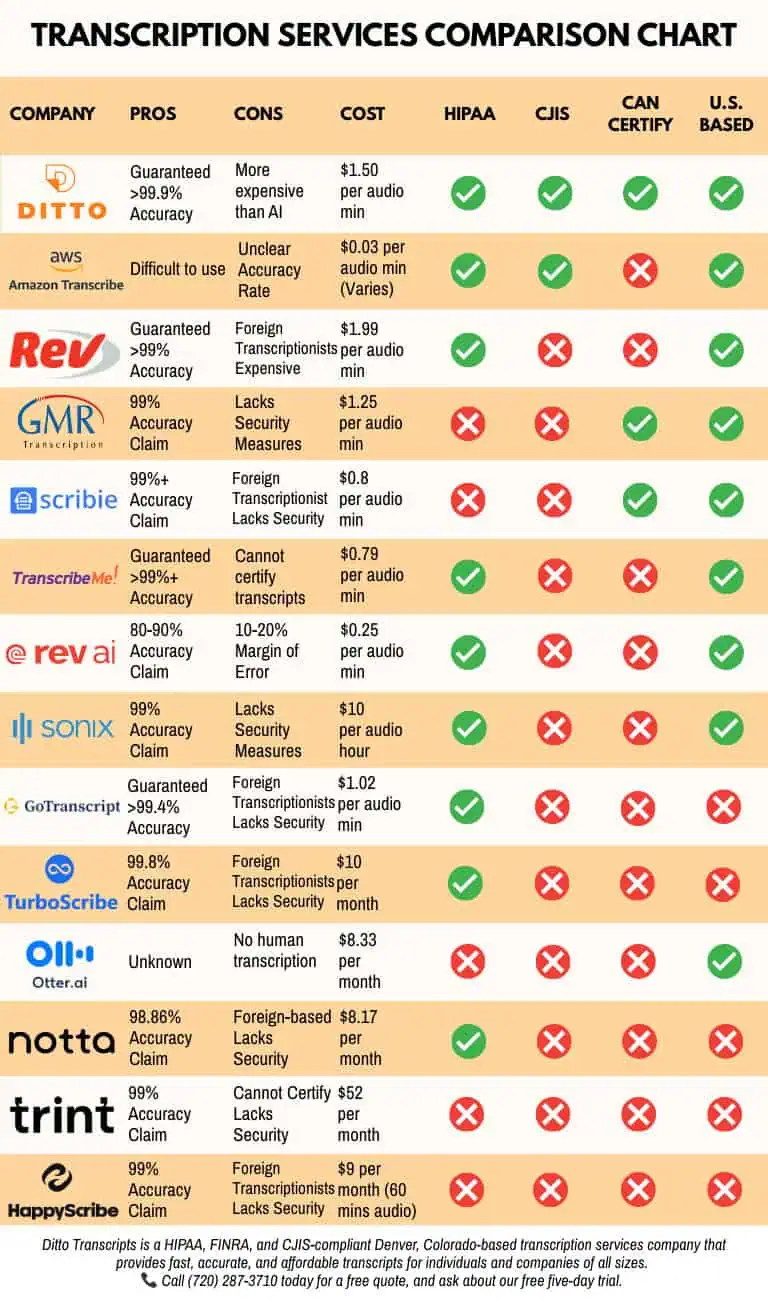
- Human transcriptionists: We use trained human transcriptionists who understand context, speaker flow, tone, terminology, and the sensitive nature of law enforcement recordings.
- Law enforcement experience: Ditto supports police departments, sheriff’s offices, government agencies, attorneys, investigators, and criminal justice professionals who need transcripts prepared for real-world case and agency needs.
- Verbatim transcription: When clients need every spoken word captured, Ditto can provide word-for-word transcripts that include false starts, filler words, pauses, interruptions, and other spoken details when required.
- Support for difficult audio: Our transcriptionists can work with body-cam footage, dash-cam audio, jail calls, 911 calls, interviews, interrogations, background noise, multiple speakers, accents, crosstalk, and poor audio quality.
- Secure handling: Law enforcement files often contain sensitive information. Ditto uses confidentiality-focused workflows designed to help protect client recordings and transcripts.
- CJIS-compliant transcription support: Ditto supports agencies that need secure handling of criminal justice information.
- Certified transcript options: When needed, Ditto can provide certified transcripts for legal, court, investigative, or official documentation purposes.
- Clear formatting: Transcripts can be prepared in formats that are easier to review, search, print, share, and redact, and that can be included in case files or legal workflows.
- Flexible turnaround options: Ditto offers turnaround options based on file length, urgency, number of speakers, audio quality, and project requirements.
- Transparent legal transcription pricing: Pricing depends on factors such as turnaround time, audio quality, number of speakers, verbatim needs, and formatting requirements.
- No long-term contract required: Agencies can use Ditto when they need transcription support without committing to unnecessary long-term arrangements.
Whether your agency needs a suspect interview transcribed, a 911 call documented, body camera footage reviewed, or a court-ready transcript prepared, Ditto Transcripts can help make the process secure, accurate, and manageable.
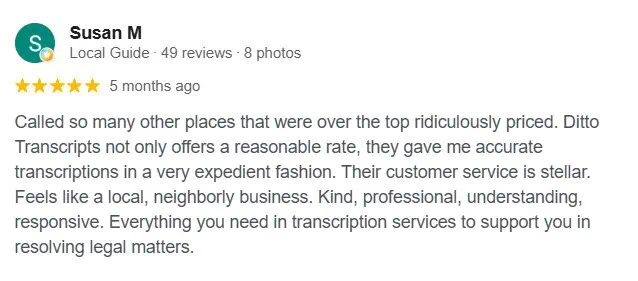
Still deciding? Here’s what one Ditto client testimonial had to say:
Speech Recognition Is a Tool, Not a Replacement
Speech recognition has useful applications in law enforcement. It can support voice commands, basic translation, dispatch assistance, and rough drafts. However, for official law enforcement transcription, it is not reliable enough on its own.
Police recordings often include difficult audio, multiple speakers, sensitive information, legal terminology, and details that must be captured accurately. Human transcriptionists remain the stronger choice when accuracy, confidentiality, and usability matter.
Ditto Transcripts is a Denver, Colorado-based FINRA, HIPAA, and CJIS-compliant transcription services company that provides fast, accurate, and affordable transcripts for individuals and companies of all sizes. Call (720) 287-3710 today for a free quote.