
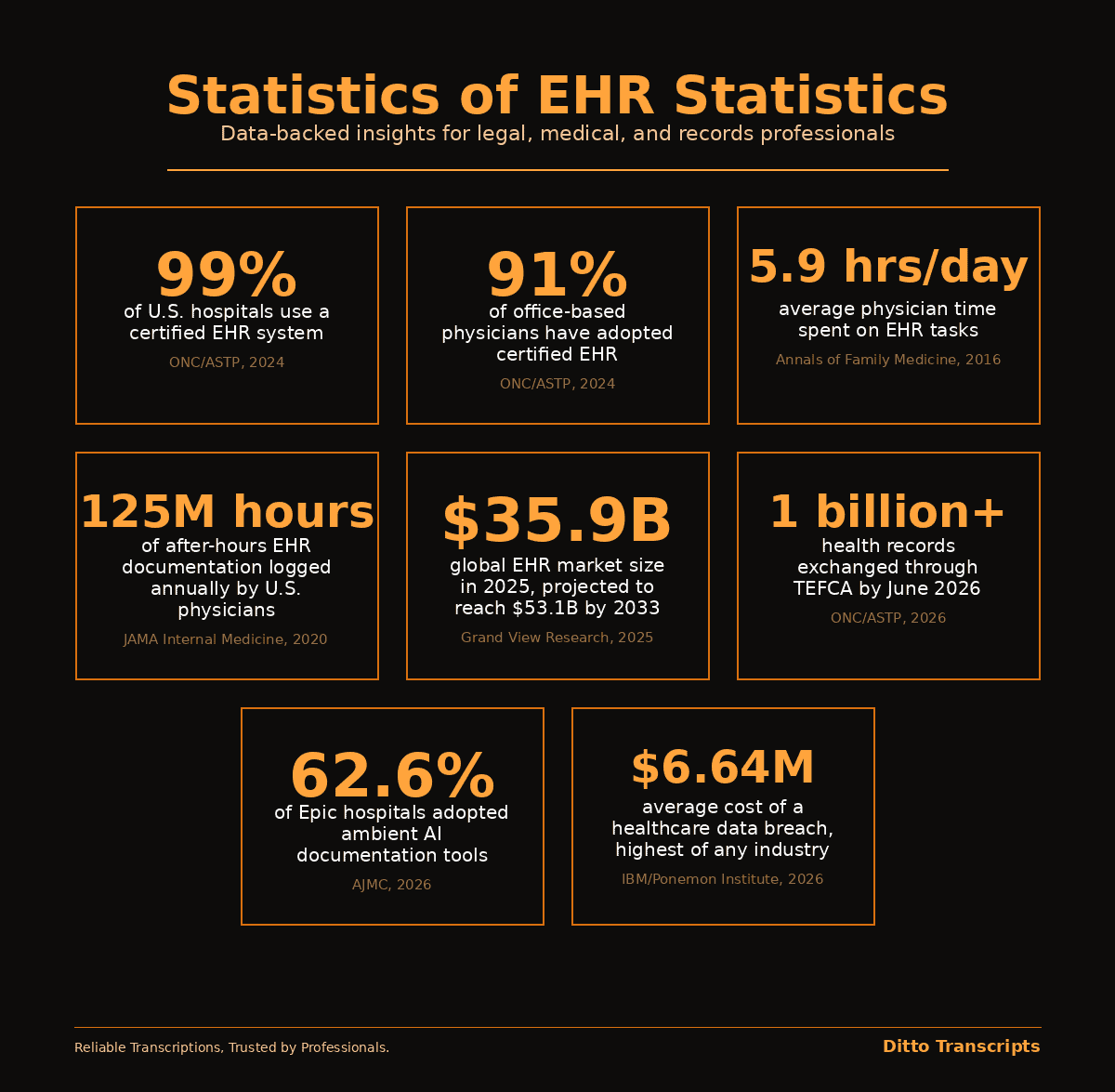
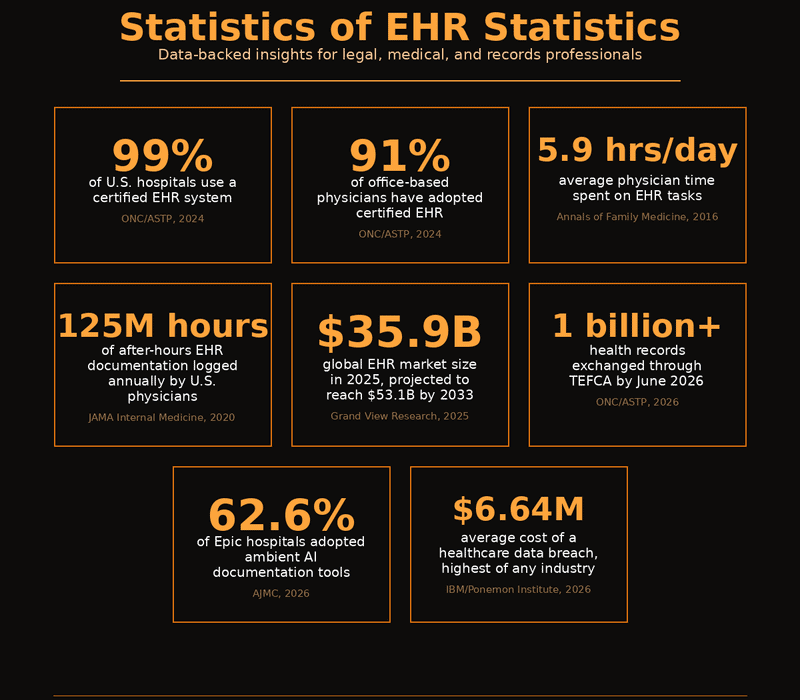
Electronic health records now reach virtually every corner of American healthcare. As of 2024, 99% of non-federal acute care hospitals and 91% of office-based physicians use a certified EHR system. In June 2026, the Office of the National Coordinator formally declared universal EHR adoption across the United States. Yet the documentation workload that EHR systems create remains a persistent challenge. Physicians spend nearly six hours a day inside their EHR, the global market has grown past $35 billion, and healthcare data breaches are still the costliest of any industry. These numbers define the state of electronic health records in 2026.
Summary: Key EHR Statistics at a Glance
- 99% of non-federal acute care hospitals used a certified EHR system in 2024 ONC/ASTP.
- 91% of office-based physicians had adopted certified EHR technology by 2024, up from 17% in 2008 ONC/ASTP.
- 5.9 hours per day is the average time physicians spend on EHR tasks, including 1.4 hours after clinic closes Annals of Family Medicine, 2016.
- 125 million hours of after-hours EHR documentation are logged each year by U.S. physicians JAMA Internal Medicine, 2020.
- $35.9 billion was the estimated global EHR market size in 2025, projected to reach $53.1 billion by 2033 Grand View Research.
- 1 billion+ health records were exchanged through TEFCA by June 2026, up from 10 million in January 2025 ONC/ASTP.
- 62.6% of hospitals running Epic had adopted ambient AI documentation tools by mid-2025 AJMC, 2026.
- $6.64 million is the average cost of a healthcare data breach, the highest of any industry for 13 consecutive years IBM/Ponemon Institute, 2026.
- $19.2 billion in administrative cost savings are projected over the next decade from new HHS interoperability rules ONC/ASTP, 2026.
- 4x longer: U.S. outpatient clinical notes are roughly four times the length of comparable notes in Canada JAMA Internal Medicine, 2020.
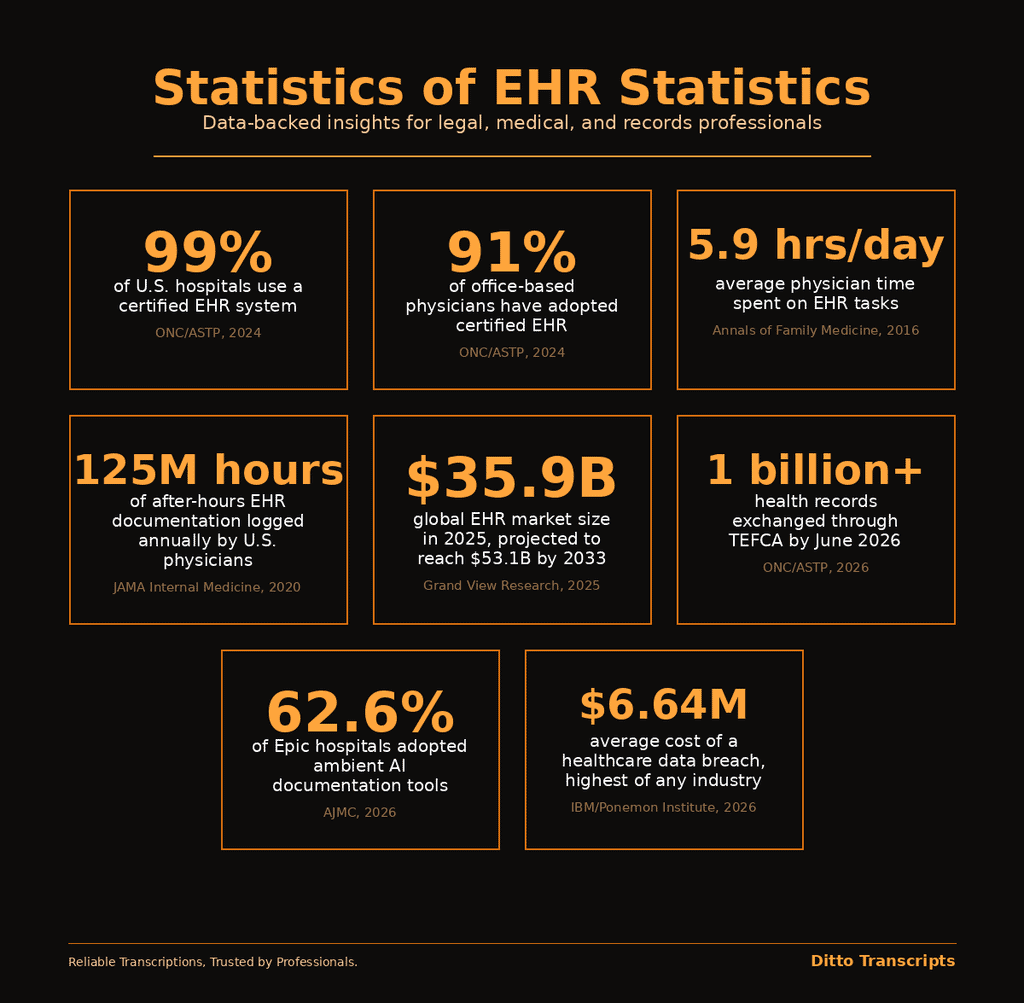
EHR Adoption Across the United States
The trajectory of EHR adoption in the United States ranks among the most dramatic technology shifts in healthcare history. In 2008, only 9% of hospitals and 17% of office-based physicians used any form of electronic health record. By 2024, those figures had climbed to 99% and 91%, respectively, driven largely by the HITECH Act’s Meaningful Use financial incentive program that launched in 2011.
Growth was steepest between 2010 and 2016. Hospital adoption jumped from 16% to 88% in six years, while physician adoption rose from 28% to 77% over the same period. By 2020, hospital adoption had effectively plateaued at 99%. Physician adoption continued to climb, reaching 82% in 2020, 84% in 2022, and 91% in 2024, according to data from the AHA IT Survey and the National Electronic Health Records Survey published by the ONC/ASTP.
In June 2026, the Office of the National Coordinator for Health Information Technology marked this progression by formally declaring universal EHR adoption across U.S. healthcare in its inaugural Coordinator’s Quarterly report. The declaration reflects both the success of federal incentive programs and the practical reality that clinical workflows, billing systems, and regulatory requirements now assume digital records as the default infrastructure.
Time in the EHR: The Documentation Burden
Adoption numbers tell only part of the story. A 2016 time-motion study published in the Annals of Family Medicine found that physicians spend an average of 5.9 hours per day on EHR-related tasks during an 11.4-hour workday. Of that time, 44.2% goes to clerical and administrative work, including documentation, order entry, billing, and coding. Another 23.7% goes to inbox management. Only a fraction supports direct clinical decision-making.
The burden extends well beyond clinic hours. A 2020 analysis of 155,000 U.S. physicians published in JAMA Internal Medicine estimated that American doctors collectively log 125 million hours of after-hours EHR documentation per year. The same study found that U.S. outpatient notes are approximately four times longer than those produced by Canadian physicians for comparable encounters, a phenomenon widely referred to as “note bloat.”
Note bloat is driven by a combination of billing requirements, legal defensiveness, and EHR templates that encourage exhaustive checkbox clicking rather than concise clinical narratives. The result is records that are longer but not necessarily more useful to the next clinician who reads them. For organizations looking to reduce documentation time without sacrificing accuracy, outsourcing to human medical transcription services offers an alternative that keeps clinicians focused on patient care while trained professionals handle the written record.
Researchers have linked this cumulative documentation load to physician burnout and turnover. EHR-related stress, particularly from inbox volume, after-hours charting, and repetitive screening attestations, is now identified as one of the leading contributing factors in physicians’ decisions to reduce clinical hours or leave practice entirely.
EHR Market Size and Growth
The global EHR market reached an estimated $35.9 billion in 2025, according to Grand View Research. The firm projects growth to $53.1 billion by 2033 at a compound annual growth rate of 5.1%. North America accounts for 43% of global revenue, with the United States representing the single largest national market.
Cloud-based and web-hosted EHR platforms now dominate the landscape, capturing 83.7% of market revenue in 2025. The shift from on-premises installations has accelerated as health systems prioritize remote access, scalability, and lower upfront capital costs. Hospitals remain the largest end-use segment at 52.8% of revenue, while ambulatory surgical centers represent the fastest-growing category.
Vendor concentration is a defining feature of the U.S. market. Epic Systems holds the leading position among inpatient EHR vendors by a wide margin. Oracle Cerner follows as the second-largest vendor, and MEDITECH holds the third position. Together, the top two vendors control a majority of hospital EHR installations nationally. Smaller vendors and proprietary systems continue to serve niche segments, particularly rural and critical access hospitals, though the trend toward consolidation has been consistent for more than a decade.
Interoperability and Health Information Exchange
The ability of different EHR systems to share patient data has improved significantly, driven in large part by TEFCA (the Trusted Exchange Framework and Common Agreement). Administered by the Assistant Secretary for Technology Policy within HHS, TEFCA reached a landmark in June 2026: more than 1 billion health records exchanged through the network in less than a year, according to the ONC/ASTP. That figure was approximately 10 million as recently as January 2025, representing a roughly 100-fold increase in 18 months.
The federal government projects substantial savings from improved interoperability. The HTI-4 rule, issued by HHS, is expected to generate $19.2 billion in administrative cost savings over the next decade by standardizing data exchange and reducing redundant workflows. A companion measure, HTI-5, estimates $1.53 billion in compliance cost savings for certified health IT developers by eliminating 34 certification criteria, as reported by ONC/ASTP.
In early 2026, the Social Security Administration connected to TEFCA through the eHealth Exchange, a step expected to cut disability claims processing times by more than 50% in many cases. This integration demonstrates how standardized health data exchange produces savings well beyond the clinical setting.
Healthcare Data Security and EHR Breaches
Healthcare remains the most expensive industry for data breaches. The 2026 Cost of a Data Breach Report from the IBM/Ponemon Institute found that healthcare organizations face an average breach cost of $6.64 million, the highest of any sector for the 13th consecutive year. The 2026 figure represents a 10.5% decrease from the $7.42 million average recorded in 2025, though it remains well above the $4.99 million global average across all industries.
The threat landscape continues to evolve. AI-driven cyberattacks increased 56% year over year, adding roughly $1 million per malicious breach, according to the same report. The mean time to identify and contain a healthcare data breach stands at 247 days, leaving patient records exposed for months before detection. EHR systems are attractive targets because patient data, including medical histories, insurance details, and Social Security numbers, commands premium prices for identity theft and insurance fraud.
Emerging Trends and What’s New in 2026
Several developments are reshaping how EHR systems are used in 2026.
- Ambient AI documentation represents the most significant operational shift. A study published in the American Journal of Managed Care in January 2026 found that 62.6% of hospitals running Epic EHR systems had adopted ambient AI tools by mid-2025. These tools listen to patient-physician conversations and generate draft clinical notes automatically. Adoption is highest among nonprofit hospitals (70.2%) and metropolitan facilities (64.7%), while for-profit hospitals (28.8%) and government-operated facilities (45.0%) lag behind. The three most widely adopted platforms (DAX Copilot, Abridge, and ThinkAndor) account for more than 80% of all implementations.
- TEFCA expansion continues at extraordinary pace. The network grew from roughly 10 million records exchanged in January 2025 to over 1 billion by June 2026. The addition of the Social Security Administration as a TEFCA participant in spring 2026 signals that the framework’s usefulness extends beyond clinical care into benefits administration and public services.
- Regulatory simplification is also underway. The proposed HTI-5 rule would remove 34 certification criteria for health IT developers, reducing compliance costs by an estimated $1.53 billion. The USCDI v7 standard, released in January 2026, proposes 29 new data elements to improve the consistency of health data exchange across systems.
How Ditto Transcripts Helps
Ditto Transcripts helps clinics and hospital departments cut documentation time without handing patient records to an unreviewed algorithm. Every transcript is produced by a human transcriptionist under HIPAA-compliant handling and returned in the format your EHR expects. Explore medical transcription services.