


Have a long recording you need in writing? Google Docs can help turn speech into text through its built-in Voice Typing feature. One important limitation, though: Google Docs doesn’t directly accept an audio file and automatically transcribe it. Voice Typing listens to sound coming through your microphone.
That makes it useful for personal notes, drafts, and recordings where occasional errors are not a major concern. For sensitive or high-stakes material, particularly case recordings and proceedings, professional legal transcription services provide human review, greater accountability, and stronger accuracy standards.
Google Docs is a convenient DIY option, although using Voice Typing to transcribe a prerecorded file is ultimately a workaround rather than a dedicated transcription workflow.
In this article, you’ll learn…
- How to transcribe audio using Google Docs Voice Typing
- Where automated transcription works well and where it can struggle
- When professional human transcription may be the better choice
Can You Transcribe Audio With Google Docs?
Yes. Google Docs’ Voice Typing feature converts speech captured by your microphone into text in an open document. You can dictate directly or play a prerecorded audio file aloud so your microphone can pick it up.
Google currently supports Voice Typing in recent versions of Chrome, Edge, and Safari. On managed Google Workspace accounts, an administrator may also turn off the feature.
For simple transcription needs, Voice Typing gives you a free way to create a rough first draft without installing dedicated transcription software.
What Do You Need to Transcribe With Google Docs?
The setup is fairly simple:
| Requirement | What You Need |
| Google account | Access to Google Docs |
| Supported browser | A current version of Chrome, Edge, or Safari |
| Working microphone | Your computer’s microphone or another properly configured input |
| Internet connection | A stable connection while using Google Docs |
| Microphone permission | Your browser must be allowed to access the microphone |
| Audio source | Your own speech or a recording played where the microphone can clearly hear it |
The clearer the audio reaching your microphone, the easier Voice Typing will recognize it. Background noise, overlapping voices, low volume, and unclear speech can make the resulting transcript harder to clean up.
How to Transcribe Audio With Google Docs
Once everything is ready, you can start turning the recording into text.
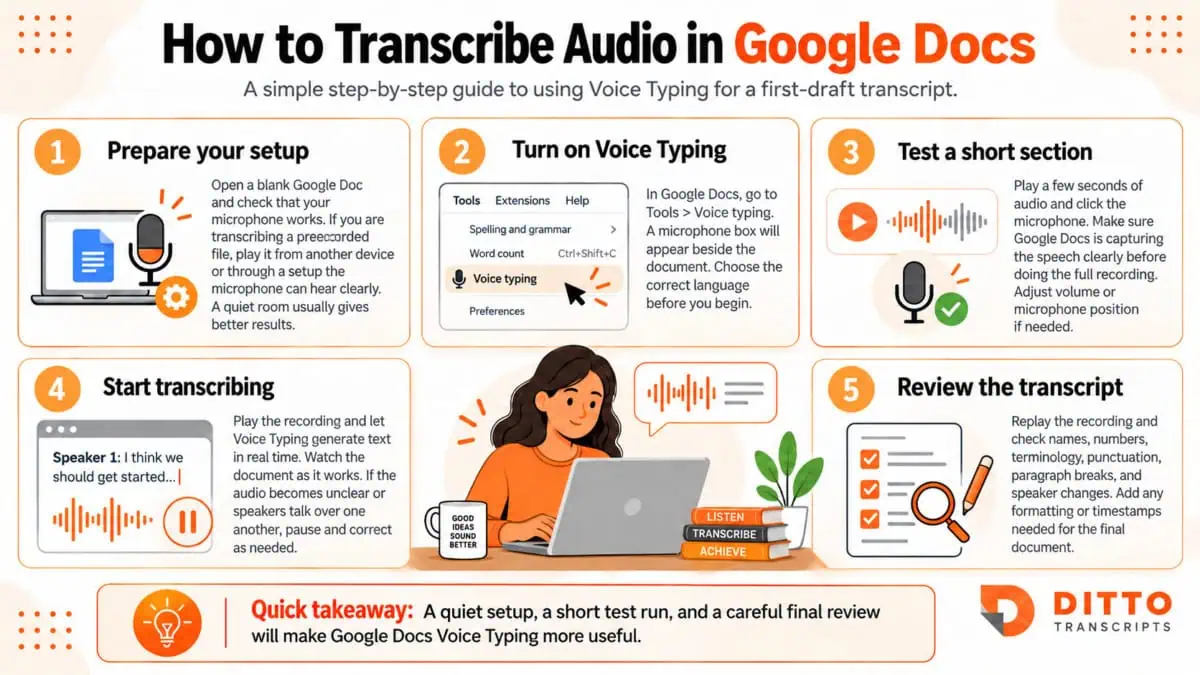
The editing stage can make a free transcription method time-consuming. A rough transcript may appear quickly; however, correcting errors throughout a long recording can require substantial manual review.
Why Are Transcripts Useful?
A transcript does more than duplicate what was said. It turns spoken information into text that you can search, review, quote, organize, and reuse far more easily than an audio or video recording alone.
Easier Documentation and Research
Finding one sentence inside a 90-minute recording can mean repeatedly skipping backward and forward. With a transcript, you can usually find a name, phrase, or topic with a simple text search.
This is particularly useful in research and education. Students, professors, doctoral candidates, and researchers use academic transcription services for lectures, research interviews, focus groups, seminars, and qualitative studies.
A searchable written record can make reviewing large amounts of spoken information considerably more efficient.
Better Accessibility
Transcripts give people another way to consume spoken content, including users who prefer reading or cannot easily listen to the original recording.
They can also support accessibility efforts, although a transcript should not automatically be treated as a substitute for captions. Video accessibility may require synchronized captions so viewers can follow speech and relevant sounds as they occur.
Providing spoken information in text form makes content useful to a broader audience and in more situations.
More Searchable and Reusable Content
Recorded interviews, webinars, podcasts, presentations, and videos often contain information that can be useful well beyond the original recording.
A transcript can become the foundation for articles, summaries, social posts, research notes, training materials, quotations, and other written resources. It also gives publishers additional text they can organize and make searchable.
Government organizations have similar needs. Hearings, meetings, interviews, and legislative proceedings often need to be converted into dependable written records, which is where professional government transcription services can become useful.
A recording creates far more value when its contents are also available as accurate text.
How Accurate Is Google Docs Voice Typing?
The answer depends heavily on the recording.
Speech-recognition technology can struggle with overlapping speakers, poor microphones, background noise, unfamiliar names, specialized terminology, strong accents, and inconsistent volume. A clear one-person recording may perform much better than a noisy group discussion.
In Ditto’s comparison of automated and human transcription, automated transcription was only 61.92% accurate. That figure should not be treated as the guaranteed accuracy of every automated system or recording, since results vary by technology and source audio.
The practical question is not simply how quickly software can create text. It’s how much time you will spend correcting that text before it becomes usable.
For a personal memo or rough draft, that tradeoff may be perfectly reasonable. For legal proceedings, formal research, official records, or other work where the details matter, errors can carry much greater consequences.
When Is Human Transcription the Better Choice?
Automated transcription is useful when speed and convenience matter more than producing a polished record immediately. Human transcription becomes more valuable when accuracy, context, confidentiality, or difficult terminology are priorities.
Consider professional transcription when a recording contains:
- Multiple or overlapping speakers
- Poor or inconsistent audio
- Industry-specific terminology
- Sensitive or confidential information
- Names, figures, dates, or quotations that must be accurate
- Material intended for professional, legal, academic, or official use
An exact record may also require more than simply capturing the general meaning. Verbatim transcription can preserve filler words, repetitions, false starts, interruptions, and other spoken details when those elements matter.
As the consequences of a transcription error increase, human review becomes much more valuable.
Why Choose Ditto Transcripts?
At Ditto Transcripts, we believe a transcript’s value depends on whether the recipient can rely on it.
Instead of handing clients machine-generated text and leaving them to find the mistakes, Ditto uses professional U.S.-based human transcriptionists and guarantees 99% accuracy.
Here is what clients can expect:
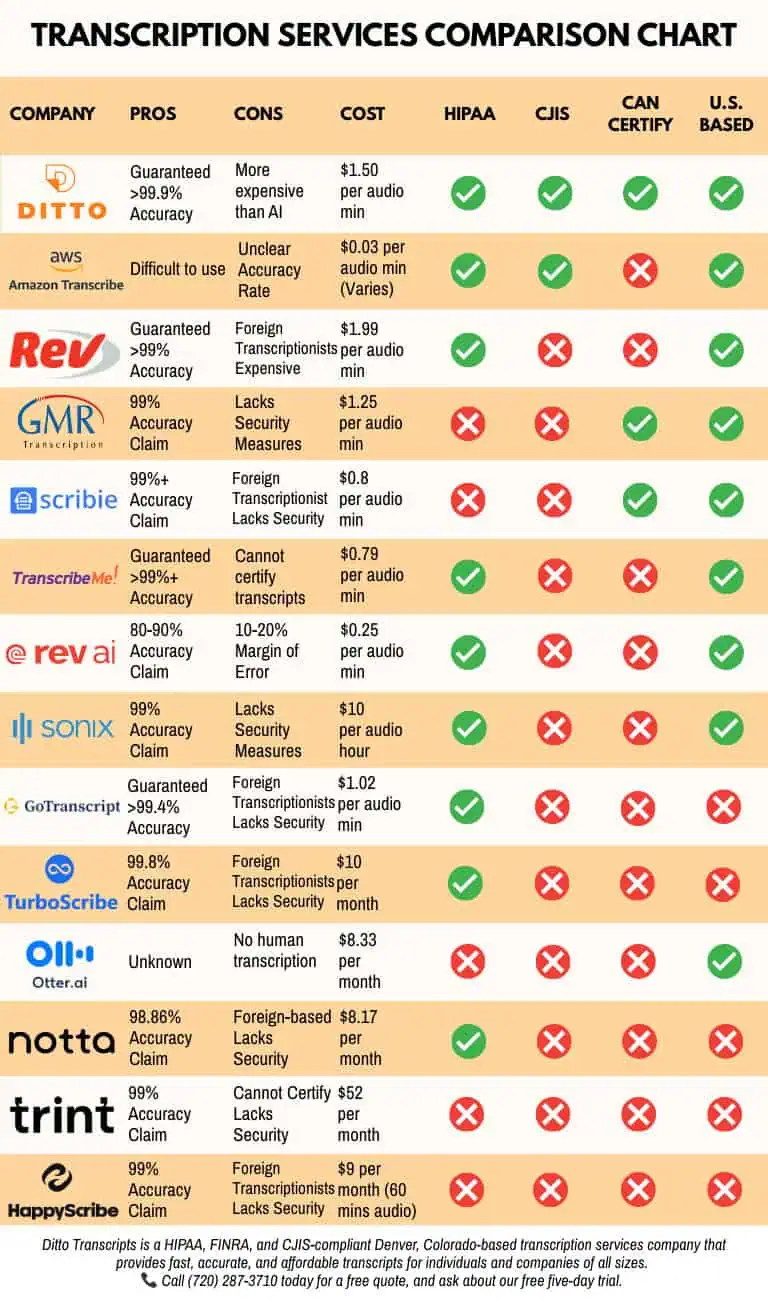
- 100% U.S.-based human transcriptionists: Your final transcript is prepared by people who can interpret context, speakers, accents, and terminology rather than relying solely on speech-recognition software.
- 99% accuracy guarantee: Ditto focuses on delivering a finished, ready-to-use document rather than a rough first draft.
- Secure handling: Ditto is HIPAA- and CJIS-compliant and works with organizations that handle confidential and sensitive recordings.
- Flexible transcript styles: Need a polished transcript, specific formatting, timestamps, or a true verbatim record? We can prepare the final document to meet the project’s requirements.
- Transparent pricing: Our legal transcription prices are published so clients can compare turnaround options and understand what affects their quote.
- Human accountability: Have a question about your transcript or need an adjustment? You can speak with real people instead of troubleshooting automated output yourself.
- Verified client experiences: Our testimonials let prospective clients see what legal, academic, research, business, and other customers have said about working with Ditto.
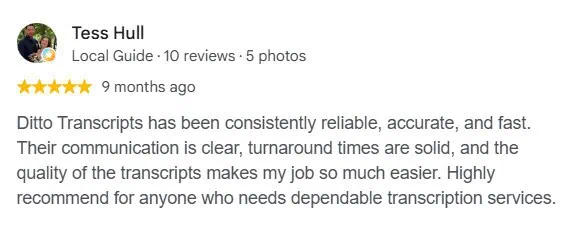
Google Docs may be enough when you need a quick rough transcript. Ditto is built for situations where the finished transcript needs to be accurate, secure, and ready for professional use.
The Bottom Line
Google Docs Voice Typing offers an accessible way to turn speech into text without purchasing dedicated transcription software. For short, clear, low-stakes recordings, it can be a useful starting point.
The tradeoff comes afterward. Automated text still needs to be checked against the original recording, and difficult audio can significantly increase the amount of editing required.
If accuracy matters more than simply producing text as quickly as possible, professional human transcription can eliminate much of that cleanup while providing greater quality control and accountability.
Ditto Transcripts is a Denver, Colorado-based transcription company providing fast, accurate, and affordable human transcription for individuals, businesses, law firms, researchers, government organizations, and other professionals. Call (720) 287-3710 today to discuss your project and request a quote.