
American courts are straining under the weight of overlapping crises. Federal district courts carry 48 vacancies and 19 judicial emergencies. The immigration court system is working through a pending caseload that exceeded 4 million in early 2025. The stenographer workforce has shrunk by 21% in a single decade, leaving fewer than 23,000 professionals to cover proceedings nationwide. Court backlogs are not one problem; they are several converging pressures affecting criminal, civil, and immigration dockets at the federal, state, and local levels. These statistics capture the current scale, the human cost of delay, and the solutions courts are deploying to recover.
Summary: Key Statistics at a Glance
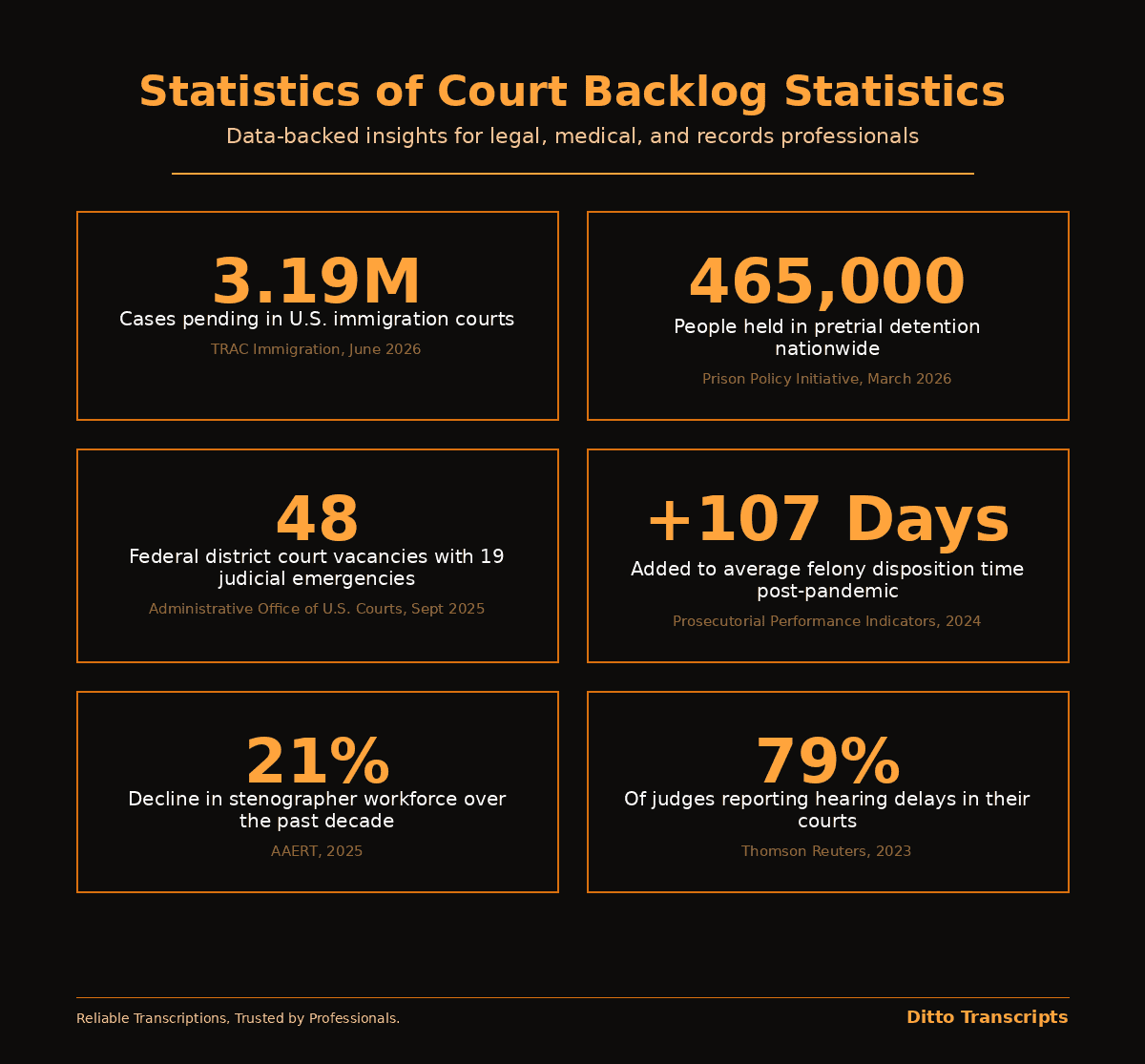
- 3.19 million cases were pending before U.S. immigration courts as of June 2026, according to TRAC Immigration at Syracuse University.
- 465,000 people were held in pretrial detention across the United States as of March 2026, per the Prison Policy Initiative.
- 48 federal district court seats sat vacant as of September 2025, with 19 judicial emergencies declared, per the Administrative Office of U.S. Courts.
- 79% of state and municipal judges reported hearing delays in 2023, averaging 10 postponed hearings per week, according to Thomson Reuters.
- 107 extra days were added to the average felony disposition time between 2019 and 2022 across 21 jurisdictions studied by the Prosecutorial Performance Indicators project.
- The stenographer workforce declined 21% over the past decade to roughly 23,000 professionals, per the AAERT 2025 Court Reporting Industry Trends Report.
- The Bureau of Labor Statistics projects 0% employment growth for court reporters through 2034, with just 17,700 positions filled as of 2024 BLS.
- 80% of courts now conduct or participate in virtual hearings, per the Thomson Reuters 2025 State of Courts Survey.
- Immigration courts completed over 722,000 cases in the first 11 months of FY 2025, the highest single-year total on record, per the DOJ Executive Office for Immigration Review.
- 70% of courts do not currently allow employees to use AI-based tools Thomson Reuters, 2025.
Federal Court Vacancies and Overloaded Dockets
The federal judiciary has not added new district court judgeships since 2003, even as caseloads have grown by 17% over the same two-decade span. As of September 2025, 48 of 677 authorized district court judgeships were vacant, and the Administrative Office of U.S. Courts classified 19 of those vacancies as judicial emergencies. Nineteen vacancies had persisted for more than 18 months, up from 15 the prior year.
The strain is concentrated in specific districts. In the Eastern District of California, six authorized judgeships serve a population that grew from 2.5 million to 8.5 million residents over four decades. Individual judges in Fresno carry caseloads exceeding 1,000 pending cases each. To manage, the district launched a consent-to-magistrate-judge program that raised the rate of cases handled by magistrate judges from 2.2% in May 2022 to 9.5% by May 2023.
Congress attempted to address the shortage through the JUDGES Act of 2024, which would have created 66 new permanent federal district judgeships phased in over a decade across 25 courts in 13 states. The bill passed both chambers but was vetoed by President Biden in December 2024. Meanwhile, the federal courts of appeals have not received new judgeships in over 40 years, even as filings per judge increased by nearly 22% through 2021.
At the appellate level, three of 179 authorized seats were vacant as of September 2025, with 113 senior judges helping absorb the load. The Eleventh Circuit alone saw more than half its active judges turn over between 2016 and 2023, creating institutional knowledge gaps even as filings climbed from 3,800 to the mid-4,000s.
Immigration Court Backlogs
Immigration courts represent the single largest category of backlog in the U.S. judicial system. According to TRAC Immigration at Syracuse University, 3.19 million active cases were pending before immigration courts as of June 2026. Of those, 2.31 million (72%) involved immigrants awaiting asylum hearings or decisions.
The backlog peaked above 4.18 million in early 2025 before a sustained effort to close cases brought it below 3.75 million by late 2025. The DOJ Executive Office for Immigration Review reported that immigration courts completed over 722,000 cases in the first 11 months of FY 2025, the highest single-fiscal-year total in the agency’s history and a pace that exceeded all of FY 2024 completions. The agency described the reduction of over 447,000 pending cases as “the sharpest decrease in caseload in EOIR’s history.”
Case outcomes have shifted markedly. Through June 2026, 81.9% of completed cases resulted in removal or voluntary departure orders, and in June 2026 alone, 87.1% ended in deportation orders. Legal representation remains scarce: only 21.5% of immigrants had attorney representation when removal orders were issued that month, according to TRAC data.
Geographic concentration adds another layer. Miami-Dade County, Florida carried 137,373 pending cases as of mid-2026, more than any other jurisdiction. Mexico led the nationalities ordered deported, with 121,001 removal orders through June 2026.
Felony Disposition Times and Pretrial Detention
The pandemic’s impact on criminal case processing has been slow to reverse. A 2024 study by the Prosecutorial Performance Indicators project at Loyola University Chicago examined 21 jurisdictions and found that average felony disposition times increased by 107 days between 2019 and 2022. Before the pandemic, most jurisdictions resolved typical felonies within 70 to 260 days from filing. By 2022, Broward County, Florida had reached 589 days (up from 271), Philadelphia exceeded 400 days, and Multnomah County, Oregon topped 400 days as well.
Recovery patterns varied. Eleven of 21 jurisdictions followed an “increase-plateau” trajectory where processing times rose and stabilized at a higher baseline. Seven showed an “increase-decrease” pattern where times peaked and began to fall, though none had fully returned to pre-pandemic norms by the end of the study period.
The downstream effect is visible in pretrial detention numbers. As of March 2026, approximately 465,000 people were held in pretrial detention across the United States, according to the Prison Policy Initiative. Over 426,000 of them sat in local jails. These individuals have not been convicted; they are waiting for courts to process their cases. The longer the backlog, the longer the wait.
The Court Reporter Shortage and Its Effect on Case Flow
One of the lesser-known contributors to court backlogs is the shrinking court reporter workforce. The AAERT 2025 Court Reporting Industry Trends Report found that the number of certified stenographers has declined by 21% over the past decade, leaving roughly 23,000 professionals to serve the entire U.S. court system. Student enrollment in stenography programs has dropped 74%, and about 42% of stenography schools have closed.
The Bureau of Labor Statistics counts just 17,700 court reporters and simultaneous captioners employed as of 2024, with a projected growth rate of 0% through 2034. The roughly 1,700 annual openings come almost entirely from retirements and transfers, not from newly created positions. AAERT Executive Director Matt Riley has characterized the situation as “more than a workforce issue; it’s a growing constitutional crisis,” noting that accurate transcripts are essential for fair trials and due process.
The shortage has measurable effects on daily court operations. According to the AAERT report, 76% of legal professionals cite scheduling difficulties as their primary challenge, and 55% report increased costs for legal transcription services. When a court cannot secure a reporter for a hearing, the hearing is postponed, and the case joins the backlog. Digital court reporting has gained traction as a scalable alternative, with 96% of surveyed professionals identifying accuracy as the most critical performance metric regardless of the reporting method used.
Emerging Trends and What’s New in 2026
Several developments are shaping how courts approach their backlogs in 2026.
- Virtual hearings have become standard practice. The Thomson Reuters 2025 State of Courts Survey found that 80% of courts now conduct or participate in virtual hearings, with 58% reporting that the format improved efficiency by reducing no-shows and rescheduling. What began as a pandemic workaround has evolved into a permanent tool for managing high-volume dockets.
- AI adoption in courts remains cautious. Despite growing interest, 70% of courts still prohibit employees from using AI-based tools, according to the same Thomson Reuters survey. Only 17% of courts have adopted generative AI, though another 17% planned to do so within the following year. Courts ranked AI as the most significant trend they will face over the next five years, with 55% of respondents expecting transformational or high impact.
- Staffing shortages are the top operational challenge. Nearly 50% of court professionals rated skilled labor shortages as having transformational or high impact on operations in the 2025 Thomson Reuters survey, and 68% had experienced workforce shortages in the prior 12 months. With Baby Boomers and Gen X judges and court staff retiring, the pipeline of replacements is not keeping pace.
- Immigration court throughput hit record levels in FY 2025. The DOJ’s EOIR reduced the immigration court pending caseload by over 447,000 cases between January and late 2025. Whether this pace continues depends on staffing levels, policy changes, and whether new filings outpace completions in FY 2026 and beyond.
How Ditto Transcripts Helps
Ditto Transcripts helps courts, attorneys, and legal teams keep proceedings on schedule with accurate, human-produced transcripts for hearings, depositions, and recorded proceedings. All work is handled by U.S.-based transcriptionists under CJIS- and HIPAA-compliant procedures, with rush turnaround available in one to two business days. Learn more about legal transcription services.