
For years, stenographers were always present in court events for a specific purpose: accurate documentation. These professionals have made it possible to preserve cases, allowing them to be referenced or, in some cases, appealed.
However, the number of cases today has grown exponentially, while the number of stenographers has not. In fact, a court reporter shortage underscores the industry’s struggles. That struggle created an opening for alternatives, including artificial intelligence.
Legal professionals need quick access to documents, and nothing beats AI’s speed. However, it does not mean that it could produce an accurate and official court record. Only a few legal transcription services produce certified, admissible transcripts.
Capturing a speech is not necessarily the same as creating an accurate transcript. AI should ideally be used only to create a draft, and a trained professional must review and finalize the document. That distinction in responsibility is being tested in Texas and California, highlighting how AI can be integrated without sacrificing accuracy.
In this article, you’ll learn…
- Why the court reporter shortage is increasing reliance on digital recordings and AI-assisted transcription
- What certified legal transcripts provide that artificial intelligence cannot, including accuracy, accountability, and chain-of-custody support
- How courts in Texas and California are evaluating the role of technology in preserving official legal records
The Court Reporter Shortage Is Reshaping the Legal Record
The shortage of court reporters and stenographers is not a hiring problem.
Over the years, fewer and fewer individuals have taken an interest in the profession. Statistics showed that the stenographer population decreased by 21% over the past decade, with only about 23,000 remaining.
As the numbers decline, cases and real people have been significantly affected, with approximately 1.2 million hearings occurring without a verbatim record.
Of course, parties may hire a private professional or proceed without a transcript. However, either choice would be costly. A private court reporter may break the bank, while continuing without a transcript would make appeals almost impossible.
A solution enabled by modern technology is digital recording, which preserves an audio/video record of the legal event. However, that does not automatically solve the problem.
Recording and Certification Are Different Jobs
Recordings must still be converted to a document – and AI is not the ideal tool for the job. AI transcription solutions struggle with what a court-ready transcript may also require:
- Accurate speaker identification
- Correct names, dates, exhibits, and case references
- Proper legal formatting
- Review of overlapping or unclear speech
- Documentation of source files
- A signed certification when required by the applicable rules
Yes, a certification is crucial because it shows who is accountable for the transcript’s completeness and accuracy. Not everyone is eligible to sign, and, depending on the jurisdiction, the signer may be a licensed court reporter, certified digital reporter, authorized transcriptionist, or another qualified professional.
Deposition transcription services often process messy audio because it may contain objections, interruptions, exhibits, and testimony that are difficult to document. This transcript underscores the importance of professional certification. Otherwise, the transcript is subject to inadmissibility due to concerns over accuracy and foundation.
What Certification Provides That AI Cannot
The certification process is not only a submit-and-sign system.
Certified legal transcripts prove that the document underwent a rigorous review. It reflects that a qualified (human) professional verified the accuracy, method, and source materials; that person is also responsible for explaining the process, correcting errors, and responding to the legal body as required.
AI cannot perform those very duties. It may be the fastest way to create a draft, although it cannot guarantee accuracy, sign a certification, or take responsibility for the output.
Certification can also support the chain of custody. Courts and attorneys need to know:
- Who created or preserved the source recording?
- Whether the recording is complete and unaltered
- Who had access to the files?
- How the transcript was produced and reviewed
- Who is accountable for the final version?
The National Court Reporters Association has stated that AI and automatic speech recognition may be useful supplemental tools; however, they cannot replace a trained, impartial professional in creating, preserving, and certifying an official record.
This distinction is more positive than it may seem because it recognizes that AI has a place in legal documentation. For legal professionals and service providers, while preserving accuracy and quality.
Two Courts Are Examining the Divide
Texas: In re Patrick Hughey
In In re Patrick Hughey, No. 25-0463, the Texas Supreme Court is considering a dispute involving a deposition transcript produced using AI-assisted speech-to-text technology.
The trial court rejected the transcript and limited the method used to produce it. The issue is whether Texas law allows this type of non-stenographic transcript to be used in court. To date, the case remains unsolved.
This case is not AI vs court reporters. Instead, it questions whether the transcript complies with state rules governing the documentation process and the use of deposition testimony.
California: Family Violence Appellate Project v. Superior Courts
California is examining a similar issue from an access perspective.
In Family Violence Appellate Project v. Superior Courts, No. S288176, petitioners challenged restrictions on electronic recording when no court reporter is available, and a litigant cannot afford one.
The California Supreme Court heard arguments on June 2 and 3, 2026, and the cases remain unresolved to date.
The case focuses on preserving proceedings when no reporter is present. However, a recording is still not a finished legal transcript – and only a trained human professional can certify it when a written record is required.
Why “Mostly Accurate” Is Not Enough
The quality of audio determines how accurately an automated speech recognition tool creates a transcript.
In controlled environments with clean audio, distinct speakers, and non-jargon vocabulary, there is a pretty high chance the AI draft will be mostly accurate.
However, when the audio is messy, the same AI draft could take longer to edit than to redo manually. AI transcription could only be 61.92%, leaving a huge margin of error that makes a transcript unusable. A missing or incorrectly transcribed name, number, or other crucial data could completely change the
For legal documents, risk should never be tolerated. Verbatim transcripts are sought out when a word-per-word capture of an audio is needed. This is usually performed by industry-specific professionals trained to understand specific contexts.
The Safe Model Is Technology Plus Human Accountability
The rise of AI, its advancements, and the value it could bring are increasingly recognized by the legal community, courts, and law firms. Today, it is becoming an accepted practice to integrate AI and the human touch into a transcript.
AI for the draft; trained human professional for accuracy checking and certification. In the end, the ever-changing legal requirements, formatting, and nitty-gritty legal details are best handled by an industry expert.
When evaluating court transcription services, legal professionals should look for:
- U.S.-based transcriptionists who can attend to calls when transcripts are challenged
- Secure access and file transfer
- Legal terminology and formatting expertise
- Human review of the transcript
- Certification eligibility.
- Transparent turnaround times and revision procedures
Why Clients Choose Ditto for Certified Legal Transcription
At Ditto Transcripts, recordings are treated as source material for a professional transcript, not as finished records, simply because software converted speech to text.
Here is what Ditto offers:
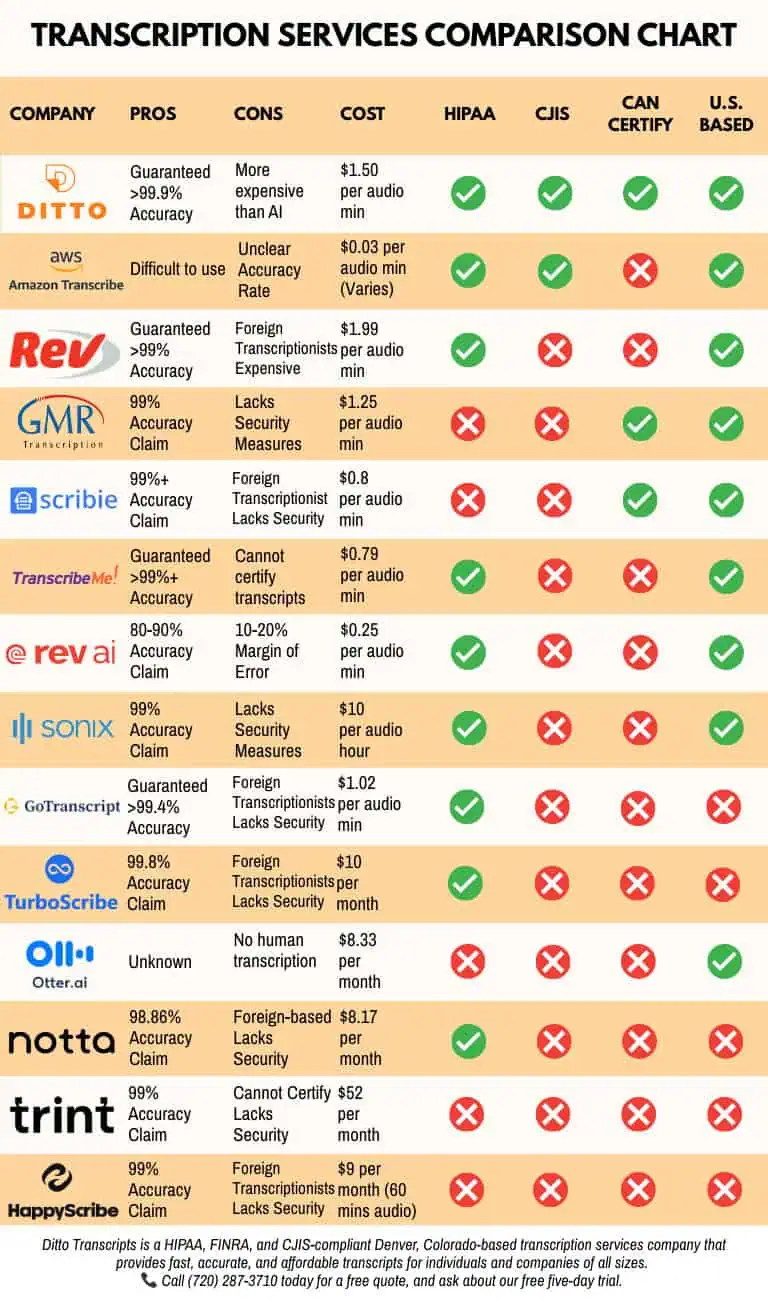
- Human-reviewed accuracy: We guarantee >99% accuracy for all transcripts produced.
- Legal experience: We have a long-standing record of working with legal recordings containing multiple speakers, objections, technical terminology, and difficult audio.
- Secure handling: We are HIPAA-, CJIS-, and FINRA-compliant, highlighting our commitment to security and confidentiality.
- U.S.-based professionals: Projects are completed by U.S.-based transcriptionists who understand American legal language and formatting expectations.
- Clear legal transcription pricing: Clients can review pricing based on factors such as turnaround time, audio quality, and project requirements, without committing to a long-term contract.
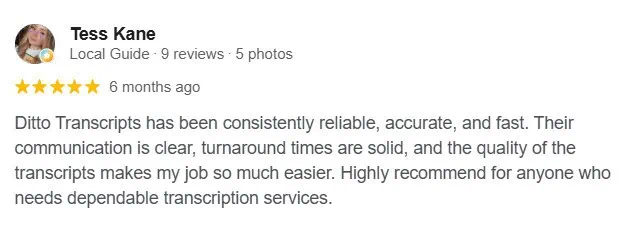
- Client testimonials: Ditto’s testimonials tell you everything you should know about our service.
The Official Record Still Needs an Accountable Human
Regardless of the ruling in Texas and California, recordings are not a standalone piece of evidence that replaces the purpose of a certified transcript. Courts do not have the luxury of time to go through hours of recording and validating an audio’s authenticity.
And while AI and digital recordings ease the workload for legal professionals, these transcripts would not produce accurate results on their own. With the decline in the number of stenographers, a qualified human must review the final transcript, take responsibility for its accuracy, and certify it when required.
Technology can capture the words. A professional makes the record reliable.
Ditto Transcripts is a Denver, Colorado-based transcription company providing fast, accurate, and affordable transcripts for individuals and organizations of all sizes. Ditto is FINRA-, HIPAA-, and CJIS-compliant. Call (720) 287-3710 today for a free quote.