


Using AI is fun and convenient – until something goes wrong. That is exactly what happened to four lawyers from Mississippi.
AI’s utility has grown significantly in recent years. Many industries saw it as a generational technology and integrated it into their workflows, from research and drafting to transcription. As much as it helps, AI outputs have flaws – a lot, actually.
In the case of these four lawyers, their filings contained something unacceptable: hallucinated legal citations. They cited references or events that never existed.
As a result, the trial was canceled, and the legal professionals were removed from the case. They were also fined a total of $8,000, and two of the lawyers were disbarred in the Northern District for two years, the harshest sanction they could get. This is one of the many cases that make legal transcription services relevant in legal documentation.
This Is Not a One-Off AI Mistake
The Mississippi case highlights that legal professionals are responsible for their final submissions, not AI.
It’s also not the first time this has happened, leaving Senior U.S. District Judge Sharion Aycock in awe and writing that her court was “yet again” burdened with AI hallucinations in filings. Rather than being an isolated case, AI hallucination is becoming a pattern.
One is luck; two may be a coincidence, though that same problem is happening in other courts. Clearly, there is something systemically wrong.
A recent review of cases revealed 22 other matters for which they found hallucinated citations. What makes this alarming is that these findings were only dated between June 30 and August 1, 2026, meaning there could be more cases than we realize.
So is this an AI mistake? Or a mistake from the legal professional?
“I Didn’t Know It Could Do That” Is Not a Defense
At Ditto Transcripts, we believe it’s a mix of both – with a heavy stress on the latter.
Legal professionals must always recognize the risks of using AI. It may be quick, convenient, and cheap; however, those qualities never equate to accuracy. And regardless of how advanced the AI tool is, it cannot submit the evidence – only a legal professional or representative can do so. So, the legal team remains responsible for verifying the accuracy of a legal document.
In the Mississippi case, one lawyer said that she had not known AI could produce hallucinated cases, even saying that she did not know what a hallucinated case was. The judge called her statement “insufficient and incredulous.”
Another lawyer said that her firm already had a policy on AI use, claiming it required lawyers to verify AI’s output – which clearly did not work.
The other two lawyers said they did not use AI tools themselves. However, they failed to review the submitted filings.
See the pattern? These problems would have been completely avoidable had they thoroughly reviewed the documents to be submitted. Take AI out of the equation, and there were still lapses in these lawyers’ efforts to ensure accuracy in the filings.
AI is meant to optimize workflow, not bear responsibility. This very principle is consistent with ABA Formal Opinion 512, which states that Lawyers can use generative AI. Yet, they still have to review its output for accuracy before submitting material to a court.
The Real Problem Was the Missing Verification Step
By the way, this Mississippi case is Withers v. City of Aberdeen – in case you want to find out more about it.
At this point, it’s pretty obvious there is a workflow failure. Specifically, here’s where everything went wrong:
- The AI output was treated as usable before it was verified.
- The legal authorities were never independently checked.
- The final review failed as a last line of defense.
In using AI, progression matters. You do not stop with the tool’s first draft. Instead, you must manually check its output before marking it as final.
The risk was never the AI; it was the lack of effort to ensure its output was usable.
Your AI Transcript Belongs in the Same Risk Conversation
Even if you are not a legal professional, the consequences of having an inaccurate transcript remain.
What good would an AI output do if it cannot help you find a word or phrase from a two-hour recording? Or, if you are absent from a class or a meeting, how confident would you be knowing that the transcript you’re reading contains inaccurate information, or worse, information that was never mentioned at all?
We tested and found that the mean AI transcription accuracy was 61.92%. At Ditto Transcripts, we offer a 99% accuracy guarantee for human transcription. That ~48% saves you time, effort, and money in the long run.
Of course, not all AI transcripts will be exactly 61.92% accurate. It could still score pretty high, especially in environments where the captured audio is clean, uninterrupted, and clearly distinguishable speakers – which, frankly, is VERY rare.
That is why legal professionals hire us for court transcription services: to document legal events and ensure transcripts are delivered in a timely, accurate manner.
What Verification Actually Looks Like
We’ve repeatedly said that AI output must be thoroughly checked and verified. However, how is that done? Here are the crucial steps:
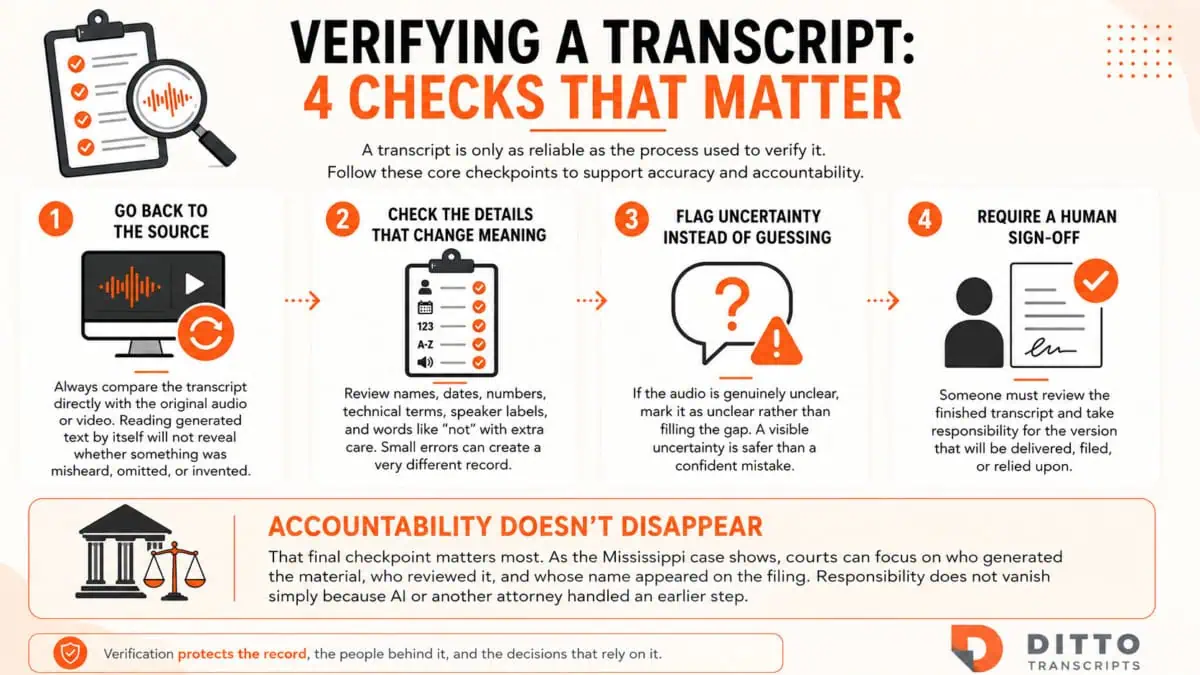
It looks pretty simple, right? So why aren’t the lawyers involved in the Mississippi case doing that? There are plenty of reasons. In general, though, time is the ultimate enemy.
Imagine legal professionals attending to tens to hundreds of cases daily. When deadlines pile up, AI becomes very attractive, and checking its output may look counterproductive – which is why it’s the step that’s easiest to skip.
Why Professionals Choose Ditto When the Record Has to Hold Up
At Ditto, we treat audio as source evidence that deserves careful handling.
That distinction matters even more in the AI era. If machine output cannot be held responsible for what it produces, accountability must exist elsewhere in the workflow.
Here is what clients can expect:
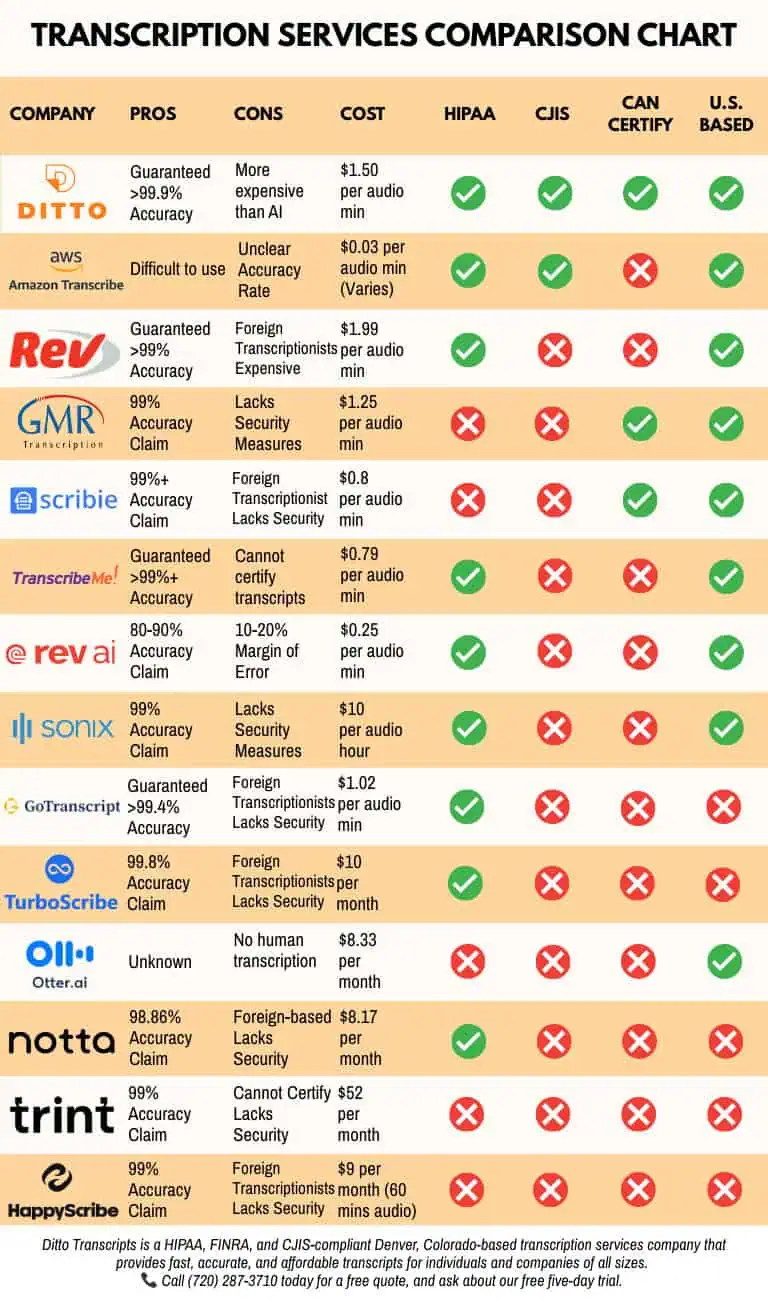
- Guaranteed accuracy: AI transcriptions only claim high accuracy; we guarantee 99% accuracy.
- 100% U.S.-based human transcriptionists: No bots involved in inquiring, transcribing, and delivering the output. We employ only local, fluent transcriptionists to meet your transcription needs.
- Secure handling: We are HIPAA-, CJIS-, and FINRA-compliant, upholding the highest standard of security for your transcripts.
- Ditto protects sensitive information through our HIPAA- and CJIS-compliant workflows.
- Human accountability: Have concerns or requests after the project is rendered? We’re here to fix it with you.
- Transparent legal transcription prices: Published rates explain how turnaround time and other complexity affect cost.
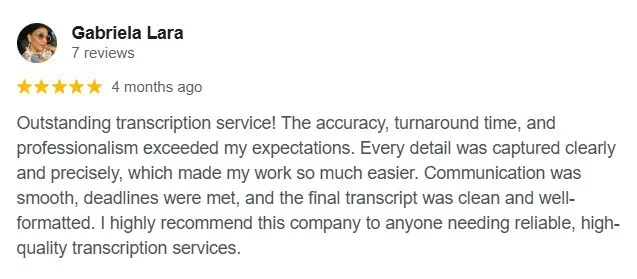
- Verified client experiences: Ditto’s testimonials basically tell you everything you should know:
And for records that require a word-for-word account, we offer verbatim transcription to preserve the original speech rather than simplifying it or omitting important context.
At Ditto, we don’t think AI is all bad. It just needs to be used responsibly. No AI drafts should ever be considered final – and their outputs must always pass a trained human professional assessment.
The Bottom Line
The Mississippi lawyers were not sanctioned because a machine touched their work. Instead, they were sanctioned because machine-generated errors weren’t verified to be factually correct.
That is the line worth remembering as AI spreads through legal work:
AI can draft, although a human has to own the record.
Ditto Transcripts is a Denver, Colorado-based transcription company providing fast, accurate, and affordable transcripts for individuals and organizations of all sizes. Ditto is FINRA-, HIPAA-, and CJIS-compliant. Call (720) 287-3710 today for a free quote.