


Taking complete notes while trying to understand a fast-moving lecture can be difficult. Students may miss definitions, examples, formulas, or important comments while switching between listening and writing. A lecture transcript provides a searchable written reference that students and educators can review after class.
Accuracy becomes even more important when academic recordings involve multiple speakers, specialized terminology, poor audio quality, or material that may be reviewed or shared. In those situations, professional academic transcription services may provide the additional human review and formatting the recording requires.
AI transcription offers a quick way to convert lecture audio into text, although its usefulness ultimately depends on how accurately it captures the material. The usefulness of an AI-generated lecture transcript ultimately depends on its accuracy, the quality of the recording, and how you’ll use it.
In this article, you’ll learn:
- Where AI lecture transcription can be useful
- Why academic recordings are difficult for automated speech recognition
- How terminology, audio conditions, and speaker patterns affect results
- When human transcription is worth considering
What Role Does AI Play in Lecture Transcription?
AI transcription systems use automatic speech recognition to convert spoken language into written text. Depending on the platform, they may produce live captions during a lecture or generate a transcript from a recorded class afterward.
These tools can be useful when students need a quick reference or instructors want a searchable draft of course material.
However, automatic transcription should not automatically be treated as a finished academic record. Even companies that provide automatic captioning advise users to review machine-generated text because speech-recognition errors still occur. Google, for example, warns that automatically generated captions may not completely or accurately represent what a speaker said.
AI works best as a starting point when mistakes are acceptable, and someone is available to review the output.
Benefits of AI for Lecture Transcription
AI transcription does offer practical benefits, particularly when speed and convenience matter more than publication-ready accuracy.
| Potential benefit | How it can help |
| Fast drafts | Converts a recorded lecture into searchable text without manual typing |
| Searchability | Helps students locate terminology, names, topics, and examples |
| Study support | Provides another reference when reviewing class notes |
| Accessibility support | Can provide real-time or recorded text as part of an accessibility strategy |
| Content reuse | Gives educators source material for study guides, summaries, or course resources |
Students may find searchable transcripts especially helpful when reviewing long lectures before an exam. Instead of replaying an entire recording, they can search for a concept and return to the corresponding portion of the lecture.
Educators may also use transcripts to create written learning materials or review how a subject was explained during class.
For recurring lectures, interviews, seminars, and research discussions where accuracy matters, academic transcription services can provide a human-reviewed alternative.
Limitations of AI Lecture Transcription
The difficulty with lecture transcription is that classrooms rarely provide the controlled speaking conditions that automated speech-recognition systems prefer.
A professor may walk around the room, switch rapidly between topics, introduce unfamiliar terminology, respond to questions, write formulas on a board, or speak over background noise.
The more complex the lecture becomes, the more carefully an automated transcript should be reviewed.
Technical Vocabulary Can Cause Errors
Academic lectures often contain terminology that is uncommon in everyday conversation.
A biology class may include molecular processes and chemical compounds. Law classes use case names, Latin terminology, and citations. Medical lectures include drug names, procedures, anatomy, abbreviations, and diagnoses.
STEM courses create additional challenges because spoken explanations may depend on:
- Mathematical expressions
- Chemical formulas
- Symbols
- Units of measurement
- Abbreviations
- Proper names
- Specialized terminology
An AI system can generate a grammatically plausible word that is completely wrong in context.
The original version of this article described one test in which mitochondrial DNA replication became a mighty cone drill DNA replication. That example illustrates the broader problem: an incorrect term may still look believable enough that a student does not notice the mistake.
Classroom Noise Reduces Clarity
Lecture halls are rarely silent.
HVAC systems, typing, papers, coughing, movement, hallway noise, and side conversations can all compete with the instructor’s voice. Student questions may also come from different parts of the room and at very different volume levels.
A professor who moves away from the microphone may become noticeably quieter in the recording.
Poor source audio creates problems for any transcription workflow; however, an automated system cannot ask a speaker to repeat an unclear phrase or independently verify an uncertain technical term.
Recording quality, therefore, matters before transcription even begins.
Multiple Speakers Complicate the Transcript
Many lectures are interactive rather than one-directional.
Students ask questions. Teaching assistants contribute explanations. The professor may interrupt or answer before someone has finished speaking.
AI may have difficulty identifying where one speaker stops and another begins, particularly when voices overlap.
This can create problems when speaker identity affects the meaning of the discussion.
Speaker identification becomes even more important when an academic recording contains formal interviews, research participants, or testimony. In those circumstances, clients may choose verbatim transcription services when they need to preserve repetitions, interruptions, fillers, and other spoken details.
Accents and Speaking Patterns Matter
People do not speak in perfectly structured sentences.
A lecturer may:
- Pause in the middle of a thought
- Restart a sentence
- Speak quickly through familiar material
- Slow down for an important explanation
- Change volume
- Use humor or sarcasm
- Switch between technical and informal language
Different accents, dialects, pronunciations, and speech patterns can also affect automatic recognition.
These differences are normal parts of human communication, yet they can make accurate automated transcription considerably more difficult.
AI Does Not Always Create Useful Academic Structure
A technically accurate collection of words is not automatically a useful study document.
Raw machine transcripts may require additional work to add:
- Paragraph breaks
- Speaker labels
- Topic divisions
- Punctuation
- Headings
- Timestamps
- Consistent terminology
That distinction matters because students generally need more than a wall of text.
A well-prepared lecture transcript should help the reader follow the structure of the discussion, not merely reproduce words in sequence.
How Accurate Is AI Lecture Transcription?
The accuracy of automatic speech recognition varies considerably according to the software, microphone quality, speakers, vocabulary, background noise, and recording environment.
Therefore, it is better to avoid assuming that every AI transcript will reach the same accuracy rate.
To compare automated output with reviewed transcription, if an AI-generated transcript is only 61.92% accurate, students may need substantial editing before they can depend on it as a study resource.
The consequences of an error also matter.
Misidentifying an ordinary conversational phrase may cause little inconvenience. Misidentifying a drug, mathematical value, historical date, legal term, or scientific process can change the meaning of what the professor taught.
Can AI Transcripts Help With Accessibility?
Yes, although AI transcription can support accessibility, it should not be described as automatically satisfying every accessibility requirement.
The Americans with Disabilities Act recognizes several types of auxiliary aids and services that can support effective communication, including open and closed captioning and real-time computer-aided transcription. The appropriate aid depends on factors such as the individual, the setting, the communication method, and the complexity of the information.
W3C also distinguishes between captions and transcripts. Captions are synchronized with media, while transcripts provide a separate text version of relevant spoken and other audio information.
A transcript can support accessibility, although institutions should determine the accommodation required for the particular student and situation rather than assuming one transcript format satisfies every need.
When Human Lecture Transcription Makes More Sense
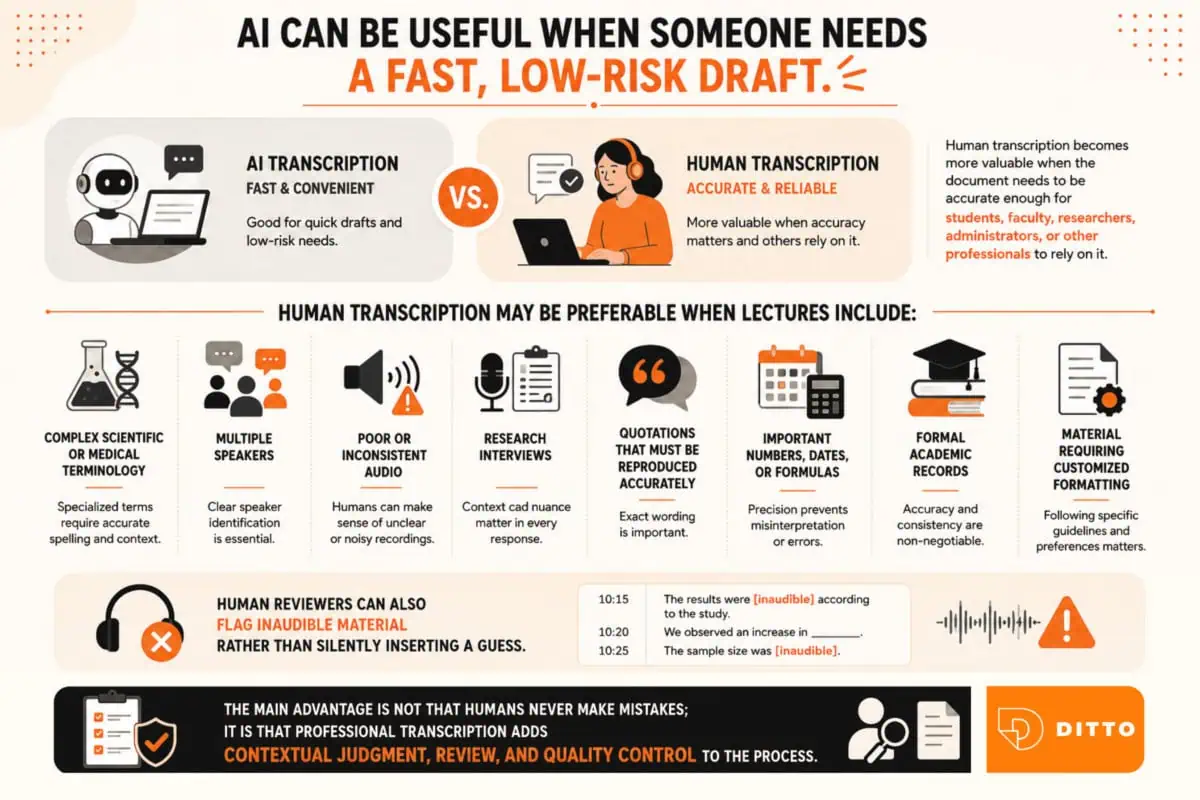
AI can be useful when someone needs a fast, low-risk draft.
A professional transcriptionist can review uncertain wording in context and apply consistent formatting throughout the transcript.
AI vs. Human Lecture Transcription
| Factor | AI transcription | Human transcription |
| Speed | Very fast draft generation | Requires more processing time |
| Cost | Often inexpensive | Usually costs more upfront |
| Technical vocabulary | May misidentify unfamiliar terms | Can research and verify terminology |
| Speaker identification | Quality varies | Can be manually reviewed |
| Formatting | Often requires cleanup | Can follow requested formatting |
| Difficult audio | Accuracy may fall sharply | Human judgment can resolve more ambiguities |
| Best use | Low-risk drafts and quick reference | Important or publication-ready transcripts |
Neither option is universally right or wrong.
The appropriate choice depends on what the transcript is for and how costly an error would be.
Why Choose Ditto for Lecture Transcription?
Students, educators, researchers, and institutions need transcripts that are accurate, readable, and suitable for their academic workflow. Clients choose Ditto for:
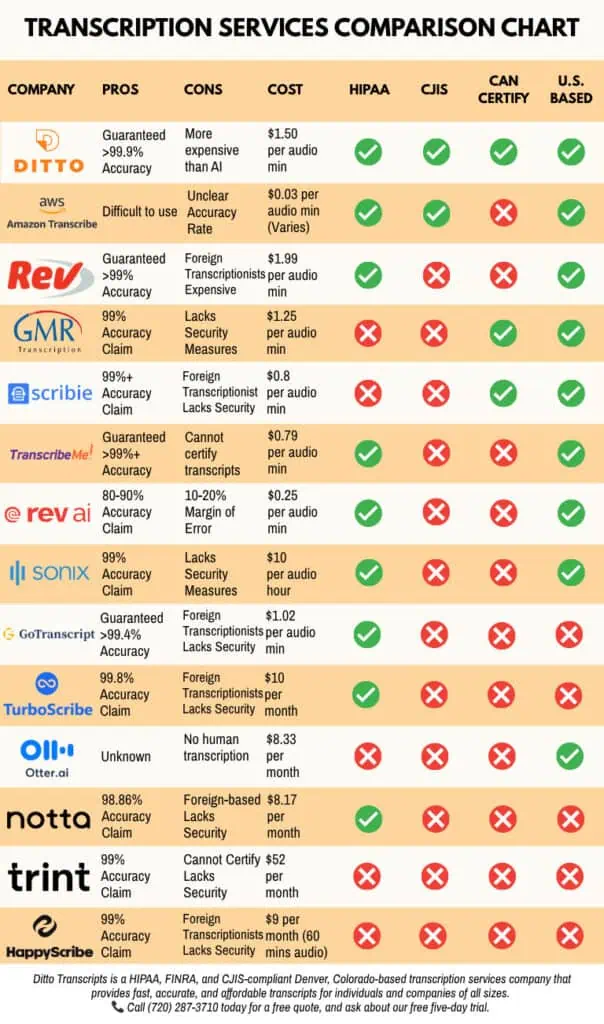
- Human-reviewed accuracy: Ditto advertises a 99% accuracy guarantee for completed human transcription projects.
- U.S.-based transcriptionists: Ditto states that its transcriptionists are based in the United States.
- Academic experience: The company handles lectures, research interviews, seminars, focus groups, presentations, and other educational recordings.
- Flexible formatting: Clients may request speaker labels, timestamps, clean-read or verbatim text, and custom templates.
- Turnaround options: Different delivery schedules are available depending on project requirements.
- Upfront transcription prices: Our transparent pricing helps clients understand how factors such as turnaround, audio quality, and speaker count can affect cost.
- Security-focused handling: Ditto provides secure processes for submitting and returning recordings and transcripts.
- No long-term contract: Schools, researchers, and individual clients can submit one-time or recurring projects without an annual commitment.
- Client feedback: Ditto’s testimonials describe customer experiences involving accuracy, service, formatting, turnaround, and pricing.
Institutions should still confirm that the transcription service, delivery method, and final transcript format meet their own accessibility, privacy, procurement, and data-handling requirements.
Get More From Your Recorded Lectures
AI has made it easier than ever to create a quick lecture transcript. For informal review and low-risk study purposes, that convenience can be useful.
The limitations matter more when the lecture includes technical vocabulary, formulas, multiple speakers, difficult audio, or information students need to reproduce accurately.
AI can provide the first draft; careful human review determines whether it’s reliable enough to use.
Ditto Transcripts is a Denver, Colorado-based FINRA-, HIPAA-, and CJIS-compliant transcription services company that provides fast, accurate, and affordable transcripts for individuals and academic institutions of all sizes. Call (720) 287-3710 today for a free quote.