


Working as a freelance transcriptionist means more control over your schedule, the ability to choose your clients, and the potential to build a business from home. However, leaving traditional employment also means taking responsibility for taxes an employer would normally help manage.
Whether you’re exploring freelance transcription jobs or already working independently, freelance transcription income is generally taxable, even when clients do not withhold taxes from your payments. Understanding your obligations early can help you avoid unexpected tax bills and maximize legitimate business deductions.
In this article, you’ll learn:
- How self-employment taxes work for freelance transcriptionists.
- When quarterly estimated tax payments may be required.
- Which business expenses may qualify for tax deductions.
- How to claim home-office expenses and organize tax records.
What Is Self-Employment Tax?
Self-employment tax covers Social Security and Medicare contributions for self-employed people.
Traditional employees generally share these taxes with their employers. Freelancers, however, pay both portions.
For 2026, the combined self-employment tax rate remains 15.3%, consisting of 12.4% for Social Security and 2.9% for Medicare.
The Social Security portion applies only up to the annual earnings limit, which is $184,500 for 2026. Medicare tax generally has no earnings cap, and higher-income individuals may owe an Additional Medicare Tax.
Self-employment tax is generally calculated on 92.35% of net earnings from self-employment, not the total amount clients pay you. Most freelancers with net earnings of $400 or more must pay this tax.
Importantly, self-employment tax is separate from federal income tax. Depending on your income and circumstances, you may owe both.
Do Freelance Transcriptionists Need to Pay Quarterly Taxes?
Freelancers typically don’t receive paychecks with federal income tax automatically withheld. Instead, they may need to make estimated payments throughout the year.
You generally must make estimated tax payments if you expect to owe at least $1,000 in federal taxes after subtracting withholding and refundable credits, and you meet the IRS’s other payment requirements.
The IRS provides Form 1040-ES to help calculate estimated payments. These cover federal income tax and applicable self-employment tax.
For the 2026 tax year, the standard payment schedule is:
| Payment Period | Due Date |
| January 1 to March 31, 2026 | April 15, 2026 |
| April 1 to May 31, 2026 | June 15, 2026 |
| June 1 to August 31, 2026 | September 15, 2026 |
| September 1 to December 31, 2026 | January 15, 2027 |
The final payment deadline moves to January 19, 2027, because January 15 falls on a weekend and is followed by the Martin Luther King Jr. federal holiday.
Making sufficient payments throughout the year can help avoid penalties. You can estimate your obligations using IRS Form 1040-ES and pay through approved IRS methods.
What Tax Deductions Can Freelance Transcriptionists Claim?
One advantage of freelancing is deducting qualifying business expenses.
Generally, the IRS allows deductions for ordinary and necessary expenses you incur while running your business. However, you can’t deduct personal purchases simply because you work from home.
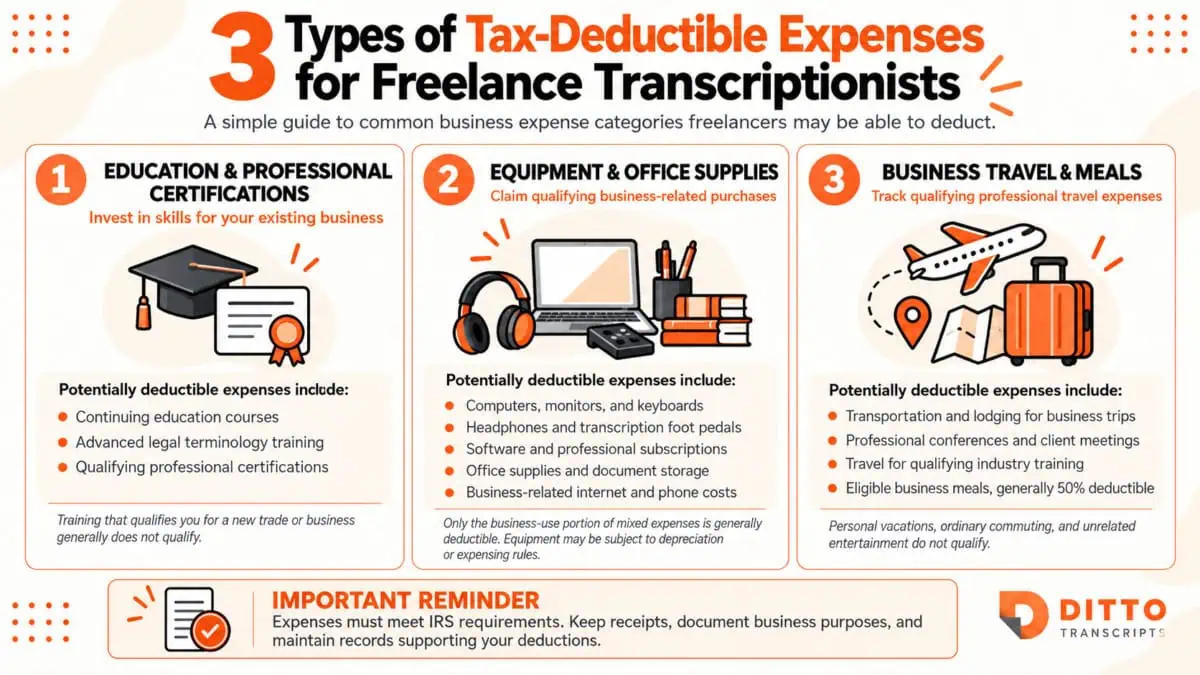
Not every business-related purchase or activity automatically qualifies for a tax deduction. The IRS generally requires expenses to be ordinary and necessary for your business, and additional rules may apply depending on the type of expense.
Freelance transcriptionists should keep accurate receipts, separate personal and business expenses, and document how each expense supports their work. Consulting a qualified tax professional can also help ensure deductions are claimed correctly.
Can Freelance Transcriptionists Claim a Home Office Deduction?
Working from home is one of the biggest attractions of freelance transcription. However, not every home workspace qualifies for a tax deduction.
The IRS generally requires a home office to be used regularly and exclusively for business and to meet the applicable principal-place-of-business rules.
A dedicated office used only for transcription work may qualify. A kitchen table shared between family meals and transcription assignments generally does not.
Eligible freelancers can choose between two calculation methods:
| Method | How It Works |
| Simplified method | Deduct $5 per square foot of qualifying workspace, up to 300 square feet and a maximum of $1,500 annually. |
| Regular method | Calculate qualifying actual home expenses based on the portion of the home used for business, subject to applicable rules. |
Under the regular method, you may deduct certain portions of rent, utilities, insurance, and other qualifying expenses.
The simplified method reduces recordkeeping requirements, although it does not change the eligibility criteria.
For details, review the IRS home-office deduction guidance.
How Should Freelancers Organize Their Tax Records?
Accurate recordkeeping makes filing taxes easier and helps substantiate deductions if the IRS requests documentation.
Freelance transcriptionists should maintain records of client payments, invoices, receipts, business purchases, and estimated tax payments.
Keeping business and personal finances separate can simplify expense tracking and reduce the risk of claiming unsupported deductions.
A dedicated business bank account and accounting software can help, although a well-maintained spreadsheet may be sufficient for a small freelance operation.
Why Clients Choose Ditto for Professional Transcription
Freelance transcriptionists understand how much effort it takes to produce accurate written records. For businesses and legal professionals, choosing a dependable transcription provider means receiving useful documents without spending extra time correcting mistakes.
At Ditto Transcripts, we provide accurate, readable, professionally formatted transcripts while reducing the administrative burden of managing recorded information.
Clients choose Ditto because we offer:
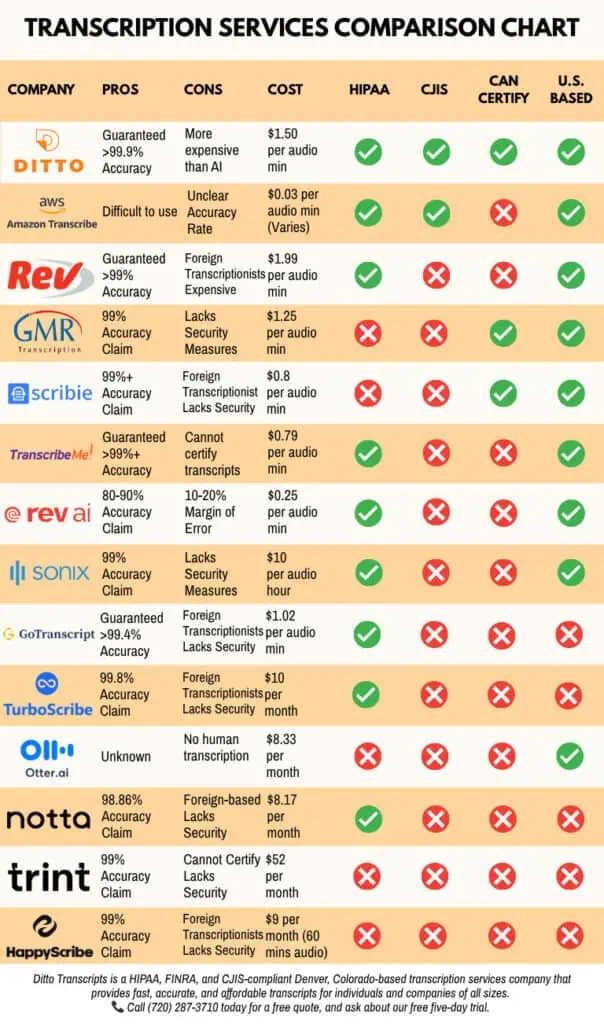
- Human transcriptionists: Trained professionals review recordings, research terminology, and use context rather than relying entirely on automated output.
- Industry-specific experience: Our team works with recordings from the legal, medical, academic, business, and government sectors.
- Support for challenging audio: We give multiple speakers, background noise, accents, and specialized terminology careful human attention.
- Flexible formatting: Clients can request speaker identification, timestamps, verbatim transcription, and other project-specific requirements.
- Secure file handling: Sensitive recordings are handled through confidentiality-focused workflows designed for professional transcription projects.
- Flexible legal transcription pricing and turnaround options: Costs and delivery schedules vary by file length, recording quality, urgency, and formatting requirements.
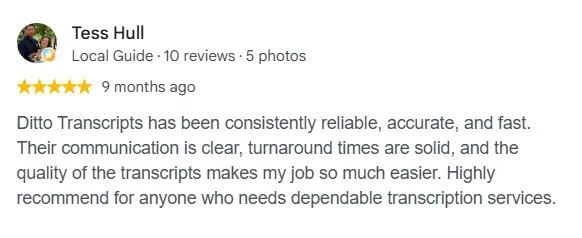
- Client testimonials: Here’s what our previous customers say about their experience.
Manage Your Freelance Transcription Taxes With Confidence
Freelancing offers independence, flexible scheduling, and opportunities to build a transcription business around your skills. However, understanding self-employment taxes is essential to staying financially organized.
Setting aside money for taxes, making required estimated payments, and documenting legitimate business expenses can help prevent surprises when filing your annual return.
The goal is to spend less time worrying about tax obligations and more time building a sustainable transcription business.
Ditto Transcripts is a Denver, Colorado-based transcription services company that is FINRA-, HIPAA-, and CJIS-compliant and provides fast, accurate, affordable transcripts for individuals and companies of all sizes. Call (720) 287-3710 today for a free quote.
Disclaimer: This article is for general informational purposes only and does not constitute tax, legal, or accounting advice. Tax obligations depend on individual circumstances and applicable federal, state, and local laws. Consult a qualified tax professional before making decisions about your tax situation.