
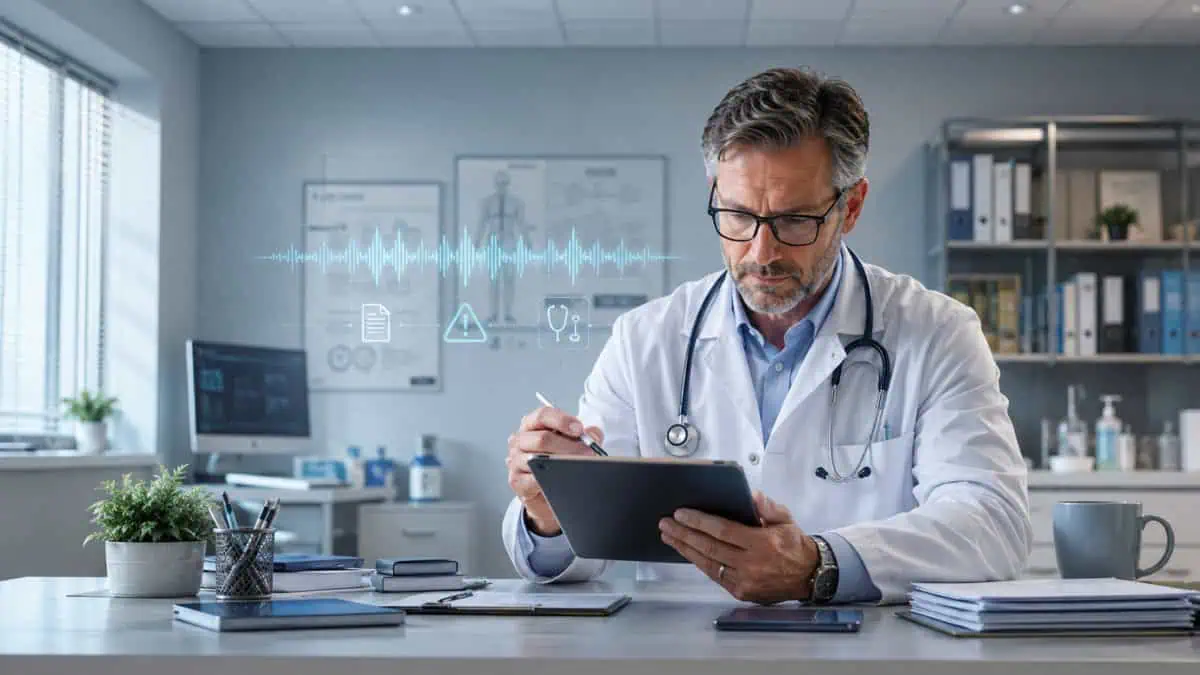

A patient goes to a clinic for treatment; a healthcare plan is received and followed for weeks, only to discover that the wrong treatment is being given. How would you react if this happened to you? And how did that even happen in the first place?
Clinicians see plenty of patients every day. Each individual has a unique case that needs to be noted, assessed, and managed with a tailored plan. Cases can pile up and become overwhelming for healthcare professionals. That is why documentation aids like Ambient AI are becoming more relevant and are even being adopted by many health systems. The reason is simple: reduce the burden of clinical documentation. However, that “savior” carries its own risk.
Unlike trusted medical transcription services used by healthcare professionals, Ambient AI does not match the accuracy that human transcription can provide.
Discovery May Reach Beyond the Final Chart
The EHR note is the obvious record. However, it may not be the only one lawyers ask for.
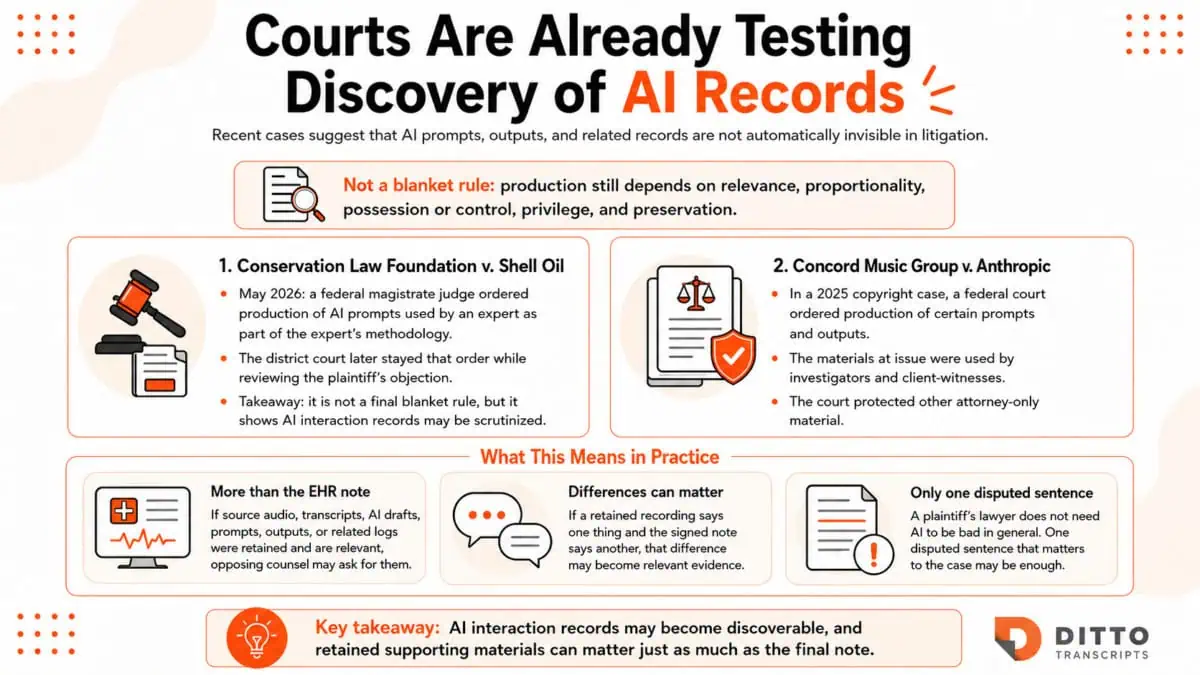
In the legal setting, accuracy is highly valuable. When the exact spoken words matter, verbatim transcription is essential because it preserves the original speech rather than turning it into a summarized clinical narrative.
The Signing Clinician Cannot Blame the Tool
Ambient scribe’s outputs are only as good as the first draft. The healthcare professional must verify and approve the final record.
That distinction is not always followed, and it can lead to unwanted consequences. In fact, the American Medical Association warned physicians that AI-generated outputs may contain errors, emphasizing that physicians are responsible for what they sign.
When clinicians deem it finalized, simply blaming AI for later-found errors won’t cut it, and there will be serious repercussions.
Hallucinations Can Become Powerful Plaintiff Evidence
An AI error is likely only a misspelling, and it can’t be that bad, right? … No.
Several studies noted that Ambient AI can contain hallucinations in as many as 31% of the notes.
What are hallucinations, and are those numbers really bad?
Hallucinations are inaccurate information added by AI. They didn’t come from the interaction between the clinician and the patient, yet somehow became part of the documentation. It could be a different drug dosage, a different symptom from what has been said, or even a different disease from what the patient reports – that is how serious it could get.
Of course, a 31% hallucination rate is not universal. But, the fact that it appears frequently in various studies says a lot about the risk posed by AI scribes. And when left unchecked, those inaccurate details also make the treatment incorrect, potentially putting the patient at greater risk.
One real-life example: the system generated a normal head-and-neck examination that had not actually been performed, while omitting the thyroid examination that had been performed.
Sure, it looks polished and harmless. However, that’s not true at all, especially in litigation. For plaintiff’s counsel, the discrepancy is not only an AI error. It can become a way to challenge the reliability of the record itself.
PHI Creates Another Trail to Manage
Ambient scribing also creates a data-handling problem that traditional note-taking may not.
Patient conversations can contain protected health information. Under HHS guidance, a vendor that creates, receives, maintains, or transmits PHI on behalf of a covered entity can qualify as a business associate, which generally requires an appropriate Business Associate Agreement. HHS also advises organizations using cloud services to understand retention, return, security, and permitted-use terms rather than assuming “HIPAA-compliant” answers every question.
Before using an ambient scribe, a healthcare organization should be able to answer practical questions:
- Where is the audio stored?
- How long is it retained?
- Can it be deleted?
- Is patient data used to train models?
- Which subprocessors can access it?
- What happens to the data after the contract ends?
Those answers matter for privacy and security. They may also matter later if litigation creates a duty to preserve relevant material.
What a Defensible Documentation Workflow Looks Like
A safer workflow does not require rejecting technology. It requires refusing to treat an AI draft as finished work.
| Stage | Defensible safeguard |
| Capture | Use approved tools and documented data-handling rules. |
| Draft | Treat machine-generated text as provisional, not chart-ready. |
| Review | Compare important details against the source and correct unsupported content. |
| Finalize | Sign only after a human can stand behind the note. |
Other records, for example, require medicolegal transcription services to add something automation cannot supply on its own: an accountable human review layer.
This is also why the issue connects directly to our earlier discussion of ambient AI medical scribes. Convenience is real. So is the need to verify what the system produced before it becomes part of a patient’s durable medical record.
Why Professionals Choose Ditto When the Record Has to Hold Up
At Ditto Transcripts, audio is not treated as raw material for the fastest possible note. We treat it as source evidence that deserves careful handling.
That matters in healthcare, where a transcript may later support treatment decisions, insurance reviews, expert analysis, or litigation. Here is what clients can expect:
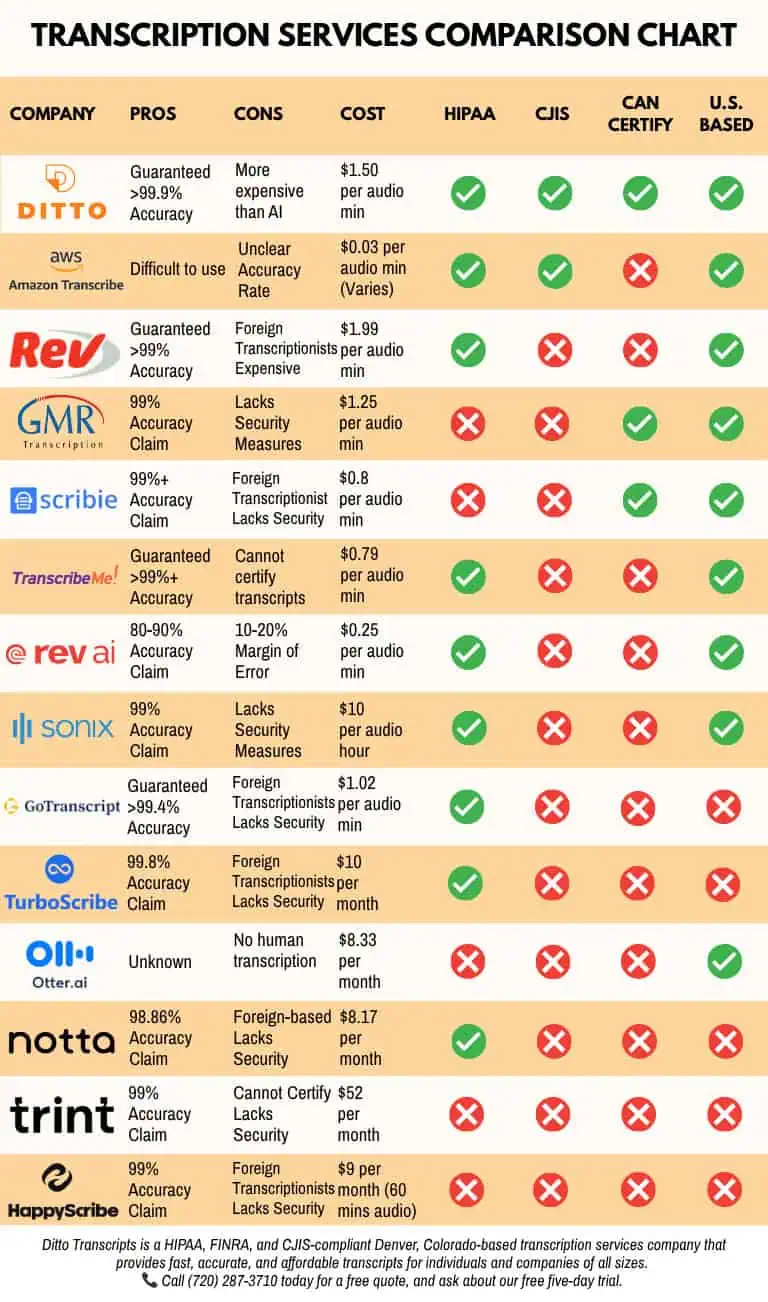
- Guaranteed accuracy: Ditto Transcripts guarantees +99% accuracy in the medical industry and practically any field.
- 100% U.S.-based human transcriptionists: We only employ trained professionals who can attest to our work whenever needed.
- Secure handling: We uphold the highest security standards through HIPAA-compliant workflows for sensitive information.
- Human accountability: Have concerns over our outputs? We’re more than happy to help even if the project has been rendered – no bot in between.
- Transparent medical transcription prices: Everything you need to know about turnaround, pricing, and flexibility is already published. We would not inconvenience you.
- Verified client experiences: Ditto’s testimonials tell you everything you should know:
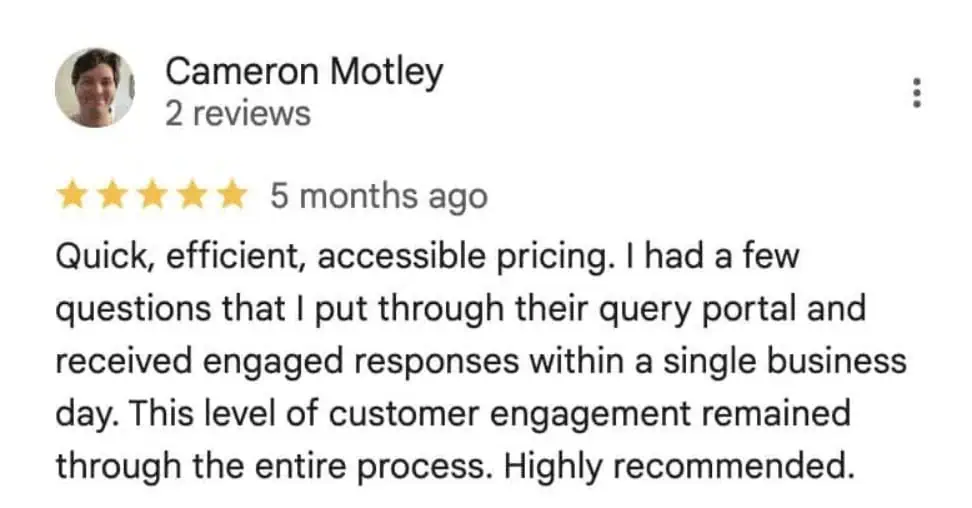
That accountability layer is the point. The goal is not to make AI disappear from healthcare. It is to keep an unverified machine-generated statement from becoming a clinical fact simply because someone was too busy to catch it.
The Bottom Line
We’re not saying that all AI outputs are bad. It offers a compelling pitch, and who wouldn’t want fast access to records?
The problem starts when that first draft is treated as final, especially in healthcare. That AI output is as good as useless if it’s inaccurate – and that only happens when the professional who should have checked it did not do their job.
For clinicians, it is much better to thoroughly check AI scribes than to spend time in court and risk losing your license. However, if you want to save time and effort, Ditto Transcripts is ready to help.
The safest rule is also the simplest: use AI for the draft if it fits your workflow. However, make sure a qualified human owns the record before it becomes final.
Ditto Transcripts is a Denver, Colorado-based transcription company providing fast, accurate, and affordable transcripts for individuals and organizations of all sizes. Ditto is FINRA-, HIPAA-, and CJIS-compliant. Call (720) 287-3710 today for a free quote.