

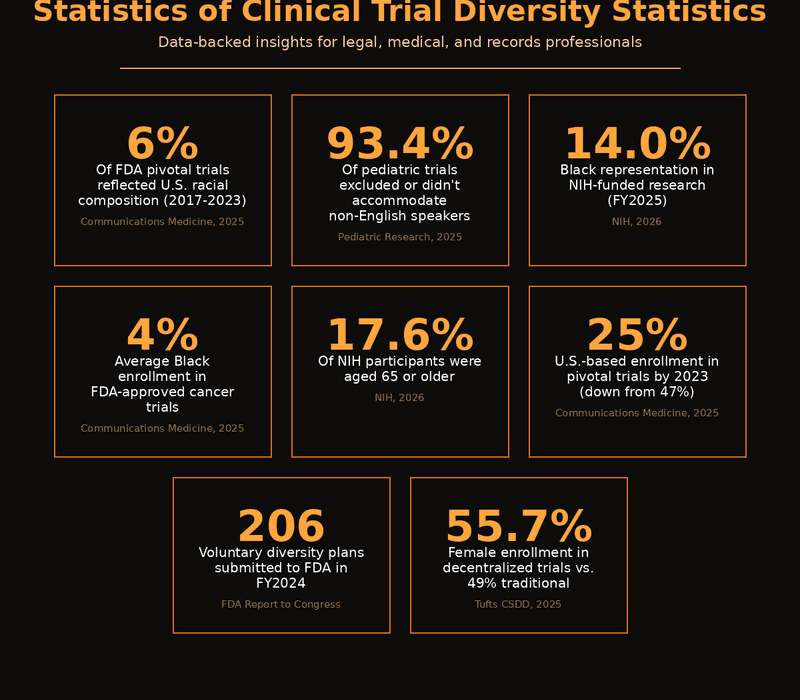
Only 6% of pivotal clinical trials approved by the FDA between 2017 and 2023 enrolled participants whose racial and ethnic composition matched the broader United States population. That finding, published in Communications Medicine in 2025, underscores a persistent gap between who participates in the research that shapes modern medicine and who ultimately receives the treatments it produces.
With nearly 40% of the U.S. population identifying as a racial or ethnic minority, and with the FDA’s own diversity guidance facing regulatory uncertainty, the data heading into 2026 tells a story of incremental gains, stubborn shortfalls, and new structural barriers that deserve close attention from researchers, sponsors, and policymakers.
Key Clinical Trial Diversity Statistics at a Glance
- Only 6% of 341 FDA pivotal trials (2017 to 2023) achieved enrollment reflecting U.S. racial and ethnic demographics Communications Medicine.
- In FY2025, 56.2% of U.S. participants in NIH-supported research were White, 14.0% were Black, and 12.6% were Hispanic NIH.
- 20.7% of race data in NIH-funded trials went unreported in FY2025 NIH.
- Black participant enrollment in FDA-approved cancer trials averaged just 4% Communications Medicine.
- Only 17.6% of NIH clinical research participants were aged 65 or older in FY2025 NIH.
- 93.4% of U.S. pediatric clinical trials either excluded non-English speakers or failed to address language access from 2019 to 2022 Pediatric Research.
- U.S.-based enrollment in pivotal trials dropped from 47% in 2020 to 25% in 2023 Communications Medicine.
- 206 voluntary diversity action plans were submitted to the FDA in FY2024, up 48% from FY2023 FDA.
- Decentralized clinical trials boosted female enrollment to 55.7% compared with 49.0% in traditional trials Tufts CSDD.
- 85% of U.S. cancer patients receive care at community-based centers, yet most clinical trials are conducted at major academic medical centers AACR.

Racial and Ethnic Representation Gaps
The most comprehensive recent analysis of trial diversity comes from a Communications Medicine study examining 341 Phase III trials behind 348 FDA-approved drugs from 2017 to 2023. The results are stark: only 6% of those trials enrolled participants at rates matching U.S. Census benchmarks for White, Black, Hispanic, and Asian populations simultaneously. Another 26% achieved representative enrollment for just one group, and 41% matched only two.
Black participant enrollment peaked in 2019 and has since declined. By 2023, only 23% of pivotal trials achieved representative Black enrollment. Hispanic enrollment fared no better, with only 30% of 2023 trials reaching adequate representation. Asian enrollment was the one bright spot, rising steadily and reaching representative levels in 81% of trials by 2023, though that increase correlated with trials conducted outside the United States rather than domestic recruitment improvements.
Cancer trials present an especially sharp disparity. The same analysis found that Black participants made up just 4% of cancer trial enrollment on average, despite Black Americans experiencing higher incidence and mortality rates for several common cancers. The AACR Cancer Disparities Progress Report noted that among states with the highest Black population percentages, three had no cancer immunotherapy trial openings at all.
Federally funded research tells a somewhat different story. NIH FY2025 enrollment data, covering more than 11 million participants worldwide, shows Black representation at 14.0% of U.S. participants, close to the Census proportion of approximately 13.4%. Hispanic enrollment stood at 12.6%, still below the roughly 18.7% population share. However, 20.7% of participants had their race listed as “unknown or not reported,” meaning the true picture remains incomplete.
Age and Sex Gaps in Trial Enrollment
Sex parity has improved considerably. NIH FY2025 data shows women made up 57.8% of participants in NIH-supported clinical research. The [FDA Drug Trials Snapshots](https://www.fda.gov/drugs/drug-approvals-and-databases/drug-trials-snapshots) program, which tracks demographics for newly approved drugs, has reported women averaging roughly 51% of participants in approval trials between 2014 and 2021. Both figures suggest that the historical underrepresentation of women in clinical research has begun to reverse, at least in aggregate.
Age representation remains a concern. Only 17.6% of NIH clinical research participants in FY2025 were 65 or older, even though adults in that age group account for a disproportionate share of chronic disease burden, medication use, and cancer diagnoses. The largest enrolled age cohort was 26 to 34 years old (12.3%), followed by 35 to 44 (11.9%). This tilt toward younger populations raises questions about whether trial results reliably predict how drugs will perform in older patients, who often have comorbidities and take multiple medications.
Language Access and Participant Communication
Language barriers create a largely invisible layer of exclusion. A 2025 analysis published in Pediatric Research examined 4,982 U.S. pediatric interventional trials registered on ClinicalTrials.gov from 2019 to 2022. The findings were striking: 93.4% of those trials either explicitly required English proficiency or provided no information about language accommodations. Only 6.6% offered services for non-English speakers. Among trials that did mandate English, just 14.4% provided a clinical justification for the requirement.
The problem was more pronounced in industry-sponsored trials, which were significantly less likely than federally funded studies to address language access. With more than 25 million U.S. residents classified as having limited English proficiency, this gap directly affects the communities that are already underrepresented in research.
The implications extend beyond enrollment. Informed consent documents, participant interviews, adverse event reporting, and follow-up communications all depend on accurate, clear language. When trial protocols exclude non-English speakers or fail to provide qualified interpretation, they lose access to communities that carry distinct disease burdens and pharmacogenomic profiles. Accurate transcription of multilingual participant interviews and clinical encounters is a practical prerequisite for inclusive trial design, and providers offering medical transcription services can support this process by ensuring that participant communications, regardless of language, are documented with the precision that regulatory submissions require.
Geographic Barriers and Trial Site Distribution
Where trials are conducted shapes who can participate. The AACR Cancer Disparities Progress Report found that nearly 85% of U.S. cancer patients receive their care at community-based practices, yet the majority of clinical trials are conducted at major academic medical centers. For patients in rural areas or regions without research hospitals, enrolling in a trial can mean traveling hundreds of miles, taking time off work, and arranging lodging.
The geographic challenge also has a global dimension. According to the Communications Medicine analysis, U.S.-based enrollment in FDA pivotal trials dropped from 47% in 2020 to just 25% in 2023. Sub-Saharan Africa and much of Latin America host fewer than 3% of pivotal trial sites, despite populations in those regions carrying genetically relevant drug-metabolism variants that affect treatment outcomes. As trials shift overseas, the already limited domestic enrollment of Black and Hispanic participants erodes further, since U.S.-based trials have historically been the strongest driver of Black enrollment (averaging 17.7% in 100% U.S.-based trials versus lower rates in international studies).
The Regulatory Landscape: FDA Diversity Action Plans
Congress took a significant step in December 2022 when it passed the Food and Drug Omnibus Reform Act (FDORA), which required sponsors of Phase III and other pivotal trials to submit diversity action plans with enrollment targets disaggregated by race, ethnicity, sex, and age. The FDA’s Report to Congress covering FY2023 and FY2024 documented growing voluntary compliance: 345 diversity plans were submitted across the three reviewing centers, with device submissions increasing 300% year over year and drug submissions rising 30%.
The regulatory trajectory shifted in January 2025. As reported by AJMC, the FDA removed its draft diversity guidance from its website on or around January 23, 2025, following an executive order curtailing federal DEI programs. The draft guidance, first issued in June 2024, had outlined how sponsors should set enrollment goals and monitor progress. Its removal occurred without public notice, leaving hundreds of sponsors who had already submitted voluntary plans uncertain about the path forward. As of mid-2026, final guidance has not been published, and the statutory deadline of June 2025 has passed without resolution.
Decentralized Trials: A Path Toward Better Representation
One structural change showing measurable results is the shift toward decentralized clinical trials (DCTs), which allow participants to complete some or all trial activities remotely through telehealth visits, local labs, and home-based monitoring. A Tufts Center for the Study of Drug Development analysis of 69 clinical trials found that DCT-enabled studies enrolled Asian participants at 20.9% compared with 14.2% in traditional trials. American Indian and Alaska Native enrollment nearly quadrupled, rising from 0.5% to 1.9%. Female participation reached 55.7% in DCTs, compared with 49.0% in site-based studies.
The effect was not uniform across all groups. Black and African American enrollment showed no significant difference between DCT and traditional trial formats, suggesting that remote access alone does not address all the barriers facing Black communities, which include historical mistrust, provider bias, and structural inequities in healthcare access. Decentralized designs are a useful tool for broadening participation, but not a complete solution.
Emerging Trends and What’s New in 2026
Several developments are shaping the clinical trial diversity landscape as of 2026. The NIH release of FY2025 enrollment data, covering more than 11 million participants, provides the most granular federal picture of trial demographics to date. The persistent 20.7% rate of unreported race data signals that data collection infrastructure, not just recruitment strategy, needs investment.
The regulatory picture remains unsettled. With FDA diversity guidance in limbo, the voluntary compliance model continues. Some sponsors are maintaining their diversity action plans regardless of the guidance status, recognizing that representative enrollment strengthens the clinical evidence base for their products. Trials with Breakthrough Therapy designation have shown more balanced enrollment across racial and ethnic groups, according to the Communications Medicine analysis, offering a potential model for other approval pathways.
Meanwhile, the rapid expansion of decentralized trial elements is removing some physical access barriers but has yet to move the needle on Black enrollment. Community-based participatory research, trusted messenger programs, and partnerships with community health centers are emerging as complementary strategies that address the trust and information gaps that technology alone cannot close. Whether these approaches scale quickly enough to reverse the declining trends in domestic trial enrollment remains one of the central questions in clinical research heading into 2027.
How Ditto Transcripts Helps
Ditto Transcripts helps clinical research teams document participant interviews, informed consent conversations, and multilingual trial communications with human-reviewed transcription under HIPAA-compliant handling. Accurate documentation supports regulatory submissions and helps ensure that every participant’s voice is captured precisely. Explore medical transcription services to see how it works.