
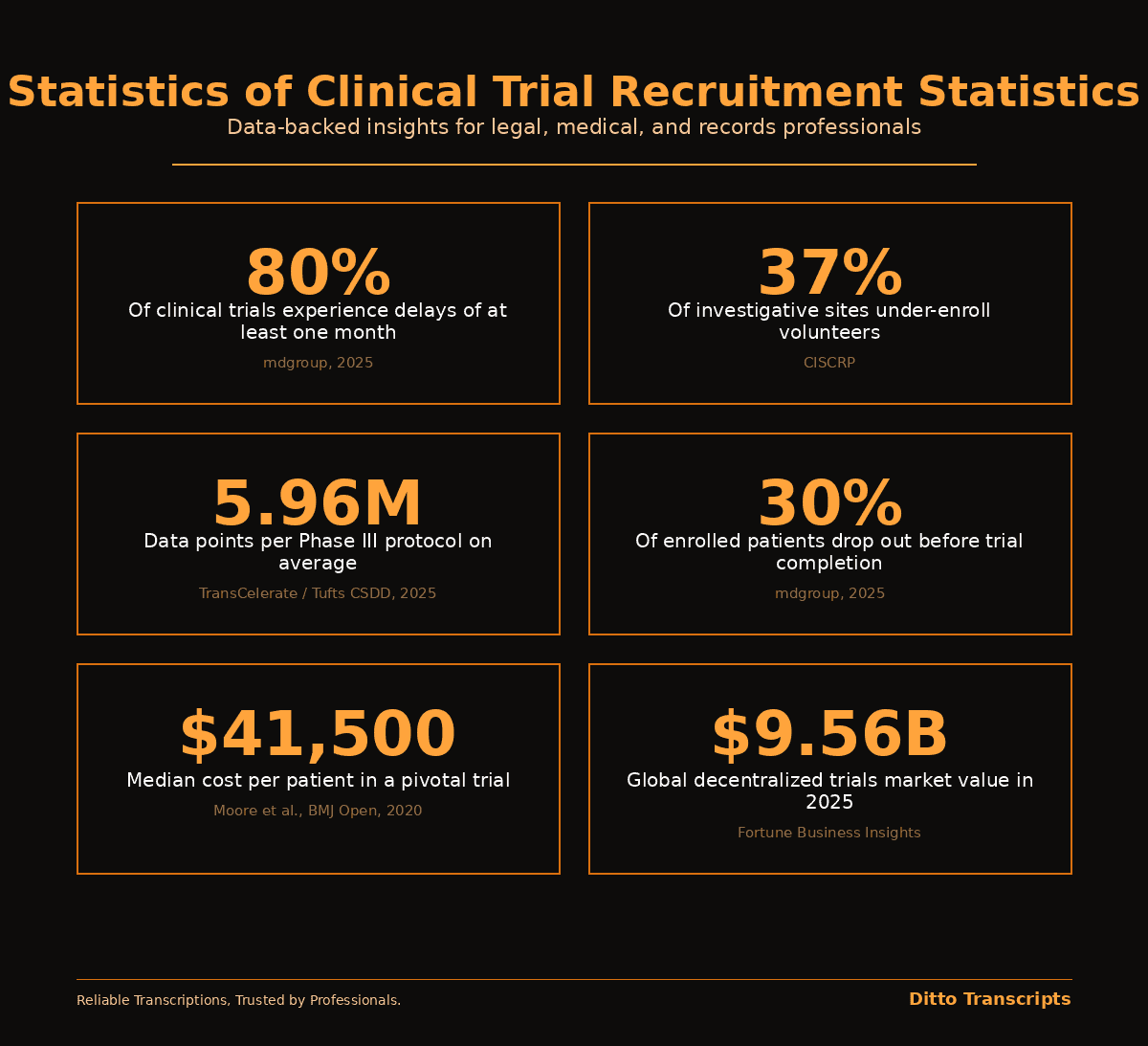
Patient recruitment remains the single largest operational bottleneck in clinical research. According to mdgroup, 80% of clinical trials experience delays of at least one month, with recruitment shortfalls driving most of those setbacks. Rising protocol complexity, growing documentation burdens at investigative sites, and persistent gaps in diversity and patient awareness continue to inflate costs and threaten study viability. The statistics below draw on the most current industry data to show where clinical trial recruitment stands in 2026, what it costs when enrollment falls behind, and where sponsors and sites are focusing their efforts to close the gap.
Key Clinical Trial Recruitment Statistics at a Glance
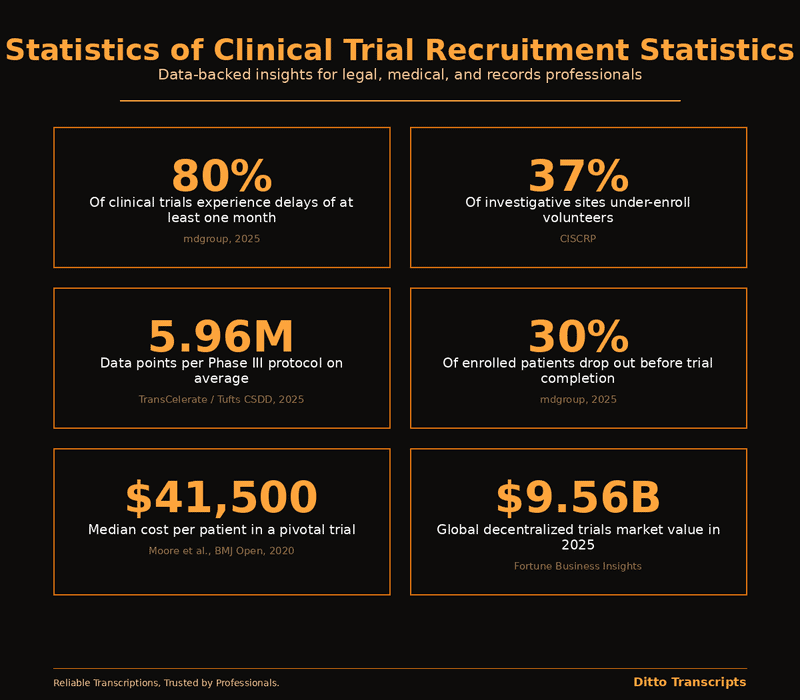
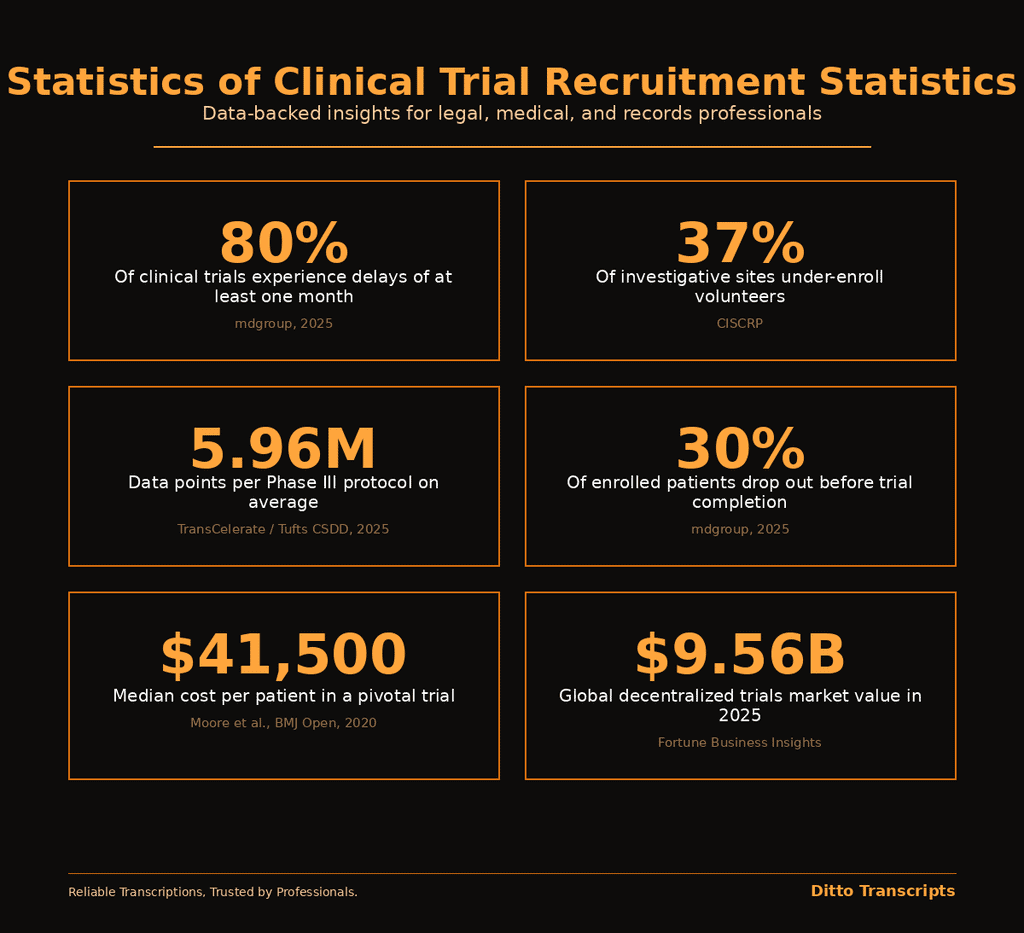
- 80% of clinical trials experience delays of at least one month, according to mdgroup.
- 37% of investigative sites under-enroll volunteers, and 11% enroll zero patients, per CISCRP.
- Between 2018 and 2021, 82% of Phase III protocols underwent at least one substantial amendment, per the Tufts Center for the Study of Drug Development.
- Protocol amendments increased 113% between 2013-2015 and 2018-2021 Tufts CSDD.
- Phase III protocols now average 5.96 million data points per study, with 32.5% classified as non-core or non-essential TransCelerate BioPharma and Tufts CSDD, 2025).
- 30% of enrolled patients drop out before trial completion mdgroup, 2025.
- Dropout rates increased 105% from 2010 to 2020 Tufts CSDD.
- Average cost to recruit one patient: $6,533. Replacing a dropout costs $19,533 mdgroup, 2025.
- Median cost per patient in a pivotal trial: $41,500 Moore et al., BMJ Open, 2020.
- The global decentralized clinical trials market reached $9.56 billion in 2025 Fortune Business Insights.
Protocol Complexity and the Recruitment Bottleneck
Clinical trial protocols have grown substantially more complex over the past decade, and that complexity is directly slowing enrollment. Between 2010 and 2020, the number of endpoints per protocol nearly doubled, procedures per protocol increased 40.6%, and the volume of data points collected tripled, according to the Tufts Center for the Study of Drug Development.
More procedures translate into more inclusion and exclusion criteria, which narrow the pool of eligible patients at every site. Enrollment duration (the time between first and last patient visit) increased 36.9% over the same period, and the time from protocol approval to first patient visit grew 27.2%, per Tufts CSDD.
Protocol amendments compound the problem. Between 2018 and 2021, 82% of Phase III protocols underwent at least one substantial amendment, with a mean of 3.5 amendments per protocol. That represents a 113% increase from 2013-2015, when 66% of protocols carried amendments averaging 2.3 each, according to Tufts CSDD. Each amendment triggers re-screening, re-consent procedures, and query remediation at every active site, consuming coordinator hours and delaying enrollment timelines.
A September 2025 study by TransCelerate BioPharma and Tufts CSDD, analyzing 105 Phase II and III protocols across 14 biopharmaceutical companies, quantified the scale of the problem. Phase III protocols now average 5.96 million data points per study. Nearly one-third (32.5%) of data collected per patient in Phase III falls into non-core or non-essential categories. In non-oncology trials, that figure reaches 40%. Reducing unnecessary data collection could shorten visit times and simplify eligibility requirements, easing two of the most persistent recruitment barriers.
Site Burden, Screen Failures, and Documentation Overhead
Even when patients are willing to participate, the activation and screening process eliminates many of them. Only 62% of investigative sites in North America successfully activate, meaning nearly four in ten sites that agree to participate never enroll their first patient, according to the Tufts Center for the Study of Drug Development. Among sites that do activate, 37% under-enroll relative to their targets, and 11% fail to enroll a single volunteer, per CISCRP.
A significant share of the site burden comes from documentation. Informed consent forms in oncology trials now average 7,471 words, with the longest forms running to 33 single-spaced pages and exceeding 12,000 words, according to SOCRA. Modern consent packages can include up to five separate documents covering sub-studies, pharmacogenetics, pharmacokinetics, HIPAA privacy provisions, and data sharing agreements. This volume requires careful preparation, review, and transcription at every stage of the screening and consent process.
Accurate medical transcription of patient interactions during screening, informed consent discussions, and adverse event reporting directly supports site efficiency and regulatory compliance. Documentation errors in these areas can trigger protocol deviations, audit findings, or delays in site activation, all of which compound the recruitment challenge.
The Cost of Delayed Enrollment
Recruitment delays carry steep financial consequences. According to mdgroup, sponsors face potential losses of $600,000 to $8 million per day of trial delay, depending on the therapeutic area and competitive landscape.
At the patient level, recruiting a single participant costs an average of $6,533, per mdgroup. When a patient drops out and must be replaced, that figure climbs to $19,533. For Phase III trials specifically, replacement costs range from $75,000 to $150,000 or more per patient when accounting for the full operational impact, including lost data, extended timelines, and additional site monitoring.
A 2020 cross-sectional study published in BMJ Open by Moore et al., analyzing 225 pivotal trials supporting 101 FDA-approved drugs (2015-2017), found a median per-patient cost of $41,500, with an interquartile range of $29,900 to $75,000. The overall cost of a single Phase III pivotal trial ranged from $12 million to $33 million, with a median of $19 million.
The industry-wide spending picture reflects this escalation. Total spending on CRO and technology vendor services grew from $10.4 billion in 2000 to $78.6 billion in 2020, according to the Tufts Center for the Study of Drug Development. Investigative site costs rose from $5.9 billion to $15.3 billion over the same period.
Diversity and Representation Gaps
Recruitment challenges are not evenly distributed across populations. According to the Tufts Center for the Study of Drug Development, Black and African-descent participants achieve only one-third of their proportional representation in clinical trials as of 2020.
The FDA’s Report to Congress on Diversity Action Plans, covering fiscal years 2023 and 2024, shows growing industry attention to the problem. Voluntary diversity action plan submissions to the Center for Drug Evaluation and Research (CDER) increased from 124 in FY 2023 to 161 in FY 2024. The Center for Devices and Radiological Health (CDRH) saw submissions jump from 6 to 24 over the same period. These plans remain voluntary for now; mandatory requirements under the FDA Omnibus Reform Act (FDORA) are still being phased in.
Patient awareness is a compounding barrier. According to CISCRP, 70% of potential participants have never considered clinical trials as a treatment option when speaking with their doctor. Yet among those who do participate, 94% say they would do so again, suggesting that an experience gap, rather than negative outcomes, is the primary obstacle to broader enrollment.
Retention and the Dropout Problem
Recruitment is only half the equation. Retaining patients through the full duration of a trial is equally critical. According to mdgroup, 30% of enrolled patients drop out before completing a trial.
The problem has been intensifying. The [Tufts Center for the Study of Drug Development found that dropout rates increased 105.1% between 2010 and 2020, a trend closely linked to rising protocol complexity. More procedures, longer visit durations, and heavier data collection burdens wear on participants, particularly those managing chronic conditions or traveling long distances to study sites.
The financial impact of each dropout extends beyond replacement recruitment costs. Lost data points, extended enrollment windows, and reduced statistical power can compromise the entire study, forcing sponsors to add sites, amend protocols, or restart enrollment phases entirely.
Emerging Trends and What’s New in 2026
Several developments are reshaping clinical trial recruitment heading into 2026.
- Decentralized and hybrid trials. The global decentralized clinical trials (DCT) market reached $9.56 billion in 2025 and is projected to grow to $29.37 billion by 2034 at a 13.2% compound annual growth rate, according to Fortune Business Insights. North America accounts for 42.46% of the global market. By bringing study procedures closer to patients through telehealth visits, home nursing, and remote monitoring devices, decentralized approaches directly address the geographic and logistical barriers that prevent many eligible patients from participating.
Regulatory momentum on diversity. The FDA’s FDORA provisions are pushing sponsors to submit diversity action plans for pivotal trials. Voluntary plan submissions are already rising, up 30% year over year at CDER, per the FDA’s Report to Congress. As mandatory requirements take effect, sponsors will face increasing pressure to demonstrate representative enrollment across race, ethnicity, age, and sex.
Protocol optimization. The 2025 TransCelerate BioPharma and Tufts CSDD findings on non-essential data collection have built a clear business case for protocol streamlining. Eliminating the roughly one-third of Phase III data that serves no core regulatory purpose could reduce site burden, shorten patient visits, and improve both enrollment speed and retention rates.
AI-assisted patient matching. Sponsors and CROs are increasingly deploying machine learning models to match patients with trials based on electronic health records, genomic profiles, and real-world data. These tools aim to reduce screen failure rates and accelerate enrollment at qualifying sites by identifying eligible patients earlier in the process.
How Ditto Transcripts Helps
Ditto Transcripts helps clinical research sites reduce documentation backlogs with human-produced, HIPAA-compliant medical transcription for screening visits, informed consent recordings, and adverse event reports. Transcripts are reviewed by U.S.-based human transcriptionists and returned in the format your workflow requires.