


Verbatim transcription captures spoken language exactly as it is heard. That can include filler words, false starts, repeated phrases, interruptions, pauses, laughter, coughing, and other sounds that help show the full context of a recording.
This level of detail is important when every word matters. Attorneys, investigators, researchers, educators, healthcare professionals, and media teams may need verbatim transcripts for review, documentation, analysis, or evidence. For example, legal transcription services often require highly accurate transcripts because even a small omission can change how a statement is understood.
In this article, you’ll learn:
- What verbatim transcription is
- The difference between true verbatim and clean verbatim transcription
- When verbatim transcripts are useful
- Why automated transcription is risky for verbatim work
- How Ditto Transcripts supports accurate verbatim transcription
What Is Verbatim Transcription?
Verbatim transcription is the process of converting audio or video into text while preserving spoken words as closely as possible.
Unlike standard transcription, verbatim transcripts do not simply clean up speech for readability. Depending on the client’s needs, it may include filler words, repeated words, incomplete sentences, stutters, pauses, interruptions, nonverbal sounds, and relevant background noises.
A verbatim transcript may capture phrases such as:
- “Um”
- “Uh”
- “You know”
- “I mean”
- “Like”
- “Well”
- Repeated words
- False starts
- Pauses
- Laughter
- Sighs
- Coughing
- Overlapping speech
These details can help readers understand what was said and how it was said.
Verbatim transcription is commonly used in legal, academic, medical, research, law enforcement, media, and investigative settings. It can be especially helpful in trial transcription services, where exact language, pauses, and interruptions may matter during review.
True Verbatim vs. Clean Verbatim Transcription
Not all verbatim transcripts are the same. The two most common options are true verbatim and clean verbatim, also called intelligent verbatim.
True Verbatim Transcription
True verbatim transcription captures everything in the recording as closely as possible. That includes spoken words, filler words, repeated words, false starts, grammar mistakes, stutters, interruptions, and relevant nonverbal sounds.
For example, a true verbatim transcript might read:
Speaker 1: Um, I, I don’t remember exactly, but I think it was, uh, around 8 p.m.
Speaker 2: You think?
Speaker 1: Yeah, I mean, I’m pretty sure. [sighs]
This type of transcript is useful when tone, hesitation, uncertainty, emotion, or speech patterns matter. In court transcription services, those details may help attorneys, judges, or reviewers understand the context behind a statement.
True verbatim transcription is also common in qualitative research, psychology, linguistics, focus groups, interviews, and law enforcement work. Pauses, hesitations, repetitions, and emotional cues may provide useful information beyond the words themselves.
The main drawback is readability. True verbatim transcripts can be harder to read because natural speech is rarely clean or perfectly organized. People pause, restart sentences, talk over one another, use fillers, and change direction mid-thought.
Clean Verbatim or Intelligent Verbatim Transcription
Clean verbatim transcription keeps the speaker’s meaning intact while removing unnecessary speech clutter.
A clean verbatim version of the earlier example might read:
Speaker 1: I don’t remember exactly, but I think it was around 8 p.m.
Speaker 2: You think?
Speaker 1: Yes, I’m pretty sure.
Clean verbatim removes filler words, repeated words, and false starts when they do not affect the meaning. The goal is to make the transcript easier to read without rewriting what the speaker said.
This format is often better for business meetings, webinars, lectures, interviews, podcasts, and general documentation. It is also useful for deposition transcription services when the client wants a clear record without preserving every filler word unless legally required.
Verbatim vs. Non-Verbatim Transcription
Verbatim and non-verbatim transcription serve different purposes. The right choice depends on how the transcript will be used.
| Transcription Type | What It Includes | Best Used For |
| True verbatim | Every spoken word, filler, repetition, false start, pause, and relevant sound | Legal review, research, psychology, linguistics, investigations |
| Clean verbatim | Spoken words with unnecessary fillers and false starts removed | Interviews, business meetings, and readable documentation |
| Non-verbatim | A cleaned-up version focused on meaning and readability | General content, summaries, internal records, presentations |
If the transcript will be analyzed closely, true verbatim may be the better choice. If the transcript needs to be readable and easy to use, clean verbatim or non-verbatim may be more practical.
Benefits of Verbatim Transcription
Verbatim transcription is not always necessary, though it is valuable when details matter.
Complete and Accurate Documentation
A verbatim transcript gives readers a more complete picture of the recording. It preserves the words spoken as well as the pauses, interruptions, and sounds that may help explain the speaker’s meaning or emotional state.
This is important in legal, medical, academic, research, and law enforcement settings, where transcripts may be reviewed multiple times by different people.
Better Qualitative Analysis
Researchers often need more than a polished version of what someone said. They may need to study how a person speaks, hesitates, responds, or reacts.
Verbatim transcription can support work in:
- Social sciences
- Linguistics
- Market research
- Consumer behavior studies
- Psychology
- Education
- Academic interviews
For academic transcription services, this level of detail can help preserve interviews, lectures, focus groups, and field recordings for later analysis.
Stronger Psychological and Behavioral Context
In psychology and psychiatry, pauses, hesitations, repeated phrases, and tone-related cues can be meaningful. A speaker’s uncertainty, stress, discomfort, or emotional response may appear in how they speak, not only in the words they choose.
A verbatim transcript can help preserve those details for review.
Improved Accessibility
Captions and subtitles often need more than spoken dialogue. For people who are deaf or hard of hearing, nonverbal sounds can provide important context.
A full verbatim transcript may include sounds such as:
- [laughter]
- [applause]
- [door closes]
- [phone rings]
- [music playing]
- [long pause]
These cues help make audio and video content more accessible and easier to understand.
Historical and Investigative Records
Verbatim transcripts can preserve speech as it happened. This matters for interviews, oral histories, investigations, public records, and events where exact wording may be reviewed later.
Language changes over time, and small details can matter. A verbatim transcript helps preserve the full record.
How Much Does Verbatim Transcription Cost?
Verbatim transcription usually costs more than standard transcription because it requires more time, listening, review, and formatting. The transcriptionist must capture filler words, repeated words, pauses, interruptions, and other relevant nonverbal sounds rather than clean them up.
At Ditto Transcripts, verbatim transcription is normally an additional $0.25 per audio minute. Final cost may depend on audio quality, turnaround time, number of speakers, timestamps, formatting needs, and file difficulty.
Legal transcription prices and other specialty rates can vary depending on the type of recording, the required level of accuracy, and whether the project requires rush delivery or special formatting. The best way to get accurate pricing is to speak with Ditto’s team before the project begins.
Ditto believes pricing should be clear. If a file requires additional work due to poor audio, multiple speakers, verbatim formatting, or other special requirements, we explain the options before moving forward.
Can AI Handle Verbatim Transcription?
Automated transcription tools are fast, although speed is not the same as accuracy. AI transcription tools offer only 61.92% accuracy, which is not reliable enough for professional verbatim transcription.
That accuracy can drop further when audio includes:
- Multiple speakers
- Background noise
- Cross-talk
- Strong accents
- Poor recording quality
- Fast speech
- Technical terms
- Legal or medical language
- Nonverbal sounds
- Speaker interruptions
Verbatim transcription requires judgment. A human transcriptionist can listen for context, identify speaker flow, mark unclear audio, and decide when to include pauses, sounds, or interruptions.
AI tools may produce a rough draft, yet they often miss the exact details that make verbatim transcription useful. They may also produce confident-looking errors, especially when speakers talk over one another or use industry-specific terminology.
For simple internal notes, automated transcription may be acceptable. For legal, medical, research, academic, law enforcement, or professional documentation, human transcription is the safer choice.
Manual Transcription vs. Automated Transcription
| Feature | Human Transcription | Automated Transcription |
| Accuracy | High-quality review | Lower and inconsistent |
| Context | Understands nuance and speaker meaning | Often misses context |
| Verbatim detail | Can capture pauses, fillers, interruptions, and sounds | Often omits or misreads details |
| Speaker identification | More reliable with review | Can confuse speakers |
| Best for | Legal, medical, academic, research, business, and sensitive recordings | Rough drafts and low-risk files |
| Final usability | Cleaner, more accurate, and easier to review | Often requires heavy editing |
The lowest-cost option is not always the most affordable. A cheap automated transcript may require hours of cleanup, especially if the recording is long, technical, or difficult to hear.
Verbatim or Clean Verbatim? Ask the Experts
Not every recording needs a full verbatim transcription. In many cases, clean verbatim is more useful because it keeps the meaning while making the transcript easier to read.
The right choice depends on the purpose of the transcript.
Choose true verbatim when every word, pause, repetition, interruption, or sound may matter. Choose clean verbatim when you want an accurate yet more readable transcript.
Ditto’s team can help you decide which format fits your project, budget, and deadline. It is also important to remember that transcriptionists do not rewrite meaning. We transcribe what is said. Clients may request cleaner formatting or removal of filler words, though transcription is not the same as editing or rewriting.
Why Clients Choose Ditto for Verbatim Transcription
Verbatim transcription requires careful listening, context, and accuracy. It is not only typing words from a recording. It preserves the details that make the transcript useful.
At Ditto Transcripts, we support attorneys, courts, researchers, healthcare teams, academic institutions, businesses, government agencies, law enforcement teams, media companies, and individuals who need accurate transcripts.
Clients choose Ditto because we offer:
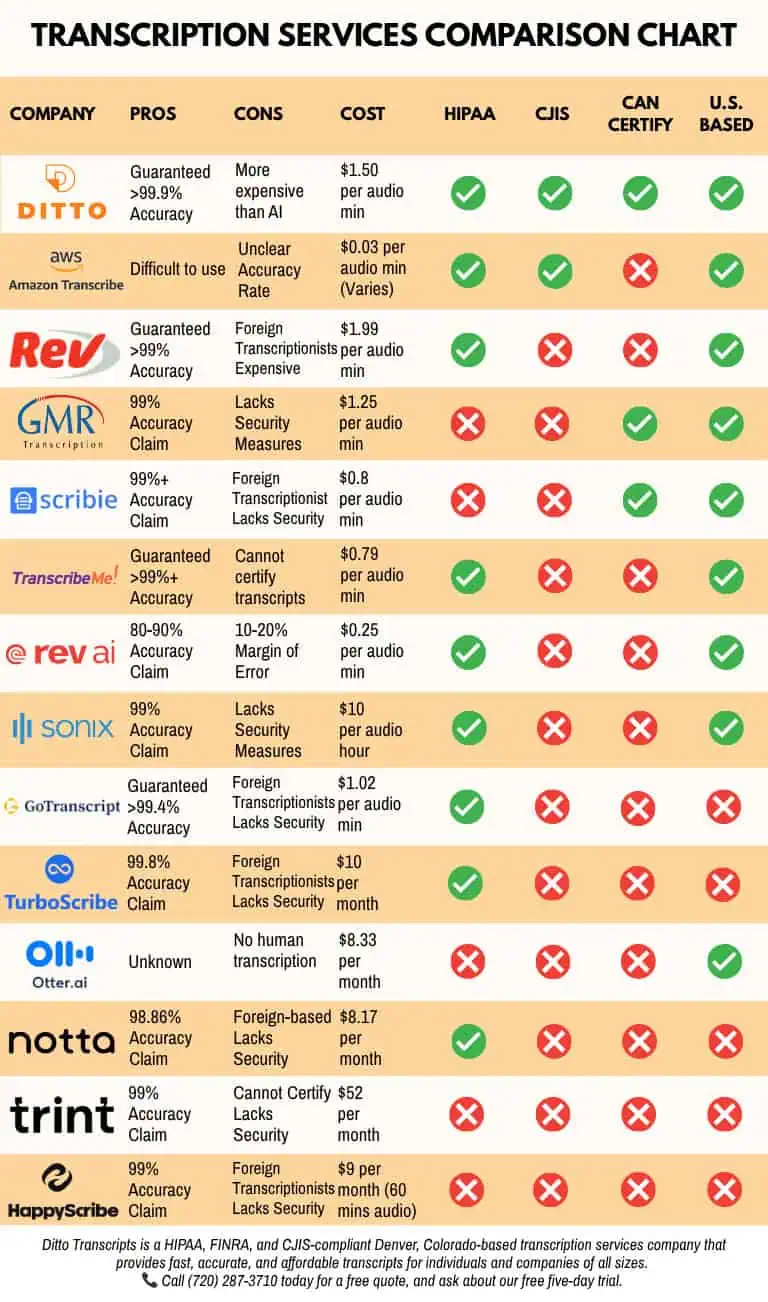
- Human transcriptionists: We use trained professionals who understand speech patterns, context, speaker flow, and industry-specific terminology.
- Verbatim transcription experience: Ditto can support true and clean verbatim transcription, timestamps, speaker labels, interviews, hearings, meetings, research files, and more.
- Secure handling: Sensitive files are handled through confidentiality-focused workflows designed to help protect recordings and transcripts.
- Compliance support: Ditto works with clients who need HIPAA-, CJIS-, and FINRA-compliant transcription support.
- Transparent legal transcription pricing: We explain rates, add-ons, turnaround options, and file requirements before work begins.
- Flexible turnaround: Clients can choose turnaround times based on urgency, recording length, file difficulty, and project requirements.
- No long-term contract required: Clients can use Ditto for a single recording, a single project, or ongoing transcription needs without being locked into unnecessary commitments.
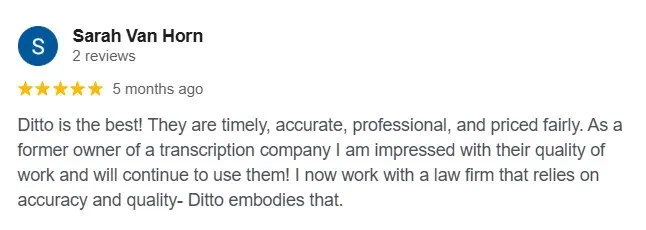
Our clients choose Ditto because they need transcripts that are accurate, secure, and ready to use—still comparing providers? Read our client testimonials to learn more about working with Ditto.
Get Accurate Verbatim Transcription With Ditto
Verbatim transcription is useful when every word, pause, hesitation, and sound may matter. It supports legal review, academic research, medical documentation, investigations, accessibility, and detailed recordkeeping.
Automated tools may be fast, yet they are not reliable enough for professional verbatim transcription. Human transcriptionists bring judgment, context, listening skill, and quality review to recordings that require accuracy.
Ditto Transcripts provides fast, accurate, secure, and affordable verbatim transcription for individuals and organizations of all sizes. Whether you need true verbatim, clean verbatim, timestamps, speaker labels, or help choosing the right format, our team can help.
Ditto Transcripts is a Denver, Colorado-based transcription services company that provides fast, accurate, and affordable transcripts for individuals and companies of all sizes and is FINRA-, HIPAA-, and CJIS-compliant. Call (720) 287-3710 today for a free quote.