


Sales managers are expected to meet quotas, review pipelines, support representatives, and find ways to improve results. Listening to hours of recorded calls often falls to the bottom of that list. A call transcript makes those conversations easier to review.
Instead of replaying an entire recording, a manager can search the transcript, find a key moment, and use it during the next coaching session.
In this article, you will learn:
- What a sales call transcript includes
- How transcripts can improve sales coaching
- How to build a useful library of successful calls
- Why AI transcripts still need human review
- What to look for in a transcription provider
What Is a Sales Call Transcript?
A sales call transcript is a written version of a conversation between a sales representative and a prospect or customer.
Depending on what the company needs, the transcript may include:
- Speaker names or labels
- Timestamps
- Questions and answers
- Product and pricing discussions
- Customer objections
- Commitments and next steps
- Relevant pauses or nonverbal sounds
Some teams want a clean transcript that removes filler words and repeated phrases. Others need the conversation captured word for word. Regardless, the same attention to detail expected in professional legal transcription services also matters in sales calls involving prices, contract terms, product claims, customer concerns, or regulated information.
Professional verbatim transcription may be useful when the exact wording matters, such as when a customer disputes a promise, price, condition, or statement made during the call.
The recording remains the original source. The transcript simply makes the conversation easier to search and review.
Why Transcribe Sales Calls?
Call recordings contain useful information, yet finding it can take time.
A manager looking for one objection or closing attempt may need to listen to a 45-minute recording from beginning to end. With a transcript, the manager can search for terms such as “budget,” “contract,” “competitor,” or “follow-up.”
This makes it easier to identify what happened without relying entirely on memory.
| Benefit | How the transcript helps |
| Performance review | Shows how the representative opened, questioned, explained, and closed |
| Faster coaching | Lets managers move directly to the useful parts of the call |
| Objection analysis | Reveals common concerns about price, timing, features, or competitors |
| Quality control | Helps identify inaccurate promises or missed disclosures |
| Better follow-up | Preserves names, needs, deadlines, and agreed next steps |
| Team training | Provides real examples for new and existing representatives |
| Customer insight | Shows the words customers use to describe their problems |
A transcript does not tell the manager whether a call was good or bad by itself. It provides the material needed for a more informed review.
Turn Long Calls Into Short Coaching Lessons
Sales representatives usually learn more from one clear example than from an hour of general advice.
Managers can use transcripts to pull short sections that show a specific skill or problem. For example:
- A strong opening question
- A missed chance to ask for more detail
- A clear product explanation
- An effective answer to a pricing concern
- A confusing transition
- An attempt to close the sale
- A customer signal that the representative overlooked
The coaching session can then focus on that exact part of the conversation.
This is more useful than telling a representative to “build better rapport” or “handle objections more confidently.” The transcript shows what was said and gives both people something specific to discuss.
Managers should also include successful moments. Coaching that only points out mistakes can quickly feel like punishment.
Use a Consistent Call Review Process
Random coaching sessions rarely produce consistent results.
A simple review structure helps managers compare calls fairly and gives representatives a better idea of what is expected.
The scorecard may cover:
- How the representative opened the call
- Whether useful discovery questions were asked
- How well the representative listened
- Whether the product was explained clearly
- How objections were handled
- Whether pricing and conditions were presented correctly
- Whether the next step was confirmed
The exact categories should match the company’s sales process.
A software company may place more weight on needs assessment and technical explanations. A financial company may focus more on required disclosures and the accuracy of the information provided.
The transcript should support the score, not replace the manager’s judgment. Tone, timing, and delivery may still require listening to the audio.
Build a Sales Win Library
A win library is a collection of successful calls or call sections that the team can use for training.
Instead of giving new representatives only a script, managers can show them how experienced sellers handled real conversations.
The library may be organized by:
- Product
- Industry
- Customer size
- Objection type
- Sales stage
- Competitor
- Deal value
- Representative
- Closing method
Each example should include a short note explaining why it was selected.
For instance, a transcript may show how a representative handled a prospect who thought the service was too expensive. The coaching note can explain which question changed the direction of the conversation and why the response worked.
The point is not to make every representative copy the same words. It is to show what a useful approach looks like in practice.
Encourage Peer Learning
Strong sales techniques should not remain with one top performer.
A good transcript allows the rest of the team to study how an experienced representative asks questions, explains value, handles silence, and moves the call forward.
Peer review can also make coaching feel less one-sided. Representatives may notice details that a manager misses because they deal with the same customers and objections every day.
Choose examples carefully. Sharing every successful call will create another large folder that nobody uses.
A smaller collection of well-labeled examples is usually more valuable.
Use Transcripts to Understand Customers
Sales call transcripts are not only useful for judging representatives. They can also show what customers care about.
By reviewing several transcripts, teams may find repeated questions or concerns involving:
- Price
- Implementation
- Contracts
- Security
- Support
- Product limitations
- Competitors
- Delivery times
- Internal approval
This information can help sales leaders improve scripts and training. Marketing teams may use it to create clearer content, while product teams may use it to identify repeated requests.
Still, a transcript should be interpreted in context. Ten calls do not necessarily represent an entire customer base.
Check the Rules Before Recording Calls
Before a call is recorded, the company should confirm which consent rules apply.
Federal law generally requires the consent of at least one party. Some states have stricter rules and may require consent from everyone on the call. Interstate calls can be more complicated because the participants may be located in states with different requirements.
The safer practice is usually to tell participants that the call is being recorded and obtain any consent required by law or company policy.
Companies should also decide:
- Which calls may be recorded
- How long recordings and transcripts are kept
- Who can access them
- Whether customers can request deletion
- How sensitive information is protected
- Whether transcripts may be used for training
Organizations selling to public agencies may also need government transcription services for procurement discussions, recorded meetings, interviews, or other official material that requires controlled handling.
Recording laws and privacy requirements can vary, so companies should obtain legal advice for their specific operations.
Can AI Be Trusted With Sales Calls?
AI transcription is fast. It can process a recording in minutes and create a draft that is useful for a quick internal reference.
However, depending on the system and the recording, AI transcription may be only 61.92% accurate.
Sales calls often contain the same conditions that cause automatic speech recognition to make mistakes:
- Product names
- Industry terms
- Prices and percentages
- Several speakers
- Strong accents
- Poor phone connections
- Background noise
- Interruptions
- Informal speech
- Names and email addresses
An error may completely change the meaning of a statement.
For example, an AI tool may confuse “fifteen” with “fifty,” remove the word “not,” or assign a customer’s statement to the sales representative.
These problems matter when managers score representatives or check what was promised to a customer.
AI may be helpful for a first draft. It should not automatically be treated as the final transcript of an important call.
Why Human Review Matters
A trained transcriptionist can listen to unclear sections more than once, check the surrounding discussion, identify speakers, and research unfamiliar terminology.
When a word cannot be understood, the transcriptionist can mark it as inaudible instead of making a confident guess.
Human review is especially useful for calls involving:
- Financial information
- Contract terms
- Healthcare products
- Legal services
- Government customers
- Complaints or disputes
- Regulated industries
- Several speakers
The sales manager should still check the most important sections against the recording. A transcript is a review tool, not a substitute for listening when tone or delivery matters.
Security Should Be Part of the Decision
Sales calls may contain names, phone numbers, payment discussions, business plans, contract details, and other confidential information.
Before sending recordings to a transcription provider, ask:
- Who will have access to the files?
- Where will the work be completed?
- Are subcontractors involved?
- How are recordings uploaded and stored?
- Do transcriptionists sign confidentiality agreements?
- When are files deleted?
- Can access be limited to approved users?
- What security standards does the provider follow?
Uploading a file through a secure page is only one part of the process. The recording should remain protected from the moment it is received until the work is returned and the file is deleted.
What to Look for in a Sales Call Transcription Provider
A useful transcript should save managers time, not create another document that needs to be completely rewritten.
Before selecting a provider, check:
- Whether trained humans review the full recording
- Whether the company can handle multi-speaker calls
- Whether speaker labels and timestamps are available
- Whether it understands your industry’s terminology
- Whether the finished format can match your workflow
- How corrections are handled
- How files are protected
- Whether pricing is explained before work starts
- Whether rush delivery is available
Companies should also confirm whether the provider can handle changes in volume. One month may involve ten calls, while the next may involve hundreds.
Why Clients Choose Ditto for Sales Call Transcription
At Ditto Transcripts, sales and customer calls are handled by trained human transcriptionists instead of being returned as unchecked AI output.
Here is what Ditto offers:
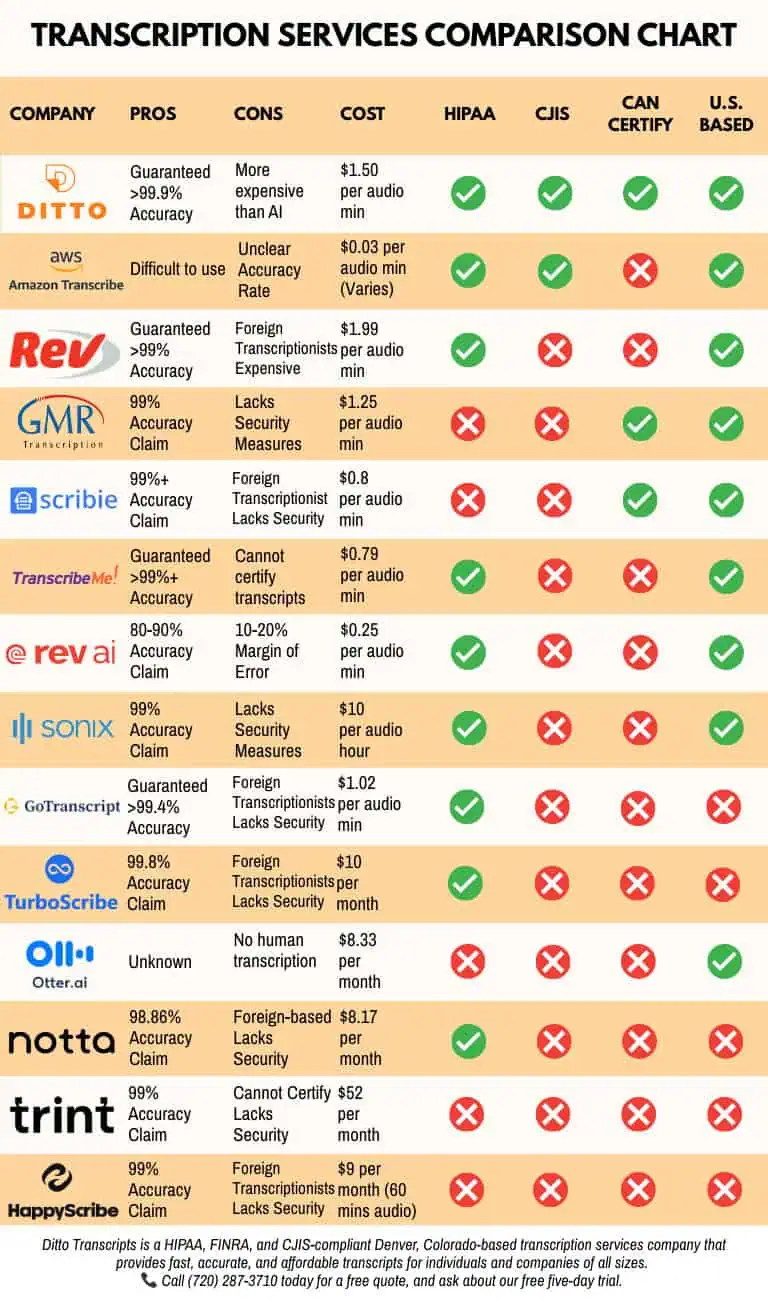
- Human-reviewed accuracy: Ditto guarantees 99% accuracy for completed human transcription projects.
- Business call experience: Ditto works with sales calls, customer service calls, conference calls, interviews, presentations, and financial discussions.
- U.S.-based transcriptionists: Projects are completed by professionals familiar with American English, business language, accents, and multi-speaker recordings.
- Speaker labels and timestamps: Clients can request formatting that makes it easier to locate important sections and identify participants.
- Clean or verbatim options: Ditto can remove unnecessary filler words or preserve every spoken word, depending on the purpose of the transcript.
- Secure handling: Ditto provides HIPAA-, CJIS-, and FINRA-compliant workflows for organizations handling sensitive information.
- Flexible turnaround: Standard, extended, and rush delivery options are available. Some rush files can be completed in as little as four hours, depending on the project.
- Clear transcription prices: Business transcription generally ranges from $1.50 to $5.00 per audio minute. The rate depends on the number of speakers, audio quality, turnaround time, and project requirements.
- No long-term commitment: Clients can submit one call or use Ditto for regular sales and customer recordings.
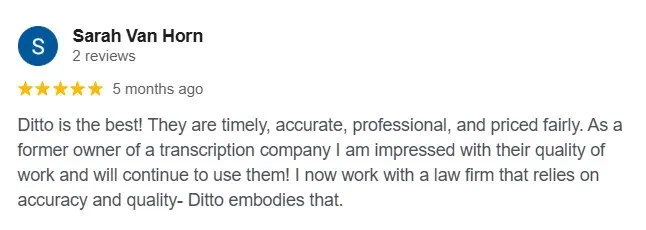
- Client feedback: Read Ditto’s testimonials to learn how customers describe its accuracy, responsiveness, turnaround time, and service.
Better Coaching Starts With Better Information
Sales calls contain more than a final yes or no. They show how representatives ask questions, explain value, respond to concerns, and move prospects toward a decision.
Recordings preserve those conversations. Transcripts make them easier to use.
Managers can find coaching moments faster, build stronger training material, and give representatives feedback based on what was actually said.
AI can create a quick draft. When accuracy, privacy, and context matter, trained human review remains the safer choice.
Ditto Transcripts helps sales teams turn recorded calls into accurate, searchable documents that can support coaching, quality review, and customer follow-up.
Ditto Transcripts is a Denver, Colorado-based transcription company providing fast, accurate, and affordable transcription services for organizations of all sizes. Ditto is HIPAA-, CJIS-, and FINRA-compliant. Call (720) 287-3710 today for a free quote.