
When transcribing recorded audio files, certain industries require fast turnaround times. For example, a lawyer that has an audio file that needs legal transcription can’t sit for too long, as it risks missing deadlines. Sometimes, results are needed as quickly as possible. Sometimes, bulk orders are required in the next couple of days. Which begs the question: How long does it take to transcribe 60 minutes of audio?
The reality is, it depends. Let’s talk about it.
In This Article You’ll Learn How:
- Transcription pricing models differ by line, page, audio minute, or flat fee. Knowing which one applies helps you avoid hidden costs.
- Audio quality, speaker count, and turnaround time are major pricing factors that directly affect your final bill.
- Transparent billing and accuracy guarantees are essential. Choosing a reputable provider like Ditto ensures U.S.-based professionals and legally admissible transcripts with 99.9% accuracy.
Average Time it Takes to Get 1 Hour of Audio Recordings Transcribed
The industry standard is that roughly one hour of audio takes about four hours to transcribe.
In the real world, though, that number varies.
Every transcriptionist has a different skill level. Every transcription provider has a different process. To drive the point further home, not every audio recording will have the same structure, flow, and complexity.
Ever had someone transcribe for the first time? I bet that was a joy to watch, because newbies usually take 6 to 8 hours to transcribe an hour of audio. That’s 50% to 100% longer. The more inexperienced a person is, the longer it will take.
Then there are other factors, such as typing speed, audio quality, number of speakers, background noise, familiarity with jargon, and more. I’ve seen (and done) court transcription with upwards of 40 to 50 speakers in one session.
The point is, while there’s a clean industry number – 4 hours for every hour of audio – each individual project will be different.
Why Transcribing 60 Minutes of Audio Takes So Long
Unlike typing from written text, transcription requires frequent pausing, rewinding, and close listening. Accuracy matters, especially for legal, medical, or business use.
A transcriptionist must:
- Listen carefully to every word
- Rewind unclear sections multiple times
- Identify speakers correctly
- Research unfamiliar terminology
- Format the transcript accurately
For instance, when two people talk at the same time during a meeting, or when a technical term is mentioned only once, a transcriptionist may need to replay that moment several times to confirm what was actually said. Small moments like these can quietly add up as recordings get longer, but that extra effort is what ensures the final transcript is clear, accurate, and reliable.
Estimated Transcription Time by Scenario
Below is a realistic breakdown of how long 60 minutes of audio may take under different conditions.
| Audio Type / Scenario | Performed By | Estimated Time |
| Single person, clear dictation | Professional | 2-3 hours |
| Two-person interview, clear audio | Professional | 3-4 hours |
| Three people, good quality audio | Professional | About 4 hours |
| Four or more people | Professional | 4-5 hours |
| Poor quality audio or heavy accents | Professional | 5-6+ hours |
Key Factors That Affect Transcription Speed
Several factors affect the time required to transcribe audio. Let’s break each of them down now and see how exactly they impact the workflow.
Audio Quality
Audio and video quality play a major role in how long transcription takes. When a recording includes background noise, unclear speech, or was captured using low-quality equipment, the transcriptionist has to spend more time replaying sections just to catch what is being said. Soft voices and older recordings can be especially tricky, since important words may fade in and out. In general, the cleaner the audio, the smoother and faster the transcription process will be.
Number of Speakers
Of course, the number of people speaking in a recording also affects turnaround time.
A single speaker allows for a steady workflow, since there is no need to pause and identify who is talking. Once multiple people are involved, things slow down. And even in the most formal of settings, it’s practically impossible for a conversation with that many people not to include speech overlaps.
That’s why transcriptionists must track speakers carefully, stop frequently, and replay sections where voices overlap. This is why court proceedings, panel discussions, and group meetings usually take longer to transcribe.
Speaker Accents and Speech Patterns
Accents and speaking habits can further influence transcription speed. Strong regional accents, fast-paced speech, or unclear grammar often require extra attention, even when the audio quality itself is good. Frequent filler words or uneven sentence structure can make it harder to produce a clean, readable transcript without slowing down to interpret meaning accurately.
Subject Matter Complexity
What is being discussed in the audio file matters just as much as how it sounds. Audio that includes legal, medical, or technical language takes longer to transcribe unless the transcriptionist already understands the subject. Someone hearing “Res ipsa loquitur” for the first time ever is likely going to think that they misheard the term, which will need further verification to be corrected.
When terminology is unfamiliar, time must be spent verifying terms and context. Transcribers with extensive industry experience can complete the jobs more quickly while maintaining a high degree of accuracy.
Transcriber Experience and Equipment
Experience, along with the right transcription software and equipment, makes a noticeable difference. Our professionals are trained to work efficiently and use equipment and transcription tools that support speed and accuracy, such as foot pedals for hands-free audio control and high-quality headphones for clarity. Without this setup, transcription becomes far more time-consuming. In many cases, someone without professional experience may take 8 or even 10 hours to complete the same project.
Transcribing 60 Minutes of Audio: Average Person vs Professional
Here is how transcription speed typically compares:
| Transcriber Type | Transcription Time for 60 Minutes of Clear Audio |
| Average person | 8 to 12 hours |
| Professional transcriptionist | About 4 hours |
| Highly experienced professional | 2.5 to 3 hours |
Professionals are not just faster, they’re also far more accurate. This difference becomes especially important when verbatim transcription is required, where every word, pause, and utterance must be captured exactly as spoken. In these cases, speed must never come at the expense of precision, making experienced professionals the clear choice.
What Types of Audio Take the Longest to Transcribe?
Some types of recordings consistently take longer to transcribe due to their complexity and structure.
Court hearings and depositions often take longer because they involve multiple speakers, formal language, and a high standard for accuracy.
Group meetings and panel discussions can also be time-intensive, especially when participants interrupt one another or speak simultaneously.
Noisy field recordings add another layer of difficulty, as background sounds can obscure speech and force repeated playback. Audio that requires timestamps, captions, or detailed speaker labeling further increases transcription time due to the added formatting and review involved.
Aside from speed, these situations often prioritize accuracy. A single mistake can change the meaning of what has been said.
That is the biggest risk, particularly in the professional setting where lives are at stake. One tragic case is the wrongful death case involving a hospital in Alabama, where a medical transcription error incorrectly recorded a physician’s dictated insulin dosage as 80 units instead of 8.
The inaccurate transcription resulted in a fatal overdose and ultimately, an unnecessary death. A jury later awarded $140 million in damages, underscoring the catastrophic consequences of transcription errors when clinical care depends on precise records.
These complex projects demand careful attention and thorough quality control to ensure the final transcript is accurate, clear, and usable. That is why many organizations rely on medicolegal transcription services, where trained professionals focus on capturing every spoken detail correctly to support critical decision-making and avoid life-altering errors.
Transcription Turnaround Time and Costs for Transcribing 60 Minutes of Audio
Professional transcription services often charge by the audio minute rather than by the hour of labor. For one-hour audio or video files, the total cost is typically influenced by the factors mentioned earlier: the complexity of the audio, the speed at which the transcript is needed, and whether industry-specific expertise is required. With all that, Ditto offers competitive transcription pricing for general, business, legal, law enforcement, and academic projects.
|
|
Rush Price |
Standard Pricing |
Extended Pricing |
|
Category A |
$2.25 / audio min. |
$1.75 / audio min. |
$1.50 / audio min. |
|
Category B |
$5.00 / audio min. |
$3.00 / audio min. |
$2.50 / audio min. |
You might be wondering what these transcription categories actually mean in practice. Here is a simple breakdown.
Category A generally covers straightforward meeting recordings. This includes single-speaker dictation or standard one-on-one interviews recorded digitally.
For example, professionals often use dictaphones or smartphones to record notes or an important meeting. When recorded in a secluded or stress-free environment, they are often clear and easy to follow, which allows them to be transcribed quickly, sometimes the same day or within a few days.
Specifically, one-on-one meetings, whether formal or informal, such as deposition preparation sessions or client interviews, also fall into this category.
Category B applies to more complex audio.
This includes recordings with three or more people, files with noticeable background noise, or situations where voices are difficult to hear due to poor recording quality or low speaking volume.
Common examples include depositions with multiple attorneys, conference calls, or presentations that are jargon-heavy. Court hearings, seminars, and workshops also fall under this category. These recordings take longer to transcribe because they require careful speaker identification and repeated review.
These cases often have audio issues or clarity issues that slow the transcription process. This could be loud background sounds like music, wind, or street noise coming through an open window, or any condition that makes it harder to clearly hear the speakers.
Looking for Accurate Transcription Services? Ditto’s Got Your Back
Now you know that it takes 60 minutes to transcribe an hour of audio. But when accurate transcription, speed, and reliability matter, choosing the right partner makes all the difference. Ditto Transcripts provides professional transcription services for any length of audio or video recordings, complex audio, and even high-stakes use cases.
Choosing Ditto means working with a team that understands both your time investment behind the transcription project and the importance of getting every word right. For us, it doesn’t matter whether we’ll transcribe recorded university lectures, business recordings, or even a highly sensitive legal case; we guarantee that you will get a highly accurate transcript every time.
We offer:

Accuracy
We don’t just claim it. Ditto Transcripts guarantees 99% accuracy on every project, capturing every spoken detail precisely. The cherry on top? Our transcripts are legally admissible, making them the standard for legal, medical, and business use where errors are not an option.
Human Expertise
Ditto relies on experienced transcriptionists, not automated tools. Our team is trained to understand multiple speakers, technical jargon, and nuanced speech patterns regardless of the industry, ensuring that transcripts reflect the true intent and flow of the conversation.
Turnaround Time
We respect your deadlines. Transcripts are delivered within agreed-upon timeframes, and you can choose between standard or expedited turnaround options depending on your needs. All of that without sacrificing accuracy.
Security
We recognize that many recordings contain sensitive information. Ditto Transcripts is HIPAA, CJIS, and FINRA compliant, so your data remains protected and confidential at all times. No need to worry about potential leaks.
Affordability
We offer transparent, competitive pricing designed to fit a wide range of budgets. Our services are flexible, so getting a transcript, unlike what many people think, would not break your bank.
24/7 Customer Service
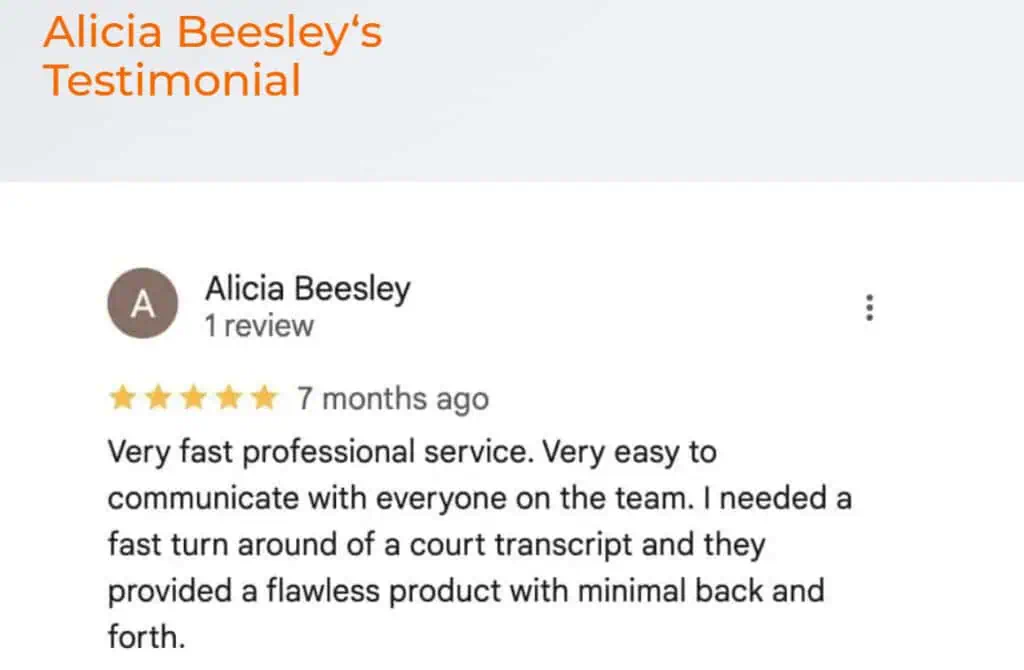
Our customer support is handled by real people, not AI. We genuinely understand your requirements, answer questions, and ensure a smooth experience from submission to delivery. And the results speak for themselves. Our client testimonials highlight why so many organizations trust us:
If you are managing long recordings and need dependable, accurate transcripts, Ditto Transcripts helps you save time and money while reducing risk so you can focus on what matters most.
Ditto Transcripts is a Denver, Colorado-based FINRA, HIPAA, and CJIS-compliant transcription services company that provides fast, accurate, and affordable transcripts for individuals and companies of all sizes. Call (720) 287-3710 today for a free quote.