
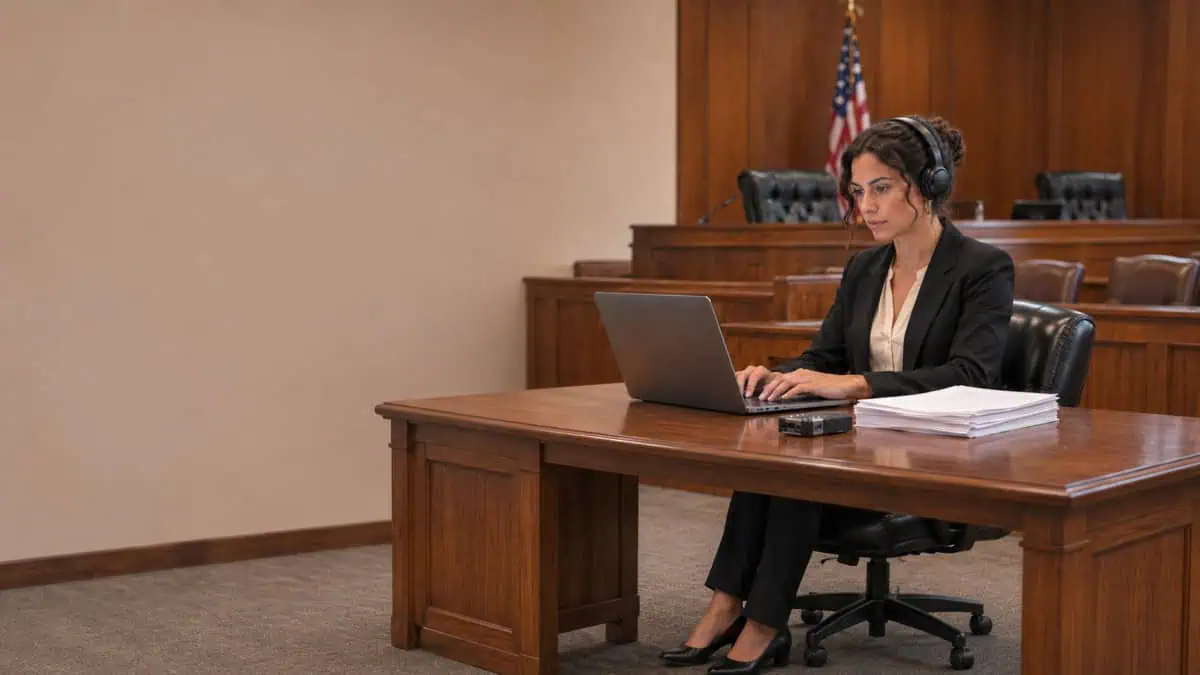
A court hearing may last only a few hours, whereas getting its written transcript can take days or even weeks.
Court transcription converts recorded legal proceedings into written documents, allowing attorneys and judges to review exactly what was said. For legal professionals, reliable legal transcription services can make a difference when preparing for appeals, reviewing testimony, or meeting filing deadlines.
Still, how long does the process actually take?
The answer depends on who prepares the transcript, the recording’s complexity, and how quickly you need it. Understanding those factors can help you plan ahead and choose a service that meets your court’s requirements.
In this article, you’ll know:
- How long court transcripts take and which turnaround options are available.
- Why court transcripts matter for reviewing testimony and preparing appeals.
- What certification means and which court requirements to confirm.
- How court transcriptionists differ from court reporters.
- What affects transcription costs, including audio quality, complexity, and delivery speed.
How Long Does It Take to Get a Court Transcript?
Court transcript turnaround times vary considerably, depending on the provider and the circumstances.
For example, under the federal judiciary’s court reporting guidelines, ordinary transcripts have a 30-calendar-day delivery schedule. Expedited options are also available, including seven-day, three-day, and daily transcripts, depending on the applicable requirements.
However, not every transcript must take that long.
Ditto Transcripts offers court transcription services with several turnaround options:
| Service | Turnaround time |
| Extended | 6-10 business days |
| Standard | 3-5 business days |
| Rush | 1-2 business days |
| Same-day | Subject to availability and project requirements |
For particularly urgent recordings, Ditto may accommodate turnaround times as short as four hours. However, Ditto must confirm availability and pricing beforehand.
Longer recordings, multiple speakers, and poor audio quality can extend the transcription process, especially when additional review is necessary.
Why Are Court Transcripts Necessary?
Court proceedings involve extensive discussions, witness testimony, objections, and rulings. Remembering every detail isn’t realistic, especially in cases with multiple hearings.
That’s why accurate court transcripts are valuable.
Attorneys use them to revisit statements, identify inconsistencies, and prepare arguments. Judges and appellate courts may also rely on transcripts when reviewing earlier proceedings.
An accurate transcript preserves the spoken record so legal professionals don’t have to rely on memory alone.
However, court transcripts aren’t automatically available to everyone. Access may depend on filing procedures, confidentiality restrictions, and whether the record has been sealed or redacted.
What Are Certified Court Transcripts?
Certified court transcripts include authentication confirming that the written document accurately reflects the recorded proceedings.
Certification requirements depend on the court and jurisdiction.
For federal proceedings, authorized court reporters and designated transcription providers must follow the judiciary’s requirements for transcript preparation and certification.
Certification may include identifying the responsible transcriber and attesting to the transcript’s accuracy.
Importantly, a transcription company’s certification doesn’t automatically make a document an official court transcript. The provider must satisfy the applicable court’s authorization, formatting, and certification requirements.
That’s why confirming these requirements before ordering is essential.
Court Transcriptionists vs. Court Reporters: What’s the Difference?
Court reporters and transcriptionists perform related yet different roles.
Court reporters typically capture proceedings as they happen, often using stenographic equipment. Some courts also use electronic recording systems operated by authorized personnel.
Transcriptionists, meanwhile, generally work with existing recordings, converting spoken testimony into written documents.
Here’s the main distinction:
- Court reporters: Record proceedings as they occur and prepare or arrange transcripts under applicable court rules.
- Court transcriptionists: Convert previously recorded proceedings into written transcripts, following the required formatting and certification standards.
Neither method is automatically better.
A stenographer may be necessary for proceedings requiring live reporting, while transcription from an existing recording can be practical when that recording is authorized and available.
For complex hearings and trials, professional trial transcription services can help prepare written records from recordings, subject to the court’s requirements.
How Much Do Court Transcriptions Cost?
Transcription prices depend on recording length, audio quality, number of speakers, and delivery speed.
At Ditto Transcripts, legal transcription prices range from $1.50 to $5.00 per recorded minute, depending on the project’s complexity and turnaround requirements. A $100 project minimum also applies.
Court hearings typically fall into the more complex pricing category because several people may be speaking.
Additional requirements, such as timestamps or full verbatim transcription, can affect the final cost.
Unlike Ditto’s per-minute pricing, federal court reporter transcript fees are generally calculated per page under the judiciary’s published rate schedule.
That makes direct price comparisons difficult without knowing the recording’s length, expected page count, and required delivery date.
How Does the Court Transcription Process Work?
Obtaining a transcript from an existing recording is relatively straightforward when the audio and necessary permissions are available.
At Ditto Transcripts, the process generally involves three steps.
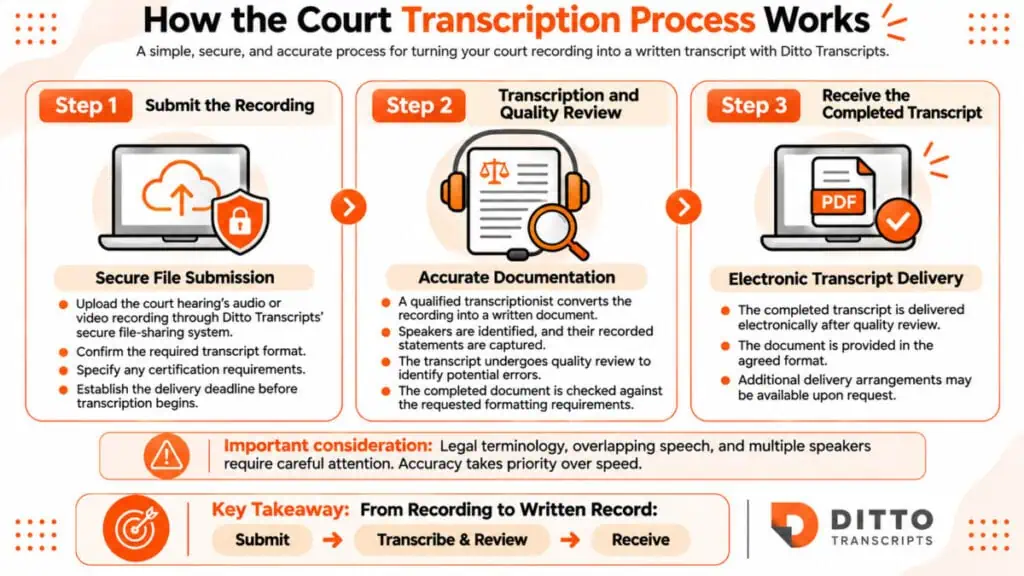
If the transcript must be filed with a court, confirm that the appropriate certification and filing procedures have been satisfied.
Why Choose Ditto Transcripts for Court Transcription?
At Ditto Transcripts, we understand that court recordings are more than conversations captured on audio. They may become part of an appeal, legal proceeding, or evidentiary review where accuracy matters.
Here’s what Ditto brings to the table:
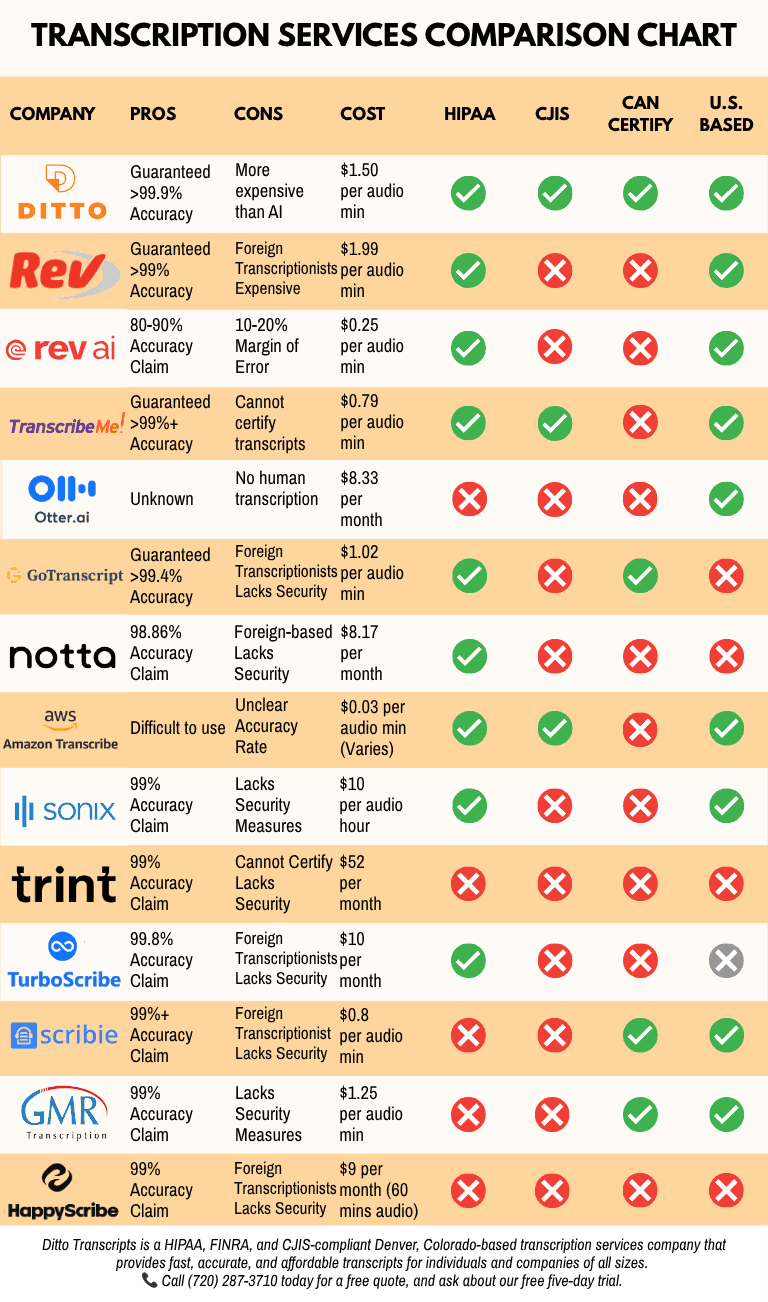
- Human accuracy: Our U.S.-based transcriptionists prepare transcripts backed by a 99% accuracy guarantee.
- Legal transcription experience: Our team handles complex terminology, multiple speakers, and recorded proceedings.
- Security: We follow CJIS- and HIPAA-compliant workflows, and our transcriptionists undergo criminal background checks.
- Flexible turnaround: Choose extended, standard, or rush delivery based on your project’s requirements.
- Transparent pricing: Our pricing calculator helps you estimate costs before you proceed, and we discuss additional requirements upfront.
- Client testimonials: Read our testimonials to learn what clients say about our accuracy, communication, and turnaround times.
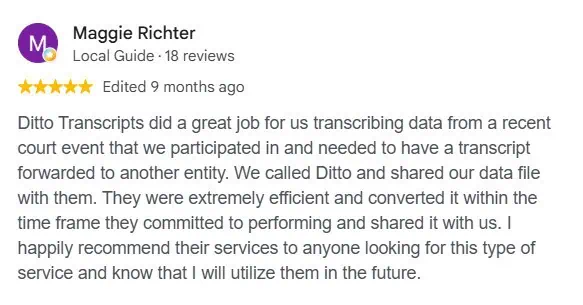
We also offer certified transcripts, and we confirm court-specific requirements before work begins.
Our goal is straightforward: provide accurate, secure, and dependable transcripts without unnecessary delays.
Getting Your Court Transcript on Time
Court transcripts serve an important purpose, whether attorneys need to review testimony, prepare an appeal, or document previous proceedings.
While some transcripts follow court-mandated schedules, qualified transcription providers can prepare others more quickly.
Confirm your deadline, recording quality, and certification requirements before ordering.
Ditto Transcripts is a Denver, Colorado-based transcription company providing accurate, secure, and affordable transcription services nationwide. Call (720) 287-3710 to discuss your recording or request a free quote.