


College is a time of learning, research, and growth. It can also be stressful, especially for graduate students preparing a thesis or dissertation. Between interviews, lectures, research notes, advisor meetings, focus groups, and deadlines, even a small amount of support can make the process easier to manage.
Academic transcription services help students, researchers, professors, and universities turn audio and video recordings into accurate written documents. These transcripts make research easier to review, search, quote, organize, and analyze.
In this article, you’ll learn:
- Why academic transcription is useful for dissertations
- How transcripts help organize research data
- Why human transcription is more reliable than AI transcription
- How transcription supports ethical research and accessibility
- Why do graduate students and institutions choose Ditto Transcripts
Why Students Need Academic Transcription Services
Transcription is the process of converting audio or video into written text. In academic settings, transcription can be used for lectures, interviews, seminars, classroom recordings, research projects, oral histories, focus groups, dissertation data, and conference presentations.
For dissertation work, transcription can be especially helpful. Graduate students often collect hours of recordings from interviews, participant sessions, research discussions, field notes, or advisor meetings. Turning those recordings into text makes the information easier to search, code, quote, and compare.
Some students try to transcribe recordings themselves to save money. That can work for very short files, although it is rarely efficient for serious academic research. Transcription takes time, focus, and careful listening. An hour of audio can take several hours to transcribe, especially when the recording includes multiple speakers, background noise, accents, technical terms, or unclear sections.
That time is usually better spent analyzing data, writing chapters, preparing citations, reviewing literature, or revising the dissertation itself.
Professional transcriptionists help reduce that burden by turning recordings into readable, organized transcripts that students can use throughout the research and writing process.
Are All Transcription Companies the Same?
Not all transcription providers offer the same quality. Some companies advertise very low rates, although low-cost transcription can come with problems such as poor accuracy, limited review, unclear formatting, outsourced labor, weak security practices, or heavy reliance on automated transcription.
For academic work, these problems matter. A poorly transcribed interview can distort participant meaning. A missing sentence can affect coding. A misheard term can weaken analysis. Inaccurate transcripts may also create extra work for students who have to spend hours checking, correcting, and reformatting the document.
A strong academic transcription provider should understand that research transcripts are not only typing projects. They are part of a larger academic process that depends on accuracy, confidentiality, consistency, and usability.
AI Transcription vs. Human Transcription
Automated transcription tools use artificial intelligence or automated speech recognition to convert speech into text. They are fast and often inexpensive, which can make them tempting for students working under a deadline.
However, speed does not guarantee accuracy. AI transcription tools offer only 61.92% accuracy, and accuracy can drop further when recordings include poor audio quality, multiple speakers, accents, technical language, overlapping speech, or background noise.
AI transcription can struggle with:
- Speaker identification
- Academic terminology
- Participant names
- Accents and dialects
- Cross-talk
- Long interviews
- Poor audio quality
- Specialized vocabulary
- Verbatim detail
- Context-dependent meaning
Automated transcripts may also require heavy cleanup. The text may contain missing punctuation, incorrect words, broken sentences, incorrect speaker labels, and formatting issues. By the time a student reviews and fixes the document, the time savings may disappear.
Human transcription is usually slower than AI, yet it is more reliable for academic research. A trained transcriptionist can listen for context, identify speaker changes, flag unclear sections, follow formatting instructions, and produce a cleaner transcript that is easier to use.
For dissertation research, accuracy matters more than speed alone.
How Transcription Helps With Dissertations
Graduate students use transcription in many stages of dissertation preparation, from data collection to final writing. Accurate transcripts can make the research process more organized and less overwhelming.
Organizing Research Data
Dissertations often involve recorded interviews, focus groups, classroom observations, fieldwork, oral histories, or advisor discussions. Without transcripts, students may need to replay recordings repeatedly to find one comment, theme, or quote.
Transcripts make the data searchable. Students can locate keywords, compare participant responses, highlight themes, and organize material by chapter, question, topic, or research objective.
This is especially useful for qualitative research, where interviews and participant responses often become the foundation of analysis.
Improving Accuracy
Research data must be handled carefully. If students rely only on memory or handwritten notes, important details may be missed. Fatigue, stress, and tight deadlines can also lead to errors.
A transcript gives students a fuller written record of what was said. It helps preserve participant language, context, and meaning. This can improve the reliability of analysis and make it easier to return to the original data when drafting or revising.
For some research projects, students may also request verbatim transcription services. Verbatim transcripts include filler words, pauses, repetitions, interruptions, and other speech details that may be important for psychology, linguistics, social sciences, legal studies, or discourse analysis.
Easier Quoting and Referencing
Dissertations often require direct quotes from interviews, lectures, focus groups, or recorded research sessions. Accurate transcripts make it easier to find, review, and cite those quotes.
Instead of scrubbing through audio, students can search the transcript for a phrase, participant ID, or topic. This saves time and helps ensure quotes are accurate and properly represented.
Accurate quoting also strengthens the credibility of the dissertation. It shows that the researcher has handled participant responses carefully and preserved meaning.
Supporting Ethical Research
Ethical research requires accurate representation of participants, careful handling of data, and respect for privacy and consent. Transcription can support these goals by creating a consistent record of participant responses and research interactions.
When transcripts are accurate, students can analyze data more objectively and reduce the risk of misrepresenting what someone said. This is especially important when research involves sensitive topics, vulnerable populations, or confidential interviews.
Students should also choose a transcription provider that understands confidentiality. Academic recordings may include personal stories, identifying details, health information, workplace information, or sensitive research data.
Faster Writing and Presentation
Dissertation work can involve hundreds of pages of notes and many hours of recorded material. Transcripts help students convert raw recordings into usable research content faster.
Written transcripts can be highlighted, annotated, coded, summarized, and organized. They can also be used when preparing presentations, defending findings, writing chapters, or sharing excerpts with advisors.
For students working under a deadline, having clean transcripts can reduce stress and improve workflow.
Better Accessibility
Academic transcription also supports accessibility. Transcripts make recorded content available to students, researchers, or participants who are deaf or hard of hearing.
They also help people who prefer reading, need to review content quietly, or want to revisit complex information more easily. In classroom and university settings, transcripts can improve access to lectures, seminars, webinars, and research presentations.
Common Academic Transcription Projects
Academic transcription can support students, professors, researchers, departments, and institutions.
Common projects include:
| Academic Recording | How Transcription Helps |
| Dissertation interviews | Creates searchable records for analysis and quoting |
| Focus groups | Preserves participant responses and group discussion |
| Lectures | Makes course material easier to review and study |
| Seminars and webinars | Turns presentations into readable reference documents |
| Research notes | Converts dictated ideas into organized text |
| Oral histories | Preserves interviews and personal narratives |
| Advisor meetings | Helps students review feedback and next steps |
| Conference presentations | Creates records for publication, reference, or sharing |
Academic transcription may also overlap with government transcription services when research involves public agencies, policy studies, hearings, grants, institutional reviews, or public-sector interviews.
How Much Does Academic Transcription Cost?
Academic transcription pricing depends on audio length, audio quality, turnaround time, number of speakers, formatting needs, timestamps, and whether the transcript needs to be verbatim or cleaned up.
At Ditto Transcripts, general transcription rates start at $1.50 per audio minute for extended turnaround options. Additional services, such as verbatim transcription or timestamps, may affect the final cost.
Why Clients Choose Ditto for Academic Transcription
Academic transcription requires accuracy, confidentiality, and careful formatting. Students and researchers need transcripts they can trust during analysis, writing, and review.
At Ditto Transcripts, we support graduate students, professors, researchers, universities, colleges, departments, legal teams, government agencies, and organizations that need accurate academic transcripts.
Clients choose Ditto because we offer:
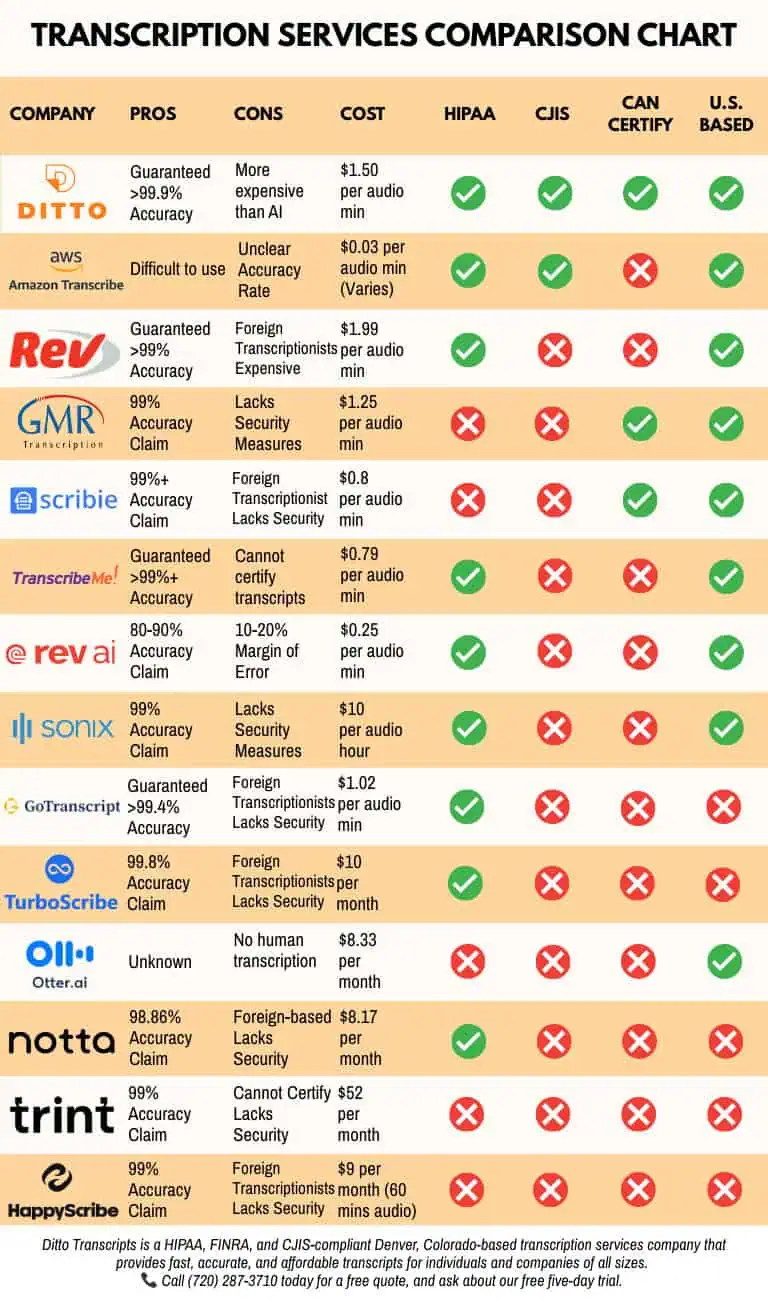
- Human transcriptionists: We use trained professionals who understand context, speaker flow, terminology, and the importance of accuracy.
- Academic transcription experience: Ditto supports dissertation interviews, focus groups, lectures, seminars, webinars, oral histories, advisor meetings, and research recordings.
- Secure handling: Sensitive files are handled through confidentiality-focused workflows designed to help protect recordings and transcripts.
- Compliance support: Ditto works with clients who need HIPAA-, CJIS-, and FINRA-compliant transcription support.
- Transparent legal transcription pricing: We explain transcription rates, add-ons, turnaround options, and project requirements before work begins.
- Flexible turnaround: Clients can choose delivery options based on urgency, file length, audio quality, and academic deadlines.
- No long-term contract required: Students and institutions can use Ditto for one file, one project, or ongoing transcription needs without unnecessary commitments.
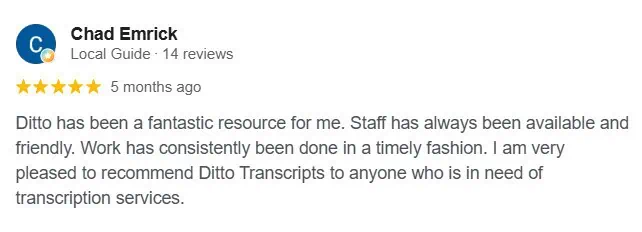
Our clients choose Ditto because they need accurate transcripts, clear communication, and dependable service. Still comparing providers? Read our client testimonials to learn more about working with Ditto.
Get Accurate Academic Transcription With Ditto
Dissertation work is demanding. Graduate students must collect data, analyze findings, write chapters, meet deadlines, and prepare for review. Transcription helps make that process more manageable by turning recordings into accurate, searchable, and usable documents.
Automated tools may be fast, yet academic work requires accuracy, context, confidentiality, and human judgment. A reliable transcript can save time, support better analysis, and help students represent their research data more carefully.
Ditto Transcripts provides fast, accurate, secure, and affordable academic transcription for students, researchers, colleges, universities, and organizations of all sizes.
Ditto Transcripts is a Denver, Colorado-based transcription services company that provides fast, accurate, and affordable transcripts for individuals and companies of all sizes and is FINRA-, HIPAA-, and CJIS-compliant. Call (720) 287-3710 today for a free quote.