


One of artificial intelligence’s greatest values is how much work it reduces for humans. That is extremely useful when you have to create a transcript from a four-hour meeting. The convenience is undeniable, until you discover how much the meaning has changed compared to the original recording.
For example, a CFO says: “We expect demand to remain resilient, assuming current conditions hold.”
An AI summary then turns that into: “Management expects demand to remain resilient.”
The statements sound similar, yet they communicate two different things. The original includes an important condition the summary omits. This is where financial transcription services become valuable, helping organizations preserve the exact wording and intended meaning of financial communications.
A single missing qualifier can change how investors interpret a company’s outlook. While such an omission might go unnoticed in an ordinary meeting, it can have serious consequences in financial reporting, compliance, and investor communications.
In this article, you’ll learn…
- Why exact wording matters in financial transcription.
- How AI summaries can change meaning by dropping key qualifiers.
- Why accuracy, retention, and security matter for financial records.
- When human transcription is the safer choice.
Why Accuracy Matters in Financial Transcription
Financial communication requires the highest level of accuracy because multiple stakeholders are involved. It involves analysts, investors, auditors, lawyers, and others, and a single mistake can be costly.
When sharing information, public companies must follow strict rules. Specifically, under Regulation FD, companies must not secretly leak important, nonpublic information to anyone. To maintain transparency, companies should announce material information on a conference call that the public can follow.
Brokers must follow SEC and FINRA “book-and-records” rules. That means that they are legally required to monitor all business communications so regulators can perform audits.
That does not mean every earnings call is legally required to have a verbatim transcript. It does mean organizations have to understand what communications they are required to preserve, how those records are maintained, and whether they can produce them when required.
So, are verbatim transcripts required? Not necessarily, although it is a plus. For companies, it only highlights how communications must be constructed, maintained, and preserved. In these matters, a “close enough” standard could be the major dealbreaker.
What AI Summaries Can Miss in Earnings Calls
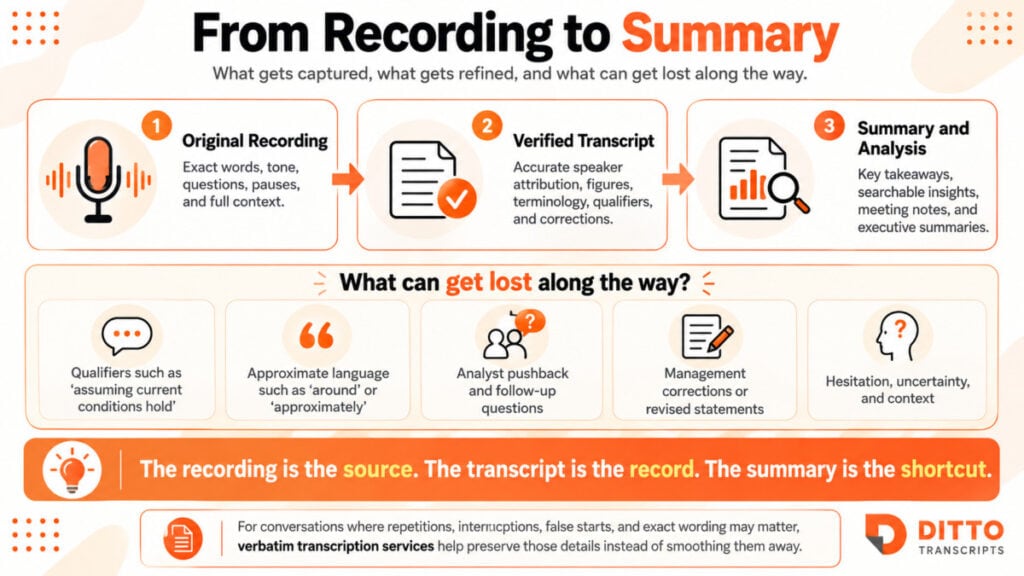
An accurate transcript can be summarized with little to no error by AI. However, financial audio is different for summaries and will almost always compress a recording, even when told not to. In most cases, that opens the door to risk. Business settings also value the raw recording because it preserves the record’s essence, especially for investors who closely follow an earnings call.
To be clearer, here’s an example of how it works; compare these two statements:
“We are comfortable with the current outlook.”
“We are comfortable with the current outlook, provided pricing remains stable.”
Even a non-expert can tell that one statement contains a condition rather than a declaration. Removing it changes the meaning entirely, though it may not be obvious at first.
That is not the only matter that can be omitted by AI. Other crucial phrases include
- “approximately,”
- “subject to,”
- “at this time,”
- “we believe,”
- “we are evaluating,” and
- “we do not expect”
Removing these changes the meaning, although AI usually dispenses with them.
Case in point: A summary tells you what the system considered important. A transcript preserves what was actually said.
Why Verbatim Transcripts Matter for Financial Records
When exact wording matters, the summary should never become the source. The safest workflow keeps every shortened version connected to the original record.
Financial Transcription Goes Beyond Earnings Calls
The need for clear communication goes deeper than public earnings calls:
- High-Stakes Meetings: Board meetings and investor sessions often cover sensitive topics like future projections, company buyouts, and strategic decisions. This creates a constant risk of the wrong information being shared with the wrong people.
- The Danger of Small Words: In compliance interviews, tiny wording differences can change everything. A massive legal gap exists between saying you “knew” something and saying you “believed” it, “approved” it, or “were told” it.
Protecting Against Disputes: This is exactly why conversations with financial advisors and brokers are recorded. When a client later disputes what was recommended, promised, or agreed upon, those recordings become the final record.
This matters because memory is the least reliable way to preserve information, and transcripts do the opposite.
That is why deposition transcription services often include transcripts to preserve sworn testimony accurately.
Accuracy, Security, and Record Retention in Financial Transcription
Financial audio presents three problems at once.
| Requirement | What matters |
| Accuracy | Names, figures, terminology, qualifiers, and speaker attribution should reflect the source accurately. |
| Retention | Records subject to retention requirements must remain available for the applicable period and in the required form. |
| Security | Sensitive recordings, transcripts, and related materials require appropriate access and handling controls. |
Transcripts must unconditionally be accurate. Further, there is no one-size-fits-all regulation from the SEC and FINRA; it depends on the firm and the type of conversation. As AI solutions get integrated into workflows, companies must answer these questions:
- Data Storage & Access: Where is the data stored and who are authorized to access it?
- Retention & Lifespan: Does AI keep the data? If so, for how long?
- Reproducibility: Can AI precisely generate the same output twice?
- Data Privacy: How is the data protected?
Accuracy is another issue. In Ditto Transcripts’ testing, the mean AI transcription accuracy was 61.92%. However, that doesn’t mean AI will always perform at that level. Its performance ultimately depends on audio quality.
That margin of error is huge, especially given its impact. A single decimal-point error may seem small, although it can change everything. For government transcription services, that standard is unacceptable, as many stakeholders use that information for their own initiatives.
Why Financial Organizations Choose Ditto for Human Transcription
The solution is not to pretend AI has no place in financial workflows.
AI can help people search recordings, locate topics, organize information, and prepare working summaries. The problem begins when an unverified machine-generated document is treated as the final record.
For financial communications, Ditto Transcripts puts an accountable human transcription process between the source recording and the completed transcript.
Ditto’s financial transcription service uses U.S.-based transcription professionals and carries a 99% accuracy guarantee.
For organizations evaluating transcription support, Ditto also offers:
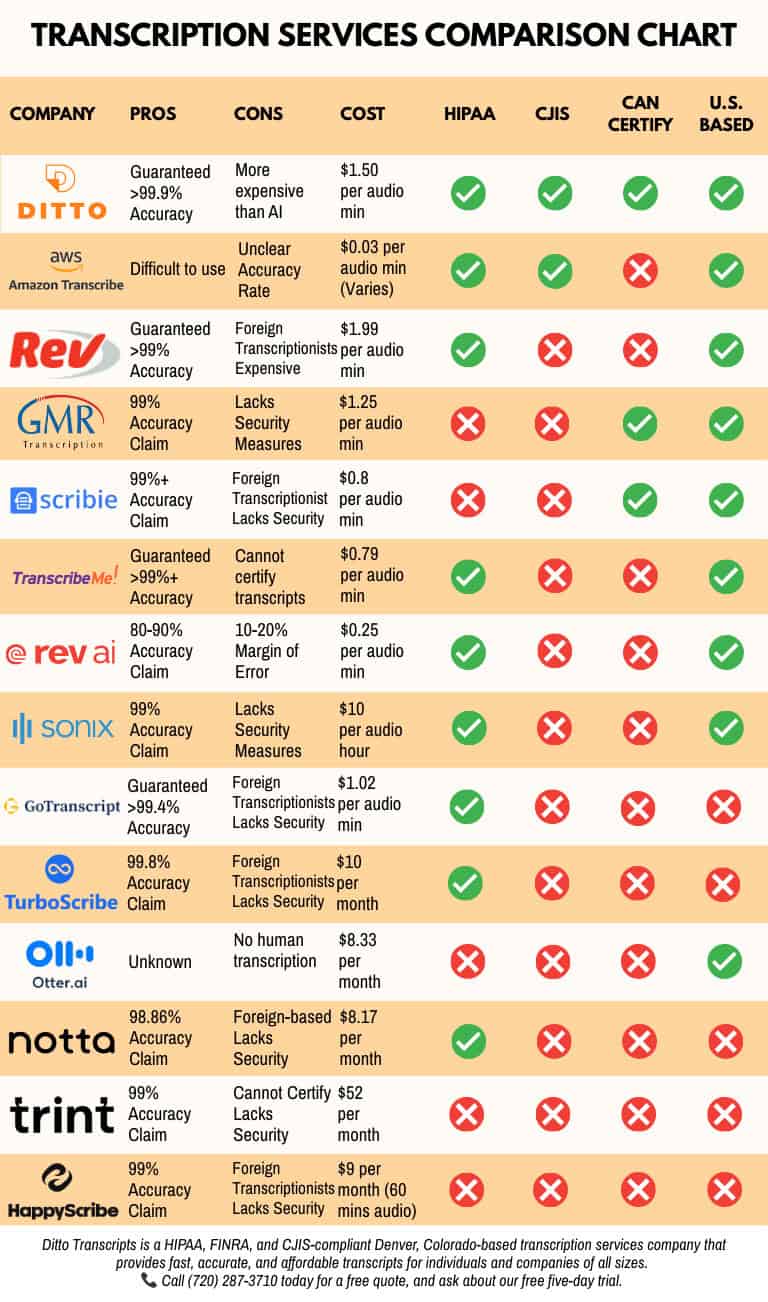
- Human transcription: We only hire U.S.-based transcriptionists who can testify to our transcripts when needed or required by the court.
- Financial transcription experience: We specialize in various fields, including professional financial matters involving strict, sensitive numbers, such as earnings calls.
- Accuracy review: Ditto goes beyond making claims by guaranteeing 99% accuracy across all our outputs.
- Transparent business transcription pricing: Use our free, easy-to-use calculator to estimate costs, or call us directly to discuss further.
- Client experiences: Our testimonials tell you everything you should know:

Exact Words Matter in Financial Compliance
A five-page summary can tell an executive what happened during an hour-long earnings call.
It cannot replace the hour.
“May” is not “will.” “Approximately” is not an exact figure. “We expect” is not “we guarantee.” And “assuming current conditions hold” isn’t filler that can disappear when a conversation is summarized.
In financial communication, the smallest words can carry the largest qualifications.
When those distinctions matter, the stronger approach is to preserve the source, create an accurate transcript, and build summaries from that record instead of allowing the summary to become the record itself.
Not every word spoken during an earnings call is automatically a regulatory filing or a record subject to the same retention obligation. However, those words can become important when investors, compliance teams, regulators, auditors, or litigators later need to determine exactly what was said.
That is why an accurate transcript is better treated as a compliance asset than an afterthought.
Ditto Transcripts is a Denver, Colorado-based transcription services company that is FINRA-, HIPAA-, and CJIS-compliant and provides fast, accurate, and affordable transcripts for individuals and companies of all sizes. Call (720) 287-3710 today for a free quote.