


Finding your first transcription job can feel like a Catch-22. Employers want experience; however, you need someone to hire you before you can build that experience. New medical, general, and legal transcriptionists ask us about this problem regularly.
The good news is that experience is not limited to years spent working for a transcription company. Training, specialized knowledge, strong test results, freelance projects, and a well-built portfolio can all show you are ready for professional work. This matters especially in specialized fields such as legal transcription services, where accuracy, terminology, formatting, confidentiality, and attention to detail matter as much as typing speed.
In this article, you’ll learn…
- How to break into transcription without prior job experience. Pasted text
- Why testing, specialization, and a strong portfolio matter. Pasted text
- How freelance, local, and entry-level roles can build experience. Pasted text
- How tailored applications improve your chances of getting hired.
Understand the Transcription Job Market Today
Medical transcription has changed considerably as speech recognition, electronic health records, and AI-assisted documentation have become more common.
In other words, transcription hasn’t disappeared, although the skills employers value are evolving. Medical transcriptionists increasingly need to review and correct speech-recognition drafts, not just transcribe audio directly. Current medical transcription training programs also teach these editing skills.
If you’re still deciding whether the profession is right for you, our guide on becoming a transcriptionist covers the skills and preparation involved.
Start With the School or Training Program You Already Know
If you recently completed a transcription course, start with your school.
Ask whether it offers career counseling, resume reviews, job boards, employer introductions, alum resources, certification preparation, or other employment assistance. Some programs maintain relationships with companies that are already familiar with their training.
For example, CareerStep continues to offer a Medical Transcription Editor program that covers transcription, editing speech-recognition-generated medical documents, and preparation for the RHDS certification exam.
Completing a course is only the first step. Use every career resource included with that training before looking elsewhere.
Do not assume your school will contact you automatically. Ask specifically what employment resources are available to graduates.
Treat Every Transcription Test Like Paid Client Work
Many transcription companies use proficiency tests before hiring or contracting with someone. That is especially important for applicants without a long work history because the test gives you a chance to prove what your resume cannot.
Ditto, for example, currently tests applicants on grammar, spelling, and transcription ability. Applicants may also be asked to work with both single-speaker and multiple-speaker recordings.
Before taking a test, make sure you can consistently handle:
- Grammar, punctuation, and spelling
- Multiple speakers and overlapping dialogue
- Accents and unfamiliar terminology
- Names, dates, numbers, and locations
- Researching terminology without guessing
- Speaker identification and formatting
- Difficult or inconsistent audio
- Following a style guide exactly
- Proofreading your own transcript before submission
Accuracy matters more than simply finishing the test quickly. A polished transcript shows that you can listen carefully, research intelligently, follow instructions, and catch your own mistakes.
It also helps to understand different transcript styles. Reviewing professional verbatim transcription can show you how filler words, false starts, interruptions, pauses, and other details may be handled when a client needs a more complete record.
Build Experience Before You Have a Full-Time Position
Your first professional experience doesn’t have to come from a traditional employer.
Freelance platforms such as Upwork still offer transcription projects, including entry-level and specialized work. Short projects can help you practice meeting deadlines, following client instructions, handling different accents, identifying speakers, and working with imperfect recordings.
However, be selective. A poorly paid project that requires hours of difficult transcription may not be worth taking simply to add one line to your resume.
Another option is to create your own sample portfolio using recordings you have permission to transcribe. Never publish confidential client material to demonstrate your abilities.
A small portfolio of clean, accurate work is more valuable than claiming experience you cannot demonstrate.
If research interviews, lectures, focus groups, or educational recordings interest you, reviewing how professional academic transcription services are structured can also help you understand what clients in that niche expect.
Specialize Instead of Applying to Everything
One of the easiest ways to get lost among other applicants is to market yourself simply as a “transcriptionist.”
Think about what you can become particularly good at.
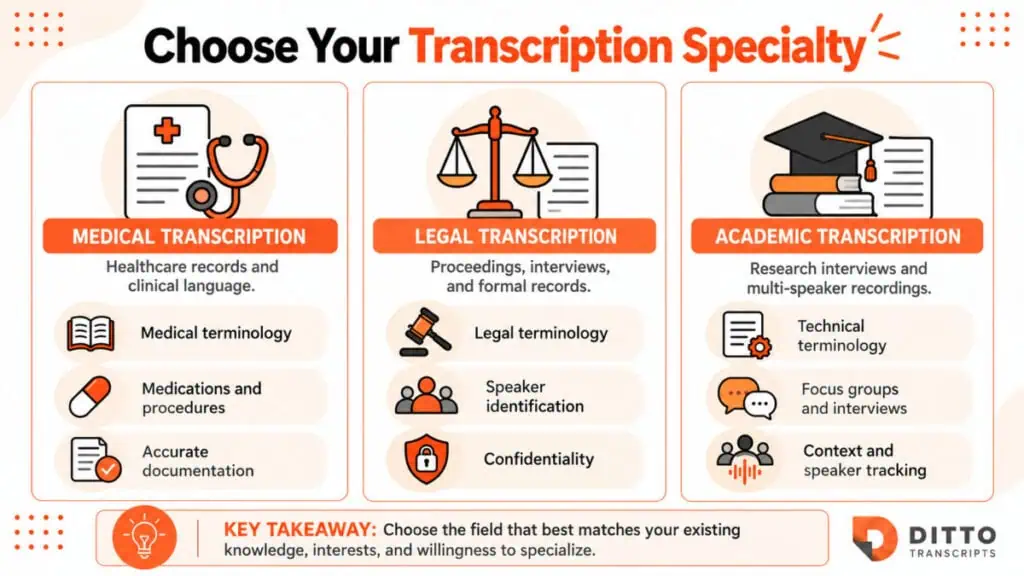
Medical transcription requires knowledge of anatomy, terminology, medications, healthcare documentation, and privacy. Legal transcription requires familiarity with legal terminology, proceedings, speakers, formatting, and confidentiality. Academic transcription may involve research interviews, focus groups, technical terminology, and detailed speaker identification.
Specialization gives an employer a reason to choose you for a particular type of work instead of comparing you with every general transcriptionist who applies.
For example, someone interested in legal work could learn the structure and terminology of testimony before pursuing deposition transcription services. That knowledge can make an application much more relevant than a generic claim that you type quickly.
Customize Every Resume and Application
Sending the same resume to every company is easy. It is also easy for an employer to ignore.
Read the job description carefully and identify the skills that matter most. Then make those skills easy to find in your resume and cover letter.
If a company needs someone familiar with radiology, highlight radiology coursework or relevant medical terminology training. If the position involves legal recordings, emphasize legal terminology, formatting, confidentiality, or related education. If the company regularly handles multi-speaker interviews, mention experience working with speaker identification.
The goal is not to make your experience look bigger than it is. The goal is to make your relevant experience impossible to miss.
A brief personalized note can also help. Explain what attracted you to that specific position, what related training you have, and why you believe your skills fit the company’s work.
Look Beyond Remote-Only Transcription Jobs
Working from home is one of transcription’s biggest attractions. However, limiting your first search to remote work can also mean competing with a much larger applicant pool.
Consider hospitals, healthcare organizations, universities, research institutions, law firms, courts, government offices, and other local organizations that may need documentation or transcription support.
An on-site or hybrid role may let a new transcriptionist learn from experienced coworkers, get familiar with professional workflows, and build the real-world experience remote employers often request.
Your first job doesn’t have to be your forever job. It needs to help you become more valuable for the second one.
Why Clients Choose Ditto for Professional Transcription
Understanding what clients expect from a professional transcription company can also help you understand what employers expect from a professional transcriptionist.
At Ditto Transcripts, the final document has to be more than a typed version of an audio file. It needs to be accurate, readable, properly formatted, secure, and useful to the person who requested it.
Clients choose Ditto because we offer:
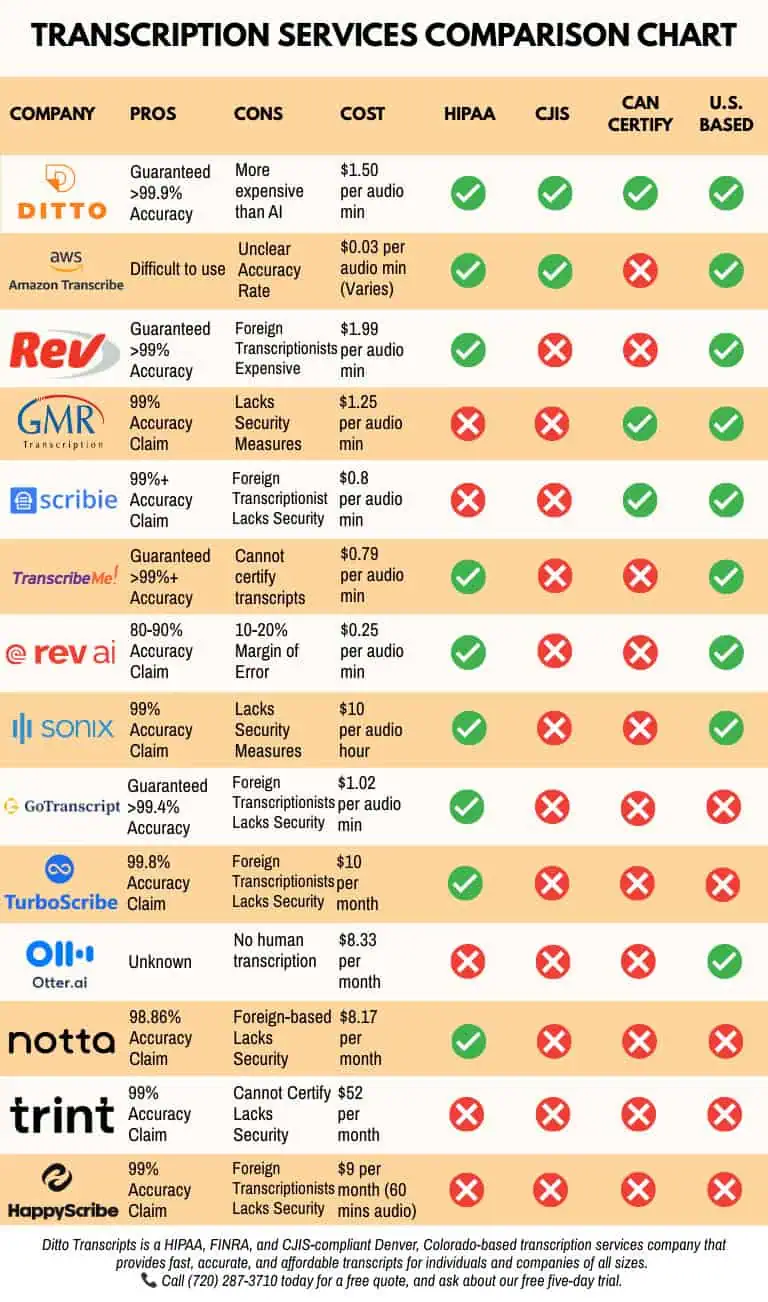
- Human transcriptionists: Trained professionals review recordings carefully and use context, research, and listening judgment to create reliable transcripts.
- Industry-specific experience: Ditto works with legal, medical, law enforcement, academic, financial, business, and other professional recordings that may require specialized terminology and formatting.
- Support for difficult audio: Our transcriptionists can work with multiple speakers, accents, background noise, technical terminology, overlapping dialogue, and other challenging recordings.
- Professional formatting: Wes can format transcripts to meet project needs, including speaker labels, timestamps, verbatim formatting, and other client-specific requirements.
- Secure file handling: We handle sensitive recordings and transcripts through confidentiality-focused workflows designed to protect client information.
- Flexible legal transcription prices and turnaround options: Pricing and delivery times vary based on file length, urgency, audio quality, number of speakers, formatting needs, and project requirements.
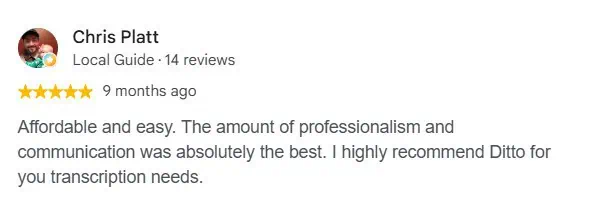
- Client testimonials: Here’s what our previous customers say about their experience.
Your First Transcription Job Is the Beginning
Breaking into transcription can be frustrating when job listings ask for experience you haven’t had the chance to earn yet. The answer is not to apply unthinkingly to hundreds of positions.
Build proof that you can do the work. Use your training resources, prepare seriously for proficiency tests, develop samples, pursue relevant freelance experience, specialize where possible, and tailor every application.
You may not land the first position you apply for. That is normal. Each useful project, test, course, and specialty you add makes the next application stronger.
And when you are ready to explore available opportunities, visit our transcription jobs page for current information about working with Ditto Transcripts.
Ditto Transcripts is a Denver, Colorado-based transcription services company that is FINRA-, HIPAA-, and CJIS-compliant and provides fast, accurate, and affordable transcripts for individuals and companies of all sizes. Call (720) 287-3710 today for a free quote.