


AI chats have become many people’s go-to advisors. What started as an assistant is now being used to share way too much information. Along those lines, some sensitive matters may have been revealed.
It’s okay, right? It’s not like other people will see those details.
Well… That’s not certain, and that argument wouldn’t hold up in court, since AI conversations don’t automatically receive legal privilege. If requested, that chat history can be subject to discovery.
For individuals, it may not seem very serious. However, it matters greatly to people who represent or belong to certain professional organizations. That is why recorded statements and conversations must not be shared lightly, even with AI, which may seem like the cheapest and most convenient option.
That’s why legal professionals still value professional legal transcription services. They can deliver accurate transcripts and stand behind their work.
A Chat Window Is Not a Privileged Room
AI can analyze information, look up laws, and seemingly perform an attorney’s function, yet it doesn’t offer attorney-client privilege.
Artificial Intelligence solutions offer unmatched speed and accessibility, which is why we at Ditto Transcripts understand their appeal. However, we also understand the risks that come along with it.
Aside from inaccuracy and hallucinations – which are already pressing concerns- sharing sensitive information with AI is not encouraged because of how the data is handled. Courts recognize this concern and are now grappling with whether AI conversations qualify for privilege or work-product protection.
Recent rulings show that protection can depend on who used the tool and why the material was created. This means a conversation that feels private doesn’t automatically mean protected. OpenAI also has a process for responding to valid civil requests for user data. The more important question, then, is whether sensitive information should be entered into the tool in the first place.
Sensitive Audio Requires a Stricter Level of Handling
Any reasonable person would not share their data with a vendor knowing there’s a risk of it being leaked. As straightforward as it sounds, many vendors know how to hide that knowledge.
Sensitive recordings usually contain the following:
- Names
- Addresses
- Medical details
- Employment allegations
- Witness accounts
- Financial information
- Facts
Regardless of what those details are, it’s clear none of them are meant to leave the file.
That standard changes once the audio is uploaded to a third-party platform. For one, uploading creates an additional copy of the original recording. So, even before the transcript is turned over, the risk is already there.
Deposition transcription services stand out because they can keep transcription within a workflow built specifically for legal records.
Sensitive Data Has More Than One Exit
AI privacy discussions often lump every risk into a single warning about “data leaks.” There are at least three distinct ways sensitive material can move beyond the intended audience.
| Exposure | What can happen | Why it matters |
| Discovery or legal process | Relevant AI chats or account data may be legally requested | All conversation can become part of an evidentiary record. |
| Security incident | Vendors, especially those that lack security measures, can be targeted by attacks that lead to unauthorized access. | Sensitive information could be leaked to parties that should never see it. |
| Training or secondary use | AI learning models are usually derived from data from their users | A party’s information could be reused for something that was never really intended. |
These are separate exposures, so solving one does not automatically solve the others.
In fact, the recent expert-witness dispute tied to the Watson Grinding explosion illustrates this risk. The case featured roughly 350 pages of ChatGPT conversations, which were revealed when opposing counsel sought the expert’s AI prompts. This shows that the AI problem is more than theoretical, as it is already manifesting in litigation.
OpenAI also disclosed instances when some users could see other users’ chat history titles and other relevant information. Bugs like this highlight that, despite AI’s capabilities, the trade-off isn’t worth it.
Compliance Gets Harder When Nobody Can Explain the Data Path
Insurance and legal teams have their own security measures and requirements. Adding a third-party vendor doesn’t exempt you from those obligations.
The NAIC Insurance Data Security Model Law reminds insurers and legal teams of their responsibilities. It states that they are responsible for the risks that are created by bringing in these third-party vendors.
State adoption of the model law varies, yet the broader principle remains familiar: outsourcing a task does not eliminate the responsibility for handling sensitive information.
Beyond that, health adds another layer. For these matters, medicolegal transcription services are sought because they meet transcription needs professionally and appropriately, in line with industry standards.
Case in point: If you cannot say where a recording went, how long it stayed there, and who could access it, you have made the workflow harder to defend.
That does not mean uploading sensitive audio to AI automatically violates a law, although compliance becomes harder when the data path is opaque.
Ask These Questions Before a Tool Touches Sensitive Audio
For insurers, legal teams, and generally all users looking to use AI for their transcription needs, it’s important that you know the answers to these questions:
- Where is the audio stored, and how long is it retained?
- Is the audio, transcript, or prompt data used for LLMs?
- Who has access?
- Are there security controls?
- When is the information deleted, or what happens when it is retained for legal reasons?
If a vendor cannot answer basic questions about retention, access, and secondary use in plain language, take that uncertainty seriously.
The ABA has similarly cautioned legal professionals against placing confidential or privileged information into generative AI tools without understanding the platform, its policies, and the applicable confidentiality obligations.
A Secure Workflow Should Be Easy to Explain
A defensible transcription workflow is not mysterious.
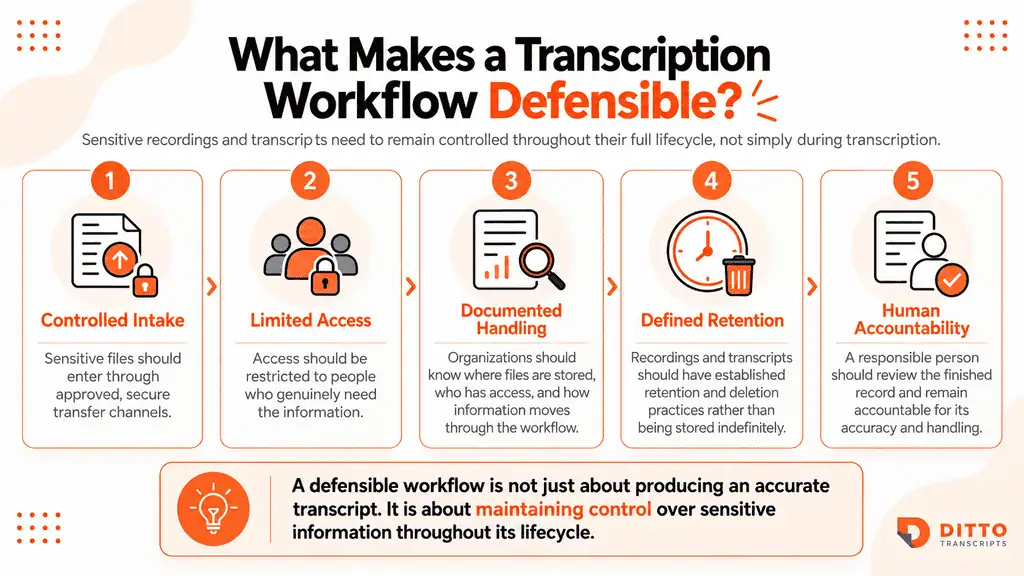
When exact speech matters, verbatim transcription preserves all data, including starts, interruptions, fillers, and other details of the original recording, without first turning the audio into a prompt in a public chatbot.
Confidentiality is not something you add after the transcript is finished. It starts with how the source recording is handled.
Why Professionals Choose Ditto When Sensitive Audio Has to Stay Controlled
At Ditto Transcripts, the goal is not to push sensitive audio through the fastest possible machine. The workflow is built around people who can be identified, standards that can be explained, and a finished transcript someone can stand behind.
Here is what clients can expect:
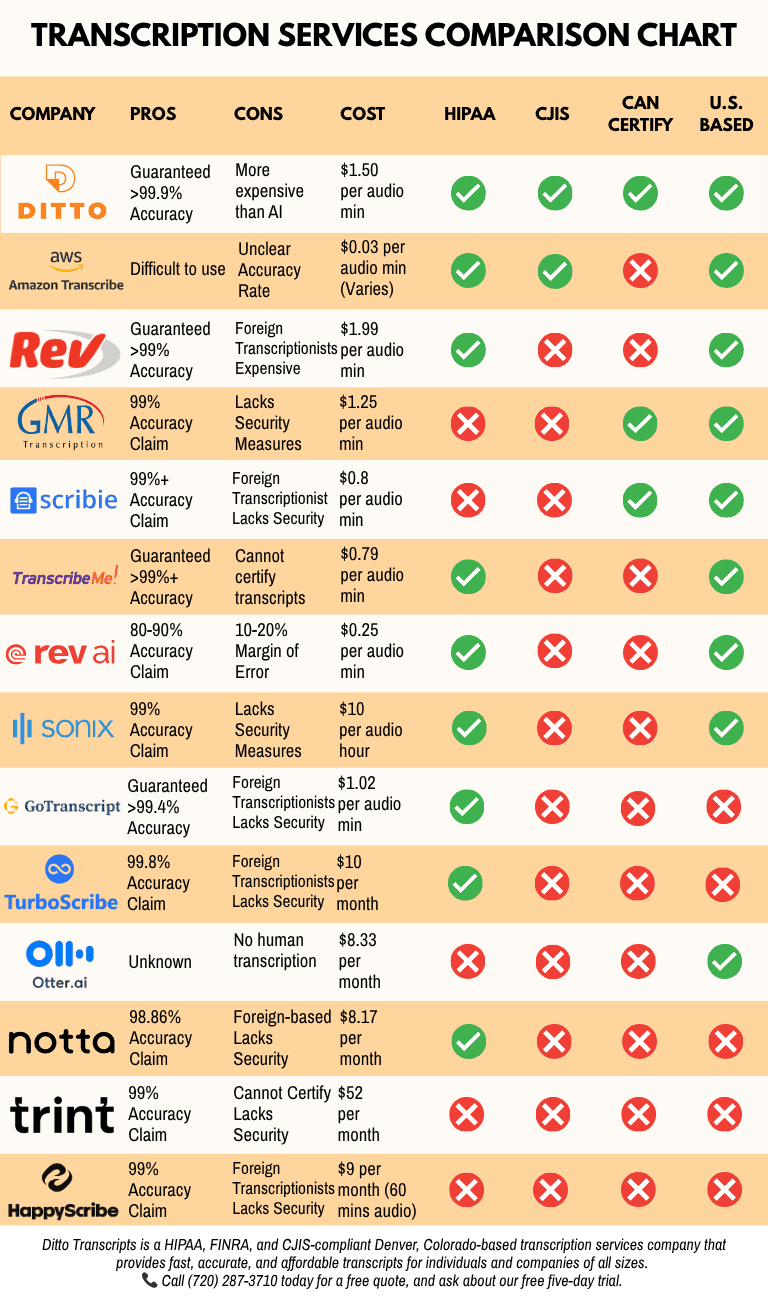
- 99% accuracy guarantee: We guarantee over 99% accuracy for all of our transcripts.
- 100% U.S.-based human transcriptionists: We ensure that the output is created and reviewed by a U.S.-based, trained human professional who can attest to and show their workflow when needed.
- Security-focused handling: At Ditto Transcripts, we uphold the highest security standards. We are CJIS-, HIPAA-, SOC 2 Type II, and FINRA-compliant for applicable workflows.
- Human accountability: Have questions or need something edited after the transcript has been rendered? We got you – no chatbot in between.
- No customer data used to train AI: Ditto states that client data is not used to train AI models.
- Transparent legal transcription prices: Published rates explain how turnaround time and other complexity affect cost.
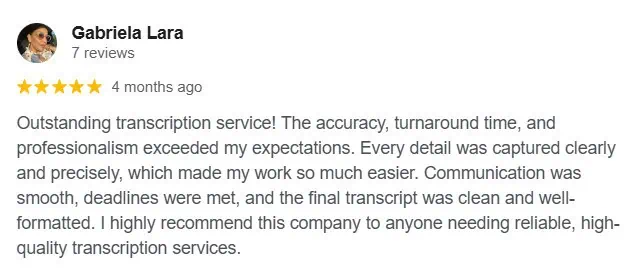
- Verified client experiences: Ditto’s testimonials basically tell you everything you should know:
The better question is not simply whether the transcript is accurate. It is whether you’re comfortable defending the entire path from recording to finished document.
The Bottom Line
Public AI tools can be useful, although only to some extent. Sensitive recordings deserve more careful treatment.
When audio contains information you would not want to resurface in discovery, during a security incident, or through an unexpected secondary use, the tool’s confidentiality posture matters as much as its accuracy.
Know where the recording goes, who touches it, and what happens afterward. And when the record needs to hold up, keep it inside a controlled workflow with a human being accountable for the result.
Ditto Transcripts is a Denver, Colorado-based transcription company providing fast, accurate, and affordable transcripts for individuals and organizations of all sizes. Ditto is FINRA-, HIPAA-, and CJIS-compliant. Call (720) 287-3710 today for a free quote.