
When a jury cannot reach a unanimous verdict, the result is a mistrial, and the case enters legal limbo. Hung juries account for roughly 6% of all state criminal trials in the United States, according to the National Center for State Courts. Federal courts see lower rates, averaging 2.5%. What happens after a hung jury is expensive and uncertain. Prosecutors must decide whether to retry the case, negotiate a plea, or dismiss the charges entirely. Available evidence suggests that conviction rates tend to drop on retrial, while costs for courts, attorneys, and taxpayers multiply. Here is what the data shows heading into 2026.
Summary: Key Statistics at a Glance
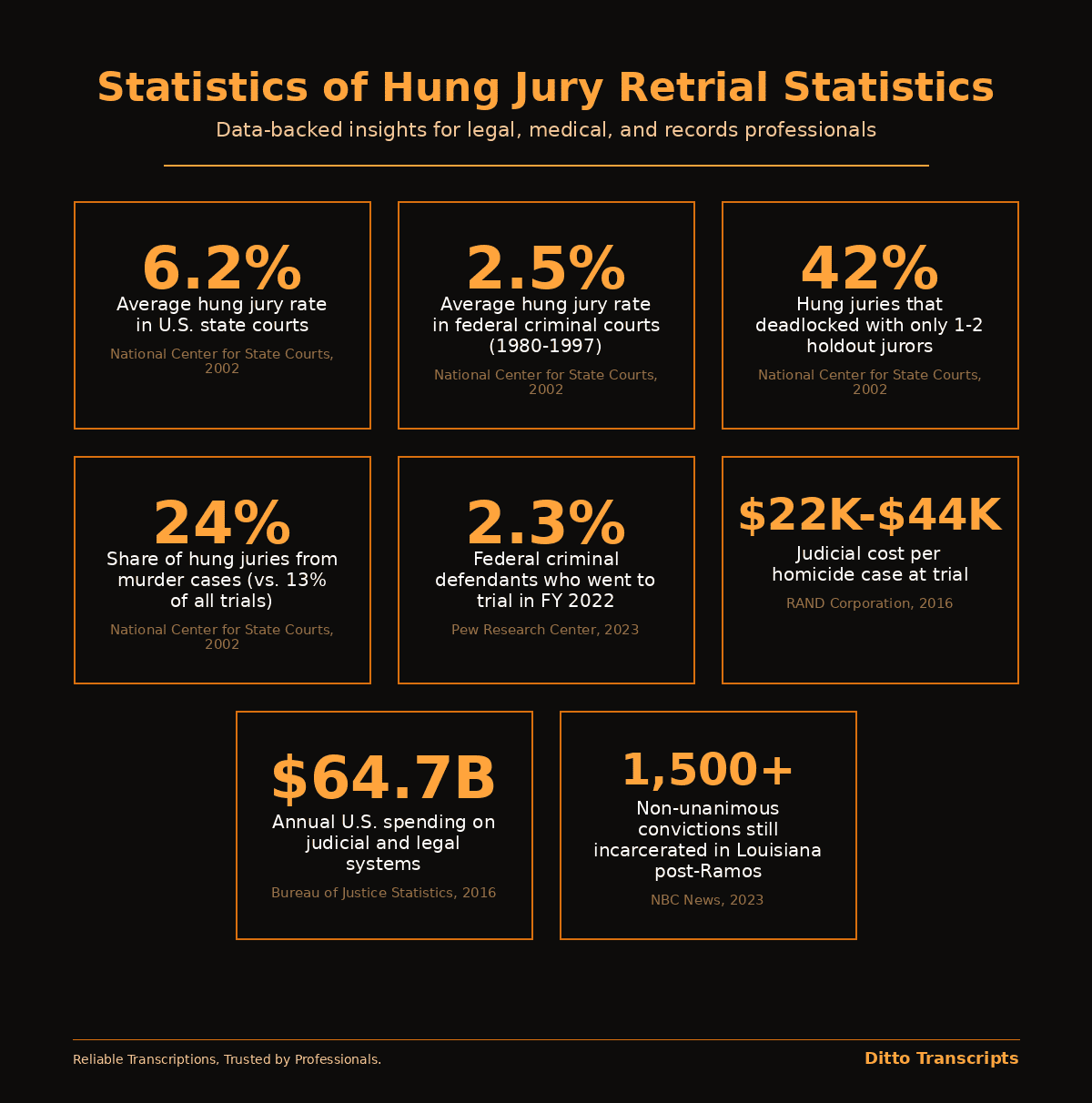
- The average hung jury rate in U.S. state courts is 6.2%, ranging from 0.1% to 14.8% depending on jurisdiction National Center for State Courts 2002.
- Federal criminal hung jury rates averaged 2.5% between 1980 and 1997, with the D.C. Circuit reaching 9.5% National Center for State Courts, 2002.
- In a four-jurisdiction deep study, 12.8% of felony trials ended in a hung jury on at least one count National Center for State Courts, 2002).
- 42% of hung juries deadlocked with only one or two holdout jurors National Center for State Courts, 2002.
- Murder cases made up 13% of all trials but 24% of hung juries in the NCSC sample National Center for State Courts, 2002.
- Only 2.3% of federal criminal defendants went to trial in fiscal year 2022; 89.5% pleaded guilty Pew Research Center, 2023.
- The judicial cost of a single homicide case ranges from $22,000 to $44,000 in court processing alone RAND Corporation, 2016.
- The Bill Cosby retrial in 2018 cost Montgomery County, Pennsylvania taxpayers over $219,000 in jury and security expenses CBS News, 2018.
- The U.S. spends $64.7 billion annually on their judicial and legal systems, according to Bureau of Justice Statistics data compiled by the American Action Forum,2020.
- After Ramos v. Louisiana (2020), an estimated 1,500+ people convicted by non-unanimous juries in Louisiana remain incarcerated with exhausted appeals NBC News, 2023.
How Often Do Juries Hang?
The most comprehensive study of hung jury rates in the United States comes from the National Center for State Courts, published in 2002 with funding from the National Institute of Justice. Examining data from 30 state courts and 14 federal circuits, the study found that state courts averaged a 6.2% hung jury rate, with enormous variation by location. Pierce County, Washington reported a rate as low as 0.1%. Los Angeles County, California reached 14.8%.
Federal courts ran lower. Between 1980 and 1997, the average criminal hung jury rate was 2.5%, with most circuits falling between 2% and 3%. The D.C. Circuit was the outlier at 9.5%.
A deeper examination of 382 felony trials across four jurisdictions (the District of Columbia, Los Angeles County, Maricopa County, and Bronx County) between 2000 and 2001 found even higher rates. Across all four sites, 12.8% of trials ended with a hung jury on at least one count. D.C. Superior Court led at 22.3%, followed by Los Angeles County at 19.5%, Maricopa County at 7.7%, and Bronx County at 3.1%.
These figures represent a notable increase from the Kalven and Zeisel study of 1966, which found a 5.5% criminal hung jury rate across more than 3,500 trials. Whether the increase reflects changes in case complexity, jury demographics, or prosecution strategy remains an open question among researchers.
Which Cases Are Most Likely to Hang?
Murder cases are disproportionately likely to produce a hung jury. In the NCSC sample, murder trials made up just 13% of all cases but accounted for 24% of hung juries. Drug cases showed the opposite pattern, representing 28% of all trials but only 12% of hung juries.
The study also found that 42% of hung juries deadlocked with only one or two holdout jurors. In most of these cases, the jury came close to a verdict but could not get past a small number of dissenters. Weak evidence was identified as the most common primary reason for deadlock, followed by concerns about police credibility, particularly in drug cases.
What Happens After a Hung Jury?
When a jury fails to reach unanimity, the judge declares a mistrial. Prosecutors then face a three-way decision: retry the case, offer a plea bargain, or drop the charges.
Double jeopardy protections do not bar retrial after a mistrial. The Fifth Amendment’s prohibition on being tried twice for the same offense applies only to acquittals, not to inconclusive outcomes. A hung jury is not a verdict, leaving prosecutors free to bring the case again.
No comprehensive national database tracks what prosecutors do after a hung jury. Court systems generally do not code these cases as a distinct outcome category, which makes systematic analysis difficult. The available evidence suggests that serious felonies, particularly murder and sexual assault, are retried at higher rates than lower-level offenses.
Why Conviction Rates Tend to Drop on Retrial
Research consistently indicates that conviction rates decline when a case is retried after a hung jury. Several structural factors explain the pattern.
Defense teams in a retrial have already seen the prosecution’s full case, including every witness, every exhibit, and every strategic decision. They can prepare targeted cross-examinations and anticipate the prosecution’s strongest arguments. Prosecutors face the opposite challenge: witness memories fade, evidence becomes harder to present with the same impact, and the emotional urgency of the case diminishes.
Jurors in a retrial may also approach the evidence differently. Knowing that a previous jury could not agree can subtly shift the burden of proof, even though the legal standard remains the same.
The Cost of Retrying a Case
Retrials do not merely repeat the original expense. They often cost more. According to the RAND Corporation (2016), the judicial cost of processing a single homicide case ranges from $22,000 to $44,000, covering judge time, prosecutor and public defender hours, and administrative overhead. That figure does not include investigation, expert witnesses, jury costs, or pretrial detention.
High-profile cases show how quickly retrial costs escalate. The 2018 retrial of Bill Cosby on sexual assault charges cost Montgomery County, Pennsylvania taxpayers over $219,000 in jury expenses and security, according to CBS News. In capital cases, costs can reach millions when defense attorney fees, expert testimony, and extended pretrial proceedings are included.
At the national level, the American Action Forum (2020) reports that U.S. taxpayers fund $64.7 billion in judicial and legal system spending annually, based on Bureau of Justice Statistics data. Combined prosecutor budgets alone total $7.6 billion across more than 2,330 offices, according to the Vera Institute of Justice (2020). Every hung jury that triggers a retrial draws additional resources from these already strained budgets.
Legal teams on both sides routinely rely on transcripts of the first trial to prepare for retrials. Accurate records of witness testimony, cross-examination exchanges, and judicial rulings become essential tools for identifying inconsistencies, impeaching witnesses, and refining trial strategy.
The Unanimity Requirement After Ramos v. Louisiana
Until 2020, Oregon and Louisiana were the only two states that permitted criminal convictions by non-unanimous jury votes. Louisiana allowed convictions on a 10-2 split; Oregon allowed 10-2 verdicts for most felonies. Both systems had roots in policies designed to dilute the influence of minority jurors.
In April 2020, the U.S. Supreme Court ruled in Ramos v. Louisiana that the Sixth Amendment requires a unanimous verdict in all state criminal cases. The decision eliminated non-unanimous convictions nationwide.
The ruling has direct implications for hung jury rates. Under the old Louisiana rules, a 10-2 split produced a conviction. Under the unanimity requirement, that same split becomes a hung jury and a potential retrial. According to NBC News (2023), the Promise of Justice Initiative estimates that more than 1,500 people convicted by non-unanimous verdicts in Louisiana remain incarcerated with exhausted appeals. Since 2021, the New Orleans District Attorney’s office has reviewed over 100 of approximately 230 such cases, resulting in 10 wrongful conviction dismissals and dozens of reduced sentences or charges.
Louisiana voters had already prohibited non-unanimous verdicts for crimes committed after January 1, 2019. The Ramos decision extended that prohibition retroactively, creating a wave of post-conviction challenges that continues into 2026.
Emerging Trends and What’s New in 2026
Fewer Trials, Higher Stakes
The broader context for hung jury data has shifted as fewer criminal cases go to trial at all. According to the Pew Research Center (2023), just 2.3% of federal criminal defendants went to trial in fiscal year 2022. The vast majority, roughly 89.5%, resolved their cases through guilty pleas. When so few cases reach a jury, each hung jury carries outsized significance for the parties involved and for the court’s calendar.
Recent High-Profile Retrials After Hung Juries
Several recent cases illustrate the unpredictable nature of retrials following hung juries. In February 2024, the murder trial of former Franklin County, Ohio deputy Jason Meade ended in a hung jury. The retrial began in April 2026, and in May 2026 a jury convicted Meade of reckless homicide, a lesser charge than the original murder count. The outcome demonstrates how retrials can produce compromise verdicts that differ significantly from the charges prosecutors originally pursued.
The double murder trial of rapper YNW Melly ended in a hung jury in July 2023. As of mid-2026, the retrial has been repeatedly delayed, with the defendant having spent more than seven years in custody without a conviction. The case underscores the human cost of prolonged legal proceedings after a deadlocked jury.
Growing Scrutiny of Repeated Retrials
Courts and legal commentators have begun questioning the limits of prosecutorial discretion to retry cases after successive hung juries. While no federal court has found a due process violation based solely on repeated retrials, the practical and financial costs of trying a case three or more times have drawn increasing attention. The informal consensus among practitioners is that three trials represents the upper limit, though no binding rule enforces this boundary.
How Ditto Transcripts Helps
Ditto Transcripts helps attorneys and legal teams prepare for retrials with accurate, human-reviewed transcripts of prior trial proceedings, depositions, and witness testimony. Every transcript is produced by U.S.-based transcriptionists, with rush turnaround available in one to two business days. Explore legal transcription services to see how it works.