

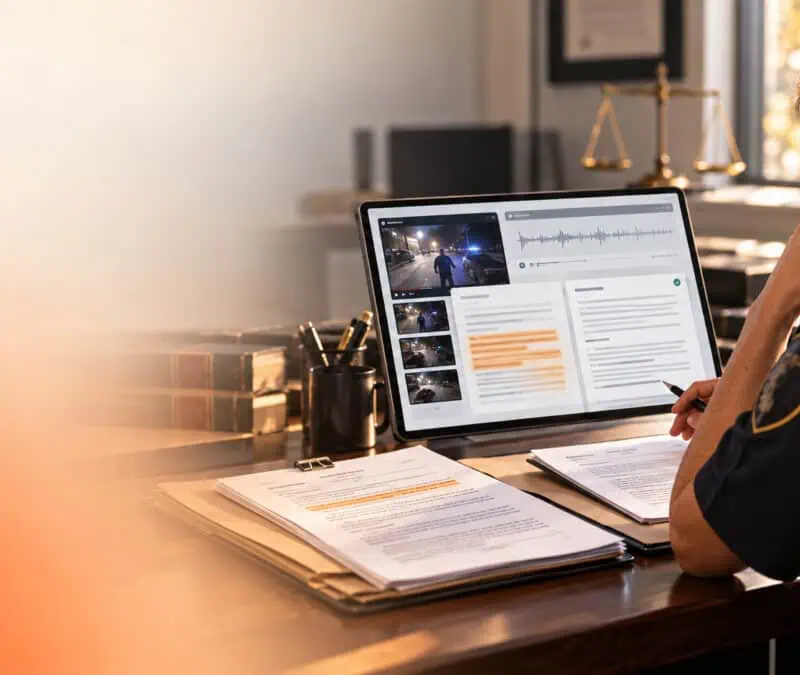
Police reports used to be written by police officers, according to their own account. Today, they’re still based on their observations, although they’re now mostly prepared by AI – and that begs the question: how accurate are AI-made reports?
It matters because artificial intelligence isn’t a hypothesis anymore. It is already integrated into law enforcement systems, turning body-camera footage or audio into first drafts. For agencies that handle records that could become evidence in a legal matter, that same system creates risk, highlighting the role and standards set by law enforcement transcription services in producing accurate, usable documents.
In this article, you’ll learn…
- How AI police reports create additional records and risks.
- Why AI-generated material may become discoverable.
- How transcription errors can affect officer credibility.
- Why agencies need strong audit trails and version control.
- How human transcription can reduce AI-related reporting risks.
How AI Changes the Reporting Trail
By now, we’re well past questioning whether AI can produce a report. It certainly can, although it may not be as accurate or as safe as you think.
After AI transcription vendors receive the footage or video, they may generate more output than legal enforcement knows. Depending on the service provider, the machine transcripts, prompts, draft versions, or activity logs also become part of the legal requirement.
Essentially, it becomes a second layer of documentation behind the official report.
The difference between the final report and what the AI-assisted version produced matters, as it can change the course of a case. Even the simplest change in a statement, a name, a missing detail, or the sequence of events is enough to question the final record and ultimately raise questions about who was responsible for verifying it.
To some extent, AI-assisted reports simplify the workload; however, in legal proceedings, it becomes a different conversation, as it can complicate the situation because it requires the nitty-gritty process used to create the document.
The Data Trail Can Become Part of the Case
When we say the workload is simplified, we mean a police officer’s role of uploading the recording and signing the final report. Rather than doing manual transcription and narrative-building, which could take hours, artificial intelligence can do it in minutes, or even seconds.
However, simplicity does not mean responsibility. The law enforcement officer must still oversee and verify the following:
- The original audio
- The machine-generated transcript
- Instructions or prompts supplied to the system
- The AI-generated first draft
- Changes between the draft and final report
- Audit or activity logs showing when those changes occurred
Whether these supporting pieces of information are required depends on the jurisdiction. However, what this generally implies is that the basic litigation question has changed.
Because AI can be integrated into workflows, its participation introduces risk. Opposing counsel or the justice system may review and verify it.
Discovery Is Expanding to AI Records
The litigation involving the Conservation Law Foundation is one example of how AI is changing the landscape.
The court treated AI prompts used as part of an expert’s work as discoverable material. However, the court later paused the requirement to turn over those materials while it considered an objection to the ruling.
While this does not mean AI prompts and activities are automatically subject to discovery, it highlights that these records are trails that do not disappear behind the technology.
Today, lawyers can ask what information was fed to AI, what it produced, and how it was used in the final document. Applied to law enforcement, if AI assisted the report, the defense can examine everything that occurred between the conversation and the officer’s final report.
An Accuracy Problem Can Become a Credibility Problem
Another reason the underlying AI trail matters is that automated transcription doesn’t work equally well under every recording condition.
Unlike the movies, body cameras rarely produce clear footage. That is because, aside from expensive advanced technologies, the external environment isn’t always conducive. Some of the noise usually caught by these cameras includes:
- Siren
- Crowds
- Traffic
- People commotion
- etc.
AI has come a long way in transcription. However, it still cannot discern recordings that are generally considered unclear. That becomes problematic when AI-generated outputs are filled with inaccuracies, because it takes a significant amount of time to edit them, and there is always a risk that a detail is left uncorrected before it is finalized.
Now here’s the bummer. At first, it would seem like a harmless mistake. However, after a few weeks or months, that report suddenly becomes important during a hearing.
That mistake is bound to be discovered, and when that happens, the law enforcement officer cannot blame the software – because that person is ultimately responsible. Artificial Intelligence solutions are only meant to help, not finalize the document – the officer owns that responsibility.
Once an inaccurate AI draft contributes to an official record, a transcription problem can become a witness-credibility problem.
That is particularly significant when reports support charging decisions such as testimonies, which are later examined through court transcription services. It’s also what separates the issue from the basic accuracy concerns discussed in our earlier look at AI-drafted police reports. The concern here is what happens after that AI output enters the litigation record.
The First Draft Can Give the Defense a Roadmap
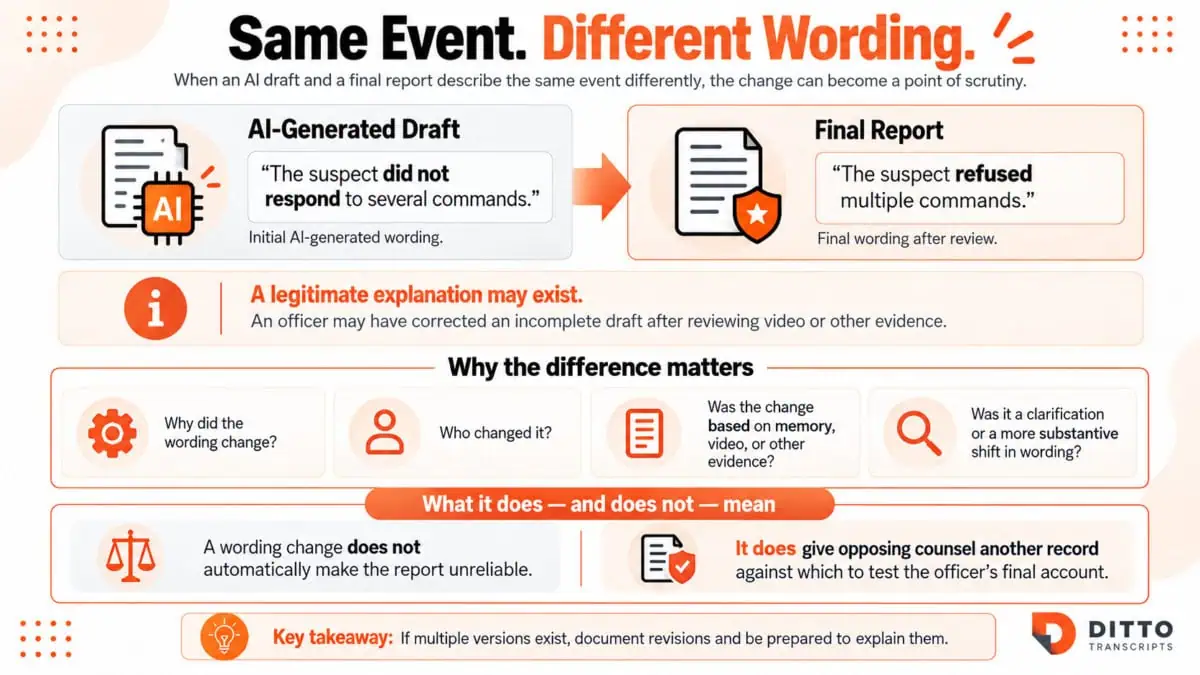
Multiple cases show AI inserting something that later disappears. When a detail appears in one document and is absent in another, it becomes a major problem under cross-examination.
AI is not only a productivity tool. It could also act unpredictably, which could lead to creating another version of the story.
Chain of Custody Now Includes the Digital Workflow
Evidence is useful only when properly documented. It shows who handled the evidence, prevents degradation, and preserves the context.
The integration of AI assistants complicates that idea because it introduces systems and other avenues that add risk and subject evidence to several stages before it becomes an official narrative.
Agencies should be able to explain where the source material went, what happened to it, and what records were created along the way.
Questions worth answering include:
- Where was the body-camera audio processed?
- Was a separate machine transcript created?
- Were prompts, drafts, or intermediate outputs stored?
- Who could access or modify those records?
- How long were they retained?
- Can the agency reproduce the version originally shown to the officer?
- Does an audit trail identify subsequent changes?
These are not merely IT questions. They can become discovery, disclosure, authentication, and records-management questions.
A transparent process is especially important for agencies already handling material through government transcription services, where security and accountability can be as important as turnaround time.
The more systems involved, the more an agency needs to understand exactly what each system does with the evidence.
What Agencies and Prosecutors Should Require
We are not suggesting AI-assisted documentation is completely unusable. We believe that it can be utilized as long as it can be defended. When drafting these outputs, assume they could later be subject to discovery.
This only means that there should be clear requirements for the following:
- Source preservation: Keep the original source.
- Documented authorship: Clearly identify if a report was written by an officer, drafted by AI, or a combination.
- Human verification: Require a qualified, trained professional or the responsible official to thoroughly review the document, rather than relying on a quick approval screen.
- Version control: Know whether drafts and edits are retained and how to retrieve them.
- Access controls: Identify who can view, edit, export, or delete records.
- Retention policies: Ask what the vendor keeps, for how long, and where it is stored.
- Disclosure procedures: Ask the vendor to identify responsive AI records when a case enters discovery.
Why Agencies Choose Ditto for Human Transcription
The cleaner alternative is a workflow in which the source recording remains the foundation and a human transcriptionist is accountable for converting that recording into text.
Ditto Transcripts’ law enforcement workflow uses U.S.-based human transcriptionists rather than speech-to-text programs or AI editors. Its current law enforcement service carries a 99% accuracy guarantee, includes review and proofreading, and uses a secure file exchange with individual access controls and file-tracking reports.
That approach does not eliminate discovery obligations. Nor does it make a transcript immune from challenge.
It avoids inserting a generative AI drafting layer between the recording and the human-produced transcript. No AI-generated narrative must later be compared with the official version, and no generative prompt history is created as part of the transcription itself.
For agencies evaluating transcription support, Ditto also offers:
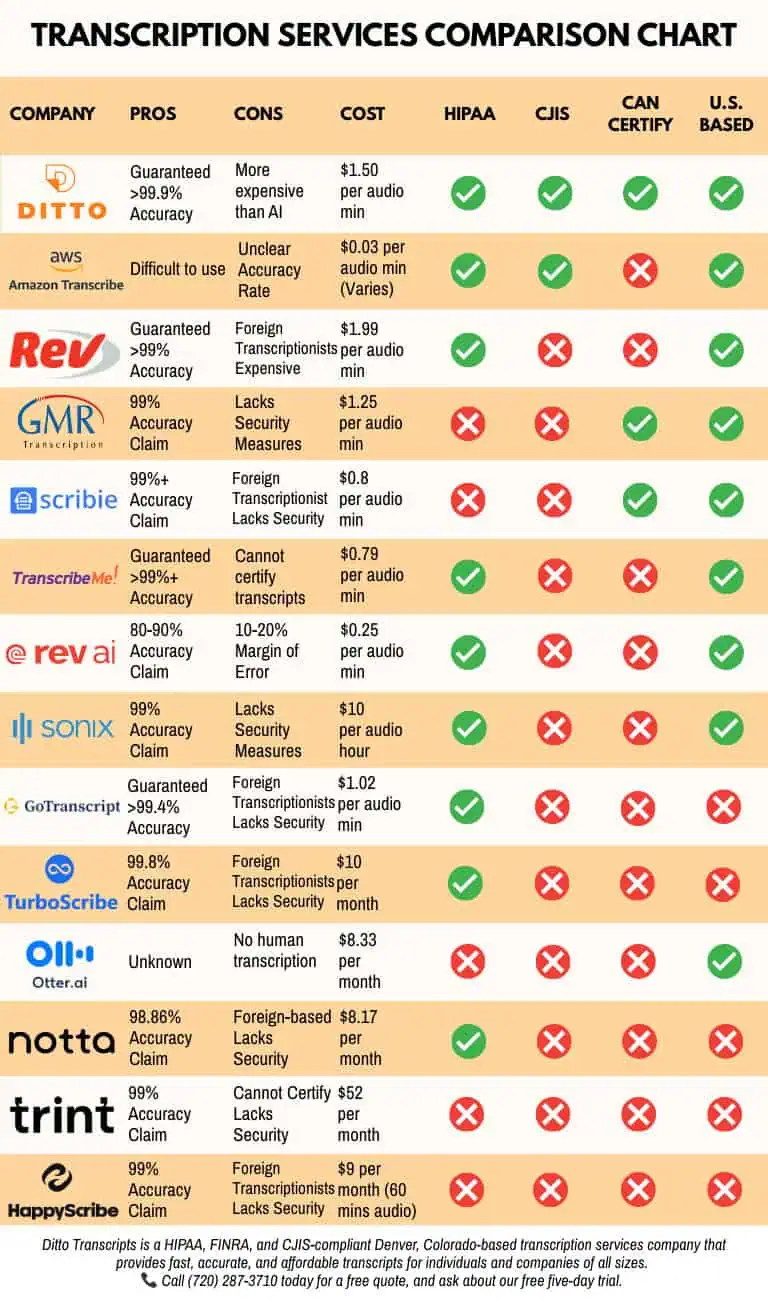
- Human transcription: Our team is composed of trained, U.S.-based human professionals who will handle your transcription needs.
- Security: We take security seriously, upholding the highest standards as we are CJIS, FINRA, and HIPAA-compliant
- Court-ready output: We are one of the few that offers court-certified transcription for law enforcement records.
- Flexible law enforcement transcription pricing: Pricing varies based on factors such as audio complexity, number of speakers, quality, and turnaround time.
- No long-term contract required: Agencies can use the service according to their transcription workload.
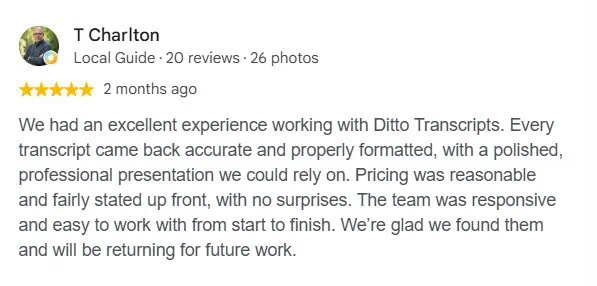
- Client testimonials: Organizations and individual clients have shared their experiences working with Ditto.
The Report Has to Survive More Than the Writing Process
The question is no longer whether AI can certainly make police reports faster. At this point, it evidently can. However, that is not the highest priority, especially if it comes with an unexplainable process and a hardly accurate output.
Not every AI prompt, log, or draft will automatically become part of discovery. However, as we have seen, these records can still be requested, reviewed, and questioned when they become relevant to the case.
Ultimately, the report must not only be written quickly. It must also survive discovery and cross-examination.
Ditto Transcripts is a Denver, Colorado-based transcription company providing human transcription services for law enforcement, legal professionals, government agencies, and organizations nationwide. Its law enforcement transcriptionists are U.S.-based, and its law enforcement workflow is CJIS-compliant. Call (720) 287-3710 for a quote.