Lawyer: The single word conjures up many different types of emotions for people. And lawyer jokes; everyone has at least one in their humor repertoire. Most lawyers will tell you that there isn’t much that is interesting about their daily grind. However, since many of the top TV shows feature crime themes, lawyers are prominently featured in television and movies.
Real-life legal proceedings are interesting to follow. Practically every trial, hearing, and deposition is transcribed into a written format for legal professionals, and in some cases, the public, to review. Below are some interesting facts and statistics about lawyers and the legal profession that you probably don’t know.
What Legal Specialty Generates the Most Income?
You can’t drive five miles on any U.S. interstate without seeing a billboard advertising legal services, especially personal injury cases. Although top personal injury firms “rake in a lot of dough,” attorneys specializing in intellectual property (IP) and patent law earn the highest salaries.
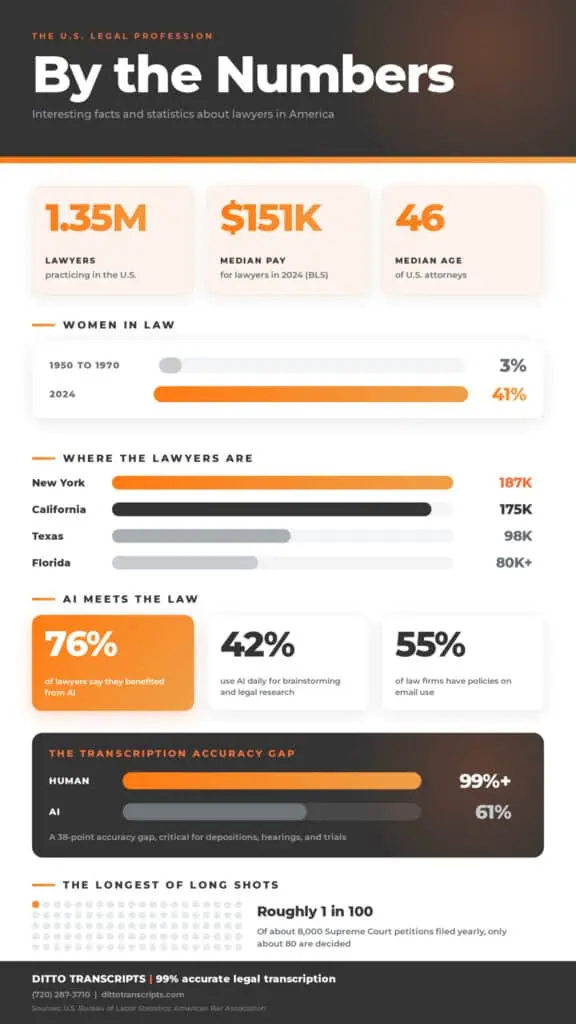
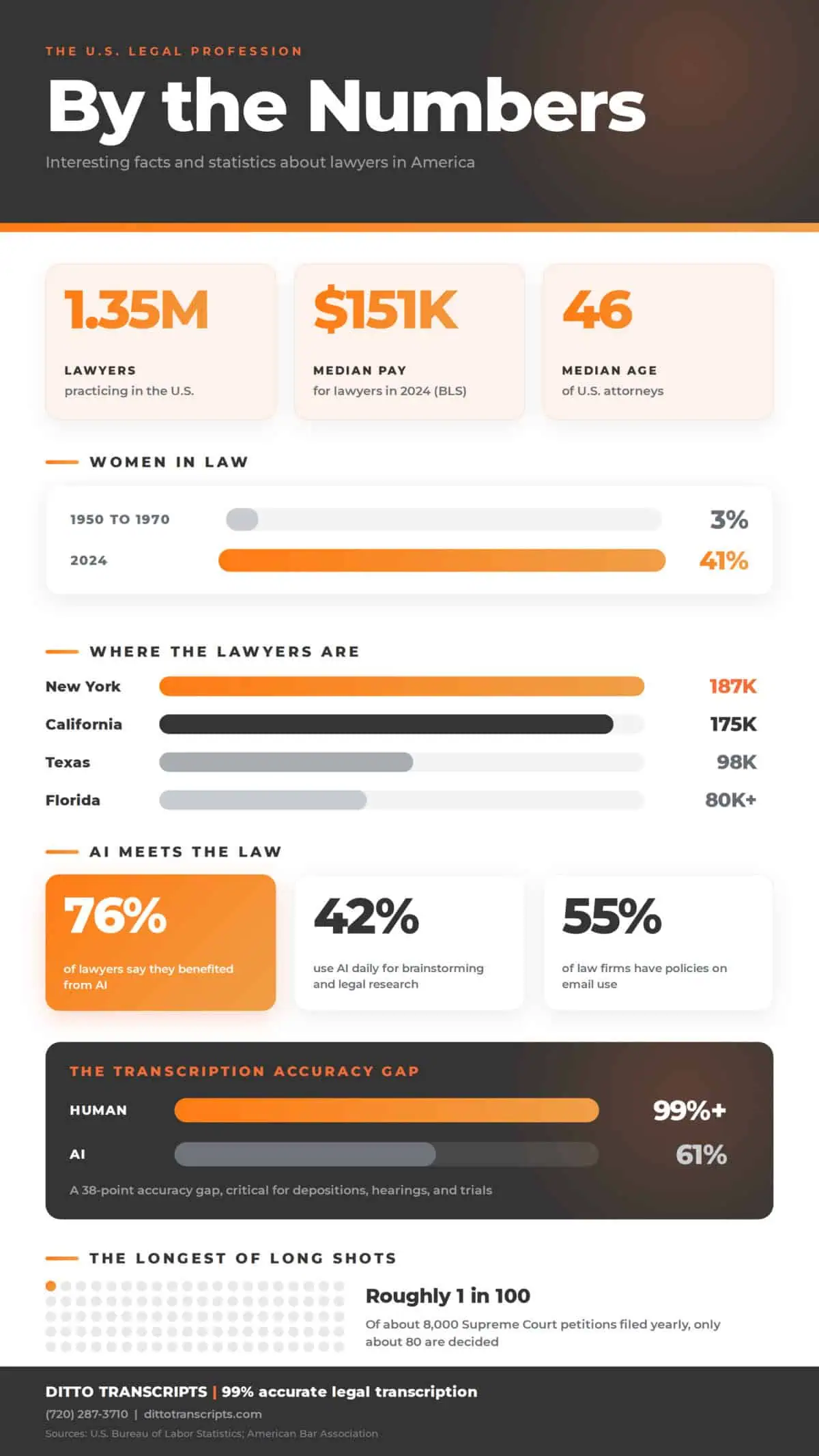
Corporate lawyers, tax attorneys, and trial lawyers follow closely behind. According to the U.S. Bureau of Labor Statistics, the 2024 median pay for lawyers topped $151,000.
How Many Lawyers Practice in the U.S.?
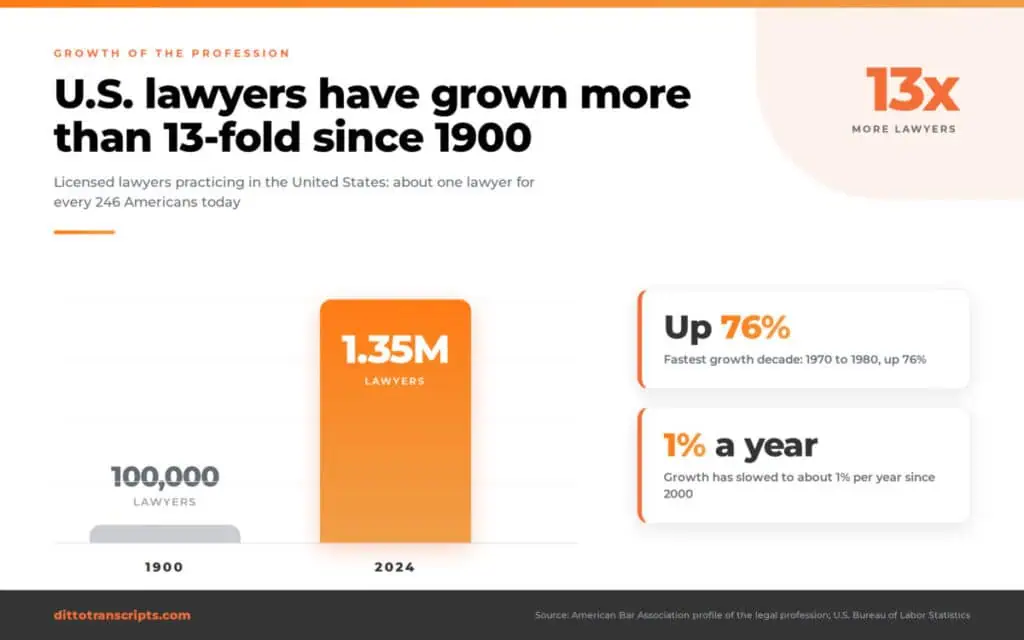
Recent statistics report that over 1.35 million lawyers are practicing in the U.S. Yes, I realize you probably think the number is much higher. That means for every American, about 246 lawyers are vying for your legal services.
Interestingly, the largest increase in lawyers occurred from 1970 to 1980 at 76 percent. The growth rate for attorneys has slowed in recent years and has remained around one percent since 2000. In 1900, there were approximately 100,000 U.S. lawyers.
The Number of Female Lawyers Has Risen Substantially
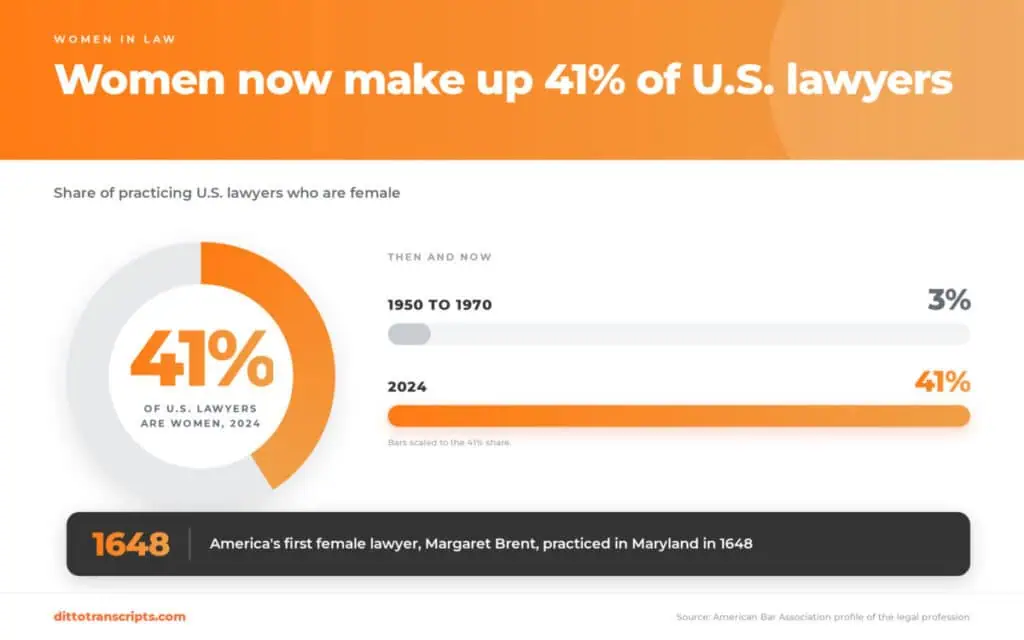
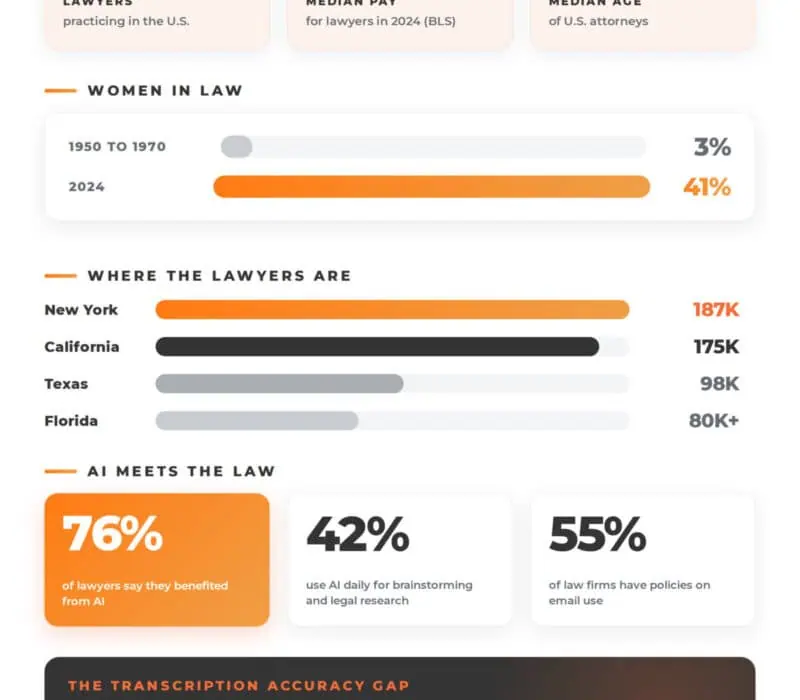
In prior decades, men dominated the legal profession. During the 20-year period from 1950 to 1970, only 3% of women practiced law. However, by 2024, 41 percent of lawyers were female. The first female lawyer in America was Margaret Brent, who practiced in Maryland in 1648. The American Bar Association created the Margaret Brent Award in 1991 to recognize the accomplishments of female lawyers.
Demographics of U.S. Attorneys
The median age of practicing attorneys in the U.S. is 46 years old. Compared with other occupations, the median age of lawyers is slightly higher.
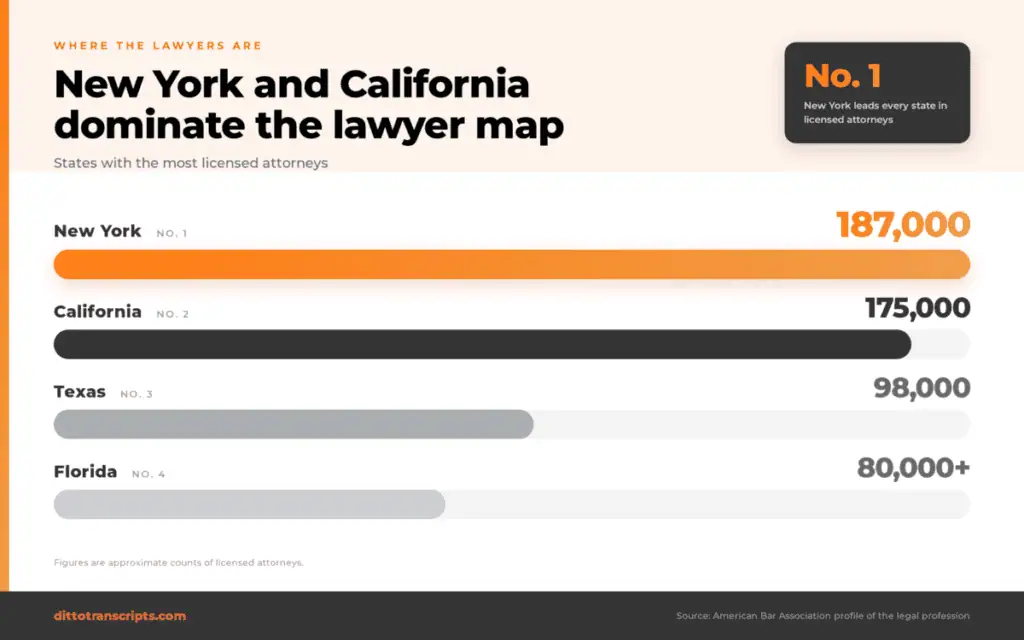
Have you ever wondered which state has the most licensed attorneys? If you guessed New York, California, Texas, Florida, and Illinois, then you are correct.
New York and California dominate with approximately 187,000 and 175,000 lawyers, respectively. The Lone Star state of Texas has around 98,000 lawyers with Florida trailing with just over 80,000.
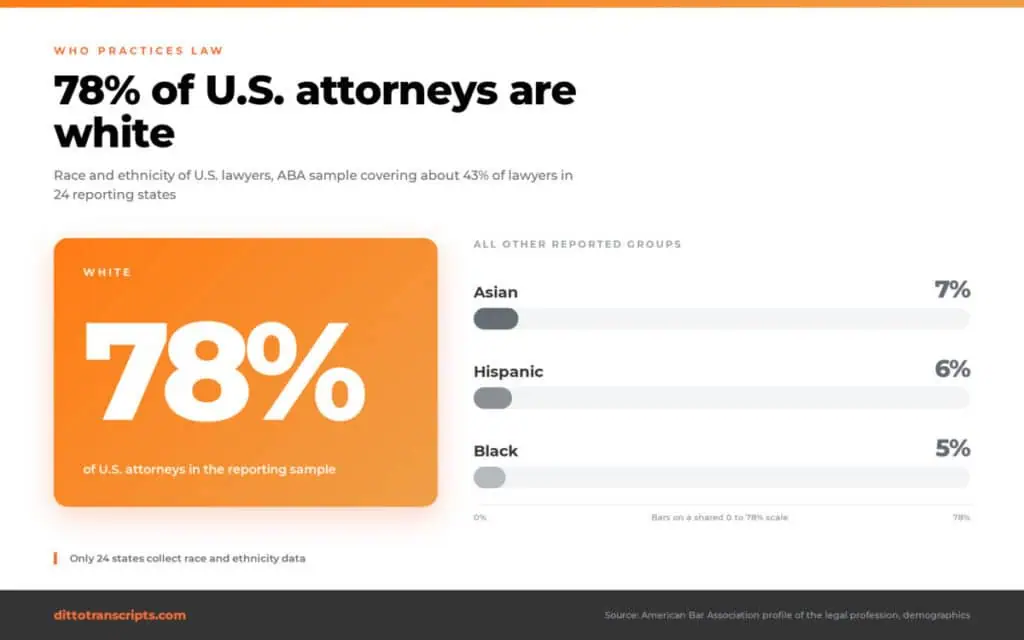
According to the American Bar Association, the premier legal association in the U.S., gathering data on race and ethnicity is challenging since only 24 states collect such information. However, drawing from a statistically large sample that covers about 43 percent of lawyers in those states, the ABA can provide a valid demographic breakdown.
Approximately 78 percent of attorneys are white, 7 percent are Asian, 6 percent are Hispanic, and 5 percent are Black. Nonetheless, the association predicts the number of Asian, Hispanic, and Native American lawyers will increase in the coming decades.
Of note, the highest percentage of minority lawyers is in Miami, Florida, at 28 percent. On the other end of the spectrum, only two percent of lawyers in Pittsburgh, Pennsylvania, are minorities.
If you are curious which metropolitan areas have the highest demand for lawyers, then a 2023 survey will provide some direction. Washington, D.C., our nation’s capital, leads the way, which probably comes as no surprise. Tallahassee and Miami, Florida, followed by New York City, also demand a high number of lawyers.
For attorneys starting their careers or seeking a change, Battle Creek, Michigan, Sheboygan, Wisconsin, and Morristown, Tennessee are in need of additional legal representation.
The Difference Between a Lawyer and an Attorney
All attorneys are lawyers, but not all lawyers are attorneys. Let that sink in for a few moments. The words “attorney” and “lawyer” are often used interchangeably. However, there is a legal difference.
A “lawyer” is someone who has successfully earned a Juris Doctor (JD), commonly referred to as a “law degree.” An “attorney” is someone with a law degree who has successfully passed a state bar exam, has taken a legal “oath,” and is legally licensed to practice law in one or more states.
What Is the First Recorded Public Trial?
Throughout recorded history, numerous examples exist of individuals facing the consequences for reported or committed acts against a set of rules or laws. Early history records many of these instances being carried out by a ruler or dictator.
According to a 1960s article published in the Indiana Law Review, the earliest known public trial occurred in the mid-11th century. In 1166, the Assise of Clarendon was enacted. Known as the forerunner of the modern-day indictment, it required that every criminal trial be held before a full court of at least twelve freemen who could charge the accused with a specific crime.
Why do English Lawyers Wear White Wigs
Prior to the 1600s, English lawyers were only required to have neatly trimmed hair and beards. During the reign of King Charles II (1660-1685), wigs, borrowed from European neighbors, became a popular fashion accessory.
As a symbol of authority, lawyers and judges began wearing wigs in the courtroom and in society to depict their status and power.
While the popularity of wigs decreased by the late 1700s, the tradition had taken hold in legal settings, even becoming a formal requirement. However, all good things usually come to an end. Rule changes to the British legal system in 2007 meant barristers (another term for attorneys) were no longer required to wear wigs in civil, family, and even Supreme Court cases. Nonetheless, criminal courts still require wigs.
Technology Dominates the Legal Profession
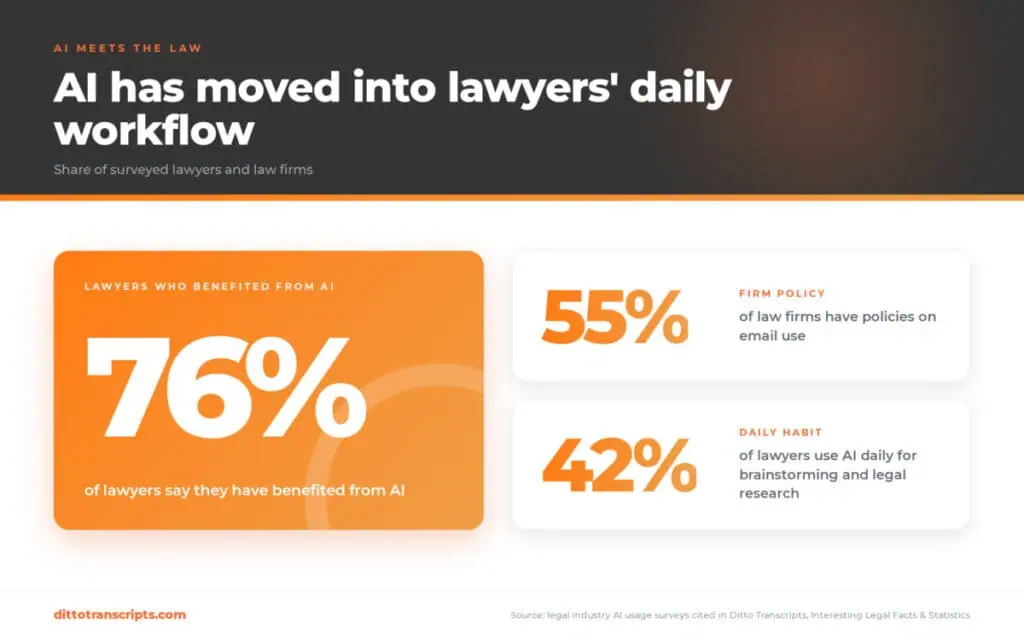
It comes as no surprise that technology plays a significant role in the legal profession. Over 42 percent of lawyers report using Artificial Intelligence (AI) daily.
However, for speech recognition and transcription, human transcription remains the superior method, with accuracy rates of 99 percent and above. AI transcription only produces an accuracy rate of about 61 percent.

Over 76 percent of lawyers said they benefited from AI, and 55 percent of law firms reported implementing policies on email use. In daily use, 42 percent of lawyers surveyed rely on AI for brainstorming and legal research.
How Federal, State, and Local Courts Are Divided
Understanding the division and classification of court systems on the federal, state, and local levels can be overwhelming. However, once you break everything down, comprehending the various courts becomes much easier.
Federal courts govern U.S. law and overlay state and local law. Within the federal court system, the Supreme Court of the United States is the country’s highest court, consisting of one Chief Justice and eight Associate Justices appointed for life. The Supreme Court has the final authority over federal and constitutional law.
Below the Supreme Court are nine Appellate Courts, followed by multiple District Courts. Individuals and entities, such as groups, associations, and businesses of all types, who have issues involving federal law begin by filing a petition with a District Court.
Once a District Court rules on either a criminal or civil case, any party wishing to appeal can seek a remedy from a Court of Appeals. The Supreme Court is the final stop in the judicial process. However, the nation’s highest court is extremely selective about which cases it will hear. Of the approximately 8,000 cases petitioned annually, they only issue around 80 decisions.
State and Local Courts
State courts are established on a similar basis, with each having a Supreme Court, criminal and civil appeals courts, and local courts that handle criminal and civil matters. Each of the nation’s 50 states has its own statutes and regulations on how judges and justices are elected, appointed, or selected.
Local court systems, such as municipal courts, typically handle minor issues, including traffic violations and low-level misdemeanor offenses. However, the next time you are unhappy with how a local judge handled your speeding ticket, it’s highly unlikely you’ll find a remedy by appealing to your state Supreme Court.
Transcription Remains a Vital Part of the Legal Profession
Whether you have a matter in local, state, or federal court, there is a good chance that any formal proceeding is recorded by an audio recording or by a court reporter. That’s why having access to a highly qualified legal transcription company is so vital.
Ditto Transcripts, one of the nation’s most reliable transcription company, provides legal transcription services to court systems across the U.S.
Our experienced legal transcriptionists undergo extensive background checks and are certified to handle sensitive legal matters, including depositions, hearings, and trials. We offer a 99 percent accuracy guarantee and a quick turnaround, depending on the type of transcription required. For more information on our legal transcription services, including law enforcement and business transcription, give us a call at (720) 287-3710 and speak directly with a member of our executive team.