
What would you do if you wrongfully lost a hearing and had no chance of appealing it?
For many people, this is not an immediate concern because they are not affected… yet. However, in the legal field, professionals know that changes are happening in the industry.
For one, the number of stenographers and court reporters is declining. Without these professionals, a court proceeding is at risk of being undocumented – which could make it nearly impossible to appeal. One modern solution is to record the entire event and have it processed by AI.
However, AI solutions cannot provide accurate and admissible transcripts. Only select legal transcription services take responsibility for the accuracy and certification of a document. And, choosing the right one isn’t that simple, especially as many “vendors” have emerged.
The Court Reporter Shortage Happening Right Now
The estimated number of court reporters and stenographers is insufficient to handle all incoming cases.
Statistics show that about 21% of the industry’s legal recording professionals have dropped out in the past decade. In California, that affected about 1.2 million hearings because they proceeded without a verbatim record.
So, why not hire a private legal record professional? While that seems a good option, it is not very feasible because their rates can be quite expensive (about $2,580 per day for a deposition and $3,300 per day for a trial).
The solution is a digital recording because it allows later transcription of the legal event. However, that is only 50% of what’s needed, as it must be accurately transcribed before it’s useful, which also entails a cost.
Capture and Certification Are Different Jobs
Recordings are processed by AI and trained human professionals differently.
Automatic speech recognition uses a trained model to predict the words spoken, while legal records professionals manually transcribe and verify the document.
When combined, the process starts with the digital recording. In this step, it is important to determine who recorded the audio, as it might later be questioned in the legal proceeding. Once it’s wrapped up, the next step is to send the audio to an AI transcription service or a human transcription provider.
AI can be used to make a draft. But if its output is treated as the final document – that is where the problem arises because it likely contains inaccuracies. No individual or party would vouch for its credibility.
A document prepared by a human transcription provider could also use AI, although only for the first draft. It is then reviewed by a human professional who is responsible for its accuracy, formatting, and verification. That person could also certify the transcript if they meet the requirements of the jurisdiction or local court.
These rules explain why professional court transcription services follow local requirements rather than relying only on speech-to-text software.
What Human Certification Actually Provides
Although small, a signature means a lot. It proves that the document has been reviewed by a qualified professional, verifying that the transcript is true and accurate. And in cases where errors are raised for review, the transcript can be investigated to explain the production process, and a correction can be issued by the signatory.
Basically, the certification answers the questions that legal teams should be able to answer:
- Who captured or preserved the source recording?
- Was the entire proceeding recorded?
- Who received or accessed the files?
- What method was used to produce the draft?
- Who checked speakers, exhibits, terminology, and inaudible sections?
- Who is responsible for the final version?
Further, the National Court Reporters Association argues that human oversight and traceability are a must for documents derived from digital recordings. It also warned that certification by undisclosed parties could make authentication difficult to establish, which could create more problems than it solves.
Federal Rule of Civil Procedure 80 explains why certification matters. Basically, it allows qualified stenographically reported testimony to be proved by a transcript certified by the reporter. For non-stenographic methods, the standard is the same: a legal transcript must be tied to an accountable professional and a recognized process.
Sounds simple, right? Ironically, that simplicity is what AI cannot provide. AI solutions alone do not show how the documentation process is performed. More seriously, AI cannot take responsibility for an error.
Texas and California Are Testing the Divide
The following two cases highlight why courts must distinguish between capturing a proceeding and producing a legally usable transcript.
Texas: In re Patrick Hughey
In re Patrick Hughey, No. 25-0463, the Texas Supreme Court is reviewing a deposition recorded via non-stenographic technology and later transcribed using AI-assisted software.
The written transcript was struck, although it did not exclude the video deposition. Instead, the recording and transcript were treated as two separate things. The appellate court denied Hughey’s request for relief. The Texas Supreme Court has since agreed to hear the dispute, with oral argument scheduled for October 6, 2026. As of July 20, 2026, the court has not issued a decision.
The case has major implications for outsourcing deposition transcription services: the more parties involved, the greater the need to establish who is responsible for the final transcript.
California: Family Violence Appellate Project v. Superior Courts
Meanwhile, California is examining the same divide from an access-to-justice perspective.
In Family Violence Appellate Project v. Superior Court, No. S288176, the petitioners are challenging California’s restrictions on electronic recording in instances where there is no official court reporter and a litigant cannot afford to hire a private alternative.
The concern stems from the difficulty of appealing when there is no record of what happened. The California Supreme Court heard oral argument on June 3, 2026. As of July 20, 2026, no final opinion has been listed on the court’s case page.
The case illustrates that allowing a machine to record the proceedings does not remove the need for an accountable human to stand behind the final transcript.
“Mostly Accurate” Is Not a Legal Standard
“This transcript is quite accurate, so we’ll accept it as evidence,” said no court ever.
The tiniest word, number, or other detail may change the intended meaning, and that could be the deciding factor in some cases. That explains why transcripts need to be very accurate.
However, accurate transcription can be challenging. It mainly depends on the quality of the audio submitted by the client. In controlled recordings where the microphone is appropriately set up, the room is soundproof, and everyone speaks clearly, the recording can be transcribed pretty easily. Even if AI achieved high accuracy, it would still need to be thoroughly checked.
That said, legal proceedings rarely take place in controlled environments. Actually, the conditions may even be the exact opposite.
Try to access a modern legal recording. You might immediately notice a lot of interruptions, unclear terminology, and generally poor audio quality. That is where AI struggles and where human professionals thrive. Professional verbatim transcription services account for every context and detail that automated systems may omit.
It does not mean that AI has no place in transcription. In fact, it is a helpful tool for first drafts. That only means a professional human touch is critical to ensuring transcripts are usable.
The Safer Model Is Technology Plus Human Responsibility
At this time, the battle is not between professional legal audio recordings and AI transcription solutions. Instead, it is about how professionals adopt AI in their workflow to improve efficiency.
Courts, law firms, and almost every other business are recognizing that AI is becoming part of the workforce. They need clear distinctions between roles and clear responsibility for the process.
Before selecting a provider for a deposition, hearing, or trial transcription service, legal professionals should confirm:
- Can they meet the certification rules in your jurisdiction?
- Will a trained human review the entire recording?
- How are the files stored, transferred, and protected?
- Does the team understand legal terminology and court formatting?
- What happens if an error needs to be corrected?
- Are the professionals U.S.-based and available if the transcript is challenged?
The goal is not necessarily a fast turnaround for the document. It’s to produce a reliable transcript that can be vouched for and traced.
Why Clients Choose Ditto for Certified Legal Transcription
At Ditto Transcripts, a recording is treated as source material for professional transcription, not as a finished legal record simply because software converted the speech into text.
Here is what Ditto offers:
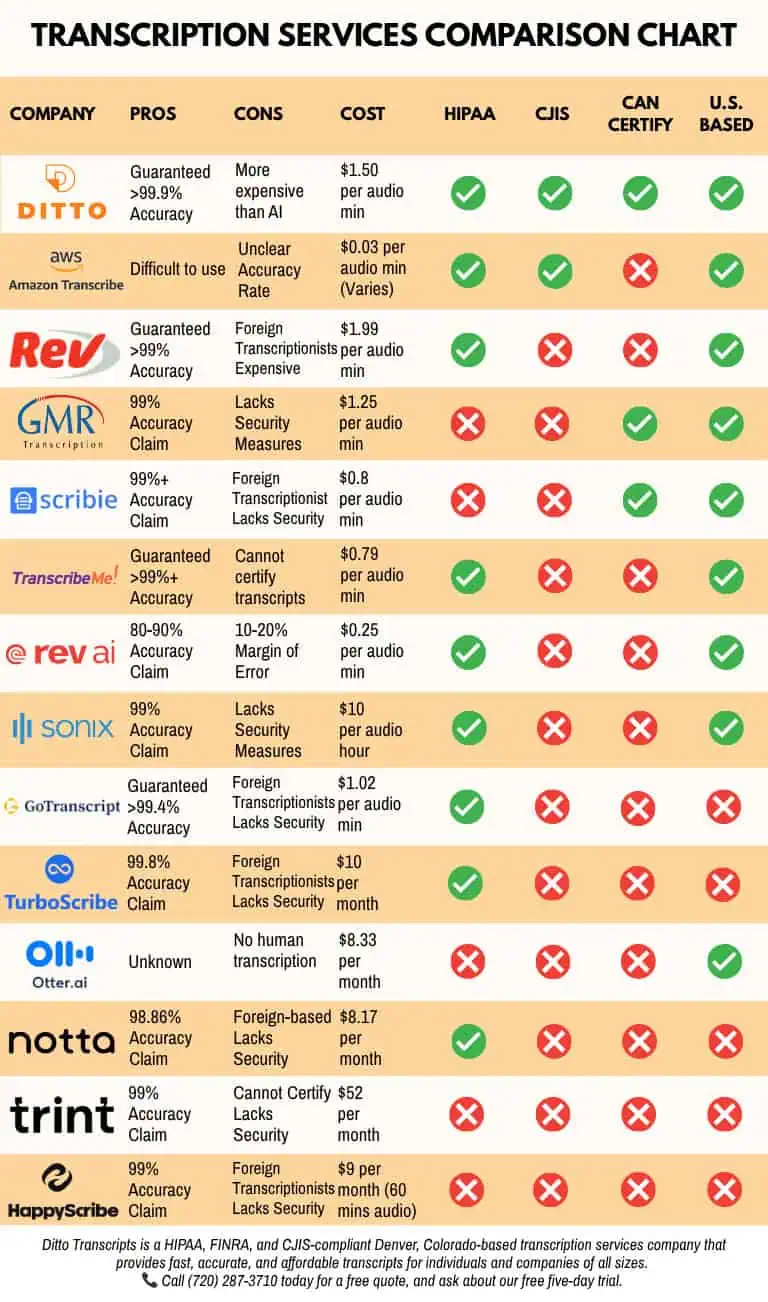
- Human-reviewed accuracy: We offer a 99%+ accuracy guarantee for all of our transcription services.
- Legal experience: Ditto employs U.S.-based transcriptionists who are familiar with and experienced in working with legal recordings.
- Certification options: Ditto can provide certified transcripts upon request.
- Secure handling: We greatly value security and uphold the highest standards, with Ditto being HIPAA-, CJIS-, and FINRA-compliant.
- U.S.-based professionals: All projects are completed by professionals familiar with American legal language and available to address questions about the final document.
- Clear pricing: Clients can review Ditto’s legal transcription prices per project and audio length, without committing to a long-term contract.
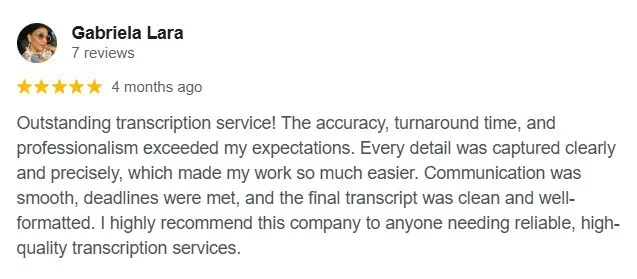
- Verified client experiences: Ditto’s testimonials provide everything you should know about our services.
The Official Transcript Still Needs an Accountable Human
Whatever the courts in Texas and California decide, one thing will remain the same: a recording is not yet a certified transcript.
Digital recording can preserve what happened. AI can speed up the first draft; however, neither can take responsibility for the final document.
AI can draft it. A qualified human must review it, correct it, and certify it when the rules require it.
Ditto Transcripts is a Denver, Colorado-based transcription company providing fast, accurate, and affordable transcripts for individuals and organizations of all sizes. Ditto is FINRA-, HIPAA-, and CJIS-compliant. Call (720) 287-3710 today for a free quote.