
Court transcripts are not ordinary documents. In most cases, the transcript becomes part of legal, medical, or government records that are never meant to be shared without authorization. That is why a court transcription provider is considered a data custodian, rather than merely a typing service.
In early 2026, court transcription work contracted by VIQ Solutions from Australia was reportedly handled by an unauthorized company based in Chennai, India.
The problem is not only about tapping an offshore transcription company, but also about its breach of contract requirements, raising questions about access to sensitive court recordings. Early public reports indicated that at least “146 court matters may have been affected, including 136 Federal Circuit and Family Court files and at least 10 Federal Court matters.”
While the full extent is still being verified, its effect raises serious questions about how data is handled.
146 Examples Where “Stored Locally” Doesn’t Mean “Accessed Locally.”
The Australian case shows the difference between data storage and data access.
A transcription provider advertises the use of “domestic servers”, yet that is useless if overseas workers or unauthorized hidden subcontractors have access to the files.
It matters because a transcript can reveal more than names and dates – it exposes details that could affect real people and real cases.
That is why legal transcription services should not be evaluated based solely on price and convenience. You should not be forced to choose among affordability, accuracy, speed, and security; get all, not at the expense of any other.
Third-party Breaches Are Up 60%
No matter the level of security a company tries to maintain, if they give their data to an unsecured platform, they are incurring a risk it tried very hard to avoid.
That is what Verizon’s Data Breach Investigation suggests, as it finds that third-party involvement in breaches rose 60%, accounting for 48% of all breaches. The leak did not happen internally. Instead, the damages were brought after the safeguarded data was given to unverified transcription aids – highlighting why you should be very careful where to entrust your data.
This is especially important for government transcription services, where sensitive data is the default.
By now, the point is clear: information has value.
$16.6 Billion in Cybercrime Losses Prove why Transcripts Need Strict Controls
In another report, the FBI’s Internet Crime Complaint Division recorded 859,532 complaints and $16.6 billion in reported losses.
These losses are not limited to personal information, but also to professional, legal, medical, and government records. Of course, transcripts are invaluable to the unintended audience. However, their contents can be extremely valuable to the wrong person.
This is one reason “cheap transcription” can become expensive.
“Lower cost” is not always true, especially when the problems of transcription arise. The real price of these cheap transcriptions increases more than what you realize, and it goes beyond money. Time will be wasted, and the worst-case scenario? The transcript you need may not even meet the deadline or be inadmissible for its intended use.
That is especially true for trial transcription services, where small problems can create larger consequences later.
At $4.4 Million per Breach, “Lowest Bid” Transcription is Very Risky
IBM’s 2025 Cost of a Data Breach Report states that the global average cost of a data breach is $4.4 million.
The worst part is that the problem goes beyond the financial cost of a data breach. When these instances occur, they raise serious questions about the investigation, operations, reputational damage, and compliance exposure.
And that is unacceptable, especially for courts and public agencies, where trust is the core foundation of the system itself.
That said, a transcription provider must be able to answer what happens after the file is uploaded. That includes who handled it, where it went, how it was protected, and whether it was accessed only by authorized personnel.
The lowest rate is not always the lowest-risk option. In some cases, the red flags only appear after the work has already been done.
Some Transcription Risks Start With Governance, Not Hacking
Not every data incident begins with a hacker. Sometimes the problem starts with a business decision.
If an organization voluntarily sends sensitive audio to an unverified transcription platform with a questionable system, then the data has already entered a new risk environment. No one had to break in, and you practically granted access.
That is a governance issue.
Before sharing sensitive recordings, organizations should clearly understand the platform’s process. Ask and find out the nitty-gritty details, such as who will access the recording, whether the work will be performed offshore or by subcontractors, whether AI tools are involved, where files are stored, how long files are retained, and, more importantly, what happens after a breach.
And no, this is not being “too much” – there is no such thing when handling sensitive data.
Why? An example of this can be found in the legal profession. A deposition includes a privileged strategy that affects a case. If this data is breached or, in a worst-case scenario, shared without authorization, it could be inadmissible, or the case could be turned around at large.
Suffice to say that if the transcription platform cannot explain its process clearly, that is not a stutter, rather a warning sign.
5 Questions to Ask Before Sending Sensitive Audio to a Transcription Vendor
Security is commonly claimed, not guaranteed. It is your responsibility to be wary and to ask these organizations questions that go beyond “How much does it cost?” and “How fast can you do it?”
Here are 5 questions you should ask your prospective transcription provider, and why:
| Question | Why it matters |
| Will any work be performed offshore? | Offshoring is not always bad, per se. Though it should be disclosed, authorized, and most importantly, appropriate for the data involved. |
| Are subcontractors used? | Hidden subcontracting may have its own terms and conditions – and that does not boldly identify control access and accountability. |
| Is AI used at any point? | Sensitive recordings should not be fed into AI tools without approval, as it risks admissibility and security of your data. |
| Is there a trained human review? | Human review matters because a trained individual can identify and verify common problems such as multiple speakers, accents, poor audio, technical terms, context, and even legal and medical language. |
| What is the incident response process? | The worst time to ask about notification, audit logs, access controls, and retention is after something has gone wrong. |
A serious transcription provider should be able to answer these questions clearly.
Government Transcription Services Need More Than a Standard Vendor Checklist.
Government recordings, put simply, contain sensitive data that not only affects one or two parties at risk, but can disrupt a whole community or system. That makes government transcription different from ordinary business transcription.
A government agency needs to know whether a transcription provider can handle sensitive files securely, and the Australian incident shows why this matters.
When a government body cannot quickly confirm who accessed sensitive recordings or whether files were copied, uncertainty becomes its own accountability problem.
Why cClients Choose Ditto for Safe & Secure Transcripts
Sensitive transcription is about more than turning audio into text. It is about protecting the people, organizations, and records behind that audio.
At Ditto Transcripts, we help clients turn audio and video recordings into accurate, readable, and professional transcripts for legal, medical, law enforcement, government, business, insurance, academic, media, and personal use.
Here is what Ditto offers:
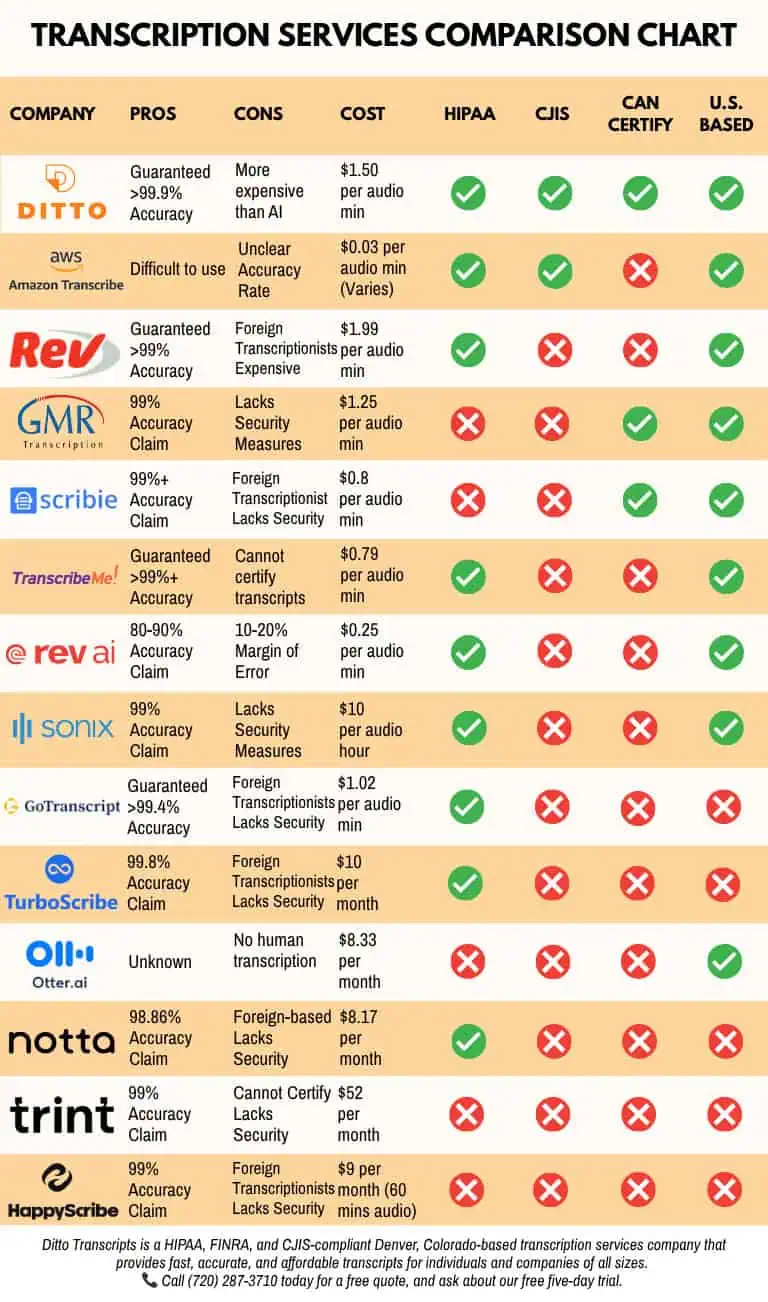
- Human transcriptionists: Ditto only employs trained professionals who can handle complex audio.
- Support for accessibility needs: We offer flexible, comprehensive transcript options, including speaker labels, readable formatting, and important visual descriptions when needed.
- Industry-specific experience: Ditto supports different fields, including legal, medical, law enforcement, and other niche transcription projects.
- Secure handling: Sensitive recordings are handled through workflows designed to protect confidentiality and client information, as Ditto Transcripts is HIPAA-, CJIS-, and FINRA-compliant transcription support.
- Flexible legal transcription pricing: Clients can choose from our turnaround and pricing options based on their needs.
- No long-term contract required: Clients can use Ditto for one project or ongoing transcription needs, no strings attached!.
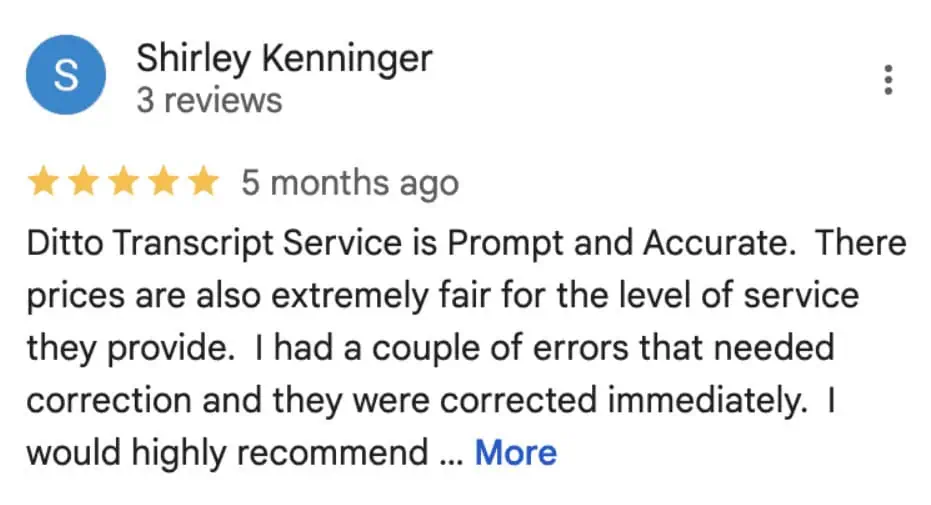
- Client testimonials: Need we say more?
The goal is simple: provide accurate transcripts while treating sensitive recordings with the care they deserve.
Transcription Should Never be Treated Like a Commodity Purchase
The lesson from Australia is not limited to Australia.
Any court, agency, hospital, law firm, insurer, business, or public institution that outsources transcription should know exactly where its recordings go and who can access them.
A transcript can be evidence. It can be a medical record. It can be a legal strategy document. It can be a government record. It can be someone’s most private story.
That means transcription should never be treated as a commodity purchase alone.
The right transcription partner should provide accuracy, confidentiality, secure handling, transparent workflows, and accountability from the first upload to the final transcript.
Ditto Transcripts is a Denver, Colorado-based transcription services company that provides fast, accurate, and affordable transcripts for individuals and companies of all sizes and is FINRA-, HIPAA-, and CJIS-compliant. Call (720) 287-3710 today for a free quote.