
Government accessibility is now on the clock. With the U.S. Department of Justice’s new ADA Title II web accessibility rule and updated requirements, state and local governments now face strict deadlines to make their digital content accessible. This includes websites, mobile apps, recorded meetings, training videos, podcasts, and livestreams. For transcription companies and legal transcription services, this is more than a growing market need but a compliance-driven shift that highlights the need for accurate captions, transcripts, and accessible media support, a critical part of how public entities serve the public and reduce legal risk.
The DOJ published the final rule in April 2024. It uses WCAG 2.1 Level AA as the accessibility standard and sets two deadlines: April 24, 2026, for public entities with populations of 50,000 or more, and April 26, 2027, for those with fewer than 50,000 people, as well as special district governments.
In this article, you’ll learn how:
- The new ADA Title II rule puts government web accessibility on a deadline.
- Captions, transcripts, and descriptive transcripts each play different compliance roles under new ADA requirements.
- Human-reviewed transcription helps public entities meet accessibility standards and lower risk. Early planning and the right transcription partner can make compliance easier.
Why the New ADA Requirement Rule Matters for Transcription
The new DOJ rule is not a transcription law, not at least by itself. Instead, it is a web and mobile accessibility rule for state and local governments under Title II of the ADA.
Still, once an audio or video is uploaded online, transcription and captioning become part of how that entity delivers accessible communication. This rule has broad coverage, from web content to mobile apps provided by public entities. This means vendors and service partners can easily integrate into the compliance workflow.
That matters for a wide range of public-facing content, which includes city council meeting recordings, training videos, podcasts, public notices, archived webinars, emergency information, court-related recordings, and other online media. If those contents are not captioned or transcribed, it could indirectly cause exclusivity as people with disabilities may be blocked from information that others can access at ease.
The DOJ’s explanation of the rule highlights inaccessible digital content as a barrier to equal access to some activities, programs, and government services, at large.
For transcription companies, this changes the role of the service itself. Transcription is no longer about documentation or convenience, but has become part of accessibility operations, public communication, and risk reduction.
What the Rule Actually Requires
The Title II final rule requires governments, in most cases, to conform to WCAG 2.1 Level AA, subject to specific exceptions and limited defenses such as undue burden or fundamental alteration. The technical standard is written into 28 CFR § 35.200.
On the other hand, for media, the WCAG framework matters because different content types have different requirements. These are generally the following:
- Prerecorded audio-only content requires a text alternative at Level A.
- Prerecorded video with audio requires captions at Level A.
- Live video with audio requires captions at Level AA.
- A full media alternative for prerecorded synchronized media, such as a complete transcript, falls under Level AAA rather than Level AA.
Distinction is important because many online articles fail to clearly distinguish between what is required and what is recommended. A clearer discussion of compliance separates minimum WCAG obligations from the general best practices that improve usability and accessibility outcomes.
So, if you are writing for a government audience, this is probably the safest framing is this: captions are crucial for prerecorded video with audio, transcripts are essential for prerecorded audio-only content, and government transcription services, along with fuller transcript options, are advisable to increase usability, searchability, records access, and broader disability access needs.
Captions, Transcripts, and Descriptive Transcripts Are Not the Same
One reason accessibility content gets confusing is that organizations often use the same words for very different deliverables.
| Format | Definition | When to Use |
| Captions | It is the synchronized text shown along with the video. | Prerecorded video with audio. |
| Transcripts | These are the text versions of spoken content and other relevant audio information. | Audio-only content such as podcasts, interviews, and recorded updates. |
| Descriptive transcripts | These are also transcripts that contain essential visual information. | Content that requires visuals to convey meaning. |
A strong accessibility workflow raises two questions: was the audio transcribed accurately, and does the final text clearly communicate the full content?
What Makes Transcription ADA-Compliant in Practice
When people say “ADA-compliant transcription”, usually what they mean is transcription and captioning work that supports accessible publishing under ADA and WCAG standards. What that means in practice is output needs to be more than technically present. It has to be usable.
A compliance-minded transcript or caption file should be:
Accurate
Details such as names, legal terms, public office titles, addresses, technical language, policy references, and speaker attributions need to be correct. In government content, small wording errors can distort public understanding, weakening the reliability of the record and overall creating chaos.
Complete Enough to Preserve Meaning
Words are not the only considerations. Meaningful non-speech information matters as well.
If a public safety video includes sirens, alarms, or background instructions, or a meeting recording includes audience responses, that context may need to appear in captions or transcripts.
Properly Synchronized for Video
For caption files, timing matters. Text must match the audio at the right moment and remain on screen long enough to be read. WCAG’s treatment of captions should assume synchronized presentation and not a loose approximation.
Structured for Readability
Transcripts should use clear formatting. This includes proper paragraphs, sensible punctuation, speaker identification, and accessible publishing formats. A transcript buried in a badly scanned PDF or pasted into a cluttered layout is not much of a help.
Easy to Locate
Accessibility guidance consistently places transcripts alongside the original content, making them easy to find on the same page. Users should not have to hunt through a document archive to find a basic text alternative.
Why Auto-Generated AI Captions Are Not Enough on Their Own
AI has made transcription faster and cheaper, but speed is not the same as compliance.
Auto-generated captions and transcripts can be useful as a first pass, sure. But on their own, they often miss the little details such as punctuations, mishear names, mishandle acronyms, skip non-speech cues, or confuse speakers. Like I said earlier, these minor errors, especially in the context of public meetings, legal information, policy statements, or service instructions, could lead to chaos.
That is why many accessibility guidelines treat auto-captions only as a starting point, subject to review and editing before publication.
That is why transcription companies remain very relevant. AI can improve turnaround, but human review is what makes the final product dependable, especially in higher-stakes work such as medicolegal transcription services.
Common Accessibility Mistakes Public Entities Still Make
Many accessibility failures are not complicated. In fact, they come from the same repeated gaps:
- Publishing Video with Only Auto-Captions: The captions exist, but are mostly inaccurate, unsynchronized, or incomplete.
- Treating Captions and Transcripts as Interchangeable: A transcript does not replace captions for prerecorded video with audio. And captions alone may not be enough for people who need a searchable, easy-to-scan text version of a long audio recording.
- Forgetting Audio-Only Content: MP3-format files are easy to overlook. Still, prerecorded audio-only content needs a text alternative under WCAG.
- Leaving Out Speaker Identification: Government content often features multiple speakers, which can lead to confusion among staff and the public. Without speaker labels, transcripts can become hard to follow very quickly.
- Hiding the Transcript: A transcript that is technically published but practically undiscoverable does little to improve access.
How Public Entities Should Prepare Before the Deadline
The best compliance strategy is to avoid waiting until the deadline and rushing remediation. Instead, it is now building an accessible media workflow.
We recommend a practical preparation plan. Here’s how it can be achieved:
Auditing Existing Media
A good way to start is with high-traffic, high-impact content. Check audio and video already published across websites, portals, apps, and public channels.
Prioritizing Essential Public Content
Critical media such as archives, training resources, benefit instructions, public notices, and high-use public information pages are better managed first, reducing complexity along the way.
Separating Content Types Clearly
Know which files need captions, which need transcripts, and which may need total improvement based on their content.
Standardizing Quality Expectations
Set consistent requirements for benchmarks, including accuracy, speaker identification, sound cues, timing, formatting, and publishing location.
Avoiding a Raw-AI Workflow
Use automation only to accelerate production if needed, but do not confuse draft output with publish-ready accessibility, as it may cause serious problems.
Working with a Company That Understands Accessibility
A company that simply converts speech to text is not necessarily the same as a vendor that can support accessible public publishing under deadline pressure.
What to Look for in a Transcription Partner
Plenty of providers promise fast turnaround. However, only a handful understand the compliance and usability demands behind government accessibility work.
If a public entity is evaluating a transcription partner, it should look for the following:
- Strong human quality review
- Experience with both transcripts and captions
- Support for speaker identification and accessibility-aware formatting
- Ability to handle public meetings, legal recordings, interviews, and training content
- Secure file handling and clear operations
- Scalable turnaround for backlog remediation
- Familiarity with WCAG-informed media accessibility expectations
Court transcription services can be especially relevant here. Government agencies often publish hearings, testimony, public meetings, court-adjacent proceedings, compliance briefings, and other records where wording, speaker attribution, and formatting accuracy are critical. In these situations, accessibility and record integrity go hand in hand.
Why Organizations Choose Ditto for ADA-Ready Transcription
If your organization is preparing for the new ADA Title II accessibility deadlines, Ditto Transcripts can help you move from uncertainty to action.
Ditto’s transcription services are built for organizations seeking absolute accuracy. We help clients produce accurate, readable, human-reviewed transcripts and captions that support accessible publishing and reduce the risks that come with rushed or low-quality media workflows.
Here at Ditto, we offer:

- High accuracy: Guaranteed 99% accuracy in our wide range of transcription practice. Each and every single time.
- Human-reviewed output: AI is fast, but even today, it is far from being accurate or verified. At Ditto, rest assured that the transcripts are thoroughly reviewed before it is given to our clients
- Flexible pricing and turnaround: We offer competitive legal transcription rates that won’t break the bank. Plus, our options cover a range of needs and can be adjusted to lower costs.
- Accessible format support: Transcript and caption-ready files that fit web, video, and document workflows.
- Experience with sensitive content: Public meetings, interviews, legal, or medical – name it, and we have the appropriate expertise to handle your transcription needs.
- Full-range service: Ditto Transcripts can help you meet ADA requirements. However, if you had a different provider when you received a complaint and your case goes to trial (a rare event), our trial transcription service can help you keep accurate records.
- Responsive service: Clear communication and practical support minus the unnecessary hassle. We don’t want to send you automated messages for your concerns – we understand how frustrating it is.
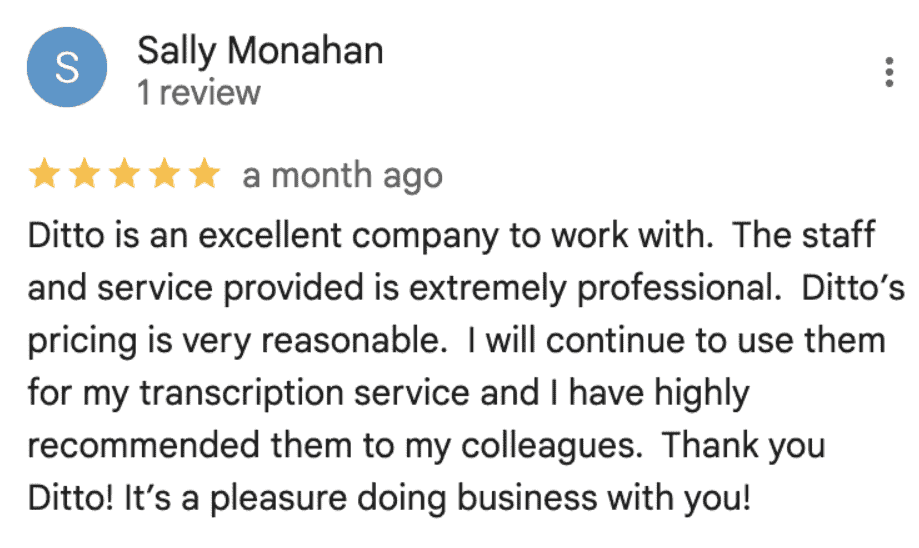
And no, these are not just claims. If you still doubt about what we offer, here’s a client testimonial that could change your mind:
ADA Title II Deadlines and What They Mean for Media Accessibility
The new DOJ ADA Title II rule gives state and local governments clear deadlines for digital accessibility. Public entities with populations of 50,000 or more must comply by April 24, 2026. Those with fewer than 50,000 people, along with special district governments, have until April 26, 2027. The technical standard is WCAG 2.1 Level AA.
For audio and video content, transcription and captioning are part of how agencies meet those requirements in practice. The organizations best positioned to handle this well will be the ones that start early, review their content, tighten their workflows, and work with partners who understand the difference between raw automated output and communication that is actually ready for accessibility.
Ditto Transcripts is a Denver, Colorado-based FINRA, HIPAA, and CJIS-compliant transcription services company that provides fast, accurate, and affordable transcripts for individuals and companies of all sizes. Call (720) 287-3710 today for a free quote.