


Students often balance lectures, assignments, exams, work, research, and other responsibilities. When a class moves quickly, keeping complete notes while also following the discussion can be difficult.
A transcript gives students a written version of recorded course material that they can review, search, and organize after class. For lectures, seminars, interviews, or other academic recordings where accuracy and documentation are especially important, professional academic transcription services may also provide the additional human review needed to produce a reliable transcript. These services can turn lectures, interviews, seminars, and research recordings into searchable study and reference material.
In this article, you’ll learn:
- How transcription can support lecture review
- Why searchable transcripts are useful for studying
- How transcripts can support accessibility
- Where AI-generated transcripts may fall short
- When professional academic transcription makes sense
What Is Academic Transcription?
Academic transcription is the process of converting spoken academic content into written text.
The recording may come from:
- A lecture
- Research interview
- Seminar
- Focus group
- Conference presentation
- Dissertation defense
- Oral history project
- Faculty meeting
- Recorded field notes
The final transcript can be prepared as clean-read text, verbatim text, or another format depending on how the material will be used.
For universities, researchers, instructors, and students who regularly work with recorded material, academic transcription services can provide professionally reviewed transcripts with consistent formatting.
Common Uses of Transcription in Academic Settings
Academic transcripts can serve several purposes beyond simply creating written lecture notes.
| Academic use | How transcription helps |
| Lecture transcription | Creates a searchable reference students can review after class |
| Research interviews | Converts recorded responses into text for coding and analysis |
| Focus groups | Creates a written record of multi-speaker discussions |
| Field notes | Turns dictated observations into searchable documents |
| Conference presentations | Preserves talks for later review or publication preparation |
| Oral history projects | Creates written records of recorded accounts |
| Dissertation defenses | Documents presentations, questions, and responses |
| Accessibility support | Provides text that may complement captions or other accommodations |
The most useful transcript format depends on the recording’s purpose.
A qualitative researcher may need every hesitation or repeated phrase preserved, while a student reviewing a lecture may prefer a cleaner document that removes unnecessary fillers without changing meaning.
How Online Transcription Services Help Students
Transcription does not replace attending class, reading assigned materials, or taking useful notes. Instead, it gives students another way to revisit information that was originally delivered through audio or video.
Review Lectures Without Replaying Everything
Rewatching a full 60- or 90-minute lecture to find one definition can be inefficient.
A searchable transcript lets students locate:
- Names
- Dates
- Definitions
- Technical terms
- Formulas discussed aloud
- Examples
- Assigned readings
- Questions from classmates
Searchability is one of the clearest advantages of turning a lecture recording into text.
Students can search for a keyword and return to the surrounding discussion rather than scanning an entire recording from the beginning.
Supplement Notes Taken During Class
Students often have to decide what is important enough to write down while simultaneously listening to the instructor.
A transcript can provide a secondary reference after class, allowing students to compare their notes with what was actually said.
This can be especially useful when:
- The instructor moves quickly through complex material
- A student misses a definition
- An example was given verbally, although it does not appear on the slides
- A class discussion introduces a useful perspective
- Several students ask questions in succession
A transcript can preserve spontaneous explanations and examples that may never appear in the textbook or presentation slides.
That point was one of the stronger ideas in the original article.
Turn Lecture Content Into Study Materials
A reviewed transcript can also serve as source material for other study resources.
Students may use it to create:
- Topic summaries
- Flashcards
- Study questions
- Vocabulary lists
- Timelines
- Comparison charts
- Review sheets
- Citation notes
For example, a student could search a transcript for every reference to a particular theory, extract the relevant passages, and organize those ideas into a study outline.
The transcript provides the source material; the student still needs to interpret and verify the information.
This distinction matters because a transcript records what was said. It does not determine what is correct, important, or likely to appear on an exam.
Support Research Workflows
Academic transcription is also widely used beyond undergraduate lectures.
Researchers working with interviews, focus groups, field recordings, and oral histories frequently need spoken responses converted into text before they can code, compare, annotate, or quote the material.
When the exact wording matters, verbatim transcription services can preserve repetitions, interruptions, fillers, false starts, and other spoken details that might be removed from a clean-read transcript.
A structured transcript can make qualitative data easier to organize. However, researchers should still maintain appropriate links between the transcript and original recording.
Can Transcripts Support Accessibility?
Yes. Transcripts can make recorded academic material more usable for some students, though they should not be treated as a universal substitute for every accessibility accommodation.
W3C describes transcripts as text versions of speech and relevant non-speech audio information. They can help people who are Deaf or hard of hearing, people who have difficulty processing auditory information, and others who prefer or require text access.
However, transcripts and captions are not identical.
Captions are synchronized with video or audio, while a transcript is typically available as a separate written document. For prerecorded video with meaningful audio, WCAG requires captions at Level A.
Educational institutions should therefore determine which accommodations are appropriate for the individual student, course material, and applicable requirements rather than assuming that a transcript alone addresses every accessibility need.
Are Online Transcripts Useful for Students Who Miss Class?
They can be, provided the institution or instructor makes the recording and transcript available.
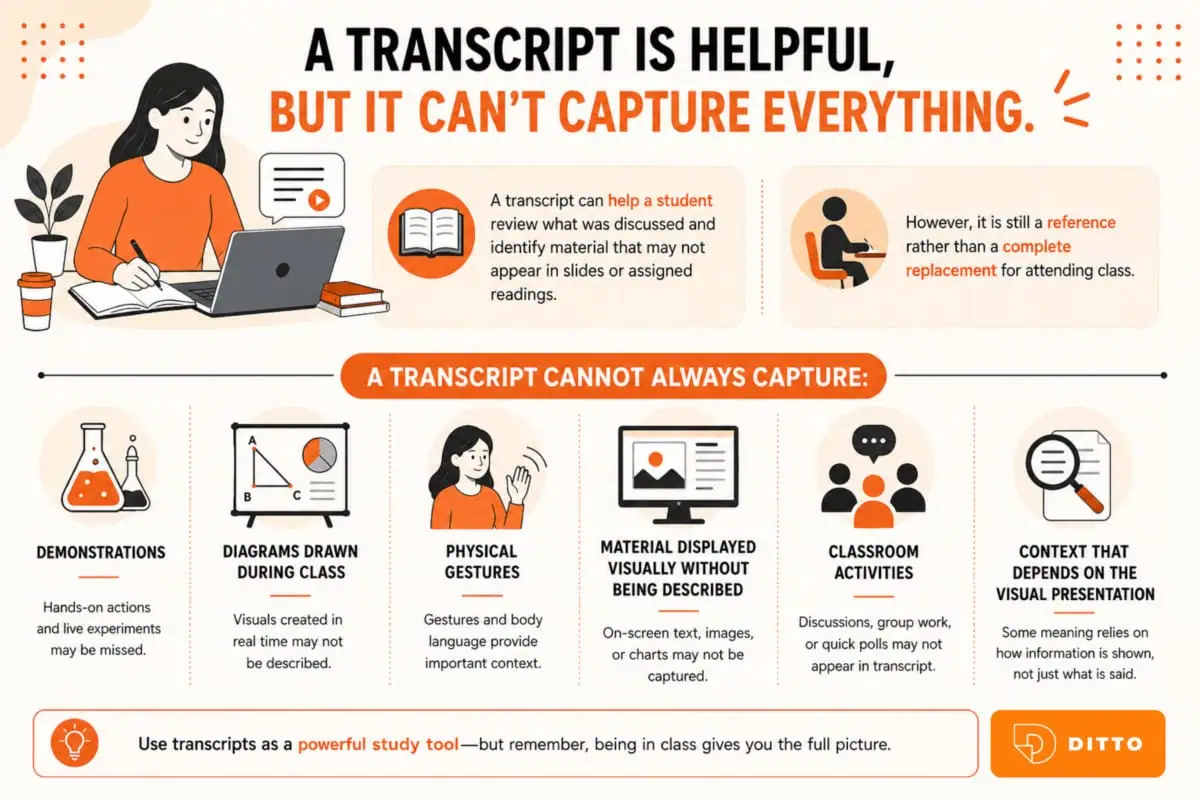
For video-based instruction, a descriptive transcript may include relevant visual information in addition to spoken content. W3C recommends descriptive transcripts when visual material is necessary to understand the content.
What Are the Limitations of AI Academic Transcription?
AI transcription can be useful when students or educators need a fast draft. However, academic recordings often contain conditions that make automatic speech recognition more difficult.
Common challenges include:
- Specialized terminology
- Heavy accents or unfamiliar pronunciations
- Several speakers
- Overlapping discussion
- Poor microphone placement
- Classroom noise
- Proper names
- Scientific and medical vocabulary
- Numbers and formulas
If an AI-generated transcript is only 61.92% accurate, substantial human correction may be required before students or researchers can rely on it.
An error may be relatively harmless in casual conversation, though more serious in a lecture.
Mishearing a scientific process, drug name, date, legal doctrine, mathematical value, or quoted statement can change the meaning of the material.
For that reason, review automated transcripts when accuracy matters.
AI vs. Human Academic Transcription
AI and professional human transcription serve different purposes.
| Factor | AI transcription | Human transcription |
| Speed | Produces a draft quickly | Requires more turnaround time |
| Cost | Often lower | Usually higher upfront |
| Technical terminology | May misidentify uncommon terms | Can research and verify terminology |
| Multiple speakers | Speaker separation varies | Can be manually reviewed |
| Formatting | May require cleanup | Can follow requested formatting |
| Quality control | Depends on user review | Includes human review |
| Best suited for | Low-risk drafts and quick reference | Important academic or research material |
The better option depends on what happens if the transcript contains an error.
A student creating a rough personal study aid may be comfortable correcting an AI draft. A researcher quoting participants in a publication may require a much higher level of review.
Why Choose Ditto for Academic Transcription?
Students, researchers, faculty members, and academic institutions need transcripts that are accurate, readable, and appropriate for their work.
Clients choose Ditto for:
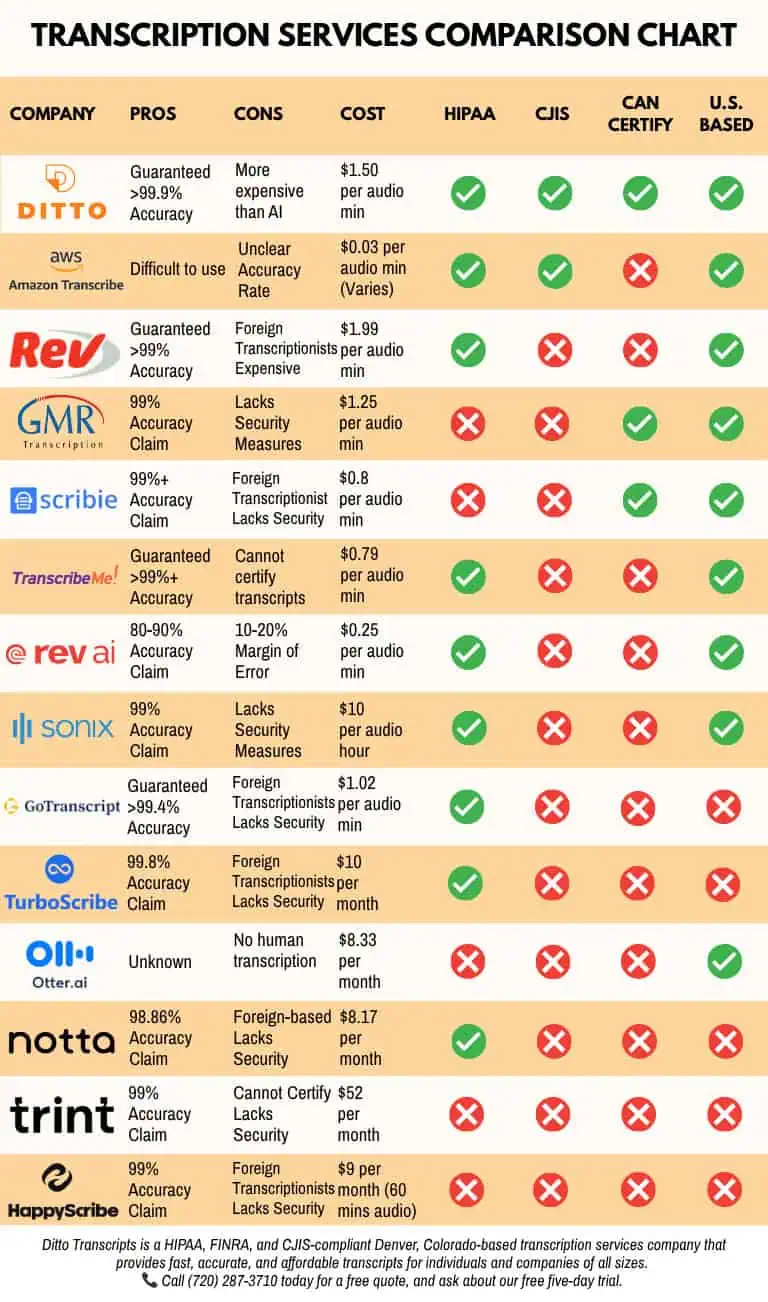
- Human-reviewed accuracy: Ditto advertises a 99% accuracy guarantee for completed human transcription projects.
- U.S.-based transcriptionists: Ditto states that U.S.-based transcriptionists handle its academic projects.
- Academic experience: The company handles lectures, seminars, research interviews, dissertations, and other educational recordings.
- Flexible formatting: Clients may request speaker labels, timestamps, clean-read text, verbatim text, or project-specific formatting.
- Turnaround options: Ditto publishes rush, standard, and extended delivery options for transcription projects.
- Transcription prices upfront: Published pricing explains how factors such as audio quality, speaker count, and turnaround can affect cost. Current published legal rates generally range from $1.50 to $5.00 per audio minute.
- Security-focused handling: Ditto states that files are handled through encrypted, HIPAA- and CJIS-compliant systems.
- No long-term contract: Clients can use pay-as-you-go transcription without committing to an annual agreement.
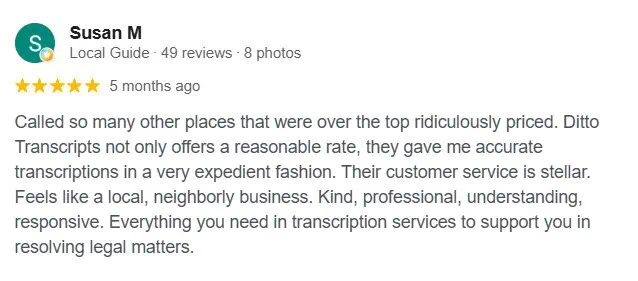
- Client feedback: Ditto’s testimonials include feedback from academic researchers and doctoral students using its transcription services.
Make Recorded Academic Content Easier to Use
Academic transcription can turn spoken material into a resource that students and researchers can search, annotate, organize, and revisit.
For students, that may mean finding one lecture explanation without replaying an entire class. For researchers, it may mean converting hours of interviews into text that can be reviewed and analyzed.
AI tools can provide a useful first draft when the stakes are low. Human transcription becomes more valuable when terminology, speaker identification, formatting, or accuracy affects how the material will be used.
A good transcript should make academic content easier to work with without changing what the speaker actually said.
Ditto Transcripts is a Denver, Colorado-based FINRA-, HIPAA-, and CJIS-compliant transcription services company that provides fast, accurate, and affordable transcripts for individuals and academic institutions of all sizes. Call (720) 287-3710 today for a free quote.