


When we see professionals transcribing audio files and typing steadily at their keyboards, it may appear straightforward. At first glance, audio transcription can seem like a simple matter of listening and typing what is heard.
In reality, audio transcription demands sustained concentration, strong language skills, and a high level of precision. Even minor errors in transcribing audio or video content can lead to misunderstandings, wasted time, or costly revisions. Despite its challenges, transcription remains a rewarding career path for those who value accuracy, efficiency, and attention to detail.
In this article, you’ll learn:
- Audio transcription is more complex than it appears. Fast speech, accents, background noise, and technical terms make accuracy a demanding, detail-oriented task.
- Common audio challenges directly affect transcript quality. Poor sound, overlapping speakers, and industry jargon require careful listening and verification.
- Human transcription delivers greater reliability than automation. While AI offers speed, professional transcription ensures contextual understanding, precision, and defensible records.
The Process of Audio Transcription
Audio transcription follows a structured workflow designed to ensure accuracy, consistency, and compliance with client requirements. While specific procedures may vary by provider, the general process typically includes the following steps:
- Step 1: File Submission: The client securely submits audio or video file(s) for transcription.
- Step 2: Project Assignment: The provider reviews the material and assigns it to the most suitable transcriptionist based on subject matter, complexity, and turnaround requirements.
- Step 3: Transcription Drafting: The transcriptionist listens carefully to the recording and produces either a clean read or verbatim transcript, depending on client specifications.
- Step 4: Formatting and Customization: Timestamps, speaker identification, formatting preferences, and accessibility features are added as requested.
- Step 5: Quality Control Review: The transcript undergoes one or more quality assurance checks to identify errors, verify terminology, and ensure overall accuracy before delivery.
Accurate audio transcription supports clarity, accountability, and long-term record keeping across industries. Whether used for internal documentation, research, or regulatory purposes, well-prepared transcripts help organizations operate more efficiently and make informed decisions. These standards are especially critical in legal settings, where deposition transcription services require precise, defensible records that can withstand formal scrutiny.
Transcribing Audio Is Not As Easy As You Might Think
Speech often outpaces typing speed, making real-time transcription inherently challenging.
Research indicates that the average English speaker talks at approximately 150 words per minute (wpm). In contrast:
- The average typing speed is about 40 wpm
- Two-finger typists average around 27 wpm
- Professional transcriptionists typically range between 50 and 80 wpm
Even under optimal conditions, spoken language moves faster than most individuals can type accurately. This does not account for:
- Accents or dialects
- Background noise
- Multiple speakers
- Technical terminology
- Required pauses for review and correction
In practice, 1 hour of recorded audio typically requires 3-4 hours of professional transcription. This industry standard reflects the need for careful listening, verification, formatting, and quality control to ensure high accuracy.
Transcription is not simply typing what is heard. It is an analytical process that demands concentration, language proficiency, and sustained attention to detail.
Other Challenges In Audio Transcription Services
Speech rate is only one factor that makes transcription demanding. Audio recordings often present technical, linguistic, and environmental challenges that can significantly affect accuracy, turnaround time, and overall transcript quality.
The table below outlines common obstacles in audio transcription and why they matter.
| Challenge | Why It Impacts Transcription Accuracy |
| Poor Audio Quality | Background noise, distortion, echoes, low-quality recording devices, compression issues, or corrupted file transfers can reduce speech clarity. Verbatim transcription becomes particularly difficult when audio quality is compromised. |
| Specialized Terminology and Jargon | Industry-specific language, acronyms, and technical vocabulary require familiarity with the subject. Fields such as finance and law frequently use terminology that must be transcribed precisely to avoid costly errors. |
| Multiple Speakers and Overlapping Dialogue | Simultaneous speech and unclear speaker transitions complicate speaker identification and sentence structure, especially in meetings, interviews, or group discussions. |
| Unintelligible Speech | Mumbling, incomplete phrases, interruptions, or heavy interference can make portions of audio difficult or impossible to transcribe accurately. |
| Accents and Dialects | Variations in pronunciation, regional speech patterns, and cultural expressions may increase the difficulty of interpretation, particularly when transcribers lack familiarity with specific dialects. |
Professional transcription requires more than typing ability. It involves critical listening, contextual interpretation, verification of terminology, and careful quality control.
In high-stakes environments, including legal proceedings where court transcription services are relied upon for accurate, defensible records, effectively managing these challenges is essential.
Is Automatic Transcription Software the Right Solution?
Automated transcription uses artificial intelligence and automated speech recognition to convert audio or video recordings into text. These tools offer speed and lower upfront costs, making them attractive for certain use cases. However, transcription quality depends on more than speed alone, especially in professional or regulated environments.
The comparison below outlines key differences between automated and human transcription.
| Factor | Automated Transcription (AI) | Human Transcription |
| Speed | Produces transcripts almost instantly. | Requires several hours per audio hour to ensure accuracy and review. |
| Cost | Generally lower upfront cost. | Higher direct costs due to professional labor and quality control. |
| Accuracy | Accuracy rates can vary and may decline with accents, technical terms, background noise, or overlapping speech. | Higher accuracy through contextual understanding, terminology verification, and structured review processes. |
| Context and Nuance | Relies on pattern recognition and training data. Limited ability to interpret tone or specialized language. | Applies contextual awareness to interpret legal, medical, academic, or technical terminology correctly. |
| Suitability for Regulated Industries | May require extensive editing before formal use. | Better suited for industries that require precision and defensible documentation. |
While automated transcription tools offer speed and convenience, accuracy and accountability remain essential in professional environments. In sectors where documentation must withstand scrutiny, including public institutions that rely on government transcription services, precision is not optional. When records serve as the foundation for policy, compliance, or legal review, reliability should always take priority over efficiency.
Best Transcription Tips to Improve Accuracy
The demand for transcription services continues to grow, and achieving high accuracy requires effort from both clients and service providers. Clear audio, proper preparation, and structured quality control processes all contribute to reliable transcripts.
To maximize the benefits of audio transcription, companies and providers should follow these best practices:
For Companies
- Use quality recording equipment to capture clear, distortion-free audio.
- Optimize audio settings before recording begins.
- Record in uncompressed or high-quality file formats to preserve sound clarity.
- Provide necessary context, including speaker names, terminology, and subject matter details.
- Give clear instructions regarding formatting, timestamps, and turnaround expectations.
- Spell out terms with multiple possible spellings in advance.
- Encourage speakers to talk at a moderate pace.
- Avoid cross-talk whenever possible during meetings or interviews.
- Record in a quiet environment to reduce background interference.
Work with reputable manual transcription providers that prioritize human accuracy and quality control.
For Professional Transcription Providers
- Employ rigorous proofreading and editing guidelines before delivering transcripts.
- Retain and continuously train skilled transcriptionists.
- Allow clients to choose preferred text formats and customization options.
- Delegate projects to the most appropriate and experienced transcribers.
- Use high-quality playback equipment and audio enhancement tools.
- Utilize professional transcription software and tools, including language correction programs, multiple monitors, ergonomic keyboards, and foot pedals.
- Maintain custom dictionaries for industry-specific terminology.
- Implement structured feedback mechanisms to improve performance.
- Encourage collaboration and internal review to reduce error rates.
Why Researchers and Organizations Choose Ditto

- Accuracy: Ditto offers up to 99.9% accuracy for qualitative and professional transcription services, supporting reliable documentation and defensible records.
- Confidentiality: Our security measures are CJIS, FINRA, and HIPAA-compliant, ensuring full control over data security and confidentiality.
- Experience: Ditto has provided transcription services across academic, legal, healthcare, and corporate sectors since 2010.
- Turnaround Time: Need transcripts quickly? We offer flexible turnaround options, including 24-hour rush services for time-sensitive projects.
- Human Transcriptionists: We work exclusively with skilled, US-based human transcriptionists. No AI tools are used in our workflow, preserving context, nuance, and precision.
- Cost: Enjoy competitive legal transcription pricing without sacrificing quality. We also offer flexible options for clients with specific budget requirements.
- Customer Support: Our support team is available to assist you throughout the entire transcription process, from submission to final delivery.
The Benefits Of Transcription For Audio And Video Are Undeniable
Transcribing audio isn’t just for courtrooms and captioning entertainment content; many industries are realizing that now. Whether you’re running a law enforcement agency or a multinational corporation, transcription can help save you money, improve workflow efficiency, and provide a safe and secure way to store written documents transcribed from your recordings
All that’s needed is to choose the right transcription service provider, and you’re golden.
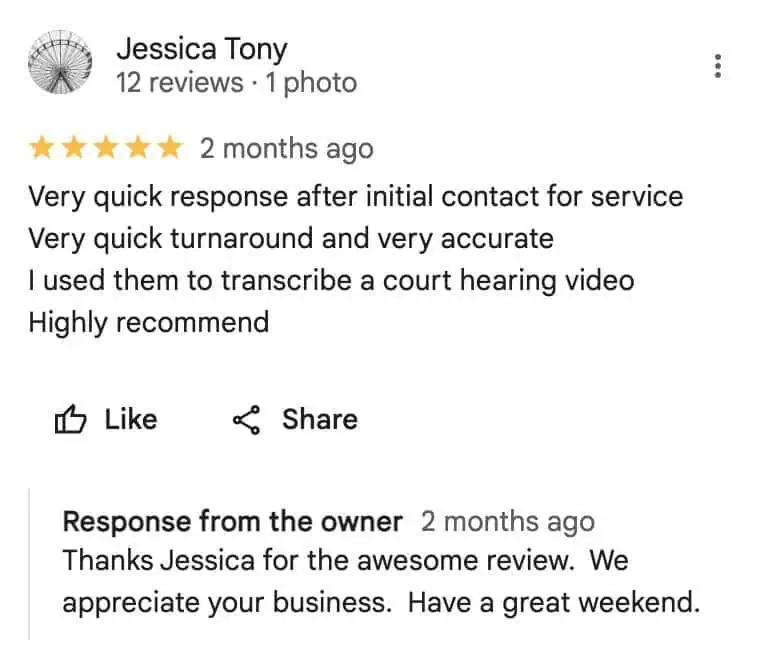
If you’re still not convinced about Ditto, here’s what our client testimonials say about our service:
Ditto Transcripts is a Denver, Colorado-based FINRA, HIPAA, and CJIS-compliant transcription services company that provides fast, accurate, and affordable transcripts for individuals and companies of all sizes. Call (720) 287-3710 today for a free quote.