


Clear billing is an important part of choosing a transcription company. Whether a client needs medical documentation or medical transcription services, they should understand how the provider calculates the final cost before submitting sensitive recordings.
Medical transcription companies may charge by the line, audio minute, word, working hour, report, or subscription. Each method has advantages, although the details matter. Two companies may both advertise per-line pricing while using different definitions of what counts as a billable line.
Understanding these billing structures can help healthcare providers compare services fairly and avoid unexpected charges.
In this article, you’ll learn:
- How medical transcription companies calculate charges using different billing methods
- How per-line, per-minute, per-report, per-word, hourly, and subscription pricing compare
- Which factors can increase medical transcription costs
- What problems to watch for when reviewing per-line billing
- How to compare providers based on pricing, accuracy, security, and included services
Common Medical Transcription Billing Methods
Per-line and per-report billing are common in medical transcription, while per-audio-minute pricing is frequently used for other types of recorded material. However, providers may choose different systems depending on their services, technology, and clients.
Per-Line Billing
Under this structure, the client pays for the number of lines in the completed transcript.
A commonly used medical transcription line contains 65 characters, including letters, numbers, spaces, and punctuation. The provider counts the characters in the finished document and divides the total by 65.
For example, a transcript containing 6,500 billable characters would equal 100 lines.
Per-line billing can work well because the client pays for the amount of text produced rather than the number of hours the transcriptionist spent on it. It also adapts to reports of different lengths.
However, clients should ask several questions:
- Does one line equal 65 characters?
- Are spaces and punctuation included?
- Are blank lines billable?
- Are headers, footers, and templates included?
- Is there a minimum charge per report?
- How are corrections or revisions handled?
Without clear answers, two providers advertising the same per-line rate may produce very different invoices.
Per-Audio-Minute Billing
Per-minute billing uses the duration of the original recording. A 30-minute file is billed as 30 audio minutes, regardless of how long the transcriptionist spends completing it.
This structure makes it easier to estimate costs before work begins. It is commonly used for interviews, meetings, legal recordings, academic research, and other multi-speaker files.
The base rate may increase when the recording includes poor audio, many speakers, heavy accents, technical terminology, or a short deadline.
A file containing long periods of silence may still be billed according to its full duration unless the provider states otherwise. Clients should therefore review whether the company bills the entire file or only the portions containing speech.
Per-Report Billing
Some medical transcription companies charge a fixed amount for each report.
This method may work well when reports are relatively consistent in length and format. It can also simplify budgeting for clinics that regularly produce the same types of documents.
However, a flat report price may not reflect major differences in length or complexity. A short follow-up note and a detailed operative report could require very different amounts of work.
Providers may therefore use pricing ranges or assign different rates to each report type.
Per-Word Billing
Per-word billing is based on the total number of words in the finished transcript.
The calculation is simple after the document is complete. However, estimating the cost in advance can be difficult. Speaking rates vary, and one minute of audio may contain substantially more words than another.
For example, at 150 words per minute, a rate of $0.03 per word would equal $4.50 per audio minute. The total can rise quickly when recordings are long or speakers talk rapidly.
Clients should calculate the likely effective per-minute cost before accepting a per-word arrangement.
Hourly Billing
Hourly billing charges for the time spent transcribing, editing, researching, formatting, and proofreading.
This may be appropriate for unusual projects where the scope is difficult to predict. However, the client may not know the final cost until the work is complete.
Slow speech does not necessarily make a file easy. Poor audio, technical terminology, and frequent rewinding may cause a short recording to require several hours of work.
Hourly billing should include clear time-tracking practices and an estimate or spending limit whenever possible.
Subscription Billing
Under a subscription model, the client pays a recurring monthly or annual fee for a set amount of transcription.
Subscriptions may benefit organizations with predictable volumes. However, the client may pay for unused capacity during a quiet month or face extra charges after exceeding the plan’s allowance.
Before subscribing, confirm:
- What volume is included
- Whether unused work carries over
- What happens when the limit is exceeded
- Whether difficult audio costs more
- Whether the contract renews automatically
- How the subscription can be canceled
A subscription should match the organization’s actual workload rather than simply offering the lowest advertised rate.
What Affects Medical Transcription Pricing?
The billing method is only one part of the final cost. Most providers adjust their rates based on the amount of work required.
Audio Quality
Clear recordings are easier and faster to transcribe. Background noise, low volume, poor microphones, file compression, and distant speakers may require repeated listening.
A provider may apply a difficult-audio surcharge when the recording requires significantly more work.
Number of Speakers
Identifying and labeling several speakers adds complexity. It becomes especially difficult when people interrupt each other or have similar voices.
This issue is common in medical conferences, consultations, investigations, and recorded legal proceedings.
Medical Complexity
General dictation may be easier than recordings filled with specialized terminology, uncommon drug names, procedures, abbreviations, or technical discussions.
The transcriptionist may need experience in the relevant medical specialty or additional time to research unfamiliar terms. Recordings connected to claims, litigation, or independent medical examinations may require medicolegal transcription services because both medical and legal accuracy matter.
Turnaround Time
Faster delivery normally costs more.
A standard file may be completed within several business days, while urgent or STAT transcription may need to be returned within hours. Rush work can require schedule changes, additional staff, or work outside normal business hours.
Clients should choose the turnaround time they actually need rather than automatically paying for the fastest option.
Formatting and Templates
Medical clients may require documents to follow specific templates, headings, margins, fonts, and naming rules.
Some providers include standard formatting in their base rates. Others charge more for custom templates, EHR preparation, timestamps, or extensive formatting instructions.
Verbatim Requirements
Most clinical dictation does not need every pause, filler word, or repeated phrase. A clear medical report is usually the goal.
However, verbatim transcripts may be required for investigations, interviews, disputed conversations, research, or proceedings where the exact spoken wording matters. Verbatim work can cost more because the transcriptionist must preserve additional details.
Common Problems With Per-Line Billing
Per-line billing can be transparent, although only when the provider explains how lines are counted.
Possible problems include:
- Different line definitions: One company may use 65 characters, while another uses a shorter line that produces a higher total.
- Billable blank space: A provider may count blank lines, empty template fields, headers, or repeated boilerplate text.
- Minimum charges: A one-line report may still be billed at a fixed minimum.
- Unclear character counts: The client may receive only a total invoice without a way to confirm the calculation.
- Quantity over quality: A provider paid according to output may prioritize speed unless it has a strong review process.
Clients should request a sample calculation or billing explanation before beginning a large project. The invoice should be understandable without specialized software or guesswork.
Accuracy and Security Should Be Part of the Price
The lowest rate does not always produce the lowest final cost.
An inexpensive transcript may require the physician or office staff to spend time correcting terminology, formatting, names, and numbers. That correction time becomes an additional expense, even if it does not appear on the transcription invoice.
Security also matters because medical recordings may contain protected health information. A provider handling that information on behalf of a HIPAA-covered organization may be considered a business associate and generally requires an appropriate business associate agreement.
Clients should confirm whether secure transfer, access controls, human proofreading, formatting, and revisions are included in the quoted rate.
Why Clients Choose Ditto for Medical Transcription
A useful medical transcription rate should be clear, predictable, and connected to the quality of the final document.
At Ditto Transcripts, we help physicians, hospitals, clinics, insurers, researchers, and other healthcare organizations convert medical recordings into accurate, professionally prepared text.
Here is what Ditto offers:
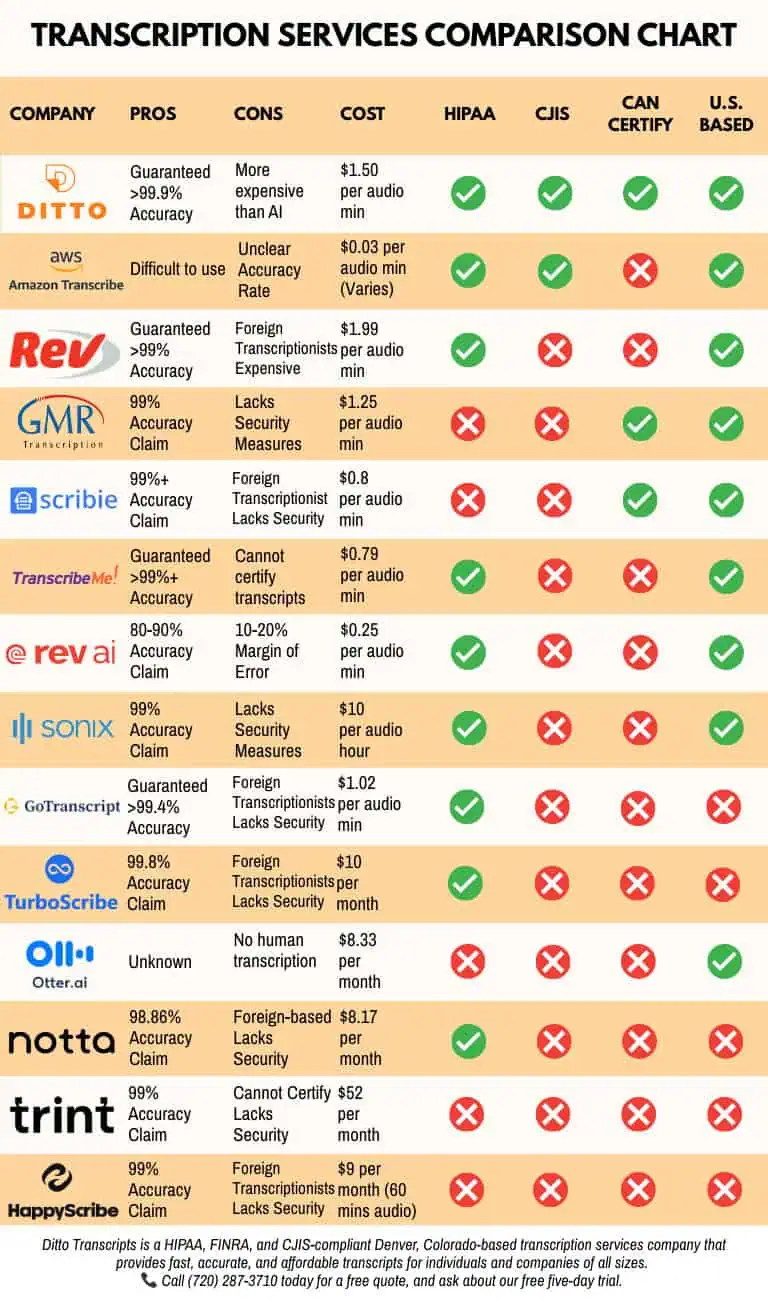
- Straightforward per-line pricing: Medical transcription is available at 7 cents per line for a 72-hour turnaround, 10 cents per line for a standard 24-hour turnaround, and 14 cents per line for STAT files with a four-hour turnaround.
- EHR and EMR report pricing: Flat rates generally range from $0.25 to $3 per report. Per-line pricing may also be available when the EHR or EMR includes a compatible line counter.
- LIS and PACS pricing: Flat rates generally range from $0.25 to $3 per report, with per-line billing available when the system provides an appropriate line count.
- Human-reviewed accuracy: Ditto uses trained transcriptionists and guarantees 99% accuracy in completed transcripts.
- Medical experience: Our transcriptionists understand clinical terminology, report formats, medications, diagnoses, and specialty-specific language.
- Secure handling: Ditto is HIPAA-compliant and provides a secure platform for transferring and handling sensitive recordings.
- Flexible turnaround: Clients can select routine, next-day, or urgent delivery based on their documentation needs.
- Transparent add-ons: Pricing factors such as poor audio, special formatting, and expedited delivery are explained before the work begins.
- No long-term commitment: Clients can submit a single report or use Ditto for recurring transcription without committing to a minimum number of files.
- Comparable service pricing: Organizations that also need other forms of transcription can review Ditto’s medical rates alongside its legal transcription prices and project-specific options.
- Client feedback: Read our testimonials to see how clients describe Ditto’s accuracy, responsiveness, turnaround times, and service.

Pricing may change, so clients should confirm current rates and project requirements when requesting a quote.
Clear Billing Builds Better Client Relationships
Medical transcription billing does not need to be complicated.
Per-line pricing can work well when the provider clearly defines a line and explains what is included. Per-minute and per-report billing can also be practical when the rate matches the type of recording.
The best option is not always the one with the lowest advertised number. It is the one that combines transparent billing, accurate human transcription, secure file handling, and a dependable turnaround time.
Ditto Transcripts is a Denver, Colorado-based transcription services company providing fast, accurate, and affordable transcripts for individuals and organizations of all sizes. Ditto is HIPAA-, CJIS-, and FINRA-compliant. Call (720) 287-3710 today for a free quote.