


Body-worn cameras, dash cameras, interview systems, and other recording tools now preserve many interactions between law enforcement officers and the public. However, reviewing hours of footage can be slow, especially when agencies need to locate one statement, time, name, or event. A law enforcement transcription company can help turn police encounters, reports, complaints, or court proceedings into searchable transcripts. A searchable transcript can make recorded information easier to review without replacing the original audio or video.
Recordings may help document what happened, support investigations, answer complaints, and provide material for training. However, their effectiveness still depends on agency policies, proper camera use, secure evidence handling, and careful interpretation.
Research on whether body-worn cameras consistently reduce complaints or uses of force has produced mixed results, so recordings should not be treated as a complete solution to accountability.
In this article, you’ll learn:
- How body-camera, dash-camera, and other police recordings support investigations and court preparation
- The main types of law enforcement encounters and the legal standards that apply
- How searchable transcripts improve report writing, evidence review, redaction, and case organization
- Why human accuracy matters when recordings contain noise, overlapping speakers, or legal terminology
- What agencies should look for in secure, CJIS-compliant law enforcement transcription services
Why Law Enforcement Encounters Are Recorded
Body and vehicle cameras can capture speech, movements, surroundings, and the sequence of an event from the camera’s perspective.
Agencies may use these recordings for:
- Evidence collection
- Incident reports and investigations
- Complaint review
- Officer training
- Supervisory review
- Court preparation
- Public-record requests
- Internal accountability
A recording can help confirm or challenge a person’s account. However, it does not always show the complete event. A camera may be blocked, pointed away, affected by poor lighting, or activated after an incident begins.
This is why recordings must be reviewed alongside reports, witness statements, physical evidence, and other available information.
Common Types of Police Encounters
The legal rules governing an encounter depend on what the officer is doing and the circumstances involved. State law may add further requirements, so these categories should be treated as a general overview.
Consensual Encounters
A consensual encounter is a voluntary interaction between an officer and another person.
The officer may ask questions, although the individual is generally free to decline and leave, provided the circumstances have not turned the interaction into a detention.
Whether an encounter is truly voluntary depends on the officer’s words, actions, positioning, and other surrounding facts.
Investigative Detentions
An investigative detention, commonly called a Terry stop, allows an officer to briefly detain someone when there is reasonable suspicion supported by specific facts that criminal activity may be occurring.
The name comes from Terry v. Ohio, the 1968 U.S. Supreme Court decision that recognized limited stops based on reasonable suspicion. The Court also permitted a limited weapons frisk when the officer reasonably believes the person may be armed and dangerous.
A Terry stop does not automatically permit a full search. Its scope and duration must generally relate to the reason for the detention.
Traffic Stops
A traffic stop is a detention involving a driver or vehicle. Officers may initiate one after observing a traffic violation or when other facts provide the required legal basis.
During the stop, an officer may request a driver’s license, vehicle registration, and proof of insurance. Additional questioning, searches, or extensions of the stop may require consent or further legal justification, depending on the circumstances.
Arrests
An arrest places a person in custody and generally requires probable cause.
Probable cause is a higher standard than reasonable suspicion. It means that the known facts would lead a reasonable person to believe that a crime was committed and that the person being arrested committed it.
An arrest does not always require a warrant. However, warrants are required in some circumstances, particularly when officers seek to enter and search places protected by the Fourth Amendment.
Why Police Recordings Should Be Transcribed
Audio and video preserve the original event, yet they are not always easy to use.
An investigator looking for one statement may have to replay a long recording several times. Background noise, radio traffic, interruptions, and overlapping speech can make that work even slower.
A transcript creates a written reference that can be searched, highlighted, compared, and shared with authorized personnel.
Faster Report Preparation
Officers may need to review body-camera footage before completing an incident report. A transcript can help them locate names, times, statements, and the order of events more efficiently.
It should not be used as a replacement for reviewing relevant footage. However, it can reduce the need to search through the entire recording repeatedly.
More Efficient Investigation Review
Detectives, supervisors, prosecutors, and other authorized personnel may need to compare several recordings from the same event.
Searchable transcripts make it easier to identify:
- Conflicting statements
- Repeated names or locations
- References to evidence
- Changes in a person’s account
- Important timestamps
- Questions requiring follow-up
For formal interviews or conversations where every word matters, verbatim transcripts can preserve false starts, interruptions, repeated statements, and relevant nonverbal sounds.
Better Organization of Recorded Evidence
Large agencies can generate substantial amounts of body-camera and dash-camera footage. Even a small number of officers can create many hours of recordings during regular shifts.
Transcripts allow departments to organize important spoken information by incident, speaker, date, or subject. Timestamps can also help reviewers return to the corresponding part of the original recording.
The recording remains the primary source. The transcript serves as a practical navigation and review tool.
Support for Court Preparation
Recorded statements may later become relevant to motions, hearings, plea discussions, or trials.
Court transcription services can help prepare readable records of interviews, interrogations, calls, body-camera footage, and other recorded material. Attorneys can then search the transcript, compare accounts, and identify sections that require closer review.
A transcript is not automatically admissible simply because it was professionally prepared. Authentication, foundation, evidentiary rules, and court requirements still apply.
When certification is requested, the provider should clearly explain what it is certifying. A transcriptionist may certify that the written document accurately reflects the supplied recording. However, that does not independently prove that the source recording is complete, authentic, or legally admissible.
Easier Redaction Review
Police recordings can contain information that should not be released publicly, including addresses, telephone numbers, medical information, names of minors, confidential sources, or details about an active investigation.
A transcript can help reviewers locate sensitive statements before audio or video is released. Timestamps make it easier to identify the matching part of the recording for redaction.
Redaction decisions must still follow applicable public-record, privacy, evidence, and agency rules.
Why Accuracy Matters
Police recordings often contain conditions that make transcription difficult:
- Radio traffic
- Sirens and road noise
- Several people speaking at once
- Shouting or emotional speech
- Movement away from the microphone
- Accents and informal language
- Codes, street names, and legal terms
- Interrupted or incomplete statements
AI transcription can create a fast first draft, yet it may be only 61.92% accurate, depending on the system, recording quality, speakers, and testing method.
A wrong name, address, time, or negative word such as “not” can materially change the meaning of a statement. Speaker errors can also attribute words to the wrong officer, witness, or suspect.
Human transcriptionists can replay unclear sections, examine the surrounding context, research terminology, and label words as inaudible instead of guessing.
Security and CJIS Considerations
Law enforcement recordings may contain criminal justice information, personally identifiable information, investigative details, and other sensitive material.
The FBI’s Criminal Justice Information Services Security Policy establishes security requirements for organizations and systems that access or handle criminal justice information. Compliance depends on the agency’s arrangement, the information involved, and the provider’s complete technical and operational safeguards.
A provider describing itself as CJIS-compliant should be prepared to explain:
- Where transcription work is completed
- Who can access the recordings
- How files are transferred and stored
- Whether personnel screening is used
- How access is logged and controlled
- When files are retained or deleted
- Whether subcontractors are involved
Secure uploading alone is not enough. The full workflow must protect information from receipt through deletion.
Agencies may also use government transcription services for council meetings, administrative hearings, public-safety recordings, and other official material that requires controlled handling and consistent formatting.
Why Clients Choose Ditto for Law Enforcement Transcription
Police recordings require accuracy, confidentiality, and transcriptionists who can work with difficult audio.
At Ditto Transcripts, we help police departments, sheriff’s offices, investigators, attorneys, government agencies, and other authorized organizations turn recorded material into searchable written transcripts.
Here is what Ditto offers:
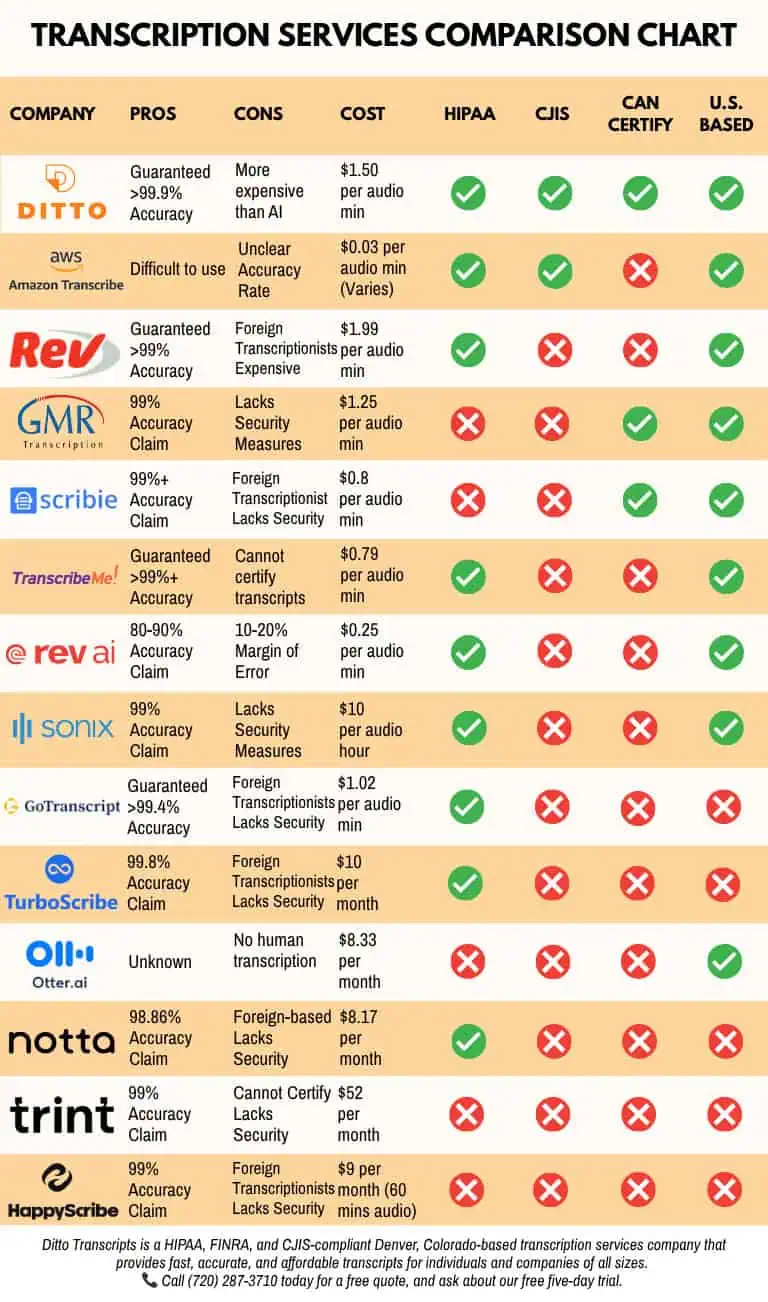
- 99% guaranteed accuracy: Completed transcripts are produced and reviewed by trained human transcriptionists rather than delivered as unchecked AI output.
- Law enforcement experience: Ditto handles body-camera footage, dash-camera recordings, interviews, interrogations, dispatch calls, jail calls, witness statements, and investigative recordings.
- U.S.-based transcriptionists: Files are handled by professionals familiar with American legal terminology, law enforcement language, and common recording formats.
- CJIS-compliant handling: Ditto provides security-focused workflows for agencies handling criminal justice information.
- Speaker labels and timestamps: Transcripts can be formatted to help reviewers identify speakers and return to relevant sections of the recording.
- Difficult-audio support: Ditto works with recordings containing background noise, radio traffic, accents, multiple speakers, and unclear sections.
- Flexible turnaround: Agencies can select delivery options based on the urgency, length, and complexity of the project.
- Clear pricing: Ditto explains project rates, add-ons, and turnaround options before work begins. Clients with related matters can also review available legal transcription prices.
- No long-term contract: Departments may submit one recording, one investigation, or recurring projects without committing to a minimum number of files or minutes.
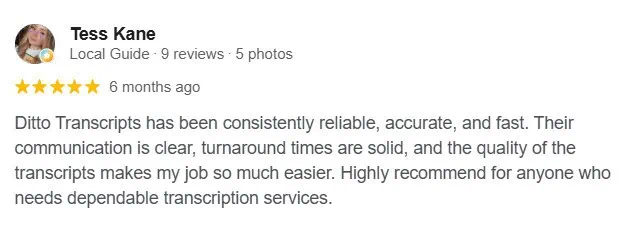
- Client feedback: Read our testimonials to learn how clients describe Ditto’s accuracy, security, communication, and service.
Make Recorded Evidence Easier to Review
Body and dash cameras can preserve valuable information, although collecting footage is only the first step.
Accurate transcripts help officers, investigators, supervisors, attorneys, and courts locate and review spoken information more efficiently. They can support reporting, evidence organization, redaction, and case preparation while keeping the original recording available for confirmation.
AI can make a quick draft. For sensitive law enforcement recordings, trained human review remains essential.
Ditto Transcripts is a Denver, Colorado-based transcription services company that provides fast, accurate, and affordable transcripts for individuals and organizations of all sizes. Ditto is CJIS-, HIPAA-, and FINRA-compliant. Call (720) 287-3710 today for a free quote.