


Witness testimony plays an important role in the legal system. In criminal and civil cases, witnesses may provide statements that help explain what happened, support or challenge claims, clarify timelines, or add context to other evidence.
Because testimony can affect case strategy, settlement discussions, trial preparation, appeals, and court outcomes, it must be preserved carefully. Audio and video recordings are useful, yet they are not always convenient for review. Legal transcription services turn those recordings into written transcripts that are easier to search, quote, organize, and share.
In this article, you’ll learn:
- What witness testimony is
- How witness testimony is commonly preserved
- Why accurate transcription matters
- How transcripts support legal review and preparation
- Why AI transcription is risky for witness testimony
- How Ditto Transcripts supports accurate legal transcription
What Is Witness Testimony?
Witness testimony is a formal statement given by a person with information relevant to a legal matter. The witness may describe what they saw, heard, experienced, observed, or know based on their role, expertise, or relationship to the case.
Witness testimony is often given under oath. That means the witness is expected to tell the truth, and false testimony may expose the person to legal consequences, including perjury.
Testimony may occur during trials, hearings, depositions, investigations, arbitration, administrative proceedings, or other legal settings. Attorneys may question witnesses directly, and opposing counsel may cross-examine them to test accuracy, credibility, memory, and consistency.
Witness testimony can help legal teams:
- Establish facts
- Build or challenge a case
- Clarify timelines
- Support or contradict other evidence
- Evaluate credibility
- Prepare for trial
- Identify inconsistencies
- Support appeals or further review
Because testimony can become part of the legal record, preserving it accurately is essential.
Common Types of Witnesses
Different witnesses serve different purposes in legal proceedings. The type of witness often affects the kind of testimony provided.
| Type of Witness | Role |
| Lay witness | Testifies about personal observations, experiences, or facts they directly encountered |
| Expert witness | Provides specialized knowledge, analysis, or opinions based on professional expertise |
| Character witness | Testifies about a person’s reputation, behavior, or character |
A lay witness may describe an event they saw. An expert witness may interpret technical, medical, financial, forensic, or scientific information. A character witness may speak about someone’s honesty, conduct, or reputation.
Each type of testimony must be recorded carefully because attorneys, courts, agencies, and reviewers may need to revisit the exact words later.
How Is Witness Testimony Preserved?
Witness testimony can be preserved in several ways, depending on the setting, court rules, and purpose of the proceeding.
Written Statements
A witness may provide a written statement, an affidavit, a declaration, or a deposition transcript. Written statements are useful when a person cannot appear in court or when the statement is collected before a formal proceeding.
Court Reporters and Stenographers
Court reporters create official records during trials, hearings, depositions, and other proceedings. They may use stenographic equipment, stenomasks, recordings, or a combination of methods to capture what is said.
Audio and Video Recordings
Audio or video recordings can preserve testimony in detail. They may capture speech, tone, pauses, gestures, interruptions, and nonverbal reactions. These recordings are valuable, yet they can be difficult to review quickly.
That is where transcription helps. A transcript turns recorded testimony into a searchable written document that attorneys and legal teams can use more efficiently.
Witness testimony transcription may also overlap with trial transcription services when testimony is captured during court proceedings, hearings, or trial preparation.
Why Testimony Transcription Accuracy Matters
Witness testimony is often scrutinized closely. A single word, pause, correction, or contradiction can affect how testimony is interpreted. Legal teams may compare testimony against other evidence, prior statements, expert reports, police records, or deposition answers.
Inaccurate transcripts can create serious problems. A wrong word or missing phrase may change meaning. Poor speaker identification may cause confusion. Missing interruptions or unclear sections may make review harder. Even formatting problems can slow down attorneys and support staff.
Accurate testimony transcription helps preserve the record and reduces the risk of avoidable confusion. It gives legal professionals a written version of the recording that can be reviewed, annotated, searched, and cited.
For recordings where every word, pause, repetition, or interruption matters, legal teams may request verbatim transcription services. Verbatim transcripts can preserve filler words, false starts, repeated phrases, pauses, and relevant nonverbal sounds when those details are important.
Why Audio and Video Alone Are Not Enough
Audio and video recordings are valuable because they capture testimony directly. However, they are not always efficient for legal work.
Attorneys may need to find a specific answer, compare statements, mark contradictions, prepare for cross-examination, or cite a section during case review. Doing that with only audio or video can require repeated listening, manual timestamps, and extra notes.
Transcripts make testimony easier to work with. Legal teams can search for names, dates, phrases, objections, exhibits, or key issues. They can also highlight sections, add comments, copy excerpts, and organize testimony by topic.
Digital transcripts can be shared securely with attorneys, paralegals, experts, investigators, and support staff. They also make remote review easier when teams are not in the same location.
Benefits of Witness Testimony Transcription
Witness testimony transcription supports legal teams in several practical ways.
| Benefit | Why It Matters |
| Accurate recordkeeping | Preserves testimony in a written format for review and reference |
| Faster search and review | Helps attorneys locate names, dates, questions, and key statements quickly |
| Better trial preparation | Supports direct examination, cross-examination, motions, and case strategy |
| Easier comparison | Makes it simpler to compare testimony against prior statements or evidence |
| Appeal support | Provides a written record that may be reviewed later |
| Accessibility | Helps people who are deaf, hard of hearing, or unable to review audio |
| Remote access | Allows legal teams to review testimony from different locations |
| Translation support | Gives translators a cleaner base document when testimony must be translated |
For court transcription services, transcripts may also help courts, attorneys, agencies, and parties maintain a usable record of proceedings and testimony.
Why AI Is Risky for Witness Testimony Transcription
Automated transcription tools are fast. However, witness testimony requires accuracy, context, and careful review. AI transcription tools offer only 61.92% accuracy, and performance can drop further when recordings include legal terminology, multiple speakers, cross-talk, background noise, accents, poor audio quality, or emotional speech.
AI transcription may struggle with:
- Speaker identification
- Objections and interruptions
- Legal terminology
- Names and dates
- Accents and dialects
- Overlapping speech
- Low-volume answers
- Fast questioning
- Nonverbal sounds
- Verbatim detail
These issues matter in legal settings. A transcript that mislabels a speaker, misses an objection, changes a date, or confuses a key phrase may require extensive correction before it can be used.
AI may be acceptable for rough internal notes. However, witness testimony, depositions, hearings, interviews, and court-related recordings should be handled by trained human transcriptionists.
What to Look for in a Witness Testimony Transcription Provider
Choosing the right provider matters because testimony transcripts may be used for legal preparation, internal review, discovery, litigation support, or court-related work.
A strong provider should offer:
- Human transcriptionists
- Legal transcription experience
- Verbatim and clean transcript options
- Speaker labels
- Timestamp options
- Secure file upload and delivery
- Clear formatting
- Quality review
- Flexible turnaround options
- Support for difficult audio
- Transparent pricing
The provider should also understand confidentiality. Legal recordings may include sensitive personal information, case strategy, privileged communications, protected records, or law enforcement details.
For deposition transcription services, the provider should be able to follow formatting instructions, clearly identify speakers, and handle question-and-answer testimony with care.
How Much Does Witness Testimony Transcription Cost?
Witness testimony transcription pricing depends on several factors, including recording length, audio quality, number of speakers, turnaround time, timestamps, formatting, and whether the client needs verbatim transcription.
At Ditto Transcripts, pricing for legal transcription is transparent before work begins. Rates vary based on file type, difficulty, turnaround, and project needs. Standard legal transcription typically starts at $1.75 per audio minute for a three- to five-business-day turnaround, with extended and rush options available.
Additional services, such as verbatim transcription, timestamps, difficult audio work, or special formatting, may affect the final price. Ditto explains pricing and project requirements before moving forward, so clients know what to expect.
Why Clients Choose Ditto for Witness Testimony Transcription
Witness testimony transcription requires accuracy, security, and legal transcription experience. Legal professionals need transcripts that are clear, organized, and ready for review.
At Ditto Transcripts, we support attorneys, law firms, courts, agencies, investigators, insurance teams, businesses, and other legal professionals who need reliable testimony transcriptions.
Clients choose Ditto because we offer:
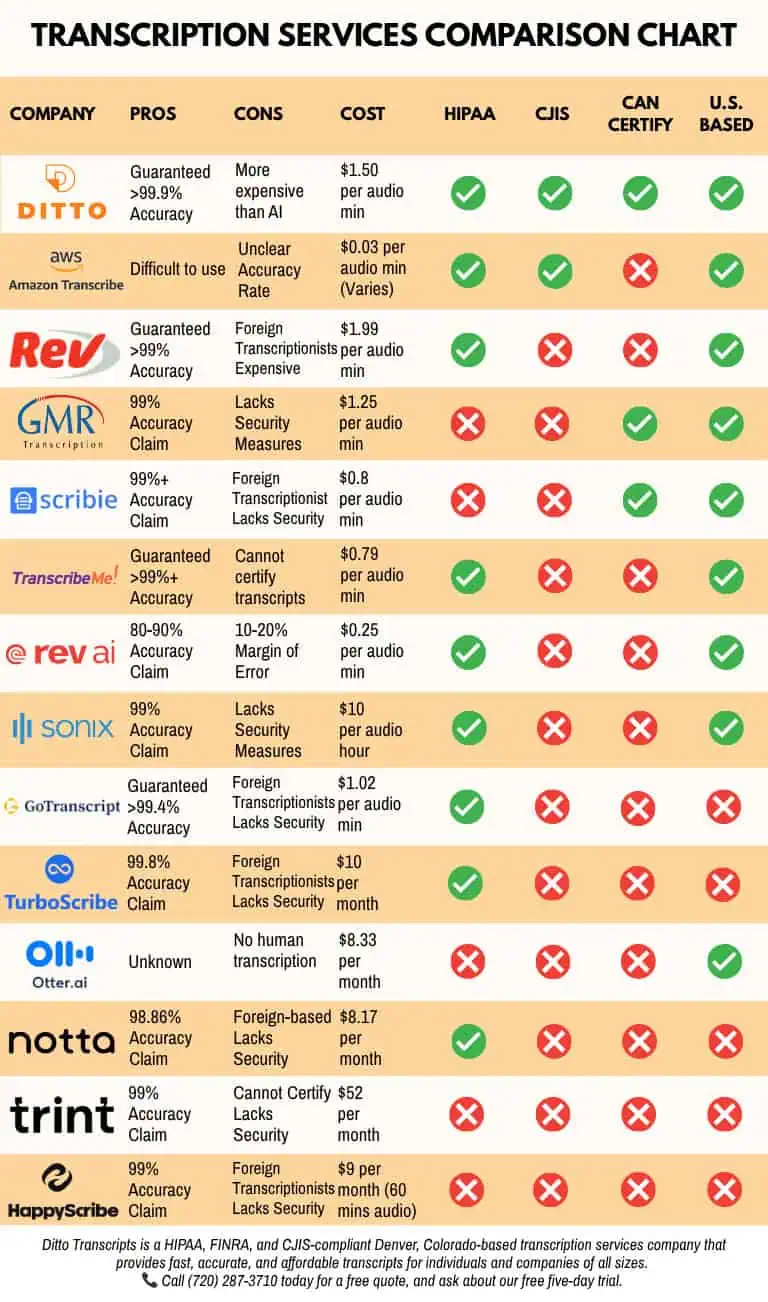
- Human transcriptionists: We use trained professionals who understand context, speaker flow, legal language, and the importance of accuracy.
- Legal transcription experience: Ditto supports witness testimony, interviews, hearings, depositions, recorded statements, trials, investigations, and other legal recordings.
- Verbatim options: Clients can request true verbatim or clean transcripts depending on how the testimony will be used.
- Secure handling: Sensitive legal files are handled through confidentiality-focused workflows designed to help protect recordings and transcripts.
- Compliance support: Ditto works with clients who need HIPAA-, CJIS-, and FINRA-compliant transcription support.
- Transparent pricing: We explain transcription rates, add-ons, turnaround options, and formatting requirements before work begins.
- Flexible turnaround: Clients can choose delivery options based on urgency, recording length, audio quality, and case needs.
- No long-term contract required: Clients can use Ditto for one file, one case, or ongoing legal transcription needs without unnecessary commitments.
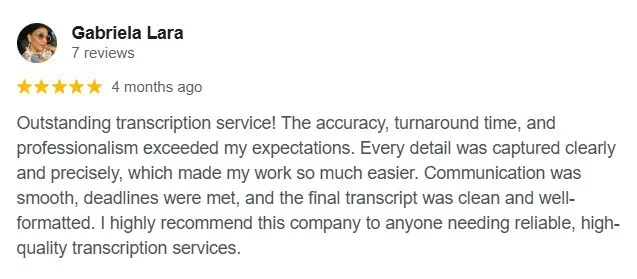
Our clients choose Ditto because they need accurate testimony transcripts, responsive service, and secure handling. Still comparing providers? Read our client testimonials to learn more about working with Ditto.
Get Accurate Witness Testimony Transcription With Ditto
Witness testimony can influence legal strategy, trial preparation, case analysis, and court outcomes. Although audio and video recordings preserve the original testimony, written transcripts make the information easier to search, review, quote, and share.
Creating an accurate legal transcript requires careful listening, human judgment, and strict confidentiality, especially when testimony includes complex terminology, overlapping speakers, or case-critical details. A reliable transcript helps legal teams work more efficiently while preserving the record with precision.
Ditto Transcripts provides fast, accurate, secure, and affordable witness testimony transcription for attorneys, law firms, courts, agencies, businesses, and organizations of all sizes.
Ditto Transcripts is a Denver, Colorado-based transcription services company that provides fast, accurate, and affordable transcripts for individuals and companies of all sizes and is FINRA-, HIPAA-, and CJIS-compliant. Call (720) 287-3710 today for a free quote.