


A medical scribe is a clerical assistant to a physician or other medical provider who types patient medical information into the provider’s EHR. The job of a “medical scribe” (also called a medical documentation specialist or clinical information manager) developed from a focus on EMR/EHR implementation in medical practices, hospitals, and surgery centers, and is vital to effective patient care. In addition to supporting healthcare documentation, professional services, like legal transcription services, ensure that all records are handled with the same accuracy, security, and compliance.
In this article, you’ll learn:
- The role and responsibilities of medical scribes, including in-person and virtual options, and how they support EHR/EMR systems.
- How outsourcing scribe tasks to services like Ditto Transcripts improves accuracy, efficiency, and compliance.
- The importance of HIPAA compliance, data security, and the benefits of trial transcription services.
- Additional transcription offerings, including legal, deposition, and court transcription services, and their integration into healthcare workflows.
How Medical Scribes Work
Medical scribes typically work in one of two ways: either shadowing doctors and recording notes in a patient’s chart from within the exam room, or being remoted into exam rooms via videoconferencing or audio/video connections to transcribe notes into a patient’s chart from a different location.
The trend of using medical scribes developed from the government’s push for EHR adoption. Physicians, unhappy with the new burden of typing their own notes into an EMR and the errors in voice recognition systems, started using medical scribes as an alternative to charting themselves.
While their work primarily involves clerical duties and information management, medical scribes are often required to be familiar with, or specialize in, various healthcare practices. This ensures that the scribe is familiar with medical terminology and that all captured information is accurate and complete. Medical professionals may hire their scribes based on such qualifications.
Furthermore, education varies significantly, as no formal training or certification program is universally accepted for becoming a medical scribe. Many scribes are either former transcriptionists who transitioned into this new role or pre-med students who take the position for on-the-job training.
Additionally, some providers outsource the task by sending patient notes to a 3rd party, such as Ditto Transcripts, to handle the work. The result is fewer clerical tasks, doctors seeing more patients, increased patient satisfaction, and improved document quality. Ditto Transcripts also offers court transcription services, providing the same high level of accuracy, security, and compliance for the documentation.
Responsibilities of a Medical Scribe
The role of a medical scribe can often be wide and varied and is usually dependent on the requirements of the healthcare professional or practice they are employed with. The most common functions are listed below:
- Documentation and Data Entry: The primary responsibility of medical scribes is documentation and clerical tasks. These functions cover all patient encounters, including symptoms, physical examination results, medical histories, physician diagnoses, treatment plans, and other relevant details. Data entry procedures vary, but implementing EHR guidelines has helped standardize them.
- Real-time Charting: Scribes may be responsible for charting patient information during the patient visit, allowing doctors to focus more on listening to the patient instead of taking notes. This improves the patient’s experience and minimizes healthcare-related lawsuit risks, such as poor communication, misdiagnoses, informed consent issues, and overall patient dissatisfaction.
- Transcription: Scribes may transcribe physicians’ verbal dictations (verbatim or shorthand) and providers’ notes from healthcare providers into EHR systems to ensure that all patient information is accurately recorded. For legal matters, deposition transcription services provide the same level of precision and reliability for court or official proceedings.
- Order Entry: Medical scribes may need to send orders for laboratory tests, medications, imaging requests, and other services, as required by the healthcare provider. These orders are usually entered in the EHR, and follow-ups can be done by phone or instant messaging.
- Patient Communication: Medical scribes may need to facilitate communication between healthcare providers and patients by explaining procedures, obtaining consent, and answering non-medical questions. This requires baseline medical knowledge and practical communication skills.
- Other Administrative Tasks: Medical scribes may perform other clerical and administrative tasks as required by the healthcare provider.
The Cost of Hiring In-house Medical Scribes
A medical scribe’s average salary is between $55,000 and $75,000 a year, depending on their years of experience and education level. This does not include any vacation, bonuses, health insurance, or other costs associated with hiring an employee, which typically add about 30% more to an employee’s overall cost to their employer.
Virtual Medical Scribes
Virtual medical scribes offer a modern solution for healthcare facilities seeking efficient, cost-effective documentation support. By working remotely, these scribes can handle patient notes and administrative tasks while maintaining accuracy, security, and integration with EHR/EMR systems.
| Category | Details |
| Definition | Virtual medical scribes provide physicians and healthcare professionals with administrative and clerical assistance remotely, via an internet connection, without being physically present. |
| Cost Savings | Hiring virtual scribes can reduce expenses on employee training, office space, and equipment, making it a more cost-effective solution than permanent in-house staff. |
| Patient Comfort | Patients may feel more at ease during visits, as they interact only with their healthcare provider, without a third person present, ensuring privacy and better communication. |
| Flexibility | Remote work allows facilities to adjust personnel based on needs. Shortages of in-house scribes can be supplemented with virtual scribes, who can be onboarded quickly and retained as required. |
| Feasibility | Virtual scribes can work effectively with EHR/EMR systems using interfaces that “push” transcribed notes into the correct fields. This satisfies Meaningful Use requirements and Medicare/Medicaid reimbursement guidelines. |
| Cost Structure | Most transcription companies charge by the line rather than by the hour or on a salary basis, allowing greater budget flexibility and lower costs than in-house scribes or transcriptionists. |
| Turnaround Time | Remote scribes can provide transcriptions with turnaround times between 2 and 24 hours, ensuring timely documentation and same-day billing. |
To ensure the highest level of accuracy, efficiency, and security, Ditto Transcripts offers trial transcription services, allowing healthcare providers to evaluate our virtual scribe solutions and transcription quality before fully committing. This gives you confidence in both turnaround times and compliance with HIPAA and other regulatory requirements.
Security and HIPAA Compliance
Security and privacy are of utmost importance in the medical field. The Health Insurance Portability and Accountability Act, or HIPAA, is a federal law and national standard that protects patients’ private information. The law covers the storage and transmission of patient data.
It enforces rules that protect private data while facilitating the free transfer of information between healthcare companies and auxiliary service providers.
Healthcare providers, companies, and service providers, such as scribes and transcription companies connected to healthcare (known as “covered entities” under the law), must comply with HIPAA guidelines. Physicians, clinics, and hospitals looking to hire virtual medical scribes must ensure HIPAA compliance before making a decision.
How Ditto Transcripts Can Help With Your Medical Scribe Needs
There are plenty of companies offering virtual medical scribing services. Quality and service levels vary, as in any industry, but the best way to gauge whether a provider is the right fit for your practice is to review the features and services they offer. Ditto Transcripts, for instance, humbly provides the following:

Accurate and 100% U.S.-based Human Transcription
Many service providers use automated software in their processes, speeding up transcription. The tradeoff, however, is that any project completed by the automated process has lower accuracy rates and requires human intervention. Having only human medical scribes — all from the U.S. and currently residing in the U.S. — allows Ditto to achieve accuracy rates of up to 99%, and we also offer verbatim transcription services for projects that require exact, word-for-word documentation.
Experienced Talent at Your Fingertips
Ditto’s medical scribes are trained in standard and specialty medical terminologies, making them effective in any medical field. Here are some of the specialties that Ditto covers:
- Primary Care
- Internal Medicine
- Family Medicine
- Pediatrics
- Cardiology
- Oncology
- Nephrology
- Dermatological surgery
- Ophthalmology
- Otolaryngology/ENT
- Podiatry
- Neurology
- Pulmonary
- OB/GYN
- Physical Medicine & Rehabilitation
- Mental Health Services
- General surgery
- Plastic surgery
- Spine surgery
- Orthopedic surgery
- Breast surgery
- Urology surgery
Flexible Pricing and Cost Efficiency
Ditto Transcripts offers a cost-effective solution that allows healthcare providers to pay only for completed work rather than managing in-house staff, reducing the burden of hiring, training, and supervising additional personnel while maintaining premium quality. For more details on our rates and services, you can check our legal transcription prices.
Customer Support You Can Count On
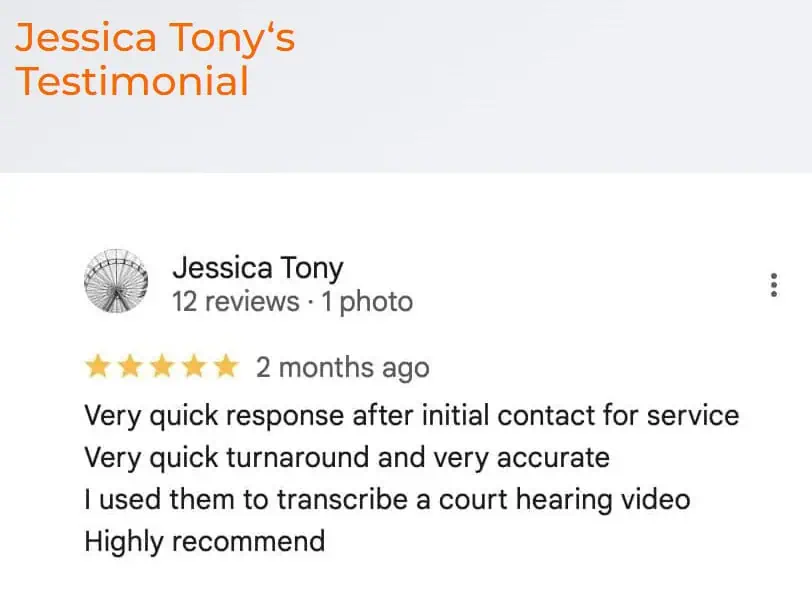
Our 100% U.S.-based customer support team is available 24/7 via phone, email, or fax. Whether you have questions about your project, need urgent turnaround, or require assistance with your EHR integration, our support team is ready to provide immediate guidance and troubleshooting. Don’t believe it? Our client testimonial may convince you:
Swift Turnaround and Scalability
Ditto Transcripts provides flexible turnaround times to match your workflow, ranging from standard 24-hour delivery to STAT requests as fast as 2–4 hours. Whether your transcription needs fluctuate weekly or you require urgent documentation for critical cases, we can scale resources accordingly to ensure uninterrupted service.
Ditto Transcripts is a Denver, Colorado-based FINRA, HIPAA, and CJIS-compliant transcription services company that provides fast, accurate, and affordable transcripts for individuals and companies of all sizes. Call (720) 287-3710 today for a free quote.