
Outsourced transcription gives businesses, law firms, healthcare providers, government agencies, and law enforcement teams access to professional transcription support without hiring in-house staff. However, once you decide to outsource, another question comes up: should you choose an offshore provider or a U.S.-based transcription company?
The answer depends on what you need. If your recordings involve meetings, interviews, medical discussions, law enforcement files, legal transcription services, or confidential business information, your provider’s location, experience, language fluency, and security practices can make a real difference.
What Are Offshore Transcription Services?
Offshore transcription providers are companies or freelancers located outside the United States. They may serve clients in many countries and offer general, medical, legal, and business transcription, as well as other specialized services.
The biggest reason companies consider offshore transcription is usually cost. Labor and operational expenses may be lower in some countries, leading to lower advertised rates.
That said, price is only one part of the decision. A lower rate can be less valuable if the transcript requires extensive editing, omits important terminology, causes communication delays, or fails to meet security and compliance requirements.
For simple, low-risk audio, offshore transcription may be enough. For sensitive, technical, legal, medical, or official recordings, many organizations prefer a U.S.-based provider.
U.S.-Based vs. Offshore Transcription at a Glance
| Factor | U.S.-Based Transcription Provider | Offshore Transcription Provider |
| English fluency | Usually, native or U.S.-based English speakers | May include non-native English speakers |
| U.S. accents and slang | Often easier to understand regional speech, idioms, and local references | May require more research or review |
| Time zone alignment | Easier communication during U.S. business hours | May involve delays depending on the location |
| Certified transcript support | More likely to support U.S. legal certification needs | May not qualify for certain legal requirements |
| Compliance needs | May support HIPAA, CJIS, FINRA, and related workflows | Requirements may vary by country and provider |
| Cost | Often higher than offshore options, yet not always | Often marketed as lower cost |
| Best fit | Sensitive, legal, medical, government, law enforcement, and business-critical recordings | Simple or low-risk transcription projects |
Accuracy and Language Proficiency
Transcription is not only about understanding English. It’s about understanding the speaker, context, terminology, accents, numbers, names, slang, and meaning.
American English includes regional accents, informal speech, industry jargon, local references, and fast pronunciation patterns that can be difficult for non-native speakers to interpret accurately. A word, phrase, address, or number that sounds obvious to a U.S.-based transcriptionist may be less familiar to someone outside the country.
That matters when recordings involve medical terms, legal phrases, police interviews, business calls, or financial discussions. An error in a name, dosage, case number, statute, street address, or contract term can create unnecessary confusion.
For court transcription services, healthcare documentation, law enforcement recordings, and business-critical files, accuracy should matter more than the lowest advertised rate.
Accents, Dialects, and Cultural Context
The United States has many regional accents and dialects. Speakers from Boston, Texas, New York, Louisiana, California, the Midwest, Appalachia, and the Southeast may all sound different. Recordings may also include slang, local references, acronyms, or industry-specific shorthand.
A U.S.-based transcriptionist is often better positioned to understand these differences because they are more familiar with how Americans speak in everyday and professional settings.
This does not mean every offshore transcriptionist will misunderstand U.S. speakers. Many are skilled. However, when audio is unclear, fast, technical, or filled with regional language, local familiarity can reduce errors and review time.
Time Zone and Communication Advantages
Communication matters when outsourcing transcription. Clients may need to clarify instructions, request a rush transcript, ask about formatting, check on a deadline, or discuss a sensitive file.
A U.S.-based provider is usually easier to reach during U.S. business hours. That can make a difference when a law firm needs a file before a hearing, a healthcare provider needs documentation quickly, or a business team needs meeting transcripts.
Time zones can also affect turnaround. If a file is sent to an offshore provider at the start of the U.S. workday, it may arrive outside that provider’s regular business hours. Some offshore companies operate around the clock, though not all do.
For organizations that need responsive communication and predictable turnaround, time zone alignment can be a major advantage.
Certified Legal Transcripts
Some legal and law-enforcement recordings may require certified transcripts. These can include depositions, suspect interviews, witness statements, court recordings, interrogations, and other case-related files.
Certification requirements can vary by use, jurisdiction, and client need. Law firms should confirm that the transcription provider can certify transcripts before sending files.
For deposition transcription services, trial preparation, court filings, or official review, a provider should understand legal terminology, transcript formatting, speaker identification, and certification expectations.
U.S.-based providers are often better positioned to support these needs because they operate within the same legal and business environment as their clients.
Security and Regulatory Compliance
Security is one of the biggest reasons to choose a U.S.-based transcription company. Many recordings contain private, regulated, or sensitive information.
This can include:
- Patient information
- Criminal justice information
- Attorney-client communications
- Business strategy
- Employee information
- Financial details
- Government records
- Insurance information
- Personal identifying information
Healthcare organizations may need HIPAA-compliant workflows. Law enforcement agencies may need CJIS-compliant handling. Financial firms may need FINRA-aware processes. Legal teams may need confidentiality and secure file handling.
Government transcription services, medical documentation, police recordings, and legal files should not be handled through casual or unclear security practices.
Before choosing any provider, ask how files are uploaded, who can access them, how transcripts are delivered, whether transcriptionists sign confidentiality agreements, and what compliance standards the provider supports.
Affordability Is About Total Value
Many people assume offshore transcription is always cheaper and U.S.-based transcription is always expensive. That is not always true.
The better question is: what is the total cost of the transcript?
A low-cost transcript may become expensive if your team has to spend hours correcting errors, reformatting the document, relistening to unclear sections, checking terminology, or fixing speaker labels.
A cost-effective transcription provider should offer a fair rate while still delivering accuracy, security, responsive service, and ready-to-use transcripts.
For important recordings, the cheapest option is not always the most affordable one.
When a U.S.-Based Transcription Company Makes the Most Sense
A U.S.-based provider is especially useful when recordings are sensitive, technical, time-sensitive, or connected to professional decision-making.
Consider using a U.S.-based transcription company for:
- Legal recordings
- Court proceedings
- Depositions
- Medical dictations
- Telehealth visits
- Law enforcement interviews
- 911 calls
- Government meetings
- Insurance recordings
- Financial calls
- Business meetings
- HR interviews
- Academic research
- Sensitive client conversations
Medicolegal transcription services are another example in which accuracy, privacy, and subject-matter understanding are critical, as the records may involve both healthcare and legal review.
Why Clients Choose Ditto for U.S.-Based Transcription Services
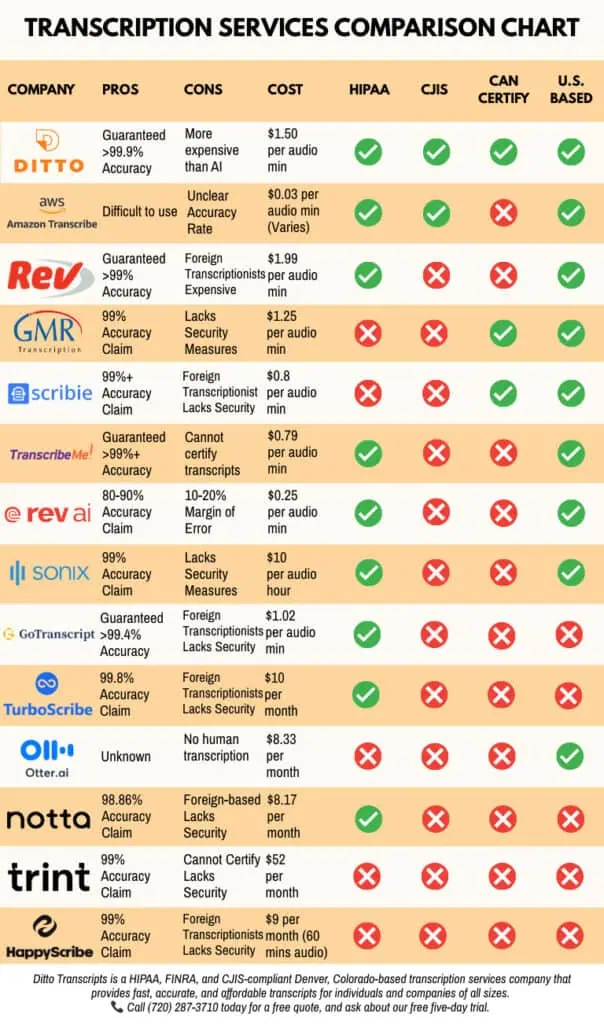
Choosing a U.S.-based transcription company is about more than location. It is about accuracy, accountability, communication, security, and trust. Clients need transcripts that are prepared by trained professionals and handled through secure workflows.
At Ditto Transcripts, we support businesses, law firms, healthcare providers, law enforcement agencies, academic institutions, financial teams, insurance professionals, government offices, and individuals who need dependable U.S.-based transcription support.
Clients choose Ditto because we offer:
- Human transcriptionists: We use trained human transcriptionists who understand context, speaker flow, tone, terminology, and the difference between a rough transcript and a professional final document.
- U.S.-based transcription support: Ditto works with U.S.-based transcriptionists and support teams who understand American English, regional speech patterns, industry terminology, and client expectations.
- Verbatim transcription: When clients need every spoken word captured, Ditto can provide word-for-word transcripts that include false starts, filler words, pauses, interruptions, and other spoken details when required.
- Industry-specific experience: Ditto works with clients across legal, medical, law enforcement, academic, business, financial, insurance, government, and personal transcription projects.
- Certified transcript options: When needed, Ditto can provide certified transcripts for legal, court, investigative, or official documentation purposes.
- Support for difficult audio: Our transcriptionists can work with multiple speakers, background noise, accents, low volume, overlapping speech, technical terms, and recordings that automated tools often struggle with.
- Secure handling: Sensitive recordings are handled through confidentiality-focused workflows designed to help protect client files and transcripts.
- Compliance support: Ditto works with clients who need HIPAA-, CJIS-, FINRA-, legal-, medical-, law-enforcement-, and government-compliant transcription support.
- Flexible turnaround options: Clients can choose turnaround times based on file length, urgency, audio quality, number of speakers, and project requirements.
- Transparent legal transcription pricing: Pricing depends on the type of transcription, turnaround time, audio quality, number of speakers, formatting, and whether the client needs certified, verbatim, or specialized transcription.
- No long-term contract required: Clients can use Ditto for one project, ongoing support, or changing transcription volumes without being locked into unnecessary commitments.
Whether you need a business meeting transcribed, a legal recording documented, a medical dictation prepared, a police interview reviewed, or an audio file converted into searchable text, Ditto Transcripts can help make the process accurate, secure, and manageable.
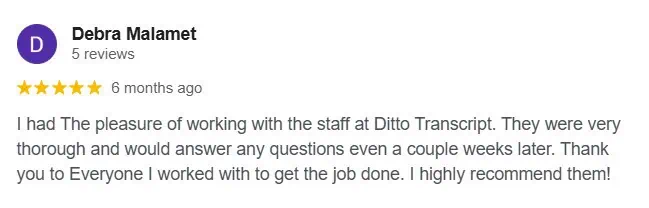
Still deciding? Here’s what one Ditto client testimonial had to say:
Choose a Transcription Provider You Can Trust
Offshore transcription may work for simple, low-risk recordings, while U.S.-based transcription is often the better choice when accuracy, confidentiality, communication, and compliance matter.
The right provider should understand your industry, protect your files, meet deadlines, and deliver transcripts your team can actually use. For legal, medical, law enforcement, government, financial, and business-critical recordings, those details matter.
Ditto Transcripts is a Denver, Colorado-based transcription services company that provides fast, accurate, and affordable transcripts for individuals and companies of all sizes and is FINRA-, HIPAA-, and CJIS-compliant. Call (720) 287-3710 today for a free quote.