


Medical transcription service providers are a core, inextricable part of the healthcare industry. Healthcare providers depend on medical transcriptionists to ease the burden of documentation—and believe me, it is quite the burden. Furthermore, given medicine’s sensitive and precise nature, the partnership between healthcare professionals and medical transcriptionists must be built on accuracy, trust, and reliability. Similarly, legal transcription services play an equally vital role in supporting attorneys, courts, and legal teams, where precision and reliability are equally essential to maintaining the integrity of legal records.
In this article, you’ll learn:
- How medical transcription reduces the administrative burden on healthcare professionals, saving time and lowering burnout risk.
- The advantages of outsourcing transcription include cost efficiency, accuracy, consistency, and HIPAA compliance.
- Why human-powered transcription outperforms AI and speech recognition software in reliability and precision.
- How Ditto Transcripts integrates seamlessly with EHR/EMR systems while offering secure, U.S.-based transcription services, including verbatim and legal transcription options.
How Bad Is Paperwork In The Healthcare Industry?
To some, doctors have one of the easiest, best-paying jobs in the world. You sit in an air-conditioned room, whip out the stethoscope for every other patient, do your Sherlock thing or Google the symptoms, prescribe drugs, and then get paid an average of $300 to $600 in the US for 10-15 minutes of “light work,” right?
I don’t blame people for having that perception, as they often only see healthcare experts in patient-facing situations. Behind the scenes, however, is an entirely different matter.
| Topic | Key Findings / Points | Impact / Implications |
| Excessive Time Spent on Documentation | Doctors may need to work up to 14 hours a day to keep up, which contributes to overwork, stress, and turnover. | Digital tools don’t guarantee time savings; they may add complexity or streamline work, depending on implementation. |
| Administrative Overload | A 2020 study (Lorkowski et al., Overload of Medical Documentation) highlights that bureaucratic requirements, duplicate forms, and rigid documentation rules overwhelm clinicians. | Leads to burnout, time wasted on redundant tasks, and reduced focus on patient care. |
| Effect of EHR/EMR Systems | Mixed results: Goldstein et al. found a slight increase in documentation time with EHRs; Joukes et al. found variable outcomes—some clinics improved, others worsened. | Digital tools don’t guarantee time savings; may add complexity or streamline work, depending on implementation. |
| Risks of Burnout | Excessive documentation contributes to resignations, decreased concentration, and more medical errors. | Directly threatens patient safety, workflow efficiency, and physician well-being. |
| Role of Medical Transcription | Transcription services can significantly reduce the documentation burden. | Allows clinicians to focus more on patient care, improve accuracy, and lower burnout risk. |
What Is Medical Transcription?
Medical transcription is the process of converting voice-recorded medical reports dictated by healthcare professionals into written or electronic text. In this process, the doctor, nurse, or medical practitioner records relevant information through dictation. The audio file is sent to a medical transcriptionist, who transcribes it into written or electronic form as the client requires.
Once the audio is transcribed, the transcript undergoes a review process (the quality and rigor of which depend on the transcriptionist or provider) to catch any errors and ensure clarity and adherence to medical standards. After that, the transcript is formatted according to templates or guidelines to fit into electronic health record (EHR) or electronic medical record (EMR) systems.
Similarly, court transcription services follow a parallel workflow in the legal field—converting recorded courtroom proceedings, depositions, and hearings into accurate, certified written records. These transcripts undergo strict quality checks and formatting requirements to maintain legal integrity and ensure they can be used in official court documentation.
What Is The Difference Between Medical Transcription And Transcription?
If you think about it, medical transcription is fundamentally similar to general transcription. However, there are notable differences that set medical transcription apart.
| Aspect | Medical Transcription | General Transcription |
| Content | Involves healthcare and medical-related audio recordings | Encompasses a broad range of topics from various industries, including materials from legal settings such as trial transcription services |
| Specialized Knowledge | Requires understanding of medical terminology and practices | Generally requires proficiency in language and subject-specific terminology, which may include familiarity with legal or courtroom procedures when handling trial content |
| Purpose | Primarily for documenting patient care and medical records | Serves various purposes depending on the context (business, legal—such as trial proceedings—academic, media, etc.) |
| Typical Content | Dictations from healthcare professionals, patient histories, diagnoses, treatment plans, etc. | Business meetings, interviews, podcasts, legal recordings |
| Accuracy Importance | Crucial for patient care and continuity in healthcare | Important for clarity and understanding, and in the case of legal or trial transcripts, essential for maintaining accurate official records |
Applications Of Medical Transcription In Healthcare
Here are some ways medical transcription services can meet different documentation requirements across medical specialties.
| Type of Recording | Description |
| Doctor-Patient Consultations | Recorded conversations between doctors and patients, covering medical history, symptoms, diagnoses, and treatment plans. |
| Surgical Procedures | Audio or video recordings of surgical procedures detailing the steps and observations by surgeons and medical staff. |
| Medical Lectures and Seminars | Educational sessions where medical professionals discuss various medical topics, research findings, or case studies. |
| Patient Interviews and History | Detailed discussions with patients, focusing on their medical history and current health issues to improve medical records. |
| Radiology Reports | Descriptions and findings from imaging studies like X-rays, MRIs, and CT scans. |
| Lab And Pathology Reports | Detailed lab work analysis, like tissue samples, including pathologist observations and diagnoses. |
| Psychiatric Evaluations | Transcripts of sessions between psychiatrists and patients discussing mental health, diagnoses, and treatment plans. |
| Emergency Room Visits | Records of patient visits to the emergency room, including symptoms, treatments, and observations. |
| Physical Therapy Sessions | Physical therapy session Notes and observations outline patient progress, exercises, and treatment plans. |
| Clinical Trial Discussions | Detailed documentation of discussions and findings during clinical trials, including patient responses and data analysis. |
In addition to these types of medical recordings, healthcare providers and researchers often rely on verbatim transcription services to ensure every word, pause, and nuance is captured accurately—an essential requirement when precision and complete documentation are critical.
The Importance Of Medical Transcription In Healthcare
Here are some of the most significant advantages of enlisting the help of reliable medical transcribers.
- Time Savings – Reduces Manual Documentation Workload: Doctors and staff spend hours writing patient histories, notes, and forms. Transcription services allow them to speak their notes instead, letting trained medical transcriptionists handle the documentation and significantly cutting paperwork time.
- Cost Efficiency – Lowers In-House Staffing Expenses: Hiring full-time transcriptionists costs up to $100,000 per person annually. Outsourcing can reduce transcription-related expenses by up to 60%, making it a far more cost-effective solution for facilities seeking streamlined documentation.
- Accuracy – Ensures High-Quality, Error-Free Documentation: Accurate records are essential, and professional transcription teams provide over 99% accuracy, far surpassing AI’s average 62%. They handle grammar, terminology, and proper placement of medical information throughout the record.
- Consistency in Documentation – Improves Standardization Across Records: Reliable transcription providers produce consistent, uniform documents that enhance readability and eliminate guesswork. This supports better record-keeping practices even outside EHR/EMR systems.
- EHR/EMR Compatibility – Integrates Seamlessly With Your Systems: Outsourced transcription services like Ditto Transcripts can work with nearly any EHR. Providers dictate notes, securely send audio, and receive properly formatted transcripts that auto-populate fields via HL7 integration—reducing workload and ensuring data accuracy.
- Regulatory Compliance – Protects Patient Information: All transcription processes follow full HIPAA standards, ensuring security, confidentiality, and regulatory compliance throughout the workflow.
Outsource Your Medical Record And Transcription Needs To Ditto
Here at Ditto Transcripts, we guarantee 99% accuracy in all medical transcription we provide to the healthcare industry, delivered on time, every time.

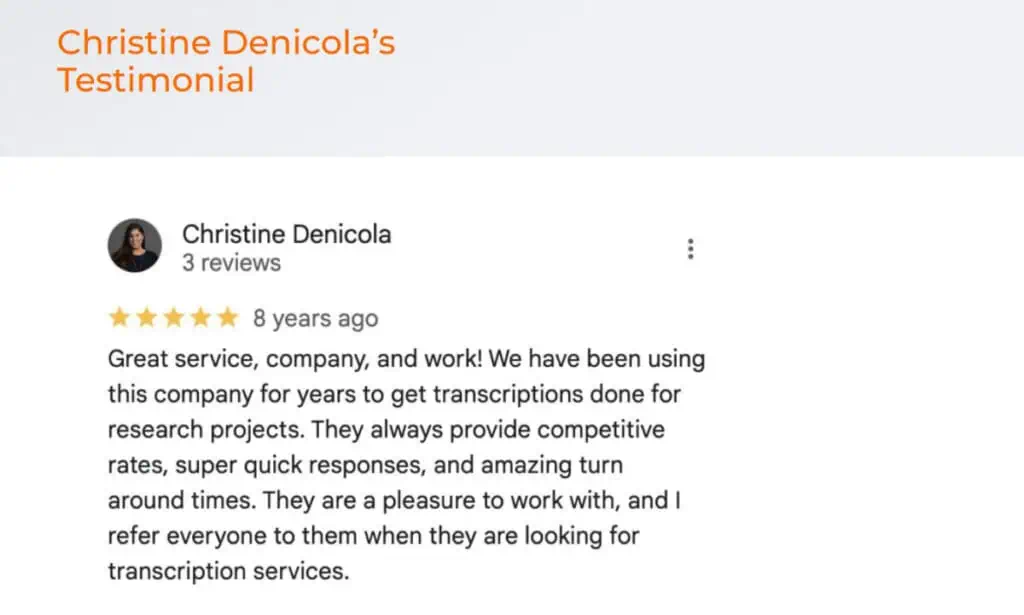
We offer affordable rates, as you can see on our legal transcription prices, flexible options, fast turnaround times, HIPAA-compliant security, and the best customer service in the industry. Don’t believe us? Check our client testimonials:
Ditto Transcripts is a Denver, Colorado-based FINRA, HIPAA, and CJIS-compliant transcription services company that provides fast, accurate, and affordable transcripts for individuals and companies of all sizes. Call (720) 287-3710 today for a free quote.