


Transcription helps organizations turn recorded speech into accurate, searchable written records. Businesses, law firms, healthcare providers, government agencies, schools, media teams, and law enforcement departments all use transcripts to save time, document conversations, share information, and keep better records.
The need is especially clear when recordings involve meetings, interviews, dictations, hearings, medical discussions, legal transcription services, or sensitive business information. A good transcript makes audio and video content easier to review, search, store, and use.
Benefits of Professional Transcription Services
Professional transcription is not only about convenience. For many organizations, it improves documentation, saves staff time, supports compliance, and helps teams work more efficiently.
Cost Savings
Outsourcing transcription can reduce the need to hire, train, and manage in-house transcription staff. Organizations can avoid adding salaries, benefits, software, equipment, workspace, and quality-control responsibilities for a role they may need only part-time or during busy periods.
Instead of building an internal transcription workflow, companies and agencies can send files to a professional provider when they need support.
Time Savings
Transcription takes longer than many people expect. Even a one-hour recording can take several hours to transcribe, review, and format, especially when the audio includes multiple speakers, poor sound quality, technical language, or unclear sections.
Outsourcing lets staff focus on higher-value work instead of replaying audio, fixing speaker labels, and cleaning up transcripts.
Accuracy and Efficiency
Accurate transcripts are important because errors can create confusion. A wrong name, number, date, medical term, legal term, or speaker label can make a transcript harder to use.
Professional transcriptionists bring listening skills, subject-matter expertise, and consistent formatting to the process. That matters for court transcription services, medical documentation, business meetings, academic research, and law enforcement recordings.
Focus on Core Work
Transcription can pull professionals away from the work they are trained to do. Attorneys should be able to focus on legal strategy. Healthcare providers should be able to focus on patient care. Police officers should be able to focus on public safety. Business leaders should be able to focus on operations, clients, and decision-making.
Professional transcription helps teams get the written records they need without turning transcription into an internal distraction.
Scalability
Transcription needs can change quickly. One week, an organization may have one interview. The next week may include hours of meetings, calls, hearings, or dictations.
A professional transcription company can help organizations scale up or down without hiring temporary staff, assigning overtime, or delaying projects.
How Transcription Helps Different Industries
Different industries use transcription in different ways. Some need clean meeting notes. Others need word-for-word records, secure handling, timestamps, or transcripts prepared for legal, medical, or official review.
| Industry | Common Recordings | How Transcription Helps |
| Legal | Depositions, hearings, client meetings, witness interviews | Creates searchable records for review, preparation, and documentation |
| Medical | Dictations, patient conversations, telehealth visits, and provider notes | Supports patient records, continuity of care, and review |
| Business | Meetings, calls, conferences, training sessions | Improves documentation, sharing, onboarding, and decision-making |
| Media | Podcasts, interviews, videos, webinars | Supports SEO, captions, repurposing, and accessibility |
| Academic | Lectures, interviews, research recordings, events | Helps with studying, analysis, note-taking, and archiving |
| Law enforcement | Interviews, 911 calls, body cam footage, reports | Supports case files, investigations, and official records |
Legal Transcription
The legal industry depends on accurate records. Attorneys, paralegals, courts, and legal teams may need legal transcription services for hearings, client meetings, recorded statements, witness interviews, and proceedings.
Deposition transcription services are especially useful when attorneys need to review testimony, identify inconsistencies, prepare for trial, or organize case details. Transcripts allow legal teams to search for specific statements rather than replaying lengthy recordings.
Accuracy is critical because legal transcripts may be used to support arguments, prepare filings, review facts, or document what was said.
Medicolegal Transcription
Medical transcription helps healthcare providers convert dictations, consultations, telehealth visits, letters, and clinical notes into written records. These transcripts can support documentation, patient history, referrals, and communication between providers.
Medicolegal transcription services are useful when recordings involve both healthcare and legal review, such as independent medical evaluations, workers’ compensation matters, injury claims, or medical records connected to legal cases.
In these settings, accuracy matters because medical terms, diagnoses, dates, and treatment details must be captured clearly.
Business Transcription
Business transcription services are useful for meetings, interviews, conference calls, training sessions, webinars, and executive discussions. A transcript gives teams a written record they can search, share, and reference later.
This is useful when employees miss a meeting, when new hires need context, or when leadership wants a clear record of decisions and action items.
Business transcripts can also help with negotiations, internal investigations, HR documentation, client calls, and project planning.
Media and Marketing Transcription
Media transcription services help media teams turn audio and video content into written assets. Podcasts, interviews, webinars, speeches, and videos can be repurposed as blog posts, articles, captions, social media content, newsletters, or searchable website content.
Transcripts can also improve accessibility for people who are deaf, hard of hearing, or unable to listen to audio. They make content easier to scan, quote, edit, and repurpose.
For online marketing, transcripts can support SEO by giving search engines more text to understand and index.
Academic Transcription
Academic transcription services are used by schools, universities, researchers, and students for lectures, classroom discussions, interviews, focus groups, seminars, and events.
Students can use transcripts to review material, supplement notes, and study more efficiently. Researchers can use transcripts to analyze interviews, code responses, compare participant answers, and archive findings.
Academic transcription is especially helpful when recordings need to be reviewed multiple times or shared with a research team.
Government and Law Enforcement Transcription
Government transcription services can support public meetings, hearings, interviews, administrative records, agency communications, and official documentation.
Law enforcement teams may use transcription for interviews, interrogations, witness statements, 911 calls, body camera footage, dash camera recordings, dispatch audio, and reports. A written transcript can make recorded information easier to review, redact, share, and include in case files.
Because these recordings may involve sensitive information, security and confidentiality are especially important.
Common Types of Transcription
Not every project needs the same type of transcript. The right format depends on how the transcript will be used.
Verbatim Transcription
Verbatim transcription captures speech word for word. This may include filler words, false starts, pauses, interruptions, repeated words, and other spoken details when needed.
This style is often useful in legal, law enforcement, research, and official review contexts because the way something was said may matter.
Clean Read Transcription
Clean read transcription removes unnecessary filler words, false starts, and repeated phrases while preserving the meaning of the recording.
This format is often easier to read and works well for business meetings, interviews, webinars, and internal documents.
Summarized Transcription
Summarized transcripts condense long recordings into key points, topics, decisions, or takeaways.
This can be helpful for executives, project teams, attorneys, researchers, or anyone who needs a high-level review instead of a full word-for-word transcript.
Time-Stamped Transcription
Time-stamped transcripts include time markers that help readers find specific points in the original recording.
This is useful for legal review, medical review, media editing, research analysis, and any situation where the transcript needs to connect back to the audio or video file.
AI Transcription vs. Human Transcription
Automated transcription tools are fast and widely available. They can be useful for rough drafts, personal notes, simple recordings, and low-risk internal use.
The problem is that AI transcription often struggles with the exact issues found in professional recordings: multiple speakers, background noise, accents, technical terminology, poor audio quality, overlapping speech, and unclear names or numbers.
Human transcriptionists can use context, listening judgment, research, and formatting experience to produce a more reliable transcript. They can also flag unclear sections properly instead of guessing.
Hybrid transcription, where a person reviews AI output, may sound efficient. However, if the automated transcript contains too many errors, editing it can take nearly as long as manually transcribing the file.
For important recordings, accuracy should matter more than speed alone.
Why Clients Choose Ditto for Industry-Specific Transcription Services
Different industries use transcripts in different ways, although they all need records that are accurate, secure, readable, and prepared for real use. A business meeting transcript, medical dictation, legal recording, police interview, podcast transcript, and academic research file should not all be handled the same way.
At Ditto Transcripts, we support businesses, law firms, healthcare organizations, law enforcement agencies, academic institutions, financial teams, insurance professionals, media teams, government offices, and individuals who need dependable transcription support.
Clients choose Ditto because we offer:
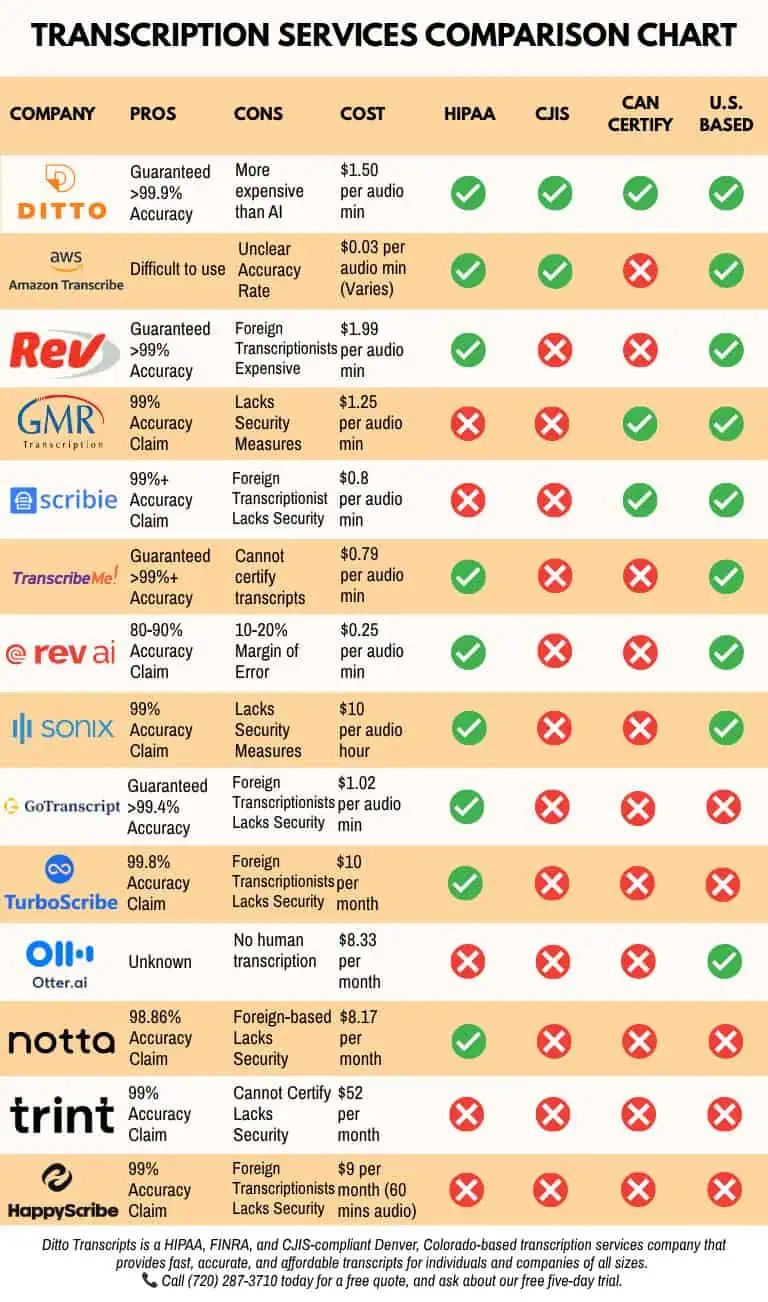
- Human transcriptionists: We use trained human transcriptionists who understand context, speaker flow, tone, terminology, and the difference between a rough transcript and a professional final document.
- Industry-specific experience: Ditto works with clients across legal, medical, law enforcement, academic, business, financial, insurance, media, government, and personal transcription projects.
- Verbatim transcription: When clients need every spoken word captured, Ditto can provide word-for-word transcripts that include false starts, filler words, pauses, interruptions, and other spoken details when required.
- Support for difficult audio: Our transcriptionists can work with multiple speakers, background noise, accents, low volume, overlapping speech, technical terms, and recordings that automated tools often struggle with.
- Secure handling: Sensitive recordings are handled through confidentiality-focused workflows designed to help protect client files and transcripts.
- Compliance support: Ditto works with clients who need HIPAA-compliant, CJIS-compliant, FINRA-compliant, legal, medical, law enforcement, and government transcription support.
- Flexible turnaround options: Clients can choose turnaround times based on file length, urgency, audio quality, number of speakers, and project requirements.
- Clear formatting: Transcripts can be prepared in readable formats that are easier to search, review, share, store, summarize, and use in professional workflows.
- Transparent legal transcription pricing: Pricing depends on the type of transcription, turnaround time, audio quality, number of speakers, formatting, and whether the client needs certified, verbatim, or specialized transcription.
- No long-term contract required: Clients can use Ditto for one project, ongoing support, or changing transcription volumes without being locked into unnecessary commitments.
Whether you need meeting notes, medical dictation, police recordings, legal audio, academic interviews, media content, or business calls turned into searchable text, Ditto Transcripts can help make the process accurate, secure, and manageable.
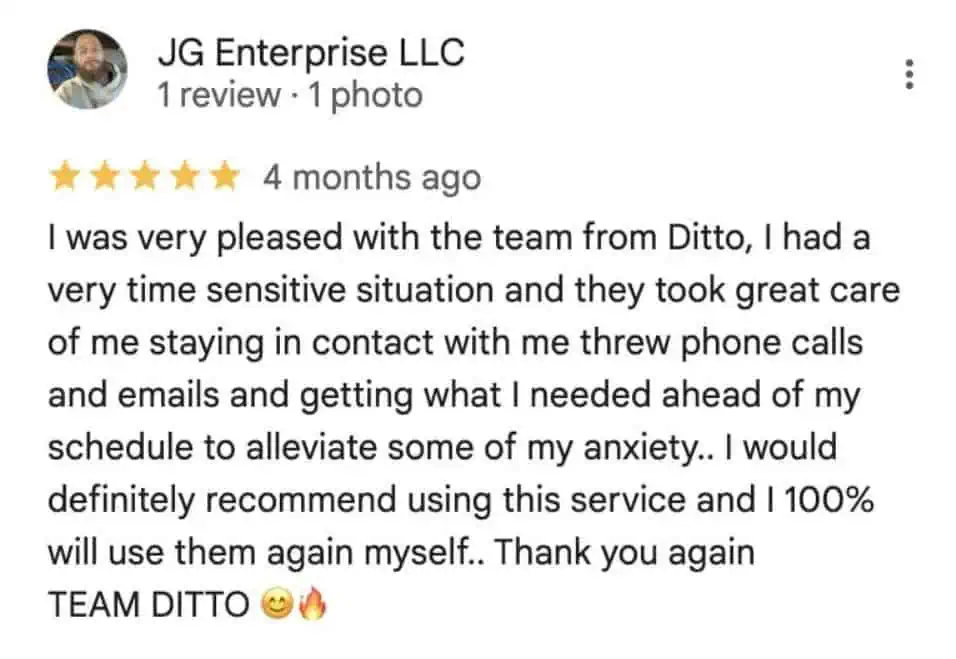
Still deciding? Here’s what one Ditto client testimonial had to say:
Transcripts Help Organizations Work Smarter
Transcription supports many industries because almost every organization relies on spoken information. Meetings, interviews, hearings, calls, reports, lectures, and recordings are easier to use when they are converted into accurate written records.
The right transcription provider can save time, improve documentation, enhance accessibility, reduce internal workload, and help teams focus on what they do best.
Ditto Transcripts is a Denver, Colorado-based FINRA, HIPAA, and CJIS-compliant transcription services company that provides fast, accurate, and affordable transcripts for individuals and companies of all sizes. Call (720) 287-3710 today for a free quote.