


Have you ever needed to know exactly what was said in a meeting, interview, phone call, or recorded conversation without replaying the entire file?
Transcription turns spoken words into searchable text, making it easier to review, share, store, and use important information. Whether the conversation is personal, business-related, academic, legal, or industry-specific, a transcript can make the recording more practical.
As long as you have the audio or video file, a transcription services company can convert it into a clear written document. In this article, we’ll cover three common transcription options, including when legal transcription services may be the best fit.
Three Ways to Transcribe a Conversation
In its most basic sense, transcription is the process of turning spoken words into written text.
There is no single best method for every conversation. The right option depends on the number of speakers, the audio quality, the subject matter, the level of accuracy you need, your budget, and how much time you have to review the final transcript.
Here are three common ways to transcribe a conversation.
1. Use Audio-to-Text Converters
Audio-to-text converters use speech recognition technology to turn audio or video recordings into written text. Some tools offer real-time transcription, while others let you upload a file and receive a transcript later.
These tools can work well for clear recordings with one main speaker and simple language. They can quickly create a rough draft of a conversation, which may be enough for low-risk uses.
However, AI transcription often struggles with multiple speakers, background noise, accents, overlapping speech, names, technical terms, and context. For important legal, business, academic, medical, technical, or court transcription services, professional human transcription is usually the safer choice.
2. Hire a Freelance Transcriptionist
Another option is to hire a freelance transcriptionist. Websites such as Upwork, Fiverr, and Freelancer give clients access to many individual contractors who offer transcription services.
Freelancers can be a reasonable option for simple projects, especially if you have time to compare providers, review samples, and check client feedback. Some may also offer lower rates than larger transcription companies.
The challenge is consistency. Quality, confidentiality practices, turnaround time, formatting, and subject-matter experience can vary widely. This matters when recordings include confidential, legal, medical, business, or sensitive personal information.
A freelance transcriptionist may work on low-risk projects. For sensitive recordings, certified transcripts, compliance needs, or high-accuracy work, a professional transcription company typically provides greater structure and accountability.
3. Use a Reliable Audio Transcription Service
A reliable audio transcription service is often best when you need an accurate, professionally reviewed transcript.
Since 2010, Ditto Transcripts has served clients across business, legal, academic, law enforcement, and government transcription services. We have transcribed audio for authors, journalists, city councils, museums, oil and gas companies, law firms, families, and organizations of many sizes.
Professional transcription is especially useful for recordings with multiple speakers, poor audio, accents, technical terminology, sensitive information, or when you do not have time to edit an AI-generated transcript yourself.
Ditto Transcripts offers general transcription services starting at $1.50 per audio minute, with flexible billing and turnaround times based on file length, audio quality, subject matter, and urgency. When accuracy, security, and reliability matter, a professional transcription company can save time and reduce errors.
Audio-to-Text, Freelancer, or Transcription Service?
Each transcription option has a place. The best choice depends on how important the conversation is and how accurate the final transcript needs to be.
| Option | Best For | What to Consider |
| Audio-to-text converter | Simple recordings, personal notes, rough drafts | Requires proofreading and may struggle with poor audio or multiple speakers |
| Freelance transcriptionist | Basic projects with flexible requirements | Quality, confidentiality, and experience may vary |
| Professional transcription service | Legal, business, academic, medical, medicolegal transcription services, sensitive, or high-accuracy recordings | More structured process, stronger quality control, and better support |
If the transcript is only for casual reference, an automated tool may be enough. If a team used for documentation will review the conversation, share it with clients, or connect it to legal, medical, or business decisions, professional transcription is usually the safer option.
Advantages of Transcribing Conversations
There are many times when a conversation transcript can be useful. Instead of replaying an entire audio or video file, you can read the transcript, search for key details, and share the written version with others.
Conversation transcription can help with:
- Keeping a record: A transcript lets you review what was said later, which can be helpful for meetings, interviews, HR issues, client conversations, and legal matters.
- Improving follow-up questions: Reviewing transcripts can help interviewers, researchers, managers, or attorneys see where they could have asked clearer questions.
- Sharing information: A written transcript is easier to distribute to teammates, clients, editors, researchers, or decision-makers.
- Tracking multiple conversations: When you conduct several interviews or meetings, transcripts make it easier to compare responses and revisit important details.
- Saving time: Reading a transcript is often faster than listening to a full recording, especially when you only need certain sections.
Transcripts can also support better organization. They turn spoken content into a written record that can be highlighted, annotated, filed, searched, and reused.
Why Use an Online Audio Transcription Service?
Creating an accurate transcript takes time, focus, and careful listening, which is why many people choose an online transcription service instead of doing it themselves.
For businesses, outsourcing can be more practical than hiring in-house staff because you only pay for transcription when you need it. Professional transcriptionists can also improve quality by handling industry terminology, formatting needs, multiple speakers, and challenging audio.
Transcripts help preserve meetings, speeches, training sessions, interviews, and phone calls in a format that is easier to search and reference. They can also support content repurposing for blogs, articles, summaries, captions, newsletters, and website pages while improving accessibility for people who are deaf, hard of hearing, or unable to listen to the recording.
Why Clients Choose Ditto for Conversation Transcription Services
Conversation transcription is not only about typing words from an audio file. It is about creating a clear, accurate, and usable written record of what was said, especially when the conversation involves business, legal, academic, medical, law enforcement, or personal information.
At Ditto Transcripts, we support individuals, businesses, legal teams, healthcare organizations, academic institutions, government agencies, and other professionals who need reliable transcriptions. Our process is designed to help clients receive accurate transcripts while keeping sensitive files secure.
Clients choose Ditto because we offer:

- Human transcriptionists: We use trained human transcriptionists who can understand context, speaker flow, tone, and industry-specific language.
- Support for difficult audio: Our transcriptionists can work with verbatim transcription in the presence of poor audio quality, background noise, heavy accents, filler words, and multiple speakers.
- Industry-specific experience: We handle business, legal, medical, academic, law enforcement, interview, and personal recordings.
- Certified transcript options: When needed, Ditto can certify transcripts and support clients who require documentation for legal or official use.
- Secure handling: Sensitive recordings are managed through confidentiality-focused workflows, with NDAs and strict privacy practices.
- Clear formatting: Transcripts are prepared to be easier to read, search, review, and share.
- Flexible turnaround options: Clients can choose timelines based on file length, urgency, audio quality, and project needs.
- Transparent legal transcription pricing: General transcription services start at $1.50 per audio minute, with billing options that fit different workflows.
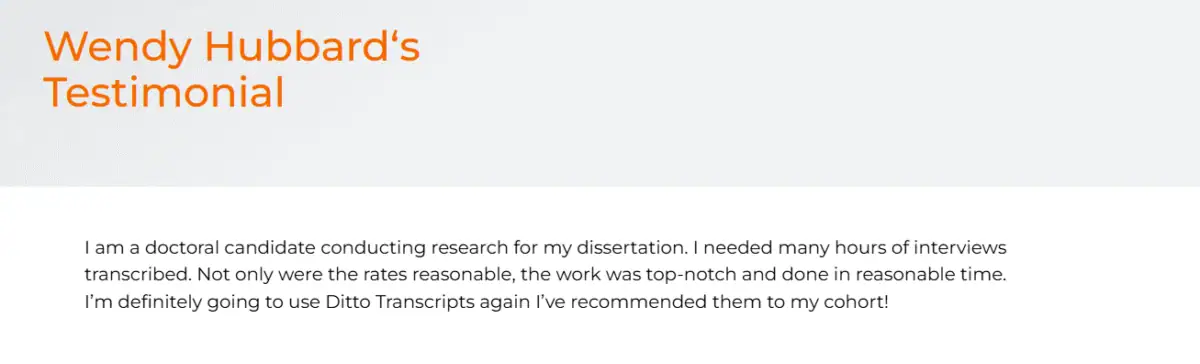
Whether you need a meeting transcribed, an interview documented, a phone conversation preserved, or an audio recording converted into searchable text, Ditto Transcripts can help make the process clear and dependable. Sounds too good to be true? It’s not! In fact, here’s a client testimonial:
When to Use Ditto Transcripts
Not every conversation needs professional transcription. Some recordings are casual and may only need a quick summary or rough AI-generated draft. Others are important enough to require careful listening, accurate formatting, and human review.
Ditto Transcripts is a strong fit when you do not have time to listen to an entire audio file, when you need to know exactly what was said, or when the conversation includes important details you cannot afford to miss.
Ditto Transcripts is a Denver, Colorado-based transcription services company that provides fast, accurate, and affordable transcripts for individuals and companies of all sizes and is FINRA-, HIPAA-, and CJIS-compliant. Call (720) 287-3710 today for a free quote.