


While AI is getting pretty good at chess, human transcription services remain the number one option when accuracy is essential. This is particularly true for legal transcription services, where every word, pause, or inflection can hold significant meaning in court proceedings, depositions, or official records. The same applies to medical documents and other areas where minor errors can have major consequences. Indeed, a human transcriber’s keen ear, contextual understanding, and familiarity with specialized terminology make them the most practical choice for achieving the most reliable and accurate results.
However, human transcription is slightly more expensive than automated transcription solutions. Still, is it worth it? Let’s find out.
In this article, you’ll learn how:
- Transcription pricing models vary, from per line and per page to per audio minute and flat fees—understanding each helps you avoid hidden costs.
- Audio quality, speaker count, and turnaround time can significantly impact your total transcription bill.
- Choosing a transparent and reputable provider like Ditto Transcripts ensures U.S.-based accuracy, legally admissible results, and no billing surprises.
What Is Human Transcription?
Transcription is the creation of a written version of an audio or video recording.
A person performs human transcriptions, not AI. A human listens to the recording and types out whatever they hear, relying on their ability to interpret even the finest details of human speech, like accents and context.
Unlike automated services, professional human transcribers (like those at Ditto Transcripts) can accurately transcribe audio with multiple speakers, background noise, or technical jargon. This level of precision is especially vital in court transcription services, where every word must be captured accurately to ensure legal admissibility and maintain the integrity of official records.
The downside of human transcription is that it takes longer and costs more than automated ones. That said, it remains the gold standard regarding accuracy and quality.
Most Common Types of Transcription
Now that you’re past the definitions, let’s have a look at the common types of transcriptions you might encounter.
| Type of Transcription | Description |
| Verbatim Transcription | It captures every word, sound, and filler, including “um,” “ah,” and stutters, providing an exact record of the audio. This is ideal for legal proceedings or research requiring precise documentation. |
| Intelligent Transcription | Focuses on the meaning and clarity of the content, removing filler words and correcting grammar for a more polished and readable transcript. Suitable for interviews, speeches, or content intended for publication. |
| Edited Transcription | Involves more extensive editing, such as restructuring sentences, correcting syntax, and eliminating irrelevant content. Commonly used for creating clear, concise transcripts for business or educational purposes. |
| Phonetic Transcription | Uses special characters to represent the sounds and pronunciations of words, rather than their spelling. This type of transcription is often used in linguistics, language learning, or speech therapy. |
How Much Does Human Transcription Cost?
Human transcription depends on many factors.
At Ditto Transcripts, the cost of human transcription starts at just $1.50 per audio minute. More on that later.
Two recordings can both be one hour long and still cost different amounts. The difference usually comes down to difficulty, deadline, and formatting:
| Factor | How It Affects Cost |
| Audio quality | Poor sound, background noise, static, echoes, or muffled voices make transcription harder |
| Number of speakers | More speakers require more careful listening, speaker labeling, and review |
| Turnaround time | Rush delivery usually costs more because the file needs priority handling |
| Accents and dialects | Strong accents or unfamiliar speech patterns can take longer to transcribe accurately |
| Subject matter | Legal, medical, academic, government, and technical recordings may require extra care |
| Verbatim requests | Capturing false starts, filler words, pauses, and interruptions adds time |
| Timestamps | Matching text to exact points in the audio or video requires extra formatting |
| File complexity | Multiple files, inconsistent audio, or unclear speaker changes can increase effort |
The best way to keep costs predictable is to give your transcription provider as much detail as possible before the project begins.
Common Transcription Pricing Models
Most transcription providers charge per audio minute, although some use other billing methods. Knowing the difference helps you compare transcription quotes accurately.
| Pricing Model | How It Works | Best Used For |
| Per audio minute | Price is based on the recording length | Most general, legal, business, academic, and law enforcement transcription |
| Per line | Price is based on 65-character lines | Medical transcription |
| Per word | Price is based on the final word count | Some document or content projects |
| Per hour | Price is based on the transcriptionist’s working time | Less predictable and harder to estimate upfront |
| Per keystroke | Price is based on keyboard strokes | Rare for standard audio and video transcription |
| Flat rate | Fixed price for a defined project | Simple projects with clear requirements |
| Per page | Price is based on typed pages | Document-to-document typing |
For most audio and video projects, per-audio-minute pricing is the clearest option because the length of the recording is already known. That is why we charge by the minute; you can see our transcription rates per minute on our pricing page. Two other things can lower your bill:
- Bulk discounts: Transcription companies may offer discounted rates for large projects or ongoing work. The more projects, the more you can save. Call us for a bulk discount!
- Subscriptions: Some providers offer packages that include a set number of transcription hours at a discounted rate, which can help if you have regular transcription needs.
Human Transcription Process
- The client submits an audio or video recording via email or our secure platform.
- We assign the video or audio recording to one of our professional human transcribers with the appropriate skills and experience. For instance, trial transcription services are handled by experienced legal transcribers who understand courtroom procedures, legal terminology, and the importance of maintaining an accurate, verbatim record.
- For verbatim transcription, the transcriber listens to the recorded file word for word and transcribes all utterances. If doing a cleaned-up or edited transcription, the transcriber lightly edits the text for grammar corrections and removes filler words.
- The transcriber submits the transcript for proofreading – and it’s how we achieve >99% accuracy.
- The completed transcript is returned to the client.
How Long Does It Take to Transcribe One Hour of Audio?
A professional transcriptionist usually needs about three to four hours to transcribe one hour of audio or video. Clear, one-speaker audio is faster. A noisy meeting, deposition, interview, or panel discussion with multiple speakers can take much longer.
This is why most transcription companies charge by the audio minute rather than by the transcriptionist’s working hour. For example, at $1.50 per audio minute, a 60-minute recording would start at $90 before add-ons, rush fees, difficult-audio charges, or special formatting.
When Is Human Transcription Required?
Let’s look at the most common scenarios where accuracy is highly valuable and human transcribers are required.
| Category | Description | Why Accuracy Matters | Example / Key Point |
| Legal Transcription | Legal proceedings like court hearings and depositions often involve complex legal jargon, multiple speakers, and challenging courtroom acoustics. Human transcriptionists are required to navigate these situations and capture details accurately, upholding the integrity of the legal record. | Legal transcripts serve as official records and can be used as evidence in future legal matters. Even minor errors can alter the outcome of a case. | Example: Cody DeShields was freed decades early due to a transcription error—36 months instead of 36 years. This highlights why accuracy is essential for legal admissibility and justice. |
| Medical Records | Medical reports, healthcare meetings, and other related documents often contain specialized medical terminology requiring high precision. Human transcribers ensure these details are correctly documented. This also includes medicolegal transcription services, which combine medical and legal expertise to transcribe documents used in legal cases involving medical information accurately. | Accurate medical transcripts support effective communication among healthcare providers, treatment plans, and legal compliance. | Professional human transcribers understand medical practices and terminology better than speech-to-text software. |
| Market Research | Focus groups, interviews, and surveys need accurate transcription to interpret participant responses effectively. Human transcribers can detect emotional nuances and sarcasm that machines miss. | Reliable transcripts are crucial for analyzing customer preferences, spotting trends, and shaping data-driven marketing strategies. | Accurate transcription enhances the quality and insight of market research results. |
| Academic Research | Academic and qualitative research often includes varied accents, interruptions, and overlapping dialogue. Human transcribers handle these challenges with care and expertise. | Even small transcription errors can distort findings and undermine research credibility. | Expert human transcribers ensure transcripts uphold academic accuracy and reliability. |
| Media Production | Used in creating subtitles, closed captions, and interview transcripts for media like YouTube videos, documentaries, podcasts, and news articles. | High-quality transcripts improve accessibility and audience reach, enhancing engagement and content quality. | Inaccurate subtitles can harm viewer experience—highlighting the importance of expert human transcription for media. |
Why Cheap Transcription Can Cost More
Some transcription providers advertise very low prices. However, cheap transcription is not always affordable transcription. Low-cost providers may rely on automated software, offshore workers, inexperienced transcriptionists, or limited quality control, and the result may be a transcript that still needs heavy editing or a complete redo.
| Option | Pros | Cons | Best For |
| Automated transcription | Fast and usually cheaper upfront | Struggles with noise, accents, multiple speakers, names, numbers, and terminology | Rough drafts and low-risk files |
| Human transcription | More accurate, better formatted, and more reliable | Costs more than automated transcription | Legal, medical, academic, business, government, and sensitive recordings |
For important recordings, human transcription is usually the better value. A cheap AI transcript can become expensive if your team spends hours fixing errors, especially for depositions, court recordings, medical reviews, academic research, and business meetings. Our transcriptionists are U.S.-based native English speakers with experience in their fields, which is why we can offer a 99% accuracy guarantee.
How Much Does Ditto’s Human Transcription Service Cost?
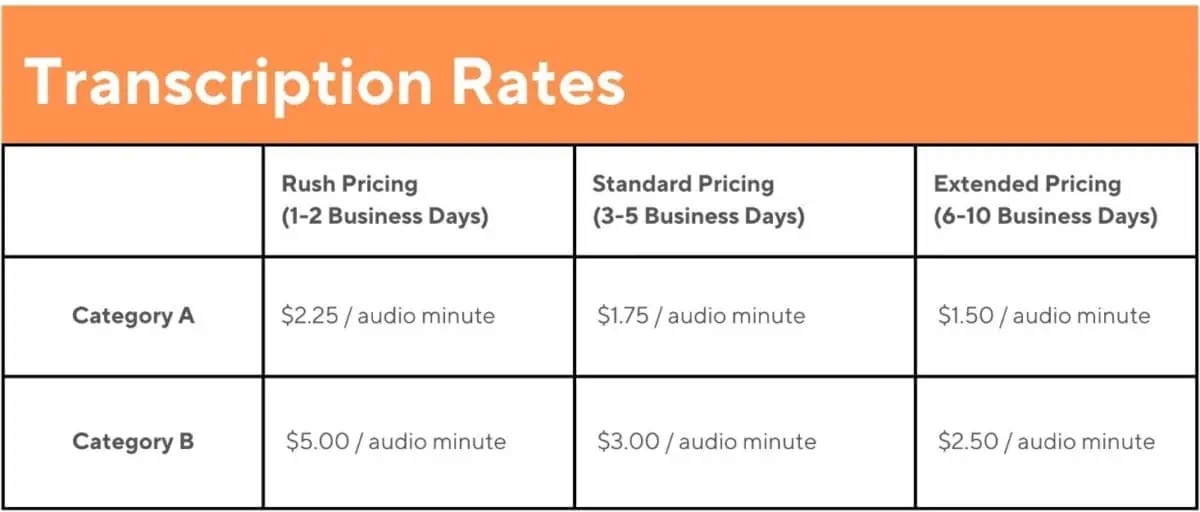
Ditto Transcripts’ human transcription services start at $1.50 per audio minute. Here’s how our pricing works:
- General, business, legal, and academic transcription: $1.50 to $5.00 per audio minute. Clear audio with one or two speakers (Category A) starts at $1.50 per minute with a 6 to 10 business day turnaround. Files with three or more speakers, background noise, or difficult audio (Category B) cost more. See the full rate table on our transcription pricing page.
- Add-ons: Verbatim transcription adds $0.25 per audio minute. Timestamps start at $0.25 per audio minute.
- Medical transcription: Billed per 65-character line, from $0.10 to $0.16 per line. See our medical transcription pricing.
- Legal work: Check our legal transcription prices for court, deposition, and other legal files.
We have a $100 minimum for standard and extended orders and a $150 minimum for rush orders. If a rate needs to change because of audio difficulties, verbatim requirements, timestamps, or other special needs, we tell you before we start. We’re happy to provide quotes, so ask if you’re concerned about audio quality, number of speakers, or other features.
After all, transparency is the cornerstone of our operations.
How to Lower Your Transcription Costs
You can often reduce transcription costs by improving the quality and organization of your recordings. Before submitting a file, try to:
- Record in a quiet location
- Use a good microphone and keep speakers close to it
- Ask speakers to identify themselves and reduce cross-talk
- Share names, acronyms, and technical terms in advance
- Choose standard turnaround when possible
- Send all formatting requirements before work begins, and skip add-ons you don’t need
- Use clear file names
A little preparation can make transcription faster, cleaner, and more affordable.
Maximize Human Transcription With Ditto Transcripts
Don’t settle for AI transcription (that’s only 61.92% accurate) or inexperienced human transcribers who could mess up your transcription job.
Ditto Transcripts is a leader in the transcription industry that offers the following for those who are looking for a dependable, human-powered transcription service:

- Accuracy: We maintain a 99% accuracy rate on all transcriptions, ensuring your content is captured precisely without errors.
- Experience: We’ve been around the block since 2010 and have gained enough experience across industries. Our team has the knowledge to handle subject matter expertly.
- Simple Submission: You can easily upload your audio/video files through our secure online platform. No extra software or complicated steps are required.
- Flexible Turnaround Options: Choose the delivery time that fits your requirements. Do you want a standard turnaround or expedited delivery in 1-2 business days? Let us know.
- Customized Formatting: You can choose your preferred transcript format. Need timestamps, speaker labels, or other requirements? We’ll deliver it exactly as you require.
- Data Security: We adhere to strict confidentiality measures, with all transcribers signing NDAs. Our staff undergoes thorough background checks and security screenings. We’re also compliant with HIPAA and CJIS regulations.
- Affordable Pricing: We offer high-quality transcription at competitive rates. Our prices start at $1.50 per audio minute.
- Trusted by many: Countless businesses and organizations across industries trust Ditto Transcripts for their transcription needs. Our customer reviews attest to our exceptional service. If you need it, we can point you to some of our satisfied clients we’ve worked with for years. Don’t believe us? Here’s one of our client testimonials:

- Customer Service: Our dedicated customer service team is available around the clock to assist you. You’ll always reach a real person, not a robot, to address any questions or needs.
Let’s Discuss Your Human Transcription Needs
When accuracy matters, trust Ditto Transcripts for your transcription needs. We offer 99% guaranteed accuracy, expert transcribers, and a commitment to data security, so you can feel confident that your content will be captured with precision. Take advantage of our flexible turnaround options, customizable formatting, and competitive pricing.
Ditto Transcripts is a Denver, Colorado-based HIPAA and CJIS-compliant transcription services company that provides fast, accurate, and affordable transcripts for individuals and companies of all sizes. Call (720) 287-3710 today for a free quote.