


Practicing medicine requires precision. In healthcare, even a small documentation error can have serious consequences. Yet doctors, nurses, and administrative staff often face heavy documentation workloads.
Medical transcription companies help reduce that burden by converting recordings into clear, structured records. Many also support specialized needs, including legal transcription services, when medical documentation overlaps with legal matters. Even so, proofreading checklists for medical transcripts remain essential for maintaining accuracy and quality.
In this article, you’ll learn how:
- Use proofreading checklists to maintain medical transcription accuracy rates of 99% or higher and reduce documentation risks in healthcare records.
- Identify common transcription errors such as incorrect medical terminology, missing words, spelling mistakes, and typing errors.
- Understand the potential consequences of inaccurate transcripts, including medication errors, treatment delays, insurance claim issues, and legal liability. Evaluate medical transcription providers based on key factors like HIPAA compliance, U.S.-based operations, EMR compatibility, clear turnaround times, and strong quality control processes.
Why Is A Proofreading Checklist Important for Medical Transcripts?
Medical transcription saves time, but skipping a proofreading checklist can introduce serious risks. Inaccurate transcripts can lead to patient harm or legal consequences, which is why quality checks remain essential. Hospitals, clinics, and transcription providers rely on proofreading checklists to catch critical errors before documentation reaches the medical record.
Physicians already operate under demanding schedules, and internal quality assurance teams may struggle to keep pace with the volume of documentation. Structured proofreading processes allow trained transcriptionists to verify key elements such as demographic details, medication names, and clinical terminology. Many transcription providers also handle other specialized work, including court transcription services, where the same level of precision and review is equally important.
Potential Consequences of Medical Transcription Errors
As mentioned earlier, medicine demands precision, and even minor transcription errors can have serious consequences. Some of the most significant risks of inaccurate transcripts include:
- Patient misidentification: Patients with similar names or birthdates may be confused with one another, especially during high-volume transcription periods.
- Medication dosage errors: Misplaced decimal points or incorrect measurement units can occur during rushed documentation.
- Treatment delays: Unclear terminology may force transcriptionists or providers to spend extra time verifying details before continuing care.
- Insurance claim rejections: Incorrect procedures or billing codes can result in denied claims.
- Legal liability issues: Incomplete or unclear documentation of patient consent may expose healthcare providers and facilities to legal disputes.
- Care coordination failures: Incorrect referral or provider information can disrupt communication between healthcare professionals.
- Patient anxiety: Patients who notice errors in their records may lose confidence in their care and become concerned about their treatment.
- Quality and compliance impacts: Documentation mistakes can negatively affect hospital reporting metrics and regulatory compliance.
Accurate medical transcripts are essential for patient safety, compliance, and clear communication across healthcare teams. Careful transcription and structured proofreading help reduce documentation errors while maintaining the reliability of medical records. As practices refine their documentation processes, some providers also offer trial transcription services, allowing teams to evaluate transcription quality before fully adopting external support.
What Are The Common Medical Transcription Errors to Check?
There are tons of errors that medical transcribers should closely watch out for.
Incorrect Medical Terms
Similar-sounding medical terms can easily be confused during documentation. A well-known example is hypertension versus hypotension. Although the difference appears small, each term refers to a completely different condition and requires different treatment. This is one reason accurate verbatim transcription can be important in certain medical documentation contexts, as it captures exactly what was said without altering terminology. When these errors appear in official records, they can lead to misunderstandings across care teams and may even create legal complications.
Missing Words in Medical Notes and Reports
Medical documentation can become risky when essential words are omitted. For instance, a note that says “take tablets daily” instead of “take 2 tablets daily” creates uncertainty about the correct dosage. These gaps often happen when dictation or documentation is interrupted, leaving incomplete information that must later be clarified.
Spelling Mistakes in Transcripts
Even small spelling errors can change the medical meaning. Words such as infarction and infraction differ by only a few letters but refer to entirely different concepts. In busy clinical environments, these mistakes can slip through if transcripts are not carefully reviewed.
Typing Errors During Transcription
Fast typing under strict turnaround deadlines can sometimes introduce mistakes. A simple slip on the keyboard could turn “normal saline” into something entirely different. Without careful review, these small errors can multiply and affect the clarity of the final medical record.
Words That Wander Off Course
Over-editing can also create problems. For example, changing “blood sugar tends to run high” to “patient demonstrates elevated glucose levels” may sound more formal but removes the physician’s intended emphasis on recurring patterns. Good transcription balances clarity with preserving the clinician’s original meaning and voice.
Choosing a Reliable Medical Transcription Provider
With many transcription companies offering medical transcription services, it can be difficult to determine which providers maintain strong accuracy and quality control standards. Choosing the right partner requires evaluating factors such as system compatibility, security compliance, and clear operational processes.
Rahul Varshneya, cofounder of the medical software development company Arkenea, highlights an important consideration:
“When choosing a transcription service for your facility, you should consider one that is compatible with your current electronic medical records (EMR) system if your practice has one. Many services offer EMR integration and free technical support so that transferring and filing patient records is easy.”
Compatibility with existing EMR systems helps streamline the documentation process and prevents unnecessary workflow disruptions. Some providers, such as Ditto Transcripts, support a wide range of audio formats and flexible submission options, making integration with existing systems much easier.
What You Need to Consider
When evaluating a transcription provider, healthcare organizations should look for the following qualities:
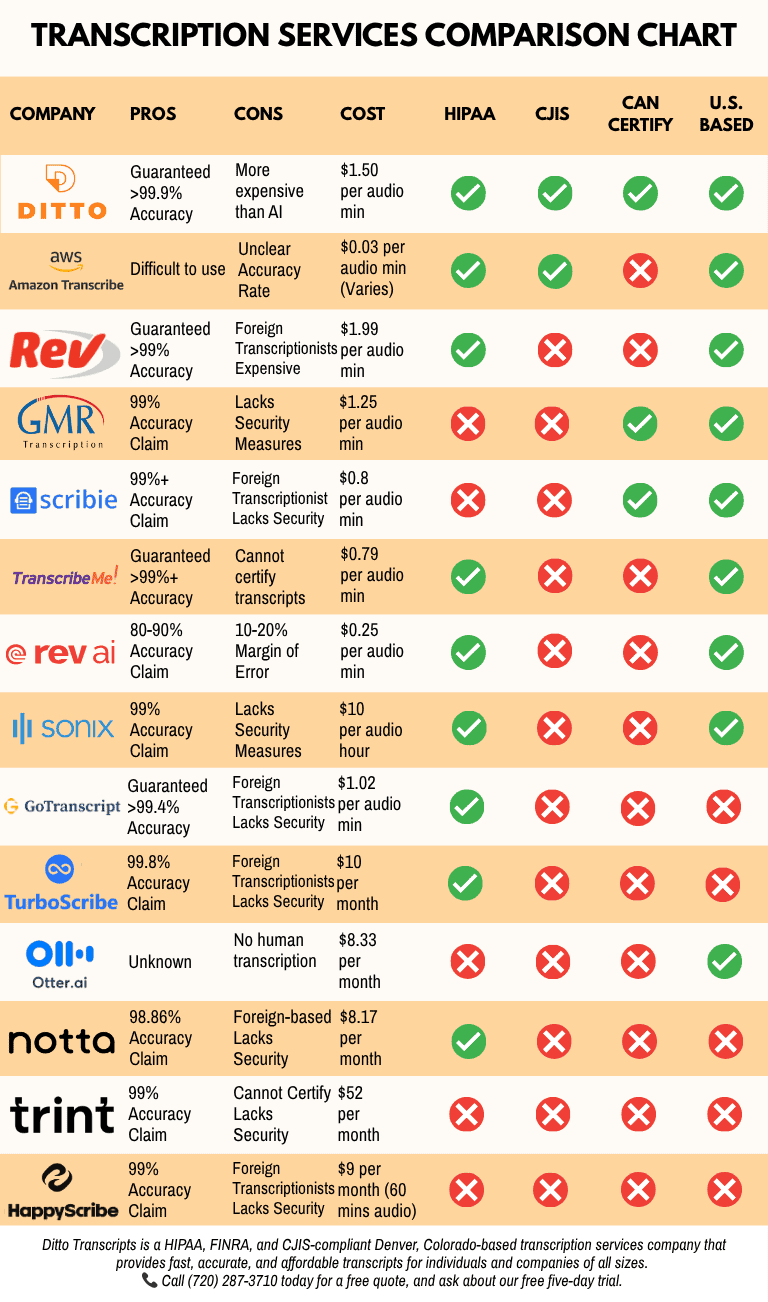
- U.S.-based transcription teams: Verifiable business licenses and physical addresses that confirm legitimate operations.
- HIPAA and HITECH compliance: Security standards that protect patient privacy and sensitive medical data.
- Government registrations or certifications: Credentials that demonstrate legal business status and regulatory compliance.
- Transparent legal transcription pricing structures: Clearly defined billing practices with no hidden costs.
- Defined turnaround times (TAT): Options such as 2, 4, 8, 12, 24, or 48 hours, with STAT or rush delivery available when needed.
- Structured transcription workflows: Organized processes covering submission, transcription, quality assurance, delivery, and secure file storage.
- Comprehensive proofreading checklists: Quality control steps designed to maintain accuracy across different medical transcripts.
- EMR compatibility: Ability to accept audio files produced by electronic medical record systems and other common formats.
- Specialized transcription experience: Familiarity with different areas of medical documentation and terminology.
- High accuracy standards: Internal quality checks that support consistently reliable transcripts.
- Appropriate insurance coverage: General liability and cyber liability policies.
Medical Transcription Services Specialty Areas
If you’re considering medical transcription services and are worried you won’t find someone with experience in your specific field, you can rest easy! We offer all of the following specialty services for transcription and more:
- Adolescent and pediatric medicine
- Allergy immunology
- Anesthesiology reports
- Cardiology reports
- Cardiology transcription
- Chart notes
- Clinical notes
- Clinical summary (ies)
- Cytopathology reports
- Dental report and transcription
- Dermatology reports and transcription
- Discharge summaries
- Doctor Note Transcription
- Electrophysiology Reports
- Emergency Room
- Endocrinology
- ENT Reports
- Family Practice transcription services
- Gerontology transcription and reports
- Group practice work
- OB/GYN – Gynecological transcription
- H & Ps
- Hematology reports
- Hepatology transcription service
- Infectious disease reports
- Internal medicine
- Neurology transcription
- Ophthalmology transcription
- Oncology reports
- Orthopedic transcription
- Pathology transcription
- Patient notes
- Pediatric transcription
- Podiatry transcription
- Progress notes
- Psychiatry transcription
- Psychology transcription
- Pulmonary transcription
- Radiology transcription
- Surgery notes transcription – pre-op and post-op
If you’re looking for something a little different and don’t see it on our list, you can contact us here to learn more about what we can do for you.
Ditto Understands That Proofreading The Transcripts is Crucial
Medical transcription services are highly specialized. At Ditto, we’re well-trained and experienced. We can help you speed up your process, help more patients, and have stronger, more accurate records than ever before, all at a lower cost than any other option.
And yes, we implement a robust proofreading checklist for medical transcripts to ensure over 99% accuracy.
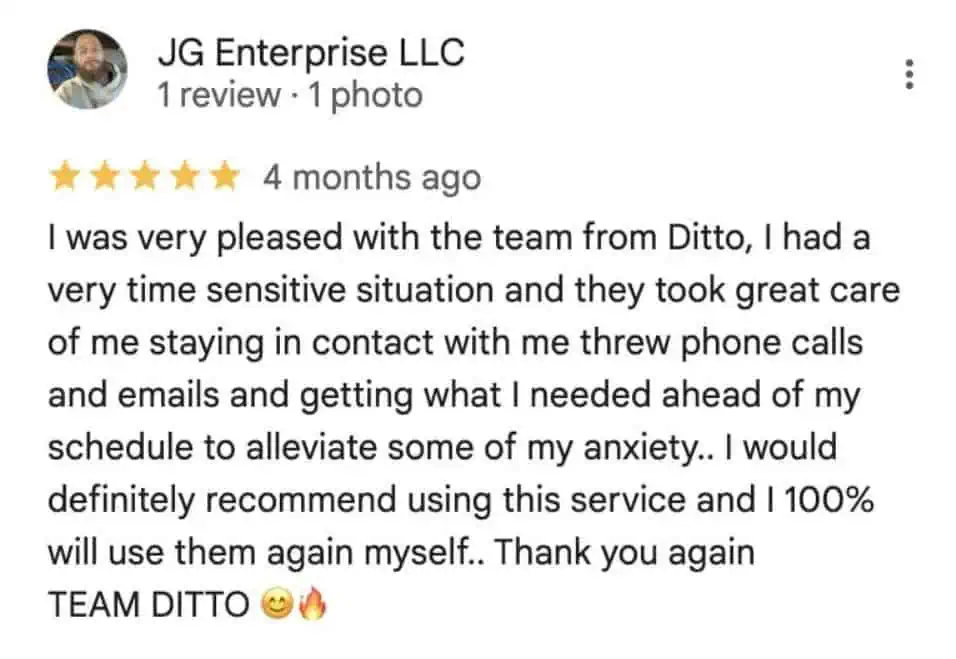
If you’re still not convinced, here’s what testimonials say about our services:
Ditto Transcripts is a Denver, Colorado-based FINRA, HIPAA, and CJIS-compliant transcription services company that provides fast, accurate, and affordable transcripts for individuals and companies of all sizes. Call (720) 287-3710 today for a free quote.