


A witness interview can shape an investigation’s direction. A witness’s information may identify new leads, support existing evidence, expose inconsistencies, or help investigators understand what happened from another perspective.
Getting useful information depends on more than asking the right questions. Investigators also need to minimize suggestion, listen carefully, document what was said, and appropriately preserve the resulting information.
When recorded interviews become part of an investigative workflow, professional law enforcement transcription services can turn the audio into a searchable written record for authorized teams to review.
Federal guidance from the National Institute of Justice recommends using primarily open-ended questions, avoiding leading questions and interruptions, and allowing witnesses to describe events in their own words.
In this article, you’ll learn…
- How to prepare for and conduct an effective witness interview
- How open-ended, neutral questioning can help preserve the witness’s independent account
- How to document, protect, and preserve witness interview recordings and transcripts
What Is a Witness Interview?
A witness interview is a structured conversation used to gather information from someone who may have seen, heard, experienced, or otherwise know something relevant to an investigation.
Witnesses may remember important details about people, places, conversations, timelines, vehicles, actions, or other circumstances connected to an incident.
The interviewer’s job is not to force a predetermined version of events. Instead, the goal is to obtain as complete and accurate an account as possible while avoiding questions or conduct that could unnecessarily influence the witness’s report.
That distinction matters because witness memory is not a recording. The way an interviewer asks questions can affect the information that comes back.
Witness Interview Best Practices at a Glance
| Best Practice | Why It Matters |
| Prepare before the interview | Helps investigators understand what information still needs to be gathered |
| Establish rapport | Creates a more comfortable environment for communication |
| Start with open-ended questions | Lets witnesses describe events in their own words |
| Avoid leading questions | Reduces the risk of suggesting an answer |
| Do not interrupt unnecessarily | Allows witnesses to complete their recollection |
| Use plain language | Reduces misunderstanding |
| Follow up carefully | Clarifies important details without replacing the witness’s account |
| Document the interview | Preserves information for later review |
| Protect sensitive information | Helps maintain confidentiality and appropriate access |
| Preserve recordings and records | Supports investigative, discovery, and evidentiary workflows |
Know the Case Before the Interview
Investigators should understand the available case information before sitting down with a witness.
Preparation can include reviewing incident reports, timelines, photographs, known evidence, earlier statements, and the witness’s apparent connection to the matter.
The objective is not to memorize a script or decide in advance what the witness should say. It is to understand what information has already been established and what remains unknown.
A prepared interviewer can recognize potentially important details without constantly stopping the conversation to consult case materials.
At the same time, investigators should avoid allowing existing evidence or theories to turn questions into exercises in confirmation. The witness should still have room to provide an independent account.
Explain the Interview and Establish Rapport
The beginning of an interview helps establish expectations.
Investigators should generally identify themselves, explain the interview’s purpose, and provide any notices or instructions required by their agency or applicable law.
A professional, respectful introduction can help reduce uncertainty and encourage better communication.
Whether a particular witness is free to leave, required to appear, entitled to counsel, or subject to other procedural protections depends on the circumstances and applicable law. Investigators should therefore follow their agency’s procedures rather than giving a blanket statement about the witness’s legal status.
Rapport does not require becoming overly informal. Patience, listening to concerns, and respectful treatment can create a better environment for obtaining information.
Start With Open-Ended Questions
Whenever practical, let the witness explain what happened before narrowing the interview with highly specific questions.
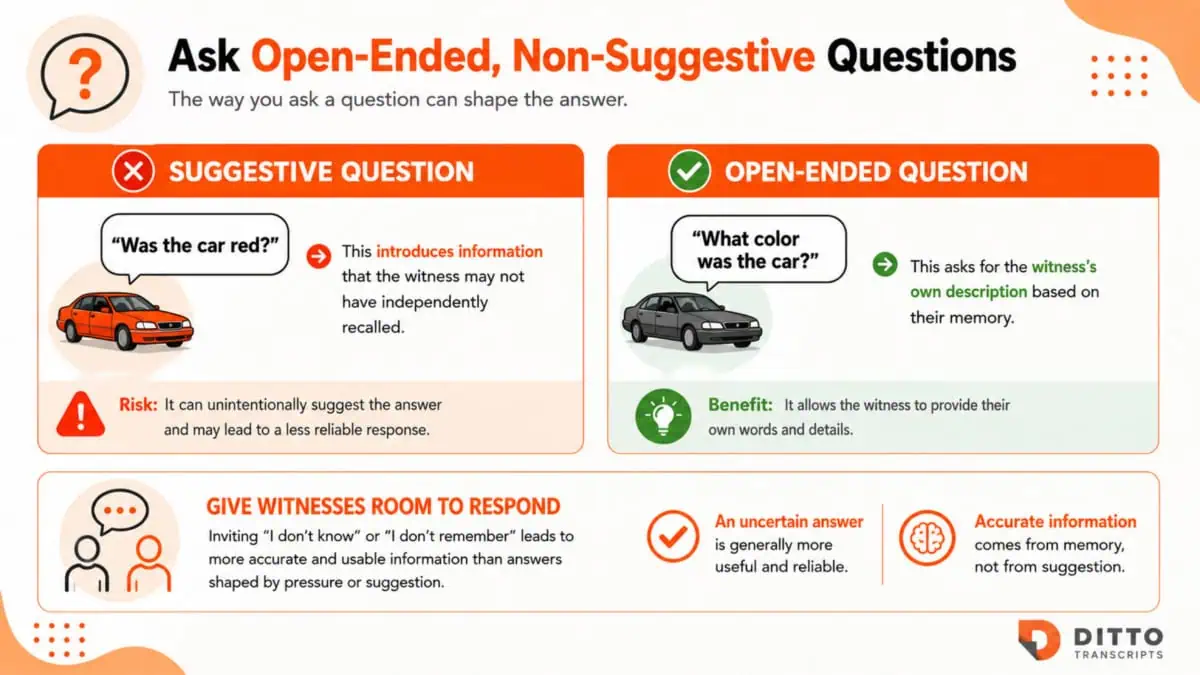
The National Institute of Justice recommends open-ended questions that encourage witnesses to provide narrative answers. Examples include asking what the witness remembers about an event or what they can describe about a particular person or object.
Once the witness has provided a free account, investigators can use more specific questions to clarify details.
For example, if a witness mentions a vehicle, the interviewer might later ask about its color, direction of travel, or identifying characteristics.
The sequence matters. Starting too narrowly can let an investigator’s assumptions shape the conversation before the witness explains what they remember independently.
Avoid Leading Questions and Guessing
Questions should gather information rather than supply it.
The National Institute of Justice advises investigators to avoid leading questions and cautions witnesses against guessing.
Let the Witness Finish
Interrupting someone may seem harmless when the interviewer wants to clarify an important detail; however, it can disrupt the witness’s train of thought.
Allowing witnesses to complete their answers can produce a fuller account and reduce the risk that the interview becomes a rapid series of investigator-directed questions.
Federal guidance recommends avoiding interruptions during open-ended answers. Instead, an interviewer can make a note and return to the issue after the witness finishes speaking.
This approach also helps investigators distinguish information the witness volunteered from information that emerged only after detailed questioning.
Use Plain, Neutral Language
Legal terminology, police jargon, acronyms, and complicated questions can create unnecessary confusion.
Questions should be understandable to the person being interviewed and neutral enough not to imply the desired response.
An investigator can always clarify unfamiliar terminology afterward.
When possible, questions should address one idea at a time. Combining several issues into a single question can make it difficult to know which part the witness actually answered.
When a response is unclear, investigators can ask the witness to explain further rather than interpreting the statement.
Listen Actively Without Overinterpreting Behavior
Active listening means paying close attention to what the witness says, identifying points that need clarification, and allowing the account to develop.
It can also include recognizing when a witness appears confused, distressed, distracted, or unable to continue comfortably.
However, investigators should not treat demeanor alone as reliable proof that a witness is truthful or deceptive.
A pause, nervous behavior, lack of eye contact, or emotional reaction can have many explanations. Investigators should focus on gathering information and comparing statements with other available evidence rather than assuming a particular behavior proves dishonesty.
Document the Interview Carefully
Accurate documentation becomes particularly important as an investigation develops.
Investigators should preserve the substance of the witness’s account in accordance with agency policy and applicable discovery or evidentiary requirements.
Relevant documentation may include the interview date and location, people present, notes, recordings, written statements, and subsequent corrections or additional information.
The Department of Justice’s Justice Manual states that agents should generally memorialize substantive witness interviews. It also says to preserve agent and prosecutor notes and original recordings. When an interview has been audio- or video-recorded, additional memorialization is generally not necessary.
If an interview or related recording later becomes part of a judicial proceeding, professional court transcription services can create a written transcript in the required format.
Protect Confidential Information
Witness interviews can contain names, addresses, medical information, criminal justice information, investigative details, and other sensitive material.
Access to recordings, transcripts, notes, and related records should follow applicable agency policies, laws, security requirements, and case-specific restrictions.
That does not mean every witness interview automatically falls under the same confidentiality standard. Requirements depend on the organization, jurisdiction, the information involved, and the purpose for which the record is maintained.
For agencies handling criminal justice information, the FBI’s CJIS Security Policy establishes requirements for protecting CJI.
Public agencies that need written records from interviews, hearings, investigations, or other official recordings may also use government transcription services when human transcription and secure handling are required.
Preserve Original Recordings
A transcript can make an interview easier to search, although it should not automatically replace the source recording.
When the original audio or video is part of the investigative record, preserve it under applicable retention, evidence, and discovery procedures.
The original recording lets authorized reviewers return to the source if a transcript contains an unclear word, disputed speaker identification, or another issue.
DOJ guidance likewise emphasizes preserving original witness-interview recordings and notes when they form part of a federal criminal investigation.
Transcribe Witness Interview Recordings
Listening to a lengthy interview every time investigators need one statement is inefficient.
A searchable transcript lets authorized personnel locate names, dates, locations, quotations, and other details without repeatedly replaying the entire recording.
The appropriate transcription style depends on how the document will be used.
Some interviews may only require a cleaned transcript that removes unnecessary filler. When the precise wording, false starts, interruptions, and other speech characteristics matter, verbatim transcription can preserve more of what occurred in the recording.
Still, check the transcript against the original recording when accuracy matters most.
Can AI Transcribe Witness Interviews?
Automated transcription can produce a quick working draft; however, witness interviews can challenge speech recognition systems.
Recordings may contain several speakers, radio noise, background sounds, unfamiliar names, legal terminology, accents, interrupted speech, and low-volume conversations.
Ditto’s testing of AI transcription platforms found a mean accuracy of 61.92% across the evaluated systems. That is Ditto’s own test result, not a universal accuracy rate for all AI systems or recordings.
A rough machine transcript may be useful when someone only needs a quick reference and intends to verify the text.
When an interview is used for detailed investigative review, quotations, legal work, or other high-stakes purposes, human transcription and quality review can reduce the amount of unverified text entering the workflow.
Why Choose Ditto for Witness Interview Transcription?
Witness-interview transcription requires more than simply turning speech into text. Investigators need a transcript that accurately handles multiple speakers, names, terminology, and difficult audio, while keeping sensitive material appropriately protected.
At Ditto Transcripts, trained human transcriptionists handle recordings rather than delivering unchecked AI transcripts.
Clients can expect:
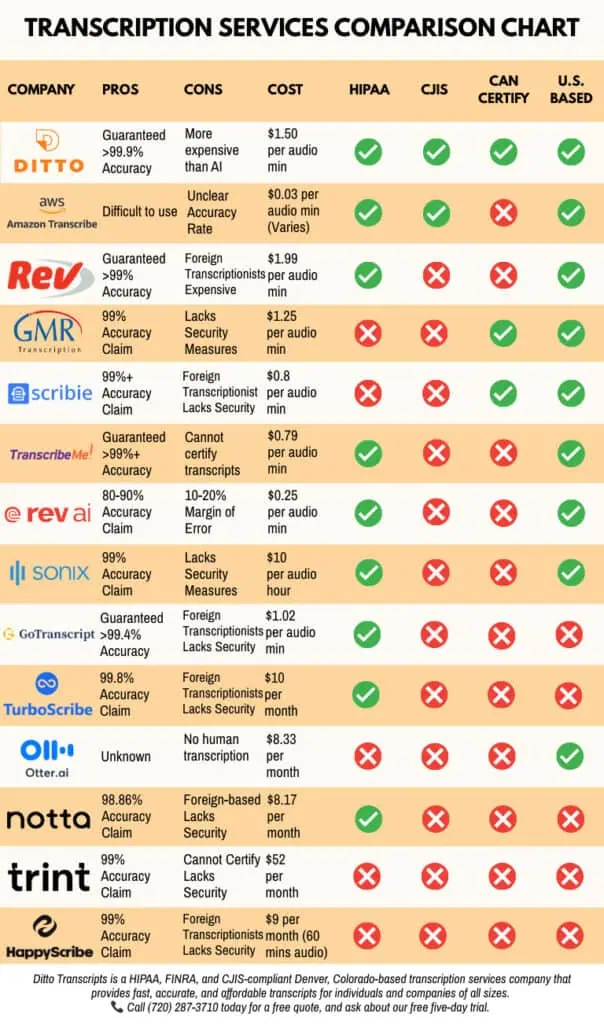
- 100% human transcription: Ditto uses U.S.-based human transcriptionists, not AI, for final transcription.
- 99% accuracy guarantee: Ditto guarantees 99% accuracy for its transcription projects.
- Experience with legal and investigative audio: Ditto works with interviews, interrogations, court proceedings, depositions, and other legal recordings.
- Support for difficult audio: Human reviewers can handle multiple speakers, background noise, quiet voices, accents, and specialized terminology.
- Security: Ditto is CJIS- and HIPAA-compliant and maintains SOC 2 Type II and FINRA compliance.
- Flexible turnaround: Clients can select turnaround options based on urgency and recording difficulty.
- Transparent pricing: Ditto publishes its legal transcription prices. Current rates begin at $1.50 per audio minute for qualifying Category A files with extended turnaround, with higher rates for faster service or more difficult recordings.
- No unnecessary long-term contract: Clients can submit individual projects or recurring work as needed.
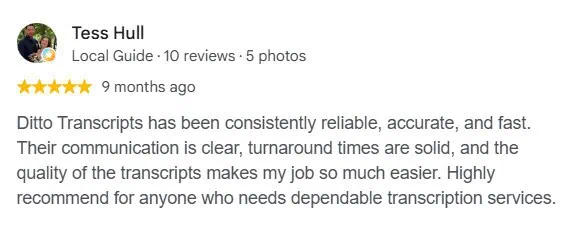
- Verified client experiences: Ditto’s testimonials include client feedback on accuracy, turnaround, communication, pricing, and service.
The goal is to give investigators a reliable written record they can search and review without losing sight of the original recording.
Better Interviews Create Better Investigative Records
A good witness interview begins before the first question is asked and continues after the conversation ends.
Investigators need to prepare, establish an appropriate environment, encourage witnesses to speak in their own words, avoid unnecessary suggestion, listen carefully, and preserve what was said.
Recording and transcription add another layer of documentation, yet neither replaces sound investigative practice. They help preserve the information that good interviewing produces.
When accuracy, security, difficult audio, or workload makes internal transcription impractical, professional human transcription can turn witness-interview recordings into searchable records that investigators and other authorized professionals can use throughout the life of a case.
Ditto Transcripts is a Denver, Colorado-based transcription services company providing human transcription for legal professionals, law enforcement agencies, government organizations, and other clients—call (720) 287-3710 for a free quote.