


Lawyers, paralegals, and legal support teams handle large volumes of paperwork, recordings, notes, and case files. Depositions, hearings, client meetings, witness statements, conference calls, interrogations, and court recordings often need to be converted into accurate written records for review, storage, preparation, or court use.
That is where legal transcription services become valuable. A professional transcription provider can help law firms save time, reduce internal workload, and create searchable transcripts that attorneys and staff can use throughout the legal process.
Why Law Firms Outsource Legal Transcription
Outsourcing transcription is not only about convenience. For law firms, accurate transcripts can support case preparation, deposition review, evidence organization, attorney notes, trial strategy, and long-term file management.
Outsourcing Saves Time and Money
Hiring in-house transcription staff can be expensive. Law firms may need to pay for recruiting, onboarding, training, salaries, benefits, software, equipment, and quality control.
Outsourcing avoids many of those costs. Instead of building an internal transcription team, a firm can send recordings to a professional provider when needed. This also prevents attorneys, paralegals, and administrative staff from being pulled away from legal work to transcribe audio or video files.
For firms with changing workloads, outsourcing is especially useful. A provider can help with one file, a large batch of recordings, or ongoing transcription support without requiring a long-term internal hire.
Transcripts Make Case Review Easier
Audio and video recordings can contain important case details, though they are time-consuming to review. Attorneys may need to replay recordings several times to find a specific statement, contradiction, date, name, or admission.
A transcript turns that recording into searchable text.
Legal teams can use transcripts to:
- Find key statements quickly
- Review witness testimony
- Prepare for depositions
- Support cross-examination
- Compare statements across recordings
- Organize case facts
- Share information with authorized team members
- Preserve a written record of conversations or proceedings
This matters for court transcription services, deposition review, client meetings, and recorded statements. A transcript makes the content easier to search, quote, annotate, and use.
Certified Transcripts May Be Needed for Court
Legal recordings often become part of formal proceedings. Depositions, custody hearings, witness statements, interrogations, attorney-client meetings, and law enforcement recordings may all be reviewed in connection with a case.
When transcripts are used for official purposes, certification may be required. A certified transcript confirms that the transcript was prepared as a true and accurate record of the audio, based on the provider’s process.
Not every transcription company can provide certified transcripts. Law firms should confirm this before sending files, especially when transcripts may be used in filings, hearings, trial preparation, or court review.
Digital Transcripts Are Easier to Store and Preserve
Law firms manage a lot of records. Paper files take up space, can be difficult to search, and may be damaged, misplaced, or destroyed over time.
Digital transcripts help preserve important information in a format that is easier to store, search, back up, and share with authorized users. Instead of relying only on audio, video, or paper notes, firms can maintain written records that are easier to organize by matter, client, date, or proceeding.
This can also help firms manage older files, archived recordings, and large case records more efficiently.
What to Look for in a Legal Transcription Provider
Choosing the right transcription company matters. Legal recordings may include privileged information, confidential case strategy, witness testimony, sensitive personal details, and evidence-related material.
A provider should be accurate, secure, experienced, and flexible enough to support legal workflows.
Legal Transcription Experience
Legal transcription requires more than general typing skills. A provider should understand legal terminology, case-related formatting, speaker identification, timestamps, certification requests, and the importance of preserving meaning.
An inexperienced company may offer low rates, though poor results can cost more in the long run. Errors, missed words, weak formatting, and inconsistent speaker labels can create extra work for attorneys and staff.
Look for a provider that has experience with:
- Depositions
- Hearings
- Court proceedings
- Witness interviews
- Client meetings
- Recorded statements
- Interrogations
- Legal conference calls
- Law enforcement recordings
- Corporate legal matters
Deposition transcription services are especially important for law firms that need accurate, searchable testimony for case preparation and attorney review.
Strong Accuracy Standards
Accuracy is critical in legal transcription. A missed word, an incorrect name, a wrong number, or a mislabeled speaker can change how a statement is understood.
Automated transcription tools can be fast, though speed is not enough for legal work. If an automated transcript is only 61.92% accurate, someone still has to spend time correcting, formatting, and verifying it before it can be used with confidence.
Human transcriptionists are better suited for legal recordings because they can listen for context, research terminology, identify speakers, flag unclear sections, and apply judgment when audio is difficult.
For trial transcription services, hearings, depositions, and case-related recordings, law firms should prioritize accuracy over the lowest price or fastest automated turnaround.
Clear and Fair Pricing
Cost-effective does not always mean cheap. Legal transcription needs to be accurate, secure, and reliable, which requires skilled people and a structured process.
A good provider should explain pricing clearly before work begins. Ask what affects the final cost, including turnaround time, audio quality, number of speakers, timestamps, verbatim transcription, certification, formatting requirements, and rush delivery.
Transparent pricing helps law firms manage budgets and avoid surprise fees.
Flexible Services and Formatting Options
Legal teams may need different transcript formats depending on the case, proceeding, or internal workflow. A reliable provider should be able to handle custom instructions and different types of audio or video files.
Useful options may include:
- Speaker labels
- Timestamps
- Certified transcripts
- Clean read transcripts
- Verbatim transcripts
- Custom formatting
- Digital signatures
- Multiple file formats
- Rush turnaround
- Translation support when available
In some cases, a clean transcript may be enough. For others, word-for-word detail may matter. Verbatim transcription is often useful when pauses, interruptions, filler words, or exact phrasing may affect how a statement is interpreted.
Security and Confidentiality
Law firms handle sensitive information. A transcription provider may receive recordings that include privileged conversations, personal information, criminal case details, business disputes, medical information, financial data, or confidential settlement discussions.
Security should be a basic requirement, not a bonus feature.
Before choosing a provider, ask about:
- Secure file upload and delivery
- Encryption
- Controlled user access
- Unique usernames and passwords
- Confidentiality agreements
- File retention policies
- Access deactivation
- Tracking and reporting
- HIPAA-compliant workflows when medical information is involved
- CJIS-compliant workflows when criminal justice information is involved
Firms that handle criminal matters, law enforcement recordings, or government-related cases may need a provider that understands CJIS requirements. Government transcription services and legal work often overlap when recordings involve agencies, courts, public records, or criminal justice information.
Legal Transcription Provider Checklist
Before outsourcing legal files, law firms can use this quick checklist to compare providers.
| What to Ask | Why It Matters |
| Do you have legal transcription experience? | Legal terminology, formatting, and speaker identification require specialized knowledge |
| Do you use human transcriptionists? | Human review improves context, accuracy, and handling of difficult audio |
| Can you provide certified transcripts? | Some court-related or official uses may require certification |
| How do you protect confidential files? | Legal recordings often include privileged or sensitive information |
| What affects pricing? | Clear pricing helps avoid surprise costs |
| Can you handle rush deadlines? | Legal work often has filing, hearing, or client-driven deadlines |
| Can you follow the custom formatting instructions? | Different firms and matters may require different transcript formats |
Why Clients Choose Ditto for Legal Transcription Services
Legal transcription is not merely about converting recordings into text. It is about creating accurate, secure, and readable records that attorneys, paralegals, courts, and legal teams can use with confidence.
At Ditto Transcripts, we support law firms, legal departments, attorneys, court professionals, government offices, law enforcement agencies, and other clients who need dependable transcripts for sensitive legal recordings. Our team handles depositions, hearings, client meetings, witness interviews, recorded statements, interrogations, conference calls, corporate legal recordings, and more.
Clients choose Ditto because we offer:
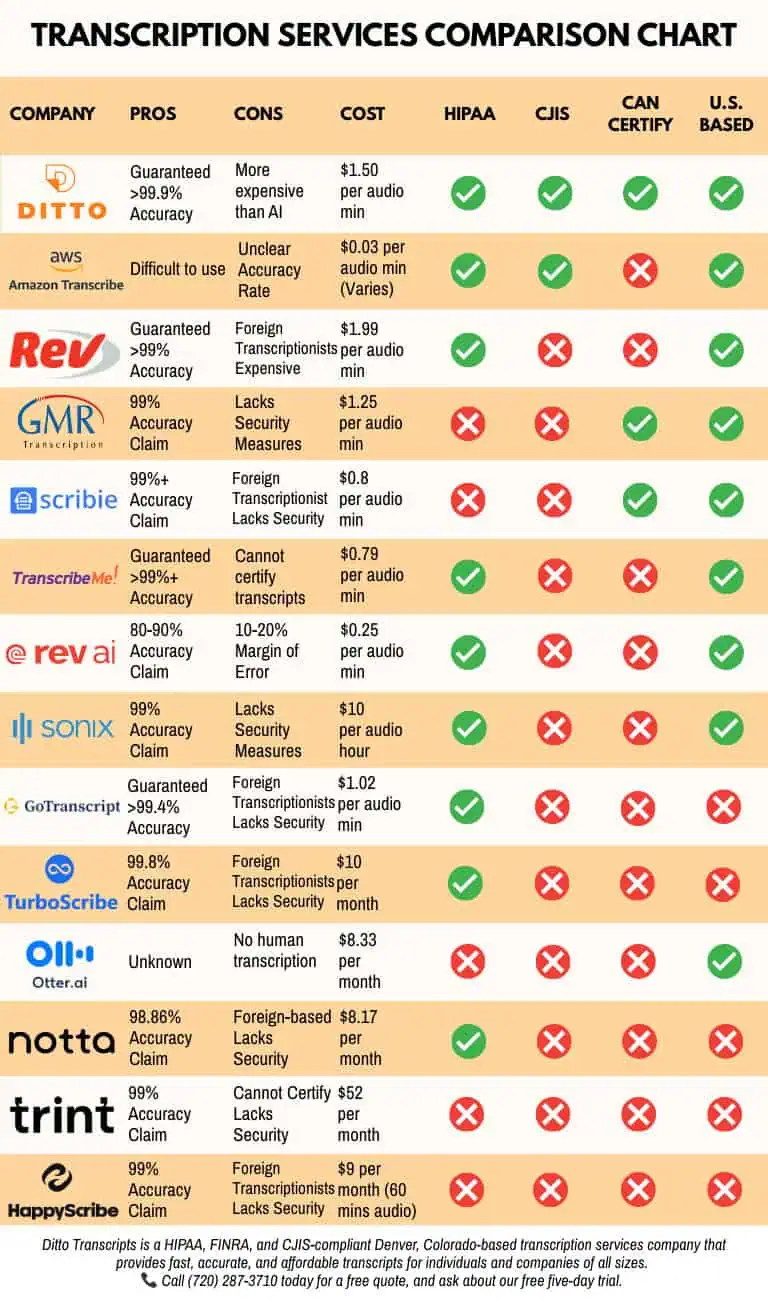
- Human transcriptionists: We use trained human transcriptionists who understand context, speaker flow, tone, terminology, and the difference between a rough transcript and a professional legal record.
- Legal transcription experience: Ditto works with attorneys, law firms, corporate legal teams, court professionals, law enforcement clients, and other organizations that need accurate legal transcripts.
- Certified transcript options: When needed, Ditto can provide certified transcripts for legal, court, investigative, or official documentation purposes.
- Support for difficult audio: Our transcriptionists can work with multiple speakers, background noise, accents, low volume, overlapping speech, legal terminology, and recordings that automated tools often struggle with.
- Secure handling: Sensitive legal recordings are handled through confidentiality-focused workflows designed to help protect client files and transcripts.
- Compliance support: Ditto works with clients who need HIPAA-compliant, CJIS-compliant, FINRA-compliant, legal, medical, law enforcement, and government transcription support.
- Flexible turnaround options: Clients can choose turnaround times based on file length, urgency, audio quality, number of speakers, and project requirements.
- Transparent legal transcription pricing: Pricing depends on the type of transcription, turnaround time, audio quality, number of speakers, formatting, and whether the client needs certified, verbatim, or specialized transcription.
- No long-term contract required: Law firms can use Ditto for one project, ongoing support, or changing caseloads without being locked into unnecessary commitments.
Whether you need a deposition transcribed, a recorded statement documented, a court recording prepared, a client meeting converted to text, or a legal audio file organized for review, Ditto Transcripts can help make the process accurate, secure, and manageable.
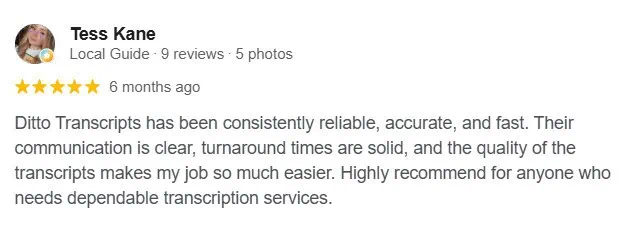
Still deciding? Here’s what one Ditto client testimonial had to say:
Choose the Right Legal Transcription Partner
Legal transcription should save law firms time, not create more work. The right provider can help attorneys and support staff review recordings more quickly, preserve key case details, protect confidential files, and keep legal documentation organized.
Before outsourcing, look for legal experience, human transcriptionists, strong accuracy standards, clear pricing, flexible formatting, certified transcript options, and secure handling.
Ditto Transcripts is a Denver, Colorado-based transcription services company that provides fast, accurate, and affordable transcripts for individuals and companies of all sizes and is FINRA-, HIPAA-, and CJIS-compliant. Call (720) 287-3710 today for a free quote.